
The pursuit of efficient, high-quality manufacturing for power transmission components like spur and pinion gears is a central challenge in modern mechanical engineering. As core elements in automotive, industrial machinery, and robotics, the performance of these gears directly dictates system reliability, noise levels, and efficiency. Traditional machining methods, while precise, are often characterized by significant material waste, discontinuous grain flow, and higher production costs. Consequently, net-shape or near-net-shape precision forming has emerged as a superior alternative, offering enhanced material utilization, improved mechanical properties through continuous fiber lines, and higher production rates. This article presents a detailed, first-person investigation into the evolution of bidirectional upsetting-extrusion processes for spur and pinion gear forming, focusing on a novel, optimized technique that addresses the limitations of conventional methods.
The fundamental challenge in forming a spur and pinion gear lies in completely filling the complex, deep, and narrow tooth cavities without defects. The process must efficiently transfer force to move metal radially outward from a central billet into the die’s tooth profiles. Conventional single-action or even early bidirectional forging with complex die shapes often leads to excessively high forming loads, premature die wear, and intricate, costly模具 structures. The principle of bidirectional loading is key, as it reduces the unsupported length of the billet, minimizes buckling tendencies, and can lower the required force by creating a more favorable triaxial stress state. The core of our research was to refine this principle by critically examining the role of punch geometry on the forming mechanics and load requirements.
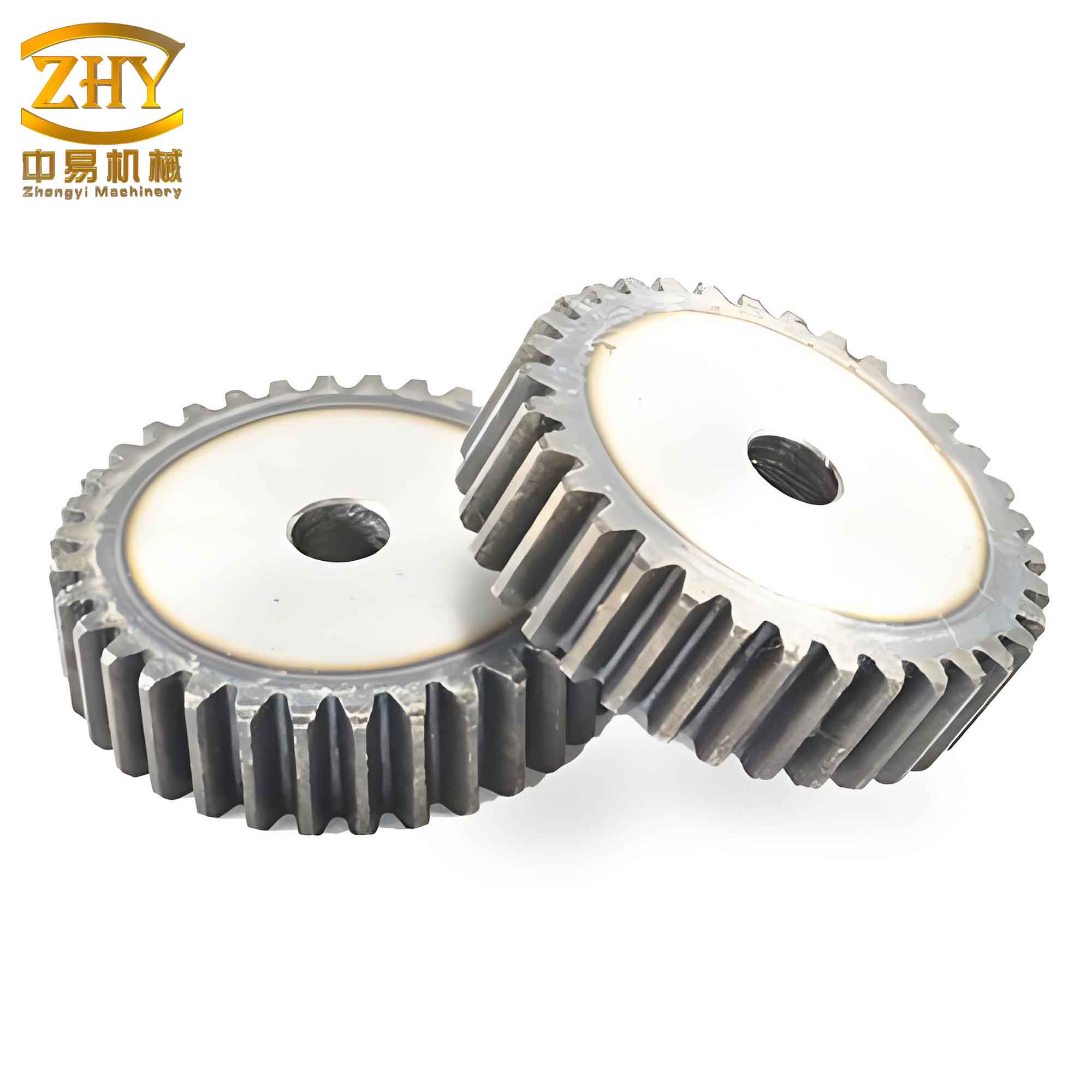
Our investigation centered on three distinct process schemes derived from the bidirectional upsetting-extrusion concept. The primary variable was the geometry of the upper and lower tooling that directly contacts the billet ends.
Scheme 1: Conventional Bidirectional Upsetting-Extrusion with Toothed Punches. This is the baseline traditional method. Both the upper and lower punches possess the negative tooth profile of the final spur and pinion gear. The billet is compressed between these two detailed punches within a split or one-piece die cavity. The contact area between the billet end faces and the punch teeth is maximal from the very beginning of the stroke.
Scheme 2: Asymmetric Punch Bidirectional Upsetting-Extrusion. This is a hybrid approach. One punch (e.g., the upper) retains the full tooth profile, while the opposing punch (the lower) is a simple, flat, or slightly profiled toothless punch. This creates an asymmetric loading condition aimed at simplifying one side of the tooling.
Scheme 3: Novel Bidirectional Upsetting-Extrusion with Toothless Punches. This is the optimized process we propose. Both the upper and lower punches are simple, non-toothed tools. The tooth-forming cavity exists entirely within a closed-die (or “occluded-die”) system, typically consisting of split die segments. A pre-clamping force is applied to the die halves to create a sealed cavity. The toothless punches then move inwards from both sides, upsetting the billet and forcing material to flow radially into the surrounding tooth profiles.
The pivotal difference among these schemes lies in the evolution of frictional forces at the billet end faces. Friction plays a dual role in metal forming: it can aid in retaining material under the punch but also significantly increases the required deformation force. The total forming force (F) can be conceptually expressed by a common plasticity equation:
$$F = K \cdot \sigma_s \cdot A$$
where $K$ is a stress state factor (or constraint factor) accounting for geometry and friction, $\sigma_s$ is the material’s flow stress, and $A$ is the projected contact area between the tool and workpiece in the direction of the force. For a given material ($\sigma_s$), reducing the contact area $A$ or improving the stress state $K$ lowers the force.
In Scheme 1, the toothed punches maintain a large, intricate contact area $A$ with the billet’s ends throughout the entire process. This results in high radial frictional forces ($F_{\sigma}$) opposing metal flow from the start. In Scheme 3, the flat, toothless punches have a minimal initial contact area. Significant radial friction on the end faces only develops in the final stages when the forged teeth themselves contact the flat punch surfaces. This delayed and reduced frictional hindrance is a primary reason for lower loads. Furthermore, as material flows into the die cavities, the lateral friction along the forming teeth ($F_{\tau}$) increases. A higher end-face friction $F_{\sigma}$ exacerbates this, creating a more restrictive deformation zone and further raising the load in Scheme 1.
To quantitatively analyze these effects, we employed a rigorous finite element analysis (FEA) framework using DEFORM-3D. The study focused on a standard spur and pinion gear with the following specifications: module m = 2.5 mm, number of teeth z = 20, face width b = 20 mm, pressure angle $\alpha = 20^\circ$, and pitch diameter d = 50 mm. A cylindrical billet of AISI-1045 steel was modeled, assuming hot-forming conditions with a billet temperature of 1100°C and a die temperature of 350°C. A shear friction factor of 0.3 was applied. The billet was meshed with approximately 200,000 tetrahedral elements, and the punch speed was set to 3.4 mm/s. The simulation tracked material flow, stress-strain distribution, and punch load throughout the forming stroke.
| Process Feature | Scheme 1 (Toothed Punches) | Scheme 2 (Asymmetric) | Scheme 3 (Toothless Punches) |
|---|---|---|---|
| Punch Geometry | Both punches have full tooth profile. | One toothed punch, one toothless punch. | Both punches are simple/flat (toothless). |
| Die System | Solid or split die. | Solid or split die. | Pre-stressed closed-die system (essential). |
| Initial Contact Area (A) | Very Large (complex shape). | Moderate (one side large, one side small). | Minimal (simple flat surface). |
| End-Face Friction Development | Immediate and high. | Asymmetric: high on one side, delayed on the other. | Delayed until final filling stage. |
| Relative Forming Load | Highest | Intermediate | Lowest |
| Tool Manufacturing & Strength | Complex, costly machining of precise punch teeth. Stress concentration at punch tooth roots. | Moderately complex. Toothed punch remains a weak point. | Simple, low-cost punch machining. Higher punch strength and easier maintenance. |
| Primary Advantage | Well-established concept. | Partial load reduction. | Significant load reduction, simpler/stronger punches. |
| Primary Disadvantage | High load, complex/weak punches. | Asymmetric filling potential, still uses one complex punch. | Requires precise closed-die system with pre-clamping. |
The FEA results for material filling were successful for all three schemes, demonstrating that complete tooth cavity filling is achievable. However, the load-stroke curves revealed critical differences. The forming process consistently exhibited three characteristic phases across all schemes:
- Free Upsetting Phase: Initial deformation where the billet expands radially without contacting the die teeth. Load increases gently.
- Cavity Filling Phase: The billet contacts and begins to fill the tooth profiles from the mid-face towards the ends. Load increases steadily with a growing slope as flow resistance rises.
- Corner Filling Phase: Final stage where the tooth root corners are filled. This requires a sharp increase in load with minimal additional punch stroke, often leading to the peak load.
The peak load values, however, differed substantially. Scheme 3 (Toothless Punches) demonstrated the lowest required force. Quantitative comparison showed that the peak loads for both upper and lower punches in Scheme 3 were approximately 55% lower than those in Scheme 1. When compared to Scheme 2, the load on the upper (toothed) punch side was reduced by about 50%, and the load on the lower (toothless) punch side was reduced by about 38%. This confirms the theoretical advantage of minimizing end-face contact and friction.
The analysis of effective (von Mises) stress distribution provided further insight. While all schemes showed maximum stress concentrations at the critical tooth root fillets and sidewalls—regions of intense metal flow—the magnitude differed. Scheme 3 exhibited the lowest maximum effective stress value (~366 MPa in our simulation), indicating a less severe stress state on the workpiece and, by inference, on the tooling. The stress distribution was uniform and without signs of localized shear bands or potential internal failure, suggesting a sound forming process.
Beyond load reduction, Scheme 3 offers profound advantages in tooling design and life. Manufacturing a precise, high-strength toothed punch is technically challenging and expensive. The teeth on such a punch are susceptible to stress concentrations, wear, and breakage. In contrast, the toothless punches in Scheme 3 are simple cylinders or blocks, which are far easier and cheaper to machine, heat treat, and polish. Their robust geometry inherently provides greater strength and resistance to failure. Furthermore, the die cavity, while complex, is now a static part of the die insert, which can be made from specialized alloys and is easier to manufacture via techniques like wire EDM than the internal features of a moving toothed punch.
To validate the FEA findings for the proposed Scheme 3, a physical modeling experiment was conducted. Due to the scale and force requirements for steel, a modeling material—lead—was used for its similar plastic deformation characteristics at room temperature. A dedicated closed-die tooling set was manufactured based on the simulation geometry. A lead billet with calculated volume was placed in the pre-clamped die, and the two toothless punches were simultaneously pressed. The experiment successfully produced a fully formed lead spur and pinion gear specimen. The teeth were completely filled, with sharp profiles and no observable folds or laps. Minor flash at the die parting line was present, which is expected and can be controlled or removed by subsequent trimming. The physical result aligned closely with the numerical prediction, confirming the feasibility of the toothless punch, closed-die bidirectional process.
In conclusion, this comprehensive study systematically compared three pathways for precision forming of spur and pinion gears. The transition from toothed punches to toothless punches within a bidirectional upsetting-extrusion framework represents a significant optimization. The proposed novel process (Scheme 3) conclusively demonstrates superior performance by drastically reducing forming loads (by over 50% compared to the traditional method), simplifying critical tooling components, and enhancing potential tool life. The underlying principle—delaying and minimizing radial friction on the billet ends—is a generalizable concept applicable to the precision forming of other gear-like components with deep profiles. Future work will focus on refining the closed-die system design for industrial robustness, exploring warm-forming conditions for high-strength alloys, and integrating this process into automated production lines for high-volume manufacturing of reliable spur and pinion gear sets.