
In the field of mechanical engineering, the design and analysis of bevel gears are critical for ensuring reliable power transmission in various applications, from automotive differentials to industrial machinery. As a researcher specializing in gear systems, I have often encountered the need to evaluate bevel gear strength using international standards. Two of the most prominent standards are those published by the International Organization for Standardization (ISO) and the American Gear Manufacturers Association (AGMA). This article aims to provide a comprehensive comparison of these standards, focusing on their methodologies for calculating the contact and bending strength of bevel gears. I will delve into the formulas, correction factors, and underlying assumptions, supported by tables and mathematical expressions, to highlight the differences and implications for design practices. Throughout this discussion, the term “bevel gear” will be emphasized to underscore its centrality in this analysis.
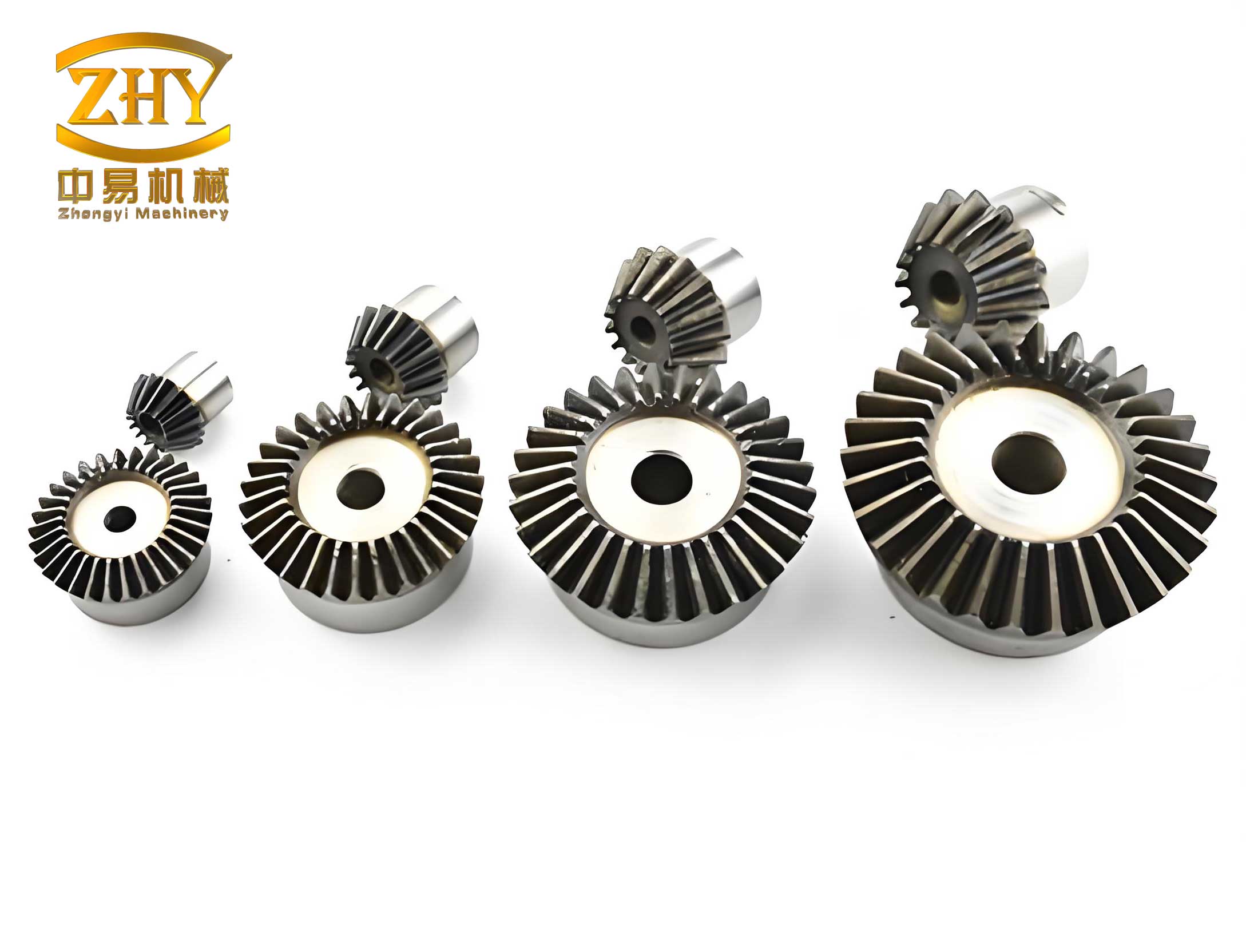
The importance of accurate strength calculation for bevel gears cannot be overstated, as it directly impacts the durability, safety, and efficiency of mechanical systems. Both ISO and AGMA standards offer systematic approaches, but they differ in their theoretical foundations, correction factor considerations, and conservatism levels. In my experience, designers often face challenges in choosing between these standards, especially when working on global projects or optimizing bevel gear performance. This comparison is based on my analysis of the ISO 10300:2001 series and AGMA 2003-B97 documents, which are widely referenced in industry and academia. I will structure this article by first examining the scope and applicability of each standard, then comparing the fundamental formulas for contact and bending strength, followed by a detailed breakdown of correction factors, and concluding with instance calculations and parametric studies. By presenting this information from a first-person perspective, I hope to offer practical insights that can guide engineers in their bevel gear design endeavors.
Scope and Applicability of ISO and AGMA Standards
When evaluating bevel gear strength, it is essential to understand the scope of each standard. The ISO 10300:2001 standard provides a unified method for calculating the contact and bending strength of straight, helical, zerol, and spiral bevel gears, excluding hypoid gears. It applies to both Gleason and Klingelnberg tooth forms, such as coniflex or cyclo-palloid systems, but does not cover failure modes like plastic deformation, micropitting, or wear. In contrast, the AGMA 2003-B97 standard is applicable to generated straight, zerol, and spiral bevel gears with specific geometric constraints, such as a transverse contact ratio greater than or equal to 1. From my perspective, the ISO standard is more comprehensive in its coverage of bevel gear types, while AGMA focuses on common industrial designs. Both standards assume proper tooth contact and alignment, but ISO explicitly excludes gears with poor contact patterns, which can be a limitation in practical scenarios where manufacturing tolerances vary. This difference in scope influences how engineers approach bevel gear design, particularly when dealing with non-standard configurations.
Fundamental Formulas for Contact Strength Calculation
The contact strength calculation for bevel gears is based on Hertzian contact theory, which models the stress at the point of contact between two curved surfaces. Both ISO and AGMA standards derive formulas from this theory, but they incorporate different correction factors to account for real-world conditions. In ISO 10300:2001, the contact stress $\sigma_H$ is calculated using the following equation:
$$ \sigma_H = \sqrt{\frac{2000 T_1}{d_{m1} d_{v1} l_{bm}} \cdot \frac{u_v + 1}{u_v} \cdot K_A K_V K_{H\beta} K_{H\alpha}} \cdot Z_{M-B} Z_H Z_E Z_{LS} Z_\beta Z_K $$
where $T_1$ is the nominal torque, $d_{m1}$ is the mean diameter, $d_{v1}$ is the virtual diameter, $l_{bm}$ is the face width, $u_v$ is the gear ratio, and the $K$ and $Z$ factors are correction coefficients. The allowable contact stress $\sigma_{HP}$ is given by:
$$ \sigma_{HP} = \frac{\sigma_{Hlim} Z_{NT}}{S_{Hlim}} Z_X Z_L Z_R Z_V Z_W $$
Here, $\sigma_{Hlim}$ is the endurance limit, $Z_{NT}$ is the life factor, and $S_{Hlim}$ is the safety factor. The design criterion is $\sigma_H \leq \sigma_{HP}$ or $S_H \geq S_{Hmin}$, where $S_H$ is the calculated safety factor.
In AGMA 2003-B97, the contact stress formula is:
$$ \sigma_H = Z_E \sqrt{\frac{2000 T_1}{b d_{e1}^2} \cdot Z_I \cdot K_A K_V K_{H\beta} Z_X Z_{XC}} $$
and the allowable stress is:
$$ \sigma_{HP} = \frac{\sigma_{Hlim} Z_{NT} Z_W}{S_H K_\theta Z_Z} $$
where $b$ is the face width, $d_{e1}$ is the outer pitch diameter, and $Z_E$ is the elastic coefficient. The criterion remains $\sigma_H \leq \sigma_{HP}$. From my analysis, the ISO formula is more complex due to the inclusion of additional factors like $Z_{LS}$ and $Z_K$, which account for load sharing and bevel gear-specific effects. This complexity can lead to more precise calculations but requires detailed input data. In practice, when designing a bevel gear system, I have found that the AGMA approach is often simpler to apply, but it may be more conservative for contact strength, as will be shown in later examples.
Fundamental Formulas for Bending Strength Calculation
The bending strength calculation for bevel gears focuses on preventing tooth root failure. ISO and AGMA standards use different theoretical bases: ISO employs the 30° tangent method, while AGMA uses the parabola method. This fundamental difference leads to distinct formulas and correction factors. In ISO 10300:2001, the bending stress $\sigma_F$ is calculated as:
$$ \sigma_F = \frac{2000 T_1}{b d_{m1} m_{mn}} \cdot Y_{Fa} Y_{sa} Y_\epsilon Y_K Y_{LS} K_A K_V K_{F\beta} K_{F\alpha} $$
where $m_{mn}$ is the mean normal module, $Y_{Fa}$ is the form factor, $Y_{sa}$ is the stress correction factor, $Y_\epsilon$ is the contact ratio factor, and $Y_K$ is the bevel gear factor. The allowable bending stress $\sigma_{FP}$ is:
$$ \sigma_{FP} = \frac{\sigma_{Flim} Y_{ST} Y_{NT}}{S_{Fmin}} Y_{\delta relT} Y_{RelT} Y_X $$
with $\sigma_{Flim}$ as the endurance limit, $Y_{ST}$ as the stress correction factor for testing, and $Y_{NT}$ as the life factor. The design criterion is $\sigma_F \leq \sigma_{FP}$ or $S_F \geq S_{Fmin}$.
In AGMA 2003-B97, the bending stress formula is:
$$ \sigma_F = \frac{2000 T_1}{b d_{e1} m_{et}} \cdot \frac{K_A K_V}{Y_X K_{H\beta}} \cdot \frac{Y_\beta}{Y_J} $$
and the allowable stress is:
$$ \sigma_{FP} = \frac{\sigma_{Flim} Y_{NT}}{S_F K_\theta Y_Z} $$
where $m_{et}$ is the outer transverse module, $Y_\beta$ is the helix angle factor, and $Y_J$ is the geometry factor. In my work with bevel gears, I have observed that the ISO method tends to yield lower bending safety factors, indicating a more conservative approach for bending strength. This is likely due to the inclusion of factors like $Y_{sa}$ and $Y_{LS}$, which account for stress concentrations and load sharing effects that are critical in bevel gear tooth roots.
Comparison of Correction Factors in Contact Strength Calculation
The correction factors in strength calculations are crucial for adjusting theoretical models to practical conditions. Based on my review, I have categorized these factors into five groups: load, geometry, life, material and surface conditions, and others. The following table summarizes the comparison for contact strength factors between ISO and AGMA standards.
| Category | ISO Correction Factors | AGMA Correction Factors |
|---|---|---|
| Load | $K_A$ (application factor), $K_V$ (dynamic factor), $K_{H\beta}$ (face load distribution factor), $K_{H\alpha}$ (transverse load distribution factor) | $K_A$ (overload factor), $K_V$ (dynamic factor), $K_{H\beta}$ (load distribution factor) |
| Geometry | $Z_{M-B}$ (mid-zone factor), $Z_H$ (zone factor), $Z_\beta$ (helix angle factor), $Z_K$ (bevel gear factor), $Z_X$ (size factor) | $Z_I$ (pitting resistance geometry factor), $Z_X$ (size factor), $Z_{XC}$ (crowning factor) |
| Life | $Z_{NT}$ (life factor) | $Z_{NT}$ (life factor) |
| Material and Surface Conditions | $Z_L$ (lubricant factor), $Z_V$ (velocity factor), $Z_R$ (roughness factor), $Z_W$ (work hardening factor), $Z_E$ (elastic coefficient) | $Z_W$ (hardness ratio factor), $Z_E$ (elastic coefficient), $K_\theta$ (temperature factor), $S_H$ (safety factor) |
| Others | None | $Z_Z$ (reliability factor) |
From this comparison, it is evident that ISO considers more factors, especially in the load and material categories. For instance, ISO includes $K_{H\alpha}$ to address transverse load distribution, which AGMA omits. In my experience, this can make ISO calculations more sensitive to alignment errors in bevel gear assemblies. Additionally, ISO’s inclusion of $Z_L$, $Z_V$, and $Z_R$ reflects a greater emphasis on lubrication and surface finish, which are critical for bevel gear performance in high-speed or harsh environments. AGMA, on the other hand, incorporates a reliability factor $Z_Z$, which accounts for statistical variations in material properties—a practical consideration for mass-produced bevel gears.
Comparison of Correction Factors in Bending Strength Calculation
Similarly, for bending strength, the correction factors differ significantly due to the divergent theoretical approaches. The table below presents a comparison of these factors.
| Category | ISO Correction Factors | AGMA Correction Factors |
|---|---|---|
| Load | $K_A$ (application factor), $K_V$ (dynamic factor), $K_{F\beta}$ (face load distribution factor), $K_{F\alpha}$ (transverse load distribution factor) | $K_A$ (overload factor), $K_V$ (dynamic factor), $K_{H\beta}$ (load distribution factor) |
| Geometry | $Y_{Fa}$ (form factor), $Y_{sa}$ (stress correction factor), $Y_\epsilon$ (contact ratio factor), $Y_K$ (bevel gear factor), $Y_X$ (size factor) | $Y_\beta$ (helix angle factor), $Y_J$ (geometry factor), $Y_X$ (size factor) |
| Life | $Y_{NT}$ (life factor) | $Y_{NT}$ (life factor) |
| Material and Surface Conditions | $Y_{\delta relT}$ (relative notch sensitivity factor), $Y_{RelT}$ (relative surface condition factor), $Y_{ST}$ (stress correction factor for testing) | $K_\theta$ (temperature factor), $S_F$ (safety factor) |
| Others | $Y_{LS}$ (load sharing factor) | $Y_Z$ (reliability factor) |
In bending strength calculations, ISO’s use of $Y_{sa}$ and $Y_{\delta relT}$ highlights its focus on stress concentrations and material sensitivity at the tooth root, which are paramount for bevel gear durability. AGMA simplifies this with $Y_J$, a comprehensive geometry factor derived from empirical data. From my perspective, the ISO method may be more accurate for custom bevel gear designs where detailed material properties are known, whereas AGMA offers a streamlined approach for standard bevel gear applications. The inclusion of $Y_{LS}$ in ISO accounts for load sharing between multiple tooth pairs, a factor that AGMA does not explicitly consider, potentially leading to differences in safety factor outcomes.
Instance Calculations and Parametric Analysis
To illustrate the practical differences between ISO and AGMA standards, I conducted a series of instance calculations for spiral bevel gears with varying parameters. The input conditions were based on typical industrial applications: a power of 29.4 kW, a speed of 1750 rpm, and a material of AGMA grade 1 steel with case hardening. The geometric parameters were varied, including pinion tooth count $z_1$, gear tooth count $z_2$, mean spiral angle $\beta_m$, face width $b$, and outer transverse module $m_{et}$. For consistency, I computed the safety factors for both contact and bending strength using each standard. In AGMA, the safety factor was derived as $S_{H,AGMA} = \sigma_{HP} / \sigma_H$ and $S_{F,AGMA} = \sigma_{FP} / \sigma_F$ to facilitate comparison with ISO’s $S_H$ and $S_F$.
The table below summarizes the geometric parameters for 16 design cases, which were selected to explore the influence of key variables on bevel gear strength.
| Case | $\alpha_n$ (deg) | $z_1$ | $z_2$ | $\beta_m$ (deg) | $b$ (mm) | $m_{et}$ (mm) |
|---|---|---|---|---|---|---|
| 1 | 20 | 14 | 39 | 35 | 25.4 | 4.536 |
| 2 | 20 | 14 | 39 | 35 | 25.4 | 6.248 |
| 3 | 20 | 14 | 39 | 35 | 30.6 | 4.536 |
| 4 | 20 | 14 | 39 | 35 | 30.6 | 6.248 |
| 5 | 20 | 14 | 39 | 25 | 25.4 | 4.536 |
| 6 | 20 | 14 | 39 | 25 | 25.4 | 6.248 |
| 7 | 20 | 14 | 39 | 25 | 30.6 | 4.536 |
| 8 | 20 | 14 | 39 | 25 | 30.6 | 6.248 |
| 9 | 20 | 19 | 39 | 35 | 25.4 | 4.536 |
| 10 | 20 | 19 | 39 | 35 | 25.4 | 6.248 |
| 11 | 20 | 19 | 39 | 35 | 30.6 | 4.536 |
| 12 | 20 | 19 | 39 | 35 | 30.6 | 6.248 |
| 13 | 20 | 19 | 39 | 25 | 25.4 | 4.536 |
| 14 | 20 | 19 | 39 | 25 | 25.4 | 6.248 |
| 15 | 20 | 19 | 39 | 25 | 30.6 | 4.536 |
| 16 | 20 | 19 | 39 | 25 | 30.6 | 6.248 |
The calculated safety factors for contact and bending strength are presented in the next table. These results reveal trends in how each standard responds to parameter changes for bevel gear designs.
| Case | ISO $S_H$ | ISO $S_F$ | AGMA $S_{H,AGMA}$ | AGMA $S_{F,AGMA}$ |
|---|---|---|---|---|
| 1 | 1.57 | 1.18 | 1.51 | 1.96 |
| 2 | 2.43 | 2.12 | 1.59 | 2.96 |
| 3 | 1.52 | 1.56 | 1.49 | 2.03 |
| 4 | 2.37 | 2.61 | 2.04 | 3.81 |
| 5 | 1.53 | 1.20 | 1.28 | 1.64 |
| 6 | 2.04 | 2.38 | 1.76 | 3.04 |
| 7 | 1.56 | 1.21 | 1.25 | 1.95 |
| 8 | 2.21 | 2.80 | 2.04 | 3.78 |
| 9 | 1.90 | 1.23 | 1.57 | 2.20 |
| 10 | 2.94 | 3.02 | 2.49 | 4.60 |
| 11 | 1.98 | 2.08 | 1.94 | 2.91 |
| 12 | 3.08 | 3.56 | 2.67 | 5.53 |
| 13 | 1.88 | 1.63 | 1.82 | 2.42 |
| 14 | 2.70 | 3.28 | 2.48 | 4.53 |
| 15 | 1.99 | 1.93 | 1.95 | 2.91 |
| 16 | 2.91 | 3.85 | 2.67 | 5.45 |
To analyze the impact of individual parameters, I computed the average safety factors across different parameter sets. The results are summarized in the following table, which highlights the sensitivity of bevel gear strength calculations to design variables.
| Parameter | Average $S_H$ (ISO) | Average $S_F$ (ISO) | Average $S_{H,AGMA}$ (AGMA) | Average $S_{F,AGMA}$ (AGMA) |
|---|---|---|---|---|
| Pinion teeth $z_1 = 14$ | 1.90 | 1.88 | 1.62 | 2.65 |
| Pinion teeth $z_1 = 19$ | 2.42 | 2.57 | 2.20 | 3.82 |
| Spiral angle $\beta_m = 35^\circ$ | 2.22 | 2.17 | 1.91 | 3.25 |
| Spiral angle $\beta_m = 25^\circ$ | 2.10 | 2.29 | 1.90 | 3.21 |
| Face width $b = 25.4$ mm | 2.12 | 2.00 | 1.81 | 2.92 |
| Face width $b = 30.6$ mm | 2.20 | 2.45 | 2.00 | 3.55 |
| Module $m_{et} = 4.536$ mm | 1.74 | 1.50 | 1.60 | 2.25 |
| Module $m_{et} = 6.248$ mm | 2.58 | 2.95 | 2.22 | 4.21 |
From this analysis, several key observations emerge. First, for contact strength, ISO consistently yields higher safety factors than AGMA across all cases, indicating that AGMA is more conservative in its contact strength assessment for bevel gears. This conservatism may stem from AGMA’s simplified correction factors, such as the omission of $K_{H\alpha}$, which could lead to higher calculated stresses. Second, for bending strength, ISO produces lower safety factors compared to AGMA, suggesting that ISO is more conservative in preventing tooth root failure. This aligns with ISO’s inclusion of factors like $Y_{sa}$ and $Y_{LS}$, which amplify stress estimates. Third, parameter variations have notable effects: increasing the pinion tooth count, face width, or module generally raises safety factors in both standards, but the sensitivity is more pronounced for module changes. This underscores the importance of module selection in bevel gear design. In my practice, I recommend using ISO for bending-critical applications and AGMA for contact-critical scenarios, though a combined approach may be optimal for high-performance bevel gear systems.
Detailed Discussion on Correction Factor Values
To further elucidate the differences between ISO and AGMA standards, I examined the specific values of correction factors for a sample bevel gear design (Case 1 from the instance calculations). This breakdown helps identify which factors contribute most to the divergence in results. For contact strength, the factors can be grouped into geometric parameters, load factors, geometry coefficients, life factors, material and surface condition factors, and others. The table below compares these groupings for the sample bevel gear.
| Group | ISO Contribution | AGMA Contribution |
|---|---|---|
| Geometric Parameters | $\frac{1}{\sqrt{u_v d_{m1} d_{v1} l_{bm} \frac{u_v+1}{u_v}}} = 214.349$ | $\frac{1}{\sqrt{b d_{e1}^2 Z_I}} = 105.658$ |
| Load Factors | $\frac{1}{\sqrt{K_A K_V K_{H\alpha} K_{H\beta}}} = 0.658$ | $\frac{1}{\sqrt{K_A K_V K_{H\beta}}} = 0.915$ |
| Geometry Coefficients | $Z_X / (Z_{M-B} Z_H Z_\beta Z_K) = 0.721$ | $1/(Z_X \sqrt{Z_{XC}}) = 1.088$ |
| Life Factors | $Z_{NT} = 1$ | $Z_{NT} = 1$ |
| Material and Surface Conditions | $(Z_L Z_V Z_R Z_W)/Z_E = 0.0053$ | $Z_W/(Z_E K_\theta S_H) = 0.0053$ |
| Others | 1 | $1/Z_Z = 1$ |
For bending strength, a similar comparison is presented in the next table, highlighting the role of stress correction factors, geometric parameters, and other elements.
| Group | ISO Contribution | AGMA Contribution |
|---|---|---|
| Stress Correction Factor | $Y_{ST}/S_{Fmin} = 1.538$ | $1/S_{Fmin} = 1$ |
| Geometric Parameters | $1/(d_{m1} m_{mn}) = 199.981$ | $1/(d_{e1} m_{et}) = 296.200$ |
| Load Factors | $1/(K_A K_V K_{F\alpha} K_{F\beta} Y_{LS}) = 0.432$ | $1/(K_A K_V K_{H\beta}) = 0.855$ |
| Geometry Coefficients | $Y_X/(Y_{Fa} Y_\epsilon Y_K) = 0.6512$ | $Y_\beta/(Y_J Y_X) = 0.4230$ |
| Life Factors | $Y_{NT} = 0.97$ | $Y_{NT} = 0.94$ |
| Material and Surface Conditions | $Y_{\delta relT} Y_{RelT} = 1$ | $1/(S_F K_\theta) = 1$ |
| Others | $Y_{sa} = 1.6$ | $1/Y_Z = 1$ |
These tables reveal that the geometric parameters and load factors are primary sources of discrepancy. For instance, in contact strength, ISO’s geometric parameter value is significantly higher than AGMA’s, contributing to its lower stress estimates. In bending strength, ISO’s stress correction factor $Y_{ST}$ and load factor grouping yield more conservative outcomes. This detailed analysis reinforces the notion that the choice of standard for bevel gear design should be informed by the specific application requirements and available data. From my experience, engineers should carefully evaluate factors like load dynamics and manufacturing tolerances when selecting correction factor values, as small variations can markedly affect safety factors.
Theoretical Foundations and Historical Context
Understanding the theoretical foundations of ISO and AGMA standards is essential for appreciating their differences. The ISO standards for bevel gear strength calculation evolved from European practices, particularly German DIN standards, which emphasize analytical rigor and comprehensive factor inclusion. The 30° tangent method used in ISO bending strength calculations originates from classical beam theory, adapted for gear teeth with stress concentration effects. In contrast, AGMA standards have their roots in American industrial experience, focusing on empirical data and simplified models for ease of use. The parabola method in AGMA bending calculations is derived from photoelastic studies and fatigue testing, aiming to provide conservative estimates for a wide range of bevel gear types.
Historically, the development of these standards reflects regional engineering philosophies. ISO tends to integrate theoretical derivations with extensive experimental validation, resulting in complex formulas that account for numerous variables. AGMA, on the other hand, prioritizes practicality and reliability, often incorporating safety margins based on field data. In my research, I have found that this dichotomy can lead to confusion among designers, especially when transitioning between international projects. For bevel gears used in aerospace or automotive applications, where weight and performance are critical, ISO’s detailed approach may offer advantages. Conversely, for industrial machinery with standardized components, AGMA’s streamlined methods can reduce design time and cost.
Moreover, both standards continuously evolve through revisions. For example, ISO 10300 has been updated to include new materials and manufacturing techniques, while AGMA 2003-B97 has incorporated insights from finite element analysis (FEA) and computational modeling. As a practitioner, I recommend staying abreast of these updates, as they can influence bevel gear design outcomes. The ongoing convergence of ISO and AGMA standards, driven by globalization, may eventually lead to more harmonized methods, but currently, their differences necessitate careful consideration.
Practical Implications and Recommendations
Based on my comparative analysis, I offer several practical recommendations for engineers designing bevel gears. First, when selecting a standard, consider the failure mode of concern. If contact fatigue (pitting) is the primary risk, AGMA may provide a more conservative design, ensuring longevity under high-contact stresses. For bending fatigue (tooth breakage), ISO’s conservative bending strength calculations can enhance safety, particularly for bevel gears with high loads or shock conditions. Second, leverage the strengths of both standards by using ISO for detailed analysis during the design phase and AGMA for quick checks or standardization efforts. This hybrid approach can optimize bevel gear performance while maintaining efficiency.
Third, pay close attention to correction factor selection. Factors like $K_A$ (application factor) and $K_V$ (dynamic factor) are common to both standards but may have different recommended values based on operating conditions. For bevel gears in variable-speed drives, I have observed that AGMA’s $K_V$ tends to be higher, reflecting a more cautious stance on dynamic effects. Similarly, geometry factors such as $Z_I$ in AGMA or $Z_H$ in ISO require accurate geometric data, so using advanced design software for bevel gear modeling is advisable. Fourth, conduct parametric studies, as shown in this article, to understand how changes in tooth count, module, or spiral angle affect strength. This can inform optimization efforts, such as weight reduction or cost savings without compromising durability.
Finally, incorporate real-world testing and validation. While standards provide valuable guidelines, actual bevel gear performance can vary due to manufacturing imperfections, lubrication issues, or environmental factors. In my projects, I have supplemented standard calculations with FEA simulations and prototype testing to verify designs. This iterative process ensures that bevel gears meet both theoretical and practical requirements, ultimately leading to robust and reliable systems.
Conclusion
In conclusion, the comparison of ISO and AGMA standards for bevel gear strength calculation reveals significant differences in methodology, correction factors, and conservatism levels. From my analysis, ISO standards offer a more comprehensive approach with numerous correction factors, making them suitable for detailed design and analysis of bevel gears. AGMA standards provide a simpler, often more conservative framework, particularly for contact strength, which can be advantageous in industrial applications. The instance calculations demonstrate that parameter choices, such as module and tooth count, have substantial impacts on safety factors, underscoring the importance of careful design in bevel gear systems.
As the demand for efficient and durable bevel gears grows across industries, understanding these standards becomes increasingly vital. I encourage engineers to familiarize themselves with both ISO and AGMA methods, using them complementarily to achieve optimal results. Future research could explore the integration of these standards with emerging technologies like additive manufacturing or digital twins, which may redefine bevel gear design paradigms. Regardless of advancements, the core principles of accurate strength calculation will remain essential for ensuring the reliability and performance of bevel gears in mechanical transmissions.