
In the field of mechanical engineering, drive systems form the backbone of countless applications, from industrial machinery to precision instruments. Among these, screw drives and worm gear drives are two fundamental transmission mechanisms that often draw comparisons due to their superficial similarities yet distinct operational principles. As an engineer with extensive experience in mechanical design, I have frequently encountered scenarios where a clear understanding of these systems is crucial for optimal selection and performance. This article delves into a comprehensive examination of both drives, highlighting their similarities and differences through detailed analysis, formulas, and tables. The goal is to provide a resource that not only clarifies these concepts but also emphasizes the unique characteristics of each, particularly the worm gear drive, which is widely used in high-torque, low-speed applications.
To begin, let’s define the basic components. A screw drive, also known as a power screw or lead screw, involves the interaction between a screw (or螺杆) and a nut, where rotational motion is converted into linear motion or vice versa. This system is prevalent in devices like vises, presses, and linear actuators. On the other hand, a worm gear drive consists of a worm (a screw-like gear) and a worm wheel (or涡轮), which transmit motion between non-intersecting, perpendicular shafts, typically at right angles. The worm gear drive is renowned for its high reduction ratios and compact design, making it ideal for gearboxes in conveyors, lifts, and automotive steering systems. Throughout this discussion, I will refer to the worm gear drive repeatedly to underscore its significance in mechanical transmissions.
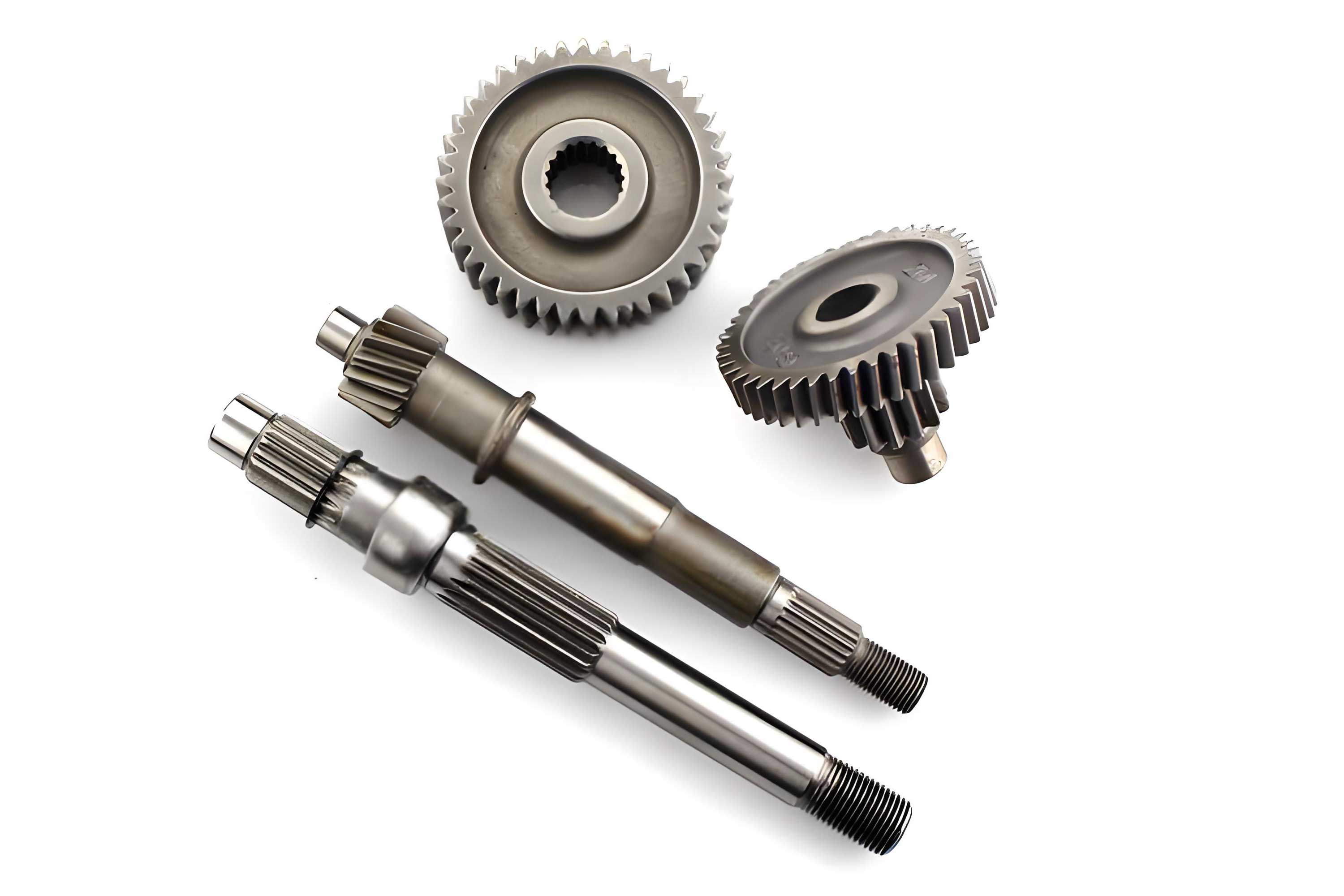
Before exploring the differences, it is essential to recognize the commonalities between screw drives and worm gear drives. These similarities often lead to confusion, but they stem from shared geometric and kinematic principles. I will outline these points in detail, supported by tables and formulas to enhance clarity.
Similarities Between Screw Drives and Worm Gear Drives
Both screw drives and worm gear drives rely on helical structures for motion transmission, which results in several analogous characteristics. From my design practice, I have observed that these similarities can be categorized into five main areas: handness determination, direction judgment, transmission conditions, applications, and failure modes.
1. Handness (旋向) Determination: The handness of a screw or worm refers to the direction of its helical thread—either right-handed or left-handed. This property is critical for defining the direction of motion. In both systems, the method for determining handness is identical. For instance, using the right-hand rule: if you align your right hand’s fingers with the axis of the screw or worm, and the thread advances in the direction of your thumb when curling your fingers, it is right-handed; otherwise, it is left-handed. This rule applies universally, whether assessing a trapezoidal thread in a screw drive or the helical teeth of a worm in a worm gear drive. Mathematically, the handness can be described by the sign of the lead angle or helix angle. For a right-handed thread, the helix angle $\theta$ is positive, and for left-handed, it is negative. The relationship is given by:
$$ \tan(\theta) = \frac{L}{\pi d} $$
where $L$ is the lead (distance advanced per revolution) and $d$ is the pitch diameter. This formula holds for both screw threads and worm gears, emphasizing their geometric kinship.
2. Direction of Motion Judgment: Determining the direction of linear motion in a screw drive or rotational motion in a worm gear drive follows similar logic. In a screw drive with a rotating screw and fixed nut, the nut’s linear movement depends on the screw’s rotation direction and handness. Similarly, in a worm gear drive, the worm wheel’s rotation direction is influenced by the worm’s rotation and handness. A common mnemonic is: for a right-handed worm, if the worm rotates clockwise, the worm wheel rotates in a direction that can be derived using the right-hand rule. This analogy simplifies design calculations. For example, the linear velocity $v$ of a nut in a screw drive is:
$$ v = n \times L $$
where $n$ is the rotational speed in revolutions per second. In a worm gear drive, the angular velocity $\omega_w$ of the worm wheel relates to the worm’s rotational speed $n_w$ by:
$$ \omega_w = \frac{n_w \times Z_w}{Z_g} $$
where $Z_w$ is the number of starts on the worm (akin to threads in a screw) and $Z_g$ is the number of teeth on the worm wheel. Both systems rely on such kinematic relationships.
3. Transmission Conditions: For successful engagement and motion transfer, both drives require specific matching conditions. In screw drives, the screw and nut must have identical pitch, handness, and thread profile (e.g., trapezoidal or square). In worm gear drives, the worm and worm wheel must share the same module (or diametral pitch), pressure angle, and have complementary helix angles. These conditions ensure proper meshing and force transmission. The table below summarizes these requirements:
| Parameter | Screw Drive | Worm Gear Drive |
|---|---|---|
| Pitch/Module | Pitch $P$ must match | Module $m$ must match |
| Handness | Same handness (right or left) | Same handness (right or left) |
| Profile Angle | Thread angle (e.g., 30° for trapezoidal) | Pressure angle $\alpha$ (typically 20°) |
| Helix/Spiral Angle | Lead angle $\lambda$ derived from pitch | Helix angle $\beta$ on worm wheel equals lead angle on worm |
Mathematically, for a worm gear drive, the condition for proper meshing is that the axial pitch of the worm equals the circular pitch of the worm wheel. This can be expressed as:
$$ p_a = \pi m $$
where $p_a$ is the axial pitch and $m$ is the module. In screw drives, a similar concept applies where the pitch $P$ defines the linear advance per revolution.
4. Applications in Reduction Mechanisms: Both screw drives and worm gear drives are employed as speed reducers due to their high transmission ratios. In screw drives, the reduction is achieved because a small rotation of the screw results in a small linear displacement of the nut, effectively reducing speed when converted back to rotation (e.g., in differential screws). In worm gear drives, the reduction is inherent: a single-start worm advancing one tooth per revolution yields a large gear ratio. The transmission ratio $i$ for a worm gear drive is given by:
$$ i = \frac{Z_g}{Z_w} $$
where $Z_g$ is the number of teeth on the worm wheel and $Z_w$ is the number of starts on the worm. For a single-start worm, $Z_w = 1$, so $i = Z_g$, which can be very high (e.g., 40:1 or more). In screw drives, the equivalent “reduction” is often measured as mechanical advantage, defined as the ratio of output force to input torque. The worm gear drive excels in applications requiring compact, high-ratio speed reduction, such as in conveyor systems or winches, where its ability to handle heavy loads is paramount.
5. Failure Modes: Both systems are prone to wear and failure under prolonged use. In screw drives, the primary failure mode is thread wear, which thins the teeth and increases backlash, leading to loss of precision and eventual jamming. In worm gear drives, similar wear occurs on the gear teeth, but exacerbated by high sliding velocities and heat generation. Lubrication failure can accelerate this process, causing scoring or pitting. The commonality lies in the reliance on surface contact and sliding friction, which necessitates careful material selection and maintenance. The wear rate can be modeled using Archard’s wear equation:
$$ V = k \frac{F_n s}{H} $$
where $V$ is the wear volume, $k$ is the wear coefficient, $F_n$ is the normal load, $s$ is the sliding distance, and $H$ is the material hardness. This applies to both screw threads and worm gear teeth, highlighting their shared vulnerability to abrasive wear.
Having established these similarities, I now turn to the core of this analysis: the differences between screw drives and worm gear drives. These distinctions are critical for design decisions, as they impact performance, efficiency, and application suitability.
Differences Between Screw Drives and Worm Gear Drives
While screw drives and worm gear drives share some geometric features, their functional differences are profound. From my engineering projects, I have identified key areas where they diverge, including motion transmission type, axis configuration, efficiency, self-locking capability, and design complexity. Each difference will be explored with technical depth, emphasizing the worm gear drive’s unique attributes.
1. Motion Transmission Type: The most fundamental difference lies in the nature of motion conversion. In a screw drive, the primary function is to convert rotational motion into linear motion (or vice versa). For example, when a screw rotates, the nut translates along the screw’s axis. This is described as a screw pair in kinematics. In contrast, a worm gear drive transmits motion between two rotating shafts; it converts rotational motion from the worm to rotational motion of the worm wheel, albeit with a change in speed and torque. There is no linear output unless coupled with other mechanisms. This distinction is crucial for applications: screw drives are ideal for linear positioning systems, while worm gear drives are used for angular transmission between crossed shafts. The kinematic equations highlight this difference. For a screw drive, the linear displacement $s$ per revolution is:
$$ s = L = P \times N $$
where $P$ is the pitch and $N$ is the number of threads (starts). For a worm gear drive, the angular displacement $\phi_g$ of the worm wheel per revolution of the worm is:
$$ \phi_g = \frac{2\pi}{Z_g} \quad \text{(for a single-start worm)} $$
This shows that screw drives output linear translation, whereas worm gear drives output rotation.
2. Axis Configuration: Another key difference is the spatial relationship between the driving and driven elements. In screw drives, the screw and nut are coaxial; that is, their axes are collinear, meaning they lie on the same straight line. This alignment allows for straightforward assembly and linear force transmission. In worm gear drives, however, the worm and worm wheel have axes that are non-intersecting and typically perpendicular (at 90°). This crossed-axis configuration enables compact designs and allows for large reduction ratios in a single stage. The worm gear drive’s ability to transmit motion between right-angle shafts makes it invaluable in applications where space constraints exist, such as in electric actuators or marine propulsion systems. The geometry can be represented using vector analysis. For a worm gear drive, the axis vectors $\vec{A_w}$ (worm) and $\vec{A_g}$ (worm wheel) satisfy:
$$ \vec{A_w} \cdot \vec{A_g} = 0 $$
indicating perpendicularity. For a screw drive, $\vec{A_s} = \vec{A_n}$ for the screw and nut axes, indicating collinearity.
3. Efficiency and Friction Characteristics: Efficiency is a major differentiator. Screw drives, especially sliding types, suffer from low efficiency due to high friction between the screw and nut threads. Efficiencies typically range from 30% to 70%, depending on lubrication and thread design. In contrast, worm gear drives can have higher efficiencies, but they are still limited by sliding friction; modern worm gear drives with optimized tooth profiles and materials can achieve efficiencies up to 90% for multi-start worms. However, single-start worm gear drives often have lower efficiencies (e.g., 50-80%) due to higher sliding action. The efficiency $\eta$ for a screw drive can be approximated by:
$$ \eta = \frac{\tan(\lambda)}{\tan(\lambda + \phi)} $$
where $\lambda$ is the lead angle and $\phi$ is the friction angle. For a worm gear drive, efficiency is given by a similar formula but accounts for gear mesh friction:
$$ \eta = \frac{\cos(\alpha) – \mu \tan(\lambda)}{\cos(\alpha) + \mu \cot(\lambda)} $$
where $\alpha$ is the pressure angle and $\mu$ is the coefficient of friction. These formulas show that both systems are sensitive to friction, but the worm gear drive’s efficiency is further influenced by gear tooth geometry. Notably, the worm gear drive often exhibits a self-locking property when the lead angle is small, preventing back-driving—a feature less common in screw drives unless designed specifically for it.
4. Self-Locking Capability: Self-locking refers to the ability of a drive to prevent reverse motion under load, which is critical for safety in applications like lifts or brakes. In screw drives, self-locking occurs when the friction angle exceeds the lead angle ($\phi > \lambda$), common in single-threaded screws with small lead angles. However, it is not guaranteed and depends on design. In worm gear drives, self-locking is a prominent feature, especially in single-start designs where the lead angle is minimal (often less than 5°). This makes the worm gear drive inherently non-reversible, meaning the worm wheel cannot drive the worm, enhancing safety. This property stems from the high friction in the gear mesh and is a key reason why worm gear drives are preferred in hoisting equipment. The condition for self-locking in both systems is similar, but it is more reliably achieved in worm gear drives due to their typical geometry.
5. Design and Manufacturing Complexity: From a production standpoint, screw drives are relatively simple to manufacture using standard threading techniques (e.g., turning or grinding). Their components are often cylindrical and easy to assemble. Worm gear drives, however, involve more complex geometry. The worm has a helical thread that must precisely match the curved teeth of the worm wheel, which is typically cut using specialized hobbing machines. The worm wheel teeth are often enveloped to the worm’s profile, requiring accurate alignment and heat treatment. This complexity increases cost but allows for higher load capacity and smoother operation. The worm gear drive’s design involves parameters like the worm diameter factor $q$ and center distance $a$, which are optimized for strength and efficiency. For example, the center distance is calculated as:
$$ a = \frac{m (Z_g + q)}{2} $$
where $q = d_w / m$ with $d_w$ as the worm pitch diameter. Such considerations are absent in screw drives, where the focus is on pitch and thread depth.
6. Load Capacity and Durability: Screw drives are generally suited for lower to medium loads, as the contact area between screw and nut is limited to thread flanks. High loads can cause deformation or wear. In contrast, worm gear drives can handle significantly higher loads due to the line contact between worm and worm wheel teeth, which distributes stress more evenly. This makes the worm gear drive ideal for heavy-duty applications like mining machinery or industrial mixers. The load capacity can be analyzed using the Lewis bending equation for gear teeth or Hertz contact stress theory. For a worm gear drive, the tangential force $F_t$ on the worm wheel is:
$$ F_t = \frac{2T_g}{d_g} $$
where $T_g$ is the torque on the worm wheel and $d_g$ is its pitch diameter. Comparative tables can illustrate these differences clearly.
| Aspect | Screw Drive | Worm Gear Drive |
|---|---|---|
| Motion Conversion | Rotational to linear (or vice versa) | Rotational to rotational (crossed shafts) |
| Axis Configuration | Coaxial (same axis) | Perpendicular and non-intersecting |
| Typical Efficiency | 30-70% (sliding), up to 90% (ball screws) | 50-90% (depends on starts and lubrication) |
| Self-Locking | Possible with small lead angles | Common in single-start designs |
| Manufacturing Complexity | Low to moderate | High (requires gear hobbing and alignment) |
| Load Capacity | Moderate, limited by thread strength | High, due to line contact and gear design |
| Primary Applications | Linear actuators, jacks, positioning systems | Gearboxes, conveyors, lifts, steering systems |
7. Thermal and Lubrication Requirements: Heat generation is a significant concern in both drives, but it manifests differently. In screw drives, friction between sliding surfaces can cause thermal expansion, leading to accuracy loss—especially in precision ball screws used in CNC machines. Lubrication is needed to reduce wear. In worm gear drives, the sliding action between worm and worm wheel teeth generates considerable heat, which can degrade lubricants and cause efficiency drops. Effective cooling and high-temperature lubricants are essential for worm gear drives in continuous operation. The heat generation rate $Q$ can be estimated from power loss:
$$ Q = P_{in} (1 – \eta) $$
where $P_{in}$ is the input power. For a worm gear drive, this often necessitates external cooling fins or oil circulation systems, adding to design complexity.
8. Backlash and Precision: Backlash, or play between mating components, affects positional accuracy. In screw drives, backlash can be minimized through preloaded nuts or double-nut arrangements, achieving high precision for applications like 3D printers. In worm gear drives, backlash is inherent due to gear clearance and can be more challenging to eliminate; however, modern designs use adjustable centers or spring-loaded mechanisms to reduce it. The worm gear drive’s backlash is critical in motion control systems, as it can cause hysteresis. The backlash $B$ in a worm gear drive is influenced by the center distance tolerance and tooth thickness, often specified in arc minutes.
9. Speed and Ratio Range: Screw drives are typically used for moderate speeds, as high rotational speeds can cause vibration and wear. They offer a wide range of leads, allowing for fine or coarse adjustments. Worm gear drives excel in low-speed, high-torque applications, with speed reduction ratios ranging from 5:1 to 100:1 or more in a single stage. This makes the worm gear drive versatile for减速 applications where space is limited. The speed ratio is fixed by the gear teeth count, whereas in screw drives, the “ratio” is variable based on lead and number of threads.
10. Cost and Maintenance: Generally, screw drives are less expensive to produce and maintain, especially simple Acme threads. Ball screw drives, which use recirculating balls for rolling friction, are costlier but offer higher efficiency. Worm gear drives tend to be more expensive due to complex manufacturing and material requirements (e.g., bronze worm wheels paired with steel worms). Maintenance involves regular lubrication and wear inspection, which can be more demanding for worm gear drives in harsh environments.
To further illustrate these differences, consider the mathematical modeling of each system. For a screw drive under axial load $F_a$, the torque $T$ required to overcome friction is:
$$ T = F_a \frac{d_m}{2} \tan(\lambda + \phi) $$
where $d_m$ is the mean diameter. For a worm gear drive, the output torque $T_g$ relates to input torque $T_w$ by:
$$ T_g = T_w \cdot i \cdot \eta $$
These equations underscore how efficiency and geometry impact performance differently.
Advanced Analysis and Applications of Worm Gear Drives
Given the emphasis on worm gear drives, it is worthwhile to delve deeper into their design nuances and applications. As an engineer, I have frequently specified worm gear drives for scenarios requiring compact right-angle drives with high reduction ratios. Their unique properties make them indispensable in various industries.
Design Considerations for Worm Gear Drives: The design process involves selecting parameters like module $m$, number of starts $Z_w$, and materials to meet load, life, and efficiency goals. The worm is often made of hardened steel to resist wear, while the worm wheel is typically bronze or plastic to reduce friction and dampen noise. The contact ratio, which affects smoothness, is calculated based on tooth geometry. For a worm gear drive, the equivalent number of teeth $Z_{eq}$ on the worm wheel is:
$$ Z_{eq} = \frac{Z_g}{\cos^3(\gamma)} $$
where $\gamma$ is the lead angle on the worm. This accounts for the helical engagement. Additionally, the center distance must be precise to ensure proper meshing and load distribution. Advanced topics include the use of double-enveloping worm gear drives, where both worm and worm wheel are throated to increase contact area and load capacity—a design that highlights the sophistication possible in worm gear drives.
Efficiency Optimization: Improving the efficiency of worm gear drives is a key research area. Multi-start worms (e.g., 2 to 6 starts) reduce the lead angle, increasing efficiency but reducing self-locking ability. Lubrication with synthetic oils and surface coatings (e.g., PTFE) can lower friction coefficients. Computational tools like finite element analysis (FEA) are used to simulate tooth stresses and optimize profiles. The efficiency formula mentioned earlier can be extended to include lubricant effects:
$$ \eta = \frac{\cos(\alpha) – \mu_{eff} \tan(\lambda)}{\cos(\alpha) + \mu_{eff} \cot(\lambda)} $$
where $\mu_{eff}$ is the effective friction coefficient, dependent on speed and temperature.
Applications Highlighting Worm Gear Drives: The worm gear drive is ubiquitous in many sectors. In automotive systems, it is used in power steering mechanisms to translate rotary input from the steering wheel to the wheels with reduced effort. In industrial machinery, worm gear drives form the core of conveyor belt drives, providing reliable speed reduction for heavy loads. Elevators and hoists rely on worm gear drives for their self-locking feature, ensuring safety during power outages. Robotics and automation employ compact worm gear drives in joint actuators for precise angular control. Each application leverages the worm gear drive’s ability to transmit high torque at right angles efficiently. For instance, in a typical gearbox, the worm gear drive might handle input speeds of 1800 RPM and output speeds as low as 20 RPM, with torque multiplication factors exceeding 50:1.
Comparative Case Study: Consider a lifting mechanism requiring a 1000 kg load to be raised vertically. A screw drive might use a trapezoidal screw with a 10 mm pitch and 50% efficiency, requiring significant input torque and potentially suffering from wear over time. A worm gear drive, with a 30:1 ratio and 80% efficiency, could accomplish the same task with a smaller motor and inherent braking due to self-locking. This illustrates the worm gear drive’s advantage in such scenarios.
Conclusion
In summary, screw drives and worm gear drives are both essential mechanical transmission systems with shared roots in helical geometry, yet they serve distinct purposes. Through this analysis, I have outlined their similarities—such as handness determination, motion direction judgment, transmission conditions, reduction applications, and failure modes—and their critical differences—including motion conversion type, axis configuration, efficiency, self-locking, design complexity, load capacity, thermal management, backlash, speed range, and cost. The worm gear drive stands out for its perpendicular shaft arrangement, high reduction capability, and frequent self-locking property, making it a cornerstone in many industrial applications. Understanding these nuances enables engineers to make informed design choices, optimizing performance and reliability. As technology advances, both systems continue to evolve, with innovations like hybrid drives integrating screw and worm principles. I hope this comprehensive discussion, enriched with formulas and tables, serves as a valuable reference for practitioners and students alike, fostering a deeper appreciation for the intricacies of mechanical drives.
Finally, it is worth noting that the selection between a screw drive and a worm gear drive often hinges on specific application requirements: if linear motion is needed, a screw drive is appropriate; if right-angle rotational transmission with high reduction is required, a worm gear drive is typically the better choice. Both have their place in the engineer’s toolkit, and mastery of their characteristics is key to effective mechanical design.