
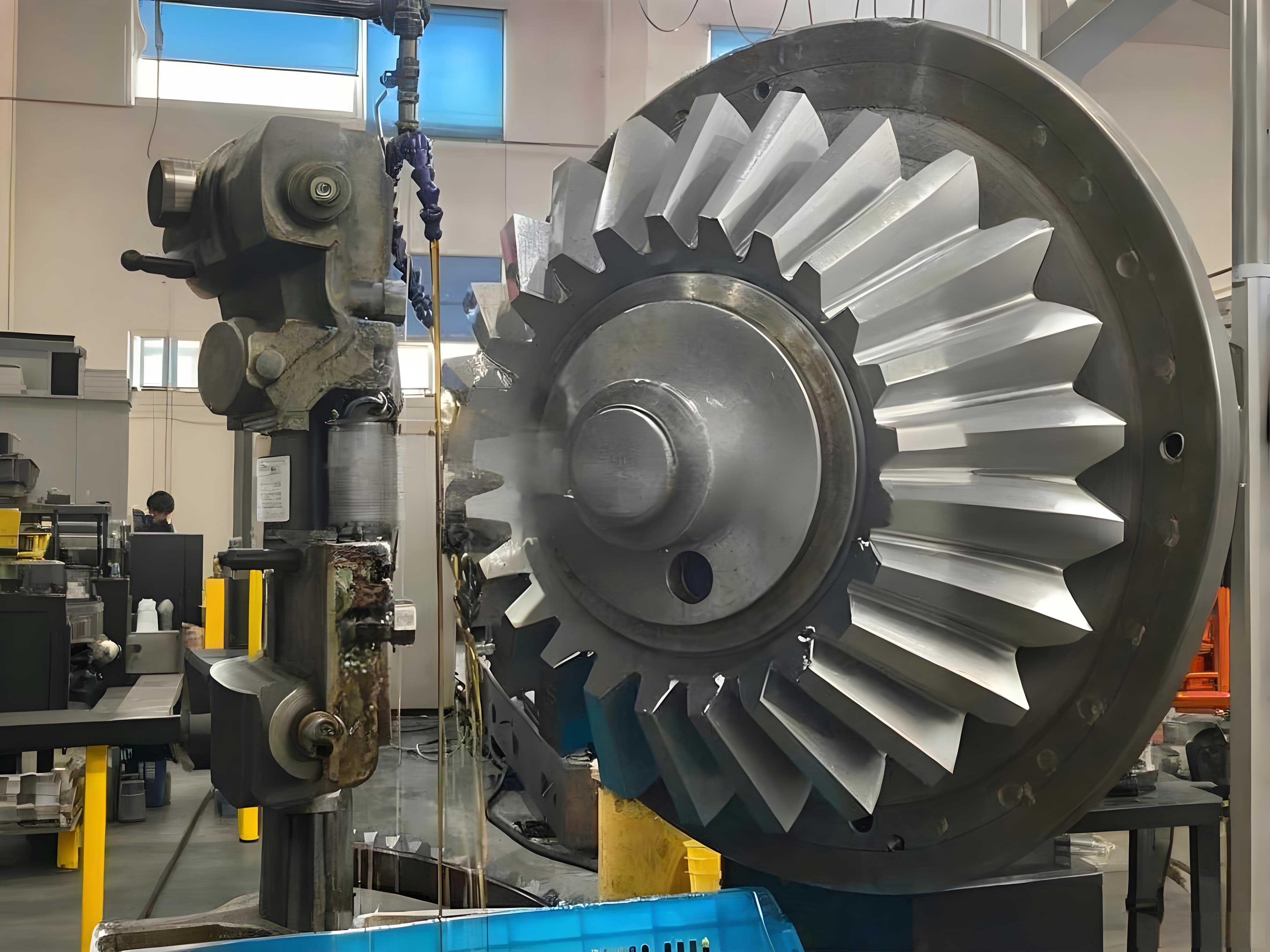
In the field of mechanical power transmission between intersecting shafts, miter gears, which are a specific type of straight bevel gears with a shaft angle of 90 degrees, play a critical role in applications such as aerospace, automotive, and precision machinery. Two primary tooth surface geometries dominate the design of such gears: the spherical involute and the octoidal form. The octoidal miter gear, generated by a planar crown rack, offers significant advantages in manufacturing due to simpler tool geometry, easier sharpening, and higher precision, potentially leading to improved efficiency and reduced costs. This study aims to conduct a comprehensive comparative analysis between spherical involute miter gears and octoidal miter gears, focusing on their mathematical modeling, tooth surface characteristics, and mechanical strength under load.
The fundamental difference lies in the generating tool. Spherical involute miter gears are produced using a crown rack with a spherical involute tooth profile, while octoidal miter gears are generated by a crown rack with a planar tooth profile. This distinction, though seemingly subtle, leads to variations in the final gear tooth geometry, particularly in the tooth flank and root fillet regions. These geometric differences ultimately influence performance metrics such as contact pattern, transmission error, bending stress, and contact stress. Therefore, a detailed investigation is warranted to validate the potential benefits of octoidal miter gears and provide guidance for gear design selection.
We begin by establishing the mathematical foundation for both gear types. The tooth surface of a spherical involute miter gear can be derived by extending the concept of a planar involute to a spherical surface. Consider a base cone and a generating plane. As the plane rolls without slipping on the base cone, a point on the plane traces a spherical involute curve. Let us define a series of coordinate systems to facilitate this derivation. A fixed coordinate system \( S_0 \) is placed on the generating plane \(\Pi\), with its origin \( O_0 \) coinciding with the center of a circle \( C \) and the sphere’s center. The \( z_0 \)-axis passes through a point \( P \) on the circle, the \( y_0 \)-axis is perpendicular to plane \(\Pi\), and the \( x_0 \)-axis is perpendicular to the plane \( y_0O_0z_0 \). A coordinate system \( S_3 \) is attached to the base cone, with its \( z_3 \)-axis aligned with the cone’s axis.
The position vector of point \( P \) in \( S_0 \) is \( \mathbf{r}^{(P)}_0 = [0, 0, r_0, 1]^T \). Through a sequence of homogeneous transformations involving rotation matrices that account for the rolling angle \( \phi \) of the plane and the base cone angle \( \gamma_b \), we obtain the spherical involute’s position vector in \( S_3 \):
$$ \mathbf{r}^{(P)}_3(\psi, \phi) = \mathbf{M}_{32}(\psi) \mathbf{M}_{21} \mathbf{M}_{10}(\phi) \mathbf{r}^{(P)}_0 $$
Here, \( \psi \) is the involute roll angle, related to \( \phi \) by \( \phi = \sin \gamma_b \, \psi \). The matrices \( \mathbf{M}_{32}, \mathbf{M}_{21}, \) and \( \mathbf{M}_{10} \) are the homogeneous transformation matrices between the respective coordinate systems. Similarly, the unit normal vector \( \mathbf{n}^{(P)}_3 \) and unit tangent vector \( \mathbf{t}^{(P)}_3 \) at point \( P \) in \( S_3 \) can be found by transforming their counterparts in \( S_0 \) using the corresponding \( 3 \times 3 \) rotation sub-matrices \( \mathbf{L} \):
$$ \mathbf{n}^{(P)}_3(\psi, \phi) = \mathbf{L}_{32}(\psi) \mathbf{L}_{21} \mathbf{L}_{10}(\phi) \mathbf{n}^{(P)}_0 $$
$$ \mathbf{t}^{(P)}_3(\psi, \phi) = \mathbf{L}_{32}(\psi) \mathbf{L}_{21} \mathbf{L}_{10}(\phi) \mathbf{t}^{(P)}_0 $$
The complete working tooth surface of the spherical involute miter gear is defined by this set of equations. However, a realistic gear tooth consists not only of the working flank but also of a transition surface connecting the flank to the root fillet. For spherical involute miter gears, this transition surface cannot be derived directly from the generation principle. We employ a Hermite interpolation technique to construct a smooth transition. This method defines a curve between two known points: the endpoint of the working tooth surface \( \mathbf{P}_0 \) and a point on the tooth root surface \( \mathbf{P}_1 \), along with their respective tangent vectors \( \mathbf{T}_0 \) and \( \mathbf{T}_1 \).
The Hermite curve is given by:
$$ \mathbf{r}(t) = (2t^3 – 3t^2 + 1)\mathbf{P}_0 + (-2t^3 + 3t^2)\mathbf{P}_1 + (t^3 – 2t^2 + t) t_0 s \mathbf{T}_0 / A_0 + (t^3 – t^2) t_1 s \mathbf{T}_1 / A_0 $$
where \( t \) is the curve parameter ranging from 0 to 1, \( s \) is the distance from the cone apex to the tooth root, \( A_0 \) is the outer cone distance, and \( t_0, t_1 \) are weighting parameters controlling the tightness of the curve at the endpoints. Larger values pull the curve more tightly towards the tangent vectors.
Now, let’s derive the tooth surface for the octoidal miter gear. This gear is generated by a planar crown rack—a special bevel gear with a pitch cone angle of 90 degrees. The generation process is analogous to that of a rack and pinion for cylindrical gears. The crown rack and the miter gear have a shaft angle \( \Sigma = 90^\circ + \gamma_1 \), where \( \gamma_1 \) is the pitch cone angle of the gear being generated. The number of teeth on the crown rack is \( N_{cg} = N_1 / \sin \gamma_1 \).
The key parameters of the crown rack include its base cone angle \( \gamma_b = 90^\circ – \alpha \) (with \( \alpha \) being the pressure angle) and the angular tooth thickness \( t_p = 180^\circ / N_{cg} \). The crown rack’s orientation is defined by an azimuth angle \( \phi_p \) and a polar angle \( \theta_p \):
$$ \phi_p = \arccos(\tan \gamma_b \tan \gamma_p) $$
$$ \theta_p = \arctan\left( \frac{\sin \gamma_b \tan \phi_p}{\sin \gamma_b} \right) – \phi_p $$
where \( \gamma_p \) is the pitch cone angle of the gear pair.
To model the octoidal tooth surface, we define a coordinate system attached to the planar crown rack. A point \( P \) on the planar profile has a known position vector \( \mathbf{r}^{(P)}_0(\rho) \) in its local system, where \( \rho \) is a radial parameter. After a series of coordinate transformations to the crown rack’s system \( S_3 \), the crown rack’s tooth surface is obtained:
$$ \mathbf{r}_{cg}(\rho, \phi) = \mathbf{M}_{43}^{(rs)} \mathbf{M}_{32} \mathbf{M}_{21} \mathbf{M}_{10}(\phi) \mathbf{r}^{(P)}_0(\rho) $$
This simplifies to the explicit form for the left and right flanks of the crown rack:
$$ \mathbf{r}_{cg}(\rho, \phi) = \begin{bmatrix}
\rho [\pm\cos \phi \sin ( \frac{t_p}{2} + \theta_p ) \mp \sin \alpha \sin \phi \cos ( \frac{t_p}{2} + \theta_p ) ] \\
\rho [ \cos \phi \cos ( \frac{t_p}{2} + \theta_p ) \mp \sin \alpha \sin \phi \sin ( \frac{t_p}{2} + \theta_p ) ] \\
-\rho (\sin \phi \cos \alpha ) \\
1
\end{bmatrix} $$
where the upper signs correspond to the left flank and the lower signs to the right flank; \( \phi \) is the angular parameter of the crown rack.
The tooth surface of the generated miter gear (either pinion or gear, denoted by index \( i \)) is the envelope of the crown rack’s tooth family during the generation motion. In the gear’s coordinate system \( S_i \), the surface is:
$$ \mathbf{r}_i(\rho, \phi, \psi_i) = \mathbf{M}_{il}(\psi_i) \mathbf{M}_{lk} \mathbf{M}_{kj} \mathbf{M}_{jcg}[\psi_{cg}(\psi_i)] \, \mathbf{r}_{cg}(\rho, \phi) $$
Here, \( \psi_{cg} \) and \( \psi_i \) are the rotation angles of the crown rack and the miter gear, respectively, related by \( \psi_{cg}(\psi_i) = N_i / N_{cg} \psi_i \), with \( N_i \) being the number of teeth on the miter gear. The meshing condition, which ensures tangency between the crown rack and the generated gear tooth surface, is given by:
$$ f_{icg}(\rho, \phi, \psi_i) = \left( \frac{\partial \mathbf{r}_i}{\partial \rho} \times \frac{\partial \mathbf{r}_i}{\partial \phi} \right) \cdot \frac{\partial \mathbf{r}_i}{\partial \psi_i} = 0 $$
Solving this equation simultaneously with the surface equation yields the complete octoidal tooth surface of the miter gear. The transition surface for the octoidal miter gear is also constructed using the same Hermite interpolation method described earlier, ensuring a continuous and smooth connection to the working flank and root.
To compare these two types of miter gears, we employ several analytical techniques. The Ease-off method is used to quantify the deviation between the spherical involute and octoidal tooth surfaces. The deviation at any point is calculated as the projection of the position vector difference onto the normal vector of the spherical involute surface. Tooth contact analysis (TCA) is performed to predict the contact pattern and transmission error under load. Finally, finite element analysis (FEA) is conducted to evaluate the bending stress at the tooth root and the contact stress on the flanks under various loading conditions.
We now present a detailed case study. The basic parameters of the miter gear pair under investigation are summarized in the table below.
| Parameter | Pinion | Gear |
|---|---|---|
| Number of teeth, \( N \) | 25 | 36 |
| Module, \( m \) (mm) | 5.0 | |
| Pressure angle, \( \alpha \) (deg) | 25.0 | |
| Shaft angle, \( \Sigma \) (deg) | 90.0 | |
| Face width, \( F_w \) (mm) | 29.2 | |
| Addendum coefficient, \( h_a^* \) | 1.0 | |
| Dedendum coefficient, \( h_f^* \) | 1.25 | |
The Ease-off analysis reveals the geometric differences between the two miter gear designs. The deviation map shows that the octoidal miter gear tooth surface is not identical to the spherical involute surface. Specifically, in the tooth root region, the octoidal surface lies slightly outside the spherical involute surface (positive deviation), indicating a locally thicker tooth. Conversely, in the tooth tip region, the octoidal surface lies slightly inside (negative deviation), indicating a locally thinner tooth. The magnitude of deviation varies across the flank. The maximum positive deviation (at the root) was found to be in the range of +2.8 μm to +7.6 μm, while the maximum negative deviation (at the tip) ranged from -1.3 μm to -3.5 μm. This inherent geometric modification of the octoidal miter gear—thicker root and thinner tip—is advantageous as it can enhance bending strength and mitigate edge contact at the tip.
We further investigated how the maximum tooth surface deviation changes with fundamental design parameters. The results indicate an approximately linear relationship between the maximum deviation and both the module \( m \) and the pressure angle \( \alpha \). This can be summarized by the following approximate relations derived from the data:
$$ \Delta_{\text{max, root}} \approx k_{1,r} \cdot m + k_{2,r} \cdot \alpha $$
$$ \Delta_{\text{max, tip}} \approx k_{1,t} \cdot m + k_{2,t} \cdot \alpha $$
where \( k_{1,r}, k_{2,r}, k_{1,t}, k_{2,t} \) are positive constants specific to the gear geometry. This linear trend confirms that the geometric difference between the two miter gear types becomes more pronounced with larger, more heavily loaded gear designs.
Tooth contact analysis for both miter gear types, performed under no-load conditions, shows that both exhibit a favorable line contact pattern that nearly covers the entire active flank area. The calculated transmission errors for both are negligible, approaching zero. This indicates that both spherical involute and octoidal miter gears possess excellent kinematic properties and are capable of smooth motion transfer.
The core of our strength comparison relies on finite element analysis. A three-dimensional model of the miter gear pair was created, and a static structural analysis was performed using commercial FEA software. The material properties were set as follows: Young’s modulus \( E = 2.06 \times 10^5 \) MPa, Poisson’s ratio \( \mu = 0.3 \), and density \( \rho = 7.8 \times 10^{-9} \) kg/mm³. Contact pairs were defined between the five consecutive tooth pairs likely to be in contact. A penalty-based contact algorithm was used. Torque was applied to the pinion shaft, and constraints were applied to the gear shaft. Multiple load steps were analyzed to observe stress progression.
First, we examined the sensitivity of the maximum bending stress in the octoidal miter gear’s root fillet to the Hermite interpolation parameters \( t_0 \) and \( t_1 \). The results are summarized below.
| \( t_0 \) value | \( t_1 \) value | Max Bending Stress (MPa) | Trend |
|---|---|---|---|
| 0.5 | 0.5 | 285 | Stress increases with increasing \( t_0 \) and \( t_1 \). |
| 1.0 | 1.0 | 298 | |
| 1.5 | 1.5 | 315 | |
| 2.0 | 2.0 | 335 |
The data clearly shows that increasing the tangent vector weighting parameters \( t_0 \) and \( t_1 \) results in a sharper, more curved fillet, which leads to higher stress concentration and thus increased maximum bending stress. For a fair comparison with the spherical involute miter gear, a standard set of parameters (e.g., \( t_0 = t_1 = 1.0 \)) was used for both gear types in subsequent analyses.
We then compared the contact and bending stresses for both miter gear types under increasing pinion input torque: 800 N·m, 1000 N·m, 1200 N·m, and 1400 N·m. The results are consolidated into the following table.
| Pinion Torque (N·m) | Gear Type | Max Contact Stress (MPa) | Max Bending Stress (MPa) | Notes |
|---|---|---|---|---|
| 800 | Spherical Involute | 1050 | 320 | Octoidal gear shows lower stress. |
| Octoidal | 980 | 300 | ||
| 1000 | Spherical Involute | 1250 | 385 | Octoidal gear shows lower stress. |
| Octoidal | 1160 | 361 | ||
| 1200 | Spherical Involute | 1680 | 450 | Spherical gear shows edge contact; stress spikes. |
| Octoidal | 1320 | 422 | No edge contact observed. | |
| 1400 | Spherical Involute | 1950 | 520 | Both gears exhibit edge contact. |
| Octoidal | 1850 | 495 |
The FEA results lead to several key observations. Firstly, across all torque levels up to the onset of edge contact, the octoidal miter gear consistently demonstrates lower maximum contact stress and lower maximum root bending stress compared to the spherical involute miter gear. At 1000 N·m, for instance, the bending stress for the octoidal miter gear is approximately 6.24% lower than that of its spherical involute counterpart \( \left( \frac{385-361}{385} \times 100\% \approx 6.24\% \right) \). This confirms the bending strength improvement suggested by the thicker root geometry.
Secondly, a critical finding is related to edge contact. Under a load of 1200 N·m, the spherical involute miter gear exhibits clear edge contact at the tooth tip, leading to a significant and abrupt increase in contact stress. In contrast, the octoidal miter gear, with its intentionally slightly thinner tip region (as revealed by the Ease-off analysis), does not experience edge contact at this load level. This geometric feature acts as a natural tip relief, promoting a more centered contact pattern and avoiding detrimental stress concentrations under moderate loads. Only at the highest load of 1400 N·m does the octoidal miter gear also begin to show edge contact, but the associated stress values remain lower than those for the spherical involute gear at the same load.
The stress nephograms from the FEA at 1400 N·m visually confirm the edge contact phenomenon for both miter gear types, with high-stress regions localized at the very edge of the tooth tip. The overall stress distribution, however, is more favorable for the octoidal miter gear due to its modified profile.
In conclusion, this comprehensive comparative study between spherical involute and octoidal miter gears provides valuable insights for designers. The mathematical models for both gear types, including their working flanks and Hermite-interpolated root fillets, have been successfully established. The analysis demonstrates that octoidal miter gears, generated by a simpler planar crown rack, offer distinct performance advantages. The inherent geometric deviation from the spherical involute form—characterized by a thicker root and a thinner tip—translates into tangible benefits: a significant improvement in tooth root bending strength (approximately 6.24% in the studied case) and a delayed onset of edge contact under load. These advantages make octoidal miter gears a compelling choice for applications where reliability, strength, and controlled contact under varying loads are paramount. The linear relationship between geometric deviation and key parameters like module and pressure angle also provides a useful guideline for predicting the magnitude of these effects in different miter gear designs. Therefore, for high-performance power transmission systems utilizing miter gears, the octoidal form presents a viable and often superior alternative to the traditional spherical involute form.