
This paper presents a comprehensive analysis of tooth root bending stress variations between speed-increasing and speed-reducing spur gear transmissions under identical power conditions. Through theoretical modeling and finite element simulations, we reveal significant differences in stress distribution patterns caused by friction direction reversal at meshing points.
1. Meshing Characteristics Analysis
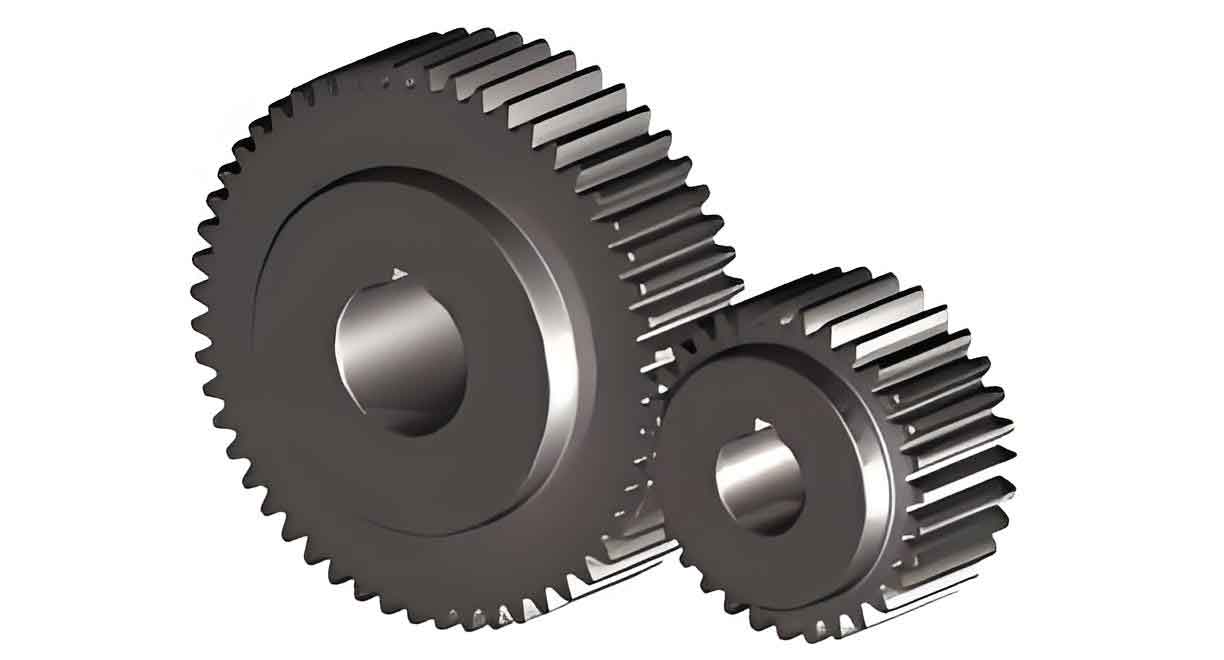
For spur gear pairs, the fundamental difference between speed-increasing (large gear driving) and speed-reducing (small gear driving) operations lies in friction direction reversal at non-pitch-point contact positions. The critical pressure angle relationship governing friction effects can be expressed as:
$$ \alpha_1 > \alpha_2 \Rightarrow v_{12} > 0 $$
where $\alpha_1$ and $\alpha_2$ represent pressure angles at meshing point A for pinion and gear respectively.
2. Theoretical Stress Calculation
2.1 Normal Force Variation
The effective normal force considering friction is calculated as:
$$ F_n = \frac{F_{n0}}{1 \pm \mu \tan\alpha} $$
where $\mu$ denotes friction coefficient and $\alpha$ is the meshing point pressure angle.
2.2 Critical Section Parameters
Key parameters for bending stress calculation include:
$$ l_1 = Y_A – l_3 – X_A \tan\alpha_A $$
$$ l_2 = l_1 + X_A \left(\tan\alpha_A + \frac{1}{\tan\alpha_A}\right) $$
Table 1 shows the geometric parameters of analyzed spur gears:
| Parameter | Pinion | Gear |
|---|---|---|
| Module (mm) | 2 | |
| Number of teeth | 20 | 63 |
| Pressure angle (°) | 20 | |
| Young’s modulus (GPa) | 210 | |
3. Finite Element Verification
Using ABAQUS simulations with 750,000 elements, we observed distinct bending stress patterns:
$$ \sigma_{\text{max}}^{\text{inc}} = 1.127-1.278\sigma_{\text{max}}^{\text{red}} \quad (\text{For gear}) $$
$$ \sigma_{\text{max}}^{\text{inc}} = 0.868-0.936\sigma_{\text{max}}^{\text{red}} \quad (\text{For pinion}) $$
| Component | Speed-Increasing (MPa) | Speed-Reducing (MPa) |
|---|---|---|
| Gear | 117.61 | 104.34 |
| Pinion | 137.09 | 150.06 |
4. Stress Distribution Patterns
The characteristic bending stress curves reveal three distinct zones:
$$ \text{Dedendum zone: } \sigma_{\text{inc}} < \sigma_{\text{red}} $$
$$ \text{Addendum zone: } \sigma_{\text{inc}} > \sigma_{\text{red}} $$
$$ \text{Pitch point: } \sigma_{\text{inc}} = \sigma_{\text{red}} $$
| Parameter | Gear | Pinion |
|---|---|---|
| Addendum stress ratio | 1.12-1.27 | 0.87-0.93 |
| Dedendum stress ratio | 0.82-0.91 | 1.08-1.15 |
5. Design Implications
The analysis suggests critical design considerations for spur gears in speed-increasing applications:
$$ K_{\text{red}} = \frac{\sigma_{\text{max}}^{\text{inc}}}{\sigma_{\text{max}}^{\text{red}}} $$
Where the derating factor $K_{\text{red}}$ ranges from 1.12 to 1.27 for gear addendum regions.
6. Conclusion
This investigation establishes that spur gear pairs in speed-increasing drives require distinct design approaches due to reversed friction effects. The developed theoretical model and simulation results provide essential guidance for optimizing gear tooth profiles and modification strategies in high-speed transmission systems.