
With the rapid development of expressways, the requirements for vehicles in road transportation have become increasingly stringent, necessitating smaller overall axle ratios. In the context of wheel-end reduction dual-stage axles, such as the Steyr axle, the minimum overall ratio has traditionally been 4.8 (with a main gear pair ratio of 21/29 and a wheel-end ratio of 3.478, yielding an overall ratio of 29/21 × 3.478 = 4.8). By altering the main driving and driven spiral bevel gears while keeping the wheel-end ratio constant, it is possible to achieve lower overall axle ratios. In response to market demands, manufacturers have intensified research and development. For instance, a major heavy-duty axle plant developed an axle with an overall ratio of 4.42 (main gear pair ratio of 26/33), while another developed one with an overall ratio of 4.38 (main gear pair ratio of 23/29). This article focuses on a comparative analysis of these two small ratio spiral gear designs in terms of geometric design, strength design, and performance, from my perspective as an engineer involved in such developments. The spiral gear, a critical component in axle systems, plays a pivotal role in transmitting torque efficiently and quietly, and its design optimization is essential for modern transportation.
In heavy-duty applications, the main reduction gear pair typically employs spiral bevel gears, often following the Gleason system for curved teeth. These spiral gears offer smoother operation, reduced noise, and higher load capacity compared to straight bevel gears. They facilitate better control and adjustment of the tooth contact pattern, are less sensitive to errors and deformation, and ensure good contact quality, commonly used in shaft intersections of 90 degrees. The teeth are usually tapered, with the driving spiral gear having a left-hand spiral and the driven spiral gear a right-hand spiral, which helps to separate the axial forces. The design of these spiral gears involves meticulous geometric parameter selection and rigorous strength verification to ensure durability under high loads.
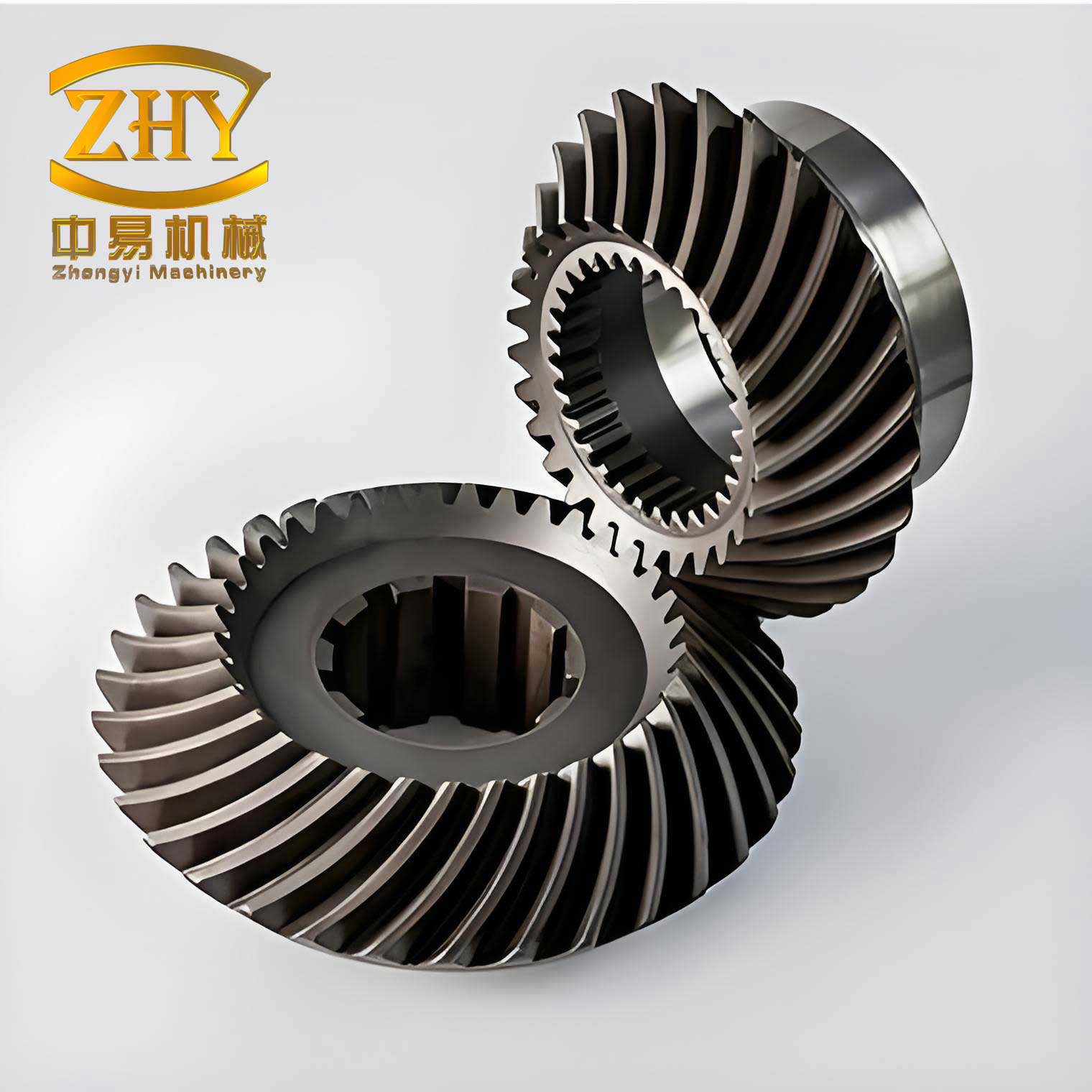
The geometric design of spiral gears begins with selecting key parameters such as the number of teeth, module, face width, spiral angle, and pressure angle. For the two small ratio configurations—4.42 (26/33) and 4.38 (23/29)—I performed calculations using standard formulas for spiral bevel gears. The geometric parameters are derived from fundamental equations that account for tooth geometry, cone angles, and dimensions. Below, I present a detailed comparison table summarizing the geometric design results for both spiral gear sets. This table encapsulates critical parameters that influence the performance and manufacturability of the spiral gears.
| No. | Parameter Name | Gear Pair for Ratio 4.42 (26/33) | Gear Pair for Ratio 4.38 (23/29) |
|---|---|---|---|
| 1 | Number of Teeth (Driving/Driven) | 26 / 33 | 23 / 29 |
| 2 | Transverse Module (mm) | 8.637 | 10.137 |
| 3 | Face Width (mm) | 50 (Driven), 60 (Driving) | 50 (Driven), 60 (Driving) |
| 4 | Addendum Coefficient | 1 | 1 |
| 5 | Dedendum Coefficient | 0.188 | 0.188 |
| 6 | Working Tooth Height (mm) | 17.274 | 22.179 |
| 7 | Shaft Angle (degrees) | 90 | 90 |
| 8 | Spiral Angle (degrees) | 35 | 35 |
| 9 | Normal Pressure Angle (degrees) | 22.5 | 22.5 |
| 10 | Spiral Direction | Left (Driving), Right (Driven) | Left (Driving), Right (Driven) |
| 11 | Pitch Diameter (mm) | 224.55 (Driving), 285.01 (Driven) | 233.979 (Driving), 295.017 (Driven) |
| 12 | Pitch Cone Angle (degrees) | 38°14′ (Driving), 51°46′ (Driven) | 38°25′ (Driving), 51°35′ (Driven) |
| 13 | Cone Distance (mm) | 181.42 | 188.27 |
| 14 | Addendum (mm) | 8.637 (Driving), 10.261 (Driven) | 10.137 (Driving), 12.0427 (Driven) |
| 15 | Dedendum (mm) | 10.261 (Driving), 8.637 (Driven) | 12.0427 (Driving), 10.137 (Driven) |
| 16 | Whole Tooth Height (mm) | 18.898 | 22.179 |
| 17 | Root Angle (degrees) | 3°14′ | 3°40′ |
| 18 | Face Cone Angle (degrees) | 41°28′ (Driving), 54°12′ (Driven) | 42°4′ (Driving), 54°21′ (Driven) |
| 19 | Root Cone Angle (degrees) | 35°48′ (Driving), 48°32′ (Driven) | 35°39′ (Driving), 47°56′ (Driven) |
| 20 | Outside Diameter (mm) | 238.09 (Driving), 292.51 (Driven) | 249.84 (Driving), 303.93 (Driven) |
| 21 | Crown To Back (mm) | 137.17 (Driving), 107.51 (Driven) | 141.22 (Driving), 111.37 (Driven) |
| 22 | Theoretical Circular Tooth Thickness (mm) | 13.5669 | 15.923 |
The geometric design process for these spiral gears involves applying formulas that relate these parameters. For instance, the pitch diameter $$d = m \times z$$, where $$m$$ is the transverse module and $$z$$ is the number of teeth. The cone distance $$R$$ can be calculated using $$R = \frac{d}{2 \sin(\delta)}$$, with $$\delta$$ as the pitch cone angle. These calculations ensure proper meshing and load distribution in the spiral gear pair. The choice of parameters impacts the gear’s size, weight, and compatibility with axle housings. Notably, the spiral gear with a ratio of 4.38 has a larger module and tooth dimensions, which generally contribute to enhanced strength, as we will explore in the strength design section.
Following the geometric design, graphical representations of the spiral gears were created based on the calculated parameters. These drawings facilitate manufacturing and assembly, ensuring that the spiral gears meet dimensional tolerances. The visualizations highlight the tooth profile, spiral curvature, and key features such as fillets and chamfers. While I cannot include the images directly here, the above link provides a reference illustration of typical spiral gears, which helps in understanding the complex geometry involved. The design of these spiral gears requires careful consideration of manufacturing processes, such as gear cutting and heat treatment, to achieve the desired performance.
Strength design is paramount for spiral gears in heavy-duty axles, as they must withstand high torque and cyclic loads without failure. The primary modes of failure are tooth bending fatigue and surface contact fatigue. Therefore, I conducted bending strength and contact strength calculations for both spiral gear sets using established formulas. These calculations account for factors like applied torque, material properties, and geometric parameters. The bending stress formula for spiral bevel gears is given by:
$$\sigma_w = \frac{2 \times 10^3 T_j K_0 K_s K_m}{K_v F z m^2 J} \, \text{N/mm}^2$$
where $$\sigma_w$$ is the bending stress, $$T_j$$ is the calculation torque (in Nm), $$K_0$$ is the overload factor (typically 1 for general trucks), $$K_s$$ is the size factor (for $$m \geq 1.6$$ mm, $$K_s = \sqrt[4]{\frac{m}{25.4}}$$), $$K_m$$ is the load distribution factor (1 for straddle-mounted gears), $$K_v$$ is the quality factor (assumed as 1), $$F$$ is the face width (in mm), $$z$$ is the number of teeth, $$m$$ is the transverse module (in mm), and $$J$$ is the geometry factor for bending (taken as 0.36 based on standard values). For comparison, I assumed equal input torque $$T$$ for both configurations. The results are summarized in the table below, which clearly shows the bending stress values for each spiral gear.
| No. | Parameter | Spiral Gear for Ratio 4.42 (26/33) | Spiral Gear for Ratio 4.38 (23/29) |
|---|---|---|---|
| 1 | Gear Type | Driving (26 teeth) | Driving (23 teeth) |
| 2 | Calculation Torque $$T_j$$ | $$T$$ | $$T$$ |
| 3 | Size Factor $$K_s$$ | $$\sqrt[4]{\frac{8.637}{25.4}} \approx 0.766$$ | $$\sqrt[4]{\frac{10.137}{25.4}} \approx 0.796$$ |
| 4 | Face Width $$F$$ (mm) | 60 | 60 |
| 5 | Transverse Module $$m$$ (mm) | 8.637 | 10.137 |
| 6 | Bending Stress $$\sigma_w$$ | $$\frac{2 \times 10^3 T \times 1 \times 0.766 \times 1}{1 \times 60 \times 26 \times (8.637)^2 \times 0.36} \approx 0.0309T \, \text{N/mm}^2$$ | $$\frac{2 \times 10^3 T \times 1 \times 0.796 \times 1}{1 \times 60 \times 23 \times (10.137)^2 \times 0.36} \approx 0.0295T \, \text{N/mm}^2$$ |
| 7 | Gear Type | Driven (33 teeth) | Driven (29 teeth) |
| 8 | Calculation Torque $$T_j$$ | $$\frac{33}{26}T$$ | $$\frac{29}{23}T$$ |
| 9 | Size Factor $$K_s$$ | 0.766 | 0.796 |
| 10 | Face Width $$F$$ (mm) | 50 | 50 |
| 11 | Transverse Module $$m$$ (mm) | 8.637 | 10.137 |
| 12 | Bending Stress $$\sigma_w$$ | $$\frac{2 \times 10^3 \times \frac{33}{26}T \times 1 \times 0.766 \times 1}{1 \times 50 \times 33 \times (8.637)^2 \times 0.36} \approx 0.0346T \, \text{N/mm}^2$$ | $$\frac{2 \times 10^3 \times \frac{29}{23}T \times 1 \times 0.796 \times 1}{1 \times 50 \times 29 \times (10.137)^2 \times 0.36} \approx 0.0366T \, \text{N/mm}^2$$ |
From the bending stress calculations, we observe that the spiral gear with a ratio of 4.38 generally exhibits lower bending stresses for the driving gear, but slightly higher for the driven gear compared to the 4.42 ratio spiral gear. However, overall, the differences are marginal, and both designs are within acceptable limits for typical materials like case-hardened steel. The spiral gear’s ability to distribute loads evenly due to its curved teeth contributes to reduced stress concentrations, which is a key advantage in heavy-duty applications.
Next, I evaluated the contact strength of the spiral gear teeth, which is critical for preventing pitting and surface wear. The contact stress formula for spiral bevel gears is expressed as:
$$\sigma_j = C_p \sqrt{\frac{2 T_{jz} K_0 K_s K_m K_f \times 10^3}{K_v F d_1 J}} \, \text{N/mm}^2$$
where $$\sigma_j$$ is the contact stress, $$C_p$$ is the elastic coefficient (232.6 N/mm² for steel gears), $$T_{jz}$$ is the driving gear calculation torque (in Nm), $$d_1$$ is the driving gear pitch diameter (in mm), $$K_f$$ is the surface quality factor (assumed as 1), and $$J$$ is the geometry factor for contact stress (taken as 0.11 based on standard values). Other factors are as defined earlier. Assuming equal input torque $$T$$, the contact stress results for both spiral gear sets are compiled in the following table. This analysis helps in assessing the durability of the spiral gear teeth under repetitive contact loads.
| No. | Parameter | Spiral Gear for Ratio 4.42 (26/33) | Spiral Gear for Ratio 4.38 (23/29) |
|---|---|---|---|
| 1 | Gear Type | Driving (26 teeth) | Driving (23 teeth) |
| 2 | Calculation Torque $$T_{jz}$$ | $$T$$ | $$T$$ |
| 3 | Pitch Diameter $$d_1$$ (mm) | 224.55 | 233.979 |
| 4 | Face Width $$F$$ (mm) | 60 | 60 |
| 5 | Geometry Factor $$J$$ | 0.11 | 0.11 |
| 6 | Contact Stress $$\sigma_j$$ | $$232.6 \sqrt{\frac{2 T \times 1 \times 1 \times 1 \times 1 \times 10^3}{1 \times 60 \times 224.55 \times 0.11}} \approx 9.39\sqrt{T} \, \text{N/mm}^2$$ | $$232.6 \sqrt{\frac{2 T \times 1 \times 1 \times 1 \times 1 \times 10^3}{1 \times 60 \times 233.979 \times 0.11}} \approx 8.96\sqrt{T} \, \text{N/mm}^2$$ |
| 7 | Gear Type | Driven (33 teeth) | Driven (29 teeth) |
| 8 | Calculation Torque $$T_{jz}$$ | $$\frac{33}{26}T$$ | $$\frac{29}{23}T$$ |
| 9 | Pitch Diameter $$d_1$$ (mm) | 285.01 | 295.017 |
| 10 | Face Width $$F$$ (mm) | 50 | 50 |
| 11 | Geometry Factor $$J$$ | 0.11 | 0.11 |
| 12 | Contact Stress $$\sigma_j$$ | $$232.6 \sqrt{\frac{2 \times \frac{33}{26}T \times 1 \times 1 \times 1 \times 1 \times 10^3}{1 \times 50 \times 285.01 \times 0.11}} \approx 11.6\sqrt{T} \, \text{N/mm}^2$$ | $$232.6 \sqrt{\frac{2 \times \frac{29}{23}T \times 1 \times 1 \times 1 \times 1 \times 10^3}{1 \times 50 \times 295.017 \times 0.11}} \approx 11.01\sqrt{T} \, \text{N/mm}^2$$ |
The contact stress analysis reveals that the spiral gear set with a ratio of 4.38 experiences lower contact stresses for both the driving and driven gears compared to the 4.42 ratio spiral gear set. This indicates better resistance to surface fatigue and potential for longer service life. The reduced stress is attributed to the larger module and optimized geometry of the 4.38 ratio spiral gear, which distributes contact loads over a broader area. In practice, this translates to improved reliability and reduced maintenance costs for axles employing such spiral gears.
Beyond the basic strength calculations, additional factors influence the performance of spiral gears. These include material selection, heat treatment processes, lubrication conditions, and manufacturing precision. For instance, case hardening or carburizing is commonly applied to spiral gears to enhance surface hardness while maintaining a tough core. The spiral gear’s tooth profile must be carefully ground or lapped to achieve low noise and high efficiency. Furthermore, dynamic loads and misalignments in real-world applications can affect stress distributions, so finite element analysis (FEA) is often employed for more accurate assessments. However, the simplified formulas used here provide a solid foundation for initial design comparisons.
In terms of application, small ratio spiral gears are essential for high-speed transportation on highways, where lower axle ratios improve fuel efficiency and reduce engine wear by allowing the engine to operate at optimal RPM. The spiral gear design must balance strength, weight, and cost. The 4.38 ratio spiral gear, with its slightly larger dimensions, may add marginal weight but offers superior strength, as evidenced by the lower calculated stresses. Market feedback has shown that axles with the 4.38 ratio spiral gear exhibit lower failure rates compared to those with the 4.42 ratio spiral gear, validating the theoretical findings. This makes the 4.38 ratio spiral gear a preferred choice for modern heavy-duty vehicles seeking durability and performance.
To further elaborate on the design process, I consider the impact of the spiral angle on gear performance. The spiral angle, set at 35 degrees in both cases, influences the overlap ratio and smoothness of engagement. A higher spiral angle can increase torque capacity but may also raise axial thrust forces. The chosen angle represents a compromise for general axle applications. Additionally, the pressure angle of 22.5 degrees is standard for spiral gears, providing a good balance between tooth strength and sliding velocity. These parameters are integral to the spiral gear’s function and are optimized through iterative design cycles.
Another aspect is the manufacturing of spiral gears, which involves specialized machines like Gleason gear cutters. The accuracy of tooth spacing, profile, and surface finish is critical for noise reduction and load sharing. Post-processing steps such as shot peening can introduce compressive residual stresses, further enhancing fatigue resistance. For the spiral gears discussed here, adherence to tight tolerances ensures that the theoretical contact patterns align with actual performance, minimizing edge loading and premature wear.
In conclusion, the comparative analysis of two small ratio spiral gear designs—4.42 (26/33) and 4.38 (23/29)—demonstrates that the 4.38 ratio spiral gear offers advantages in terms of both bending and contact strength under identical torque conditions. The geometric design parameters, particularly the larger module and adjusted tooth dimensions, contribute to lower stresses and higher durability. From my perspective, this makes the 4.38 ratio spiral gear a more robust solution for heavy-duty axles in high-speed transportation. Future developments in spiral gear technology may focus on advanced materials, such as composites or coatings, to further enhance performance while reducing weight. However, the foundational principles of geometric and strength design remain paramount for reliable spiral gear applications. The ongoing evolution of spiral gear designs will continue to drive innovations in axle systems, meeting the ever-growing demands of the transportation industry.