
In the demanding environment of underground coal mining, the scraper conveyor stands as a critical piece of equipment, functioning not only as the primary coal transport system but also as the track for the shearer and the anchorage point for hydraulic roof supports. The reliability of its drive unit, comprising the motor, coupling, and gearbox, is paramount to continuous and efficient operation. Given the complex and harsh conditions, maintenance and repair of gearboxes are exceptionally challenging and costly. Therefore, minimizing gearbox failure rates is a significant engineering objective, directly impacting mine productivity and economic performance. A prevalent and critical failure mode involves the premature failure of internal gear shafts. This article presents a detailed, first-person analysis of such failures, drawing from field investigations and technical evaluations, to identify root causes and propose comprehensive, lifecycle-oriented improvement strategies.
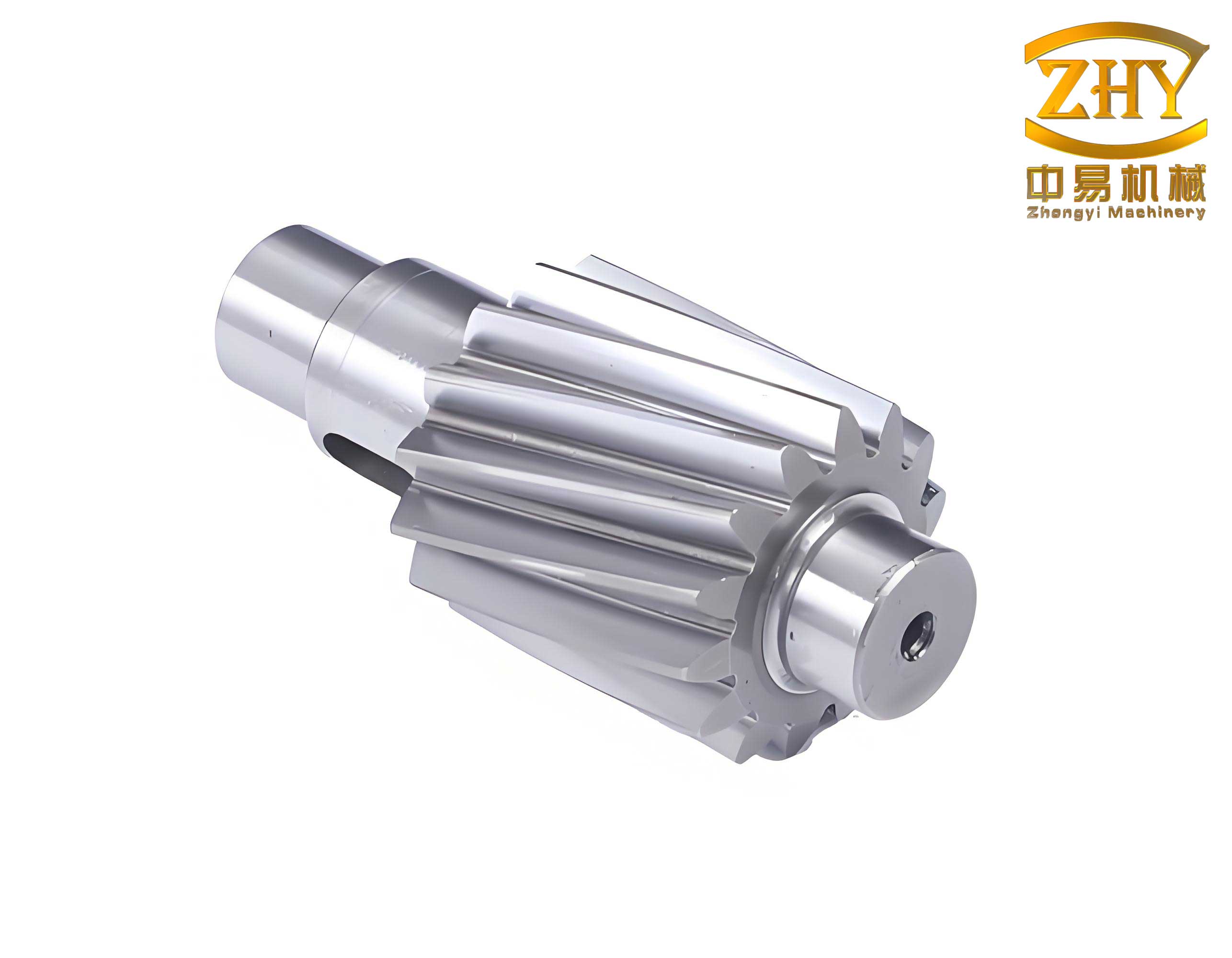
The impetus for this analysis stemmed from the repeated failure of JS200 type reducers paired with SGZ764/400 scraper conveyors in a mining operation. Multiple units exhibited severe damage to the third-stage gear shafts within a surprisingly short service period of less than six months. Disassembly revealed catastrophic failures characterized by broken teeth, and in extreme cases, complete stripping of entire gear sections. This pattern of premature failure across several identical units indicated a systemic issue rather than an isolated incident, necessitating a thorough failure mode and effects analysis (FMEA) of the gear shafts.
Initial checks confirmed the surface hardness of the failed gear shafts was within the specified range of HRC 58-62, ruling out gross under-hardening as the primary cause. Standard bending and contact stress calculations using a service factor of 1.5 also suggested the design was nominally adequate. Consequently, the investigation shifted focus from pure design specification to the integrity of the manufacturing and material realization process. The journey of a gear shaft from raw material to finished component is intricate, and a flaw in any critical step can introduce fatal weaknesses.
Root Cause Analysis: A Multi-Stage Investigation
The structure of the problematic gear shaft is integral, featuring a central gear section flanked by bearing and coupling journals. The material specified was 20CrMnTi, a low-alloy carburizing steel, subjected to case hardening to achieve a hard, wear-resistant surface and a tough, ductile core. The suspected failure points in the production chain include forging, heat treatment, and final gear machining.
1. Forging and Material Flow Defects
Forging is the first step in defining the internal integrity of a gear shaft. For an integral component with a central gear mass and smaller-diameter shafts, the correct forging sequence—upsetting the center and drawing out the ends—is crucial to align the grain flow with the component’s geometry and principal stress directions. Improper technique, such as insufficient heating time leading to a temperature gradient between the surface and core, can result in internal flaws like voids, inclusions, or incomplete recrystallization. These defects act as stress concentrators and initiation sites for fatigue cracks under cyclic loading. The variability in forging practices and often-inadequate non-destructive testing (NDT) at supplier facilities make this a high-risk stage for introducing latent defects into the gear shafts.
2. Heat Treatment Process Deficiencies
Heat treatment, particularly carburizing, quenching, and tempering, is arguably the most critical process for achieving the desired mechanical properties in gear shafts. Analysis of the process sheets revealed potential deviations. First, the omission of a stress-relief anneal (or normalizing) after rough machining leaves residual stresses from turning operations, which can superimpose on heat treatment stresses. More critically, the post-quench tempering parameters are suspect. Insufficient tempering time or temperature fails to adequately transform retained austenite and relieve quenching stresses. High residual tensile stresses, especially in the case-core transition zone and at tooth roots, significantly reduce fatigue strength and can promote spontaneous micro-cracking. The recommendation is to optimize the cycle: lower the quenching temperature from 860°C to approximately 810°C to reduce thermal shock and distortion, and substantially increase the low-temperature tempering duration from, for instance, 6 hours to 10-12 hours to ensure complete stress relaxation. The relationship between fatigue limit (\(\sigma_f\)) and residual stress (\(\sigma_{res}\)) can be approximated by:
$$\sigma_f \approx \sigma_{f0} – k \cdot \sigma_{res}$$
where \(\sigma_{f0}\) is the fatigue limit with zero mean stress and \(k\) is a material constant. High tensile \(\sigma_{res}\) drastically lowers \(\sigma_f\).
3. Surface Finish and Geometric Accuracy
Heavy-duty mining gear standards typically mandate a high quality level, such as AGMA 10 or DIN 6. A key requirement is an excellent surface finish on the gear flanks to prevent stress concentration from machining marks. Examination of the failed teeth often revealed visible tool marks, indicating the final finishing operation (like grinding or honing) was either omitted or poorly executed. The surface roughness (\(R_a\)) directly influences the effective stress concentration factor (\(K_f\)). For bending fatigue at the tooth root, the stress can be magnified:
$$\sigma_{actual} = K_f \cdot \sigma_{nominal}$$
where \(K_f\) increases with higher \(R_a\). Inadequate finish accelerates pitting initiation and reduces bending fatigue life. For a heavily loaded third-stage gear shaft, which transmits the highest torque within the gearbox, achieving a superior surface finish is non-negotiable.
4. Material Selection Suitability
While 20CrMnTi is a common choice, its performance under severe shock loads characteristic of scraper conveyor start-ups and blockages may be suboptimal. Its core toughness can be limited compared to more advanced alloys. A comparative analysis with a premium material like 17CrNiMo6 is instructive.
| Material | C | Mn | Cr | Ni | Mo | Ti |
|---|---|---|---|---|---|---|
| 20CrMnTi | 0.17-0.23 | 0.80-1.10 | 1.00-1.30 | – | – | 0.04-0.10 |
| 17CrNiMo6 | 0.15-0.20 | 0.40-0.60 | 1.50-1.80 | 1.40-1.70 | 0.25-0.35 | – |
| Material | Tensile Strength \(\sigma_b\) (MPa) | Yield Strength \(\sigma_s\) (MPa) | Elongation \(\delta_5\) (%) | Impact Toughness (J) |
|---|---|---|---|---|
| 20CrMnTi | ≥ 1080 | ≥ 835 | ≥ 10 | ~55 (at 20°C) |
| 17CrNiMo6 | ≥ 1180 | ≥ 885 | ≥ 7 | ≥ 60 (at -20°C) |
The higher nickel and molybdenum content in 17CrNiMo6 provides superior hardenability, allowing for a deeper effective case depth with a more favorable hardness gradient and exceptional core toughness. This translates to better resistance to shock loads and fatigue crack propagation in the critical root region of the gear shafts.
5. Gear Geometry and Design Philosophy
The original design employed a standard involute profile with a high positive profile shift to balance tooth strength and center distance. However, for extreme-duty applications, more advanced geometric strategies should be employed. Increasing the operating pressure angle (\(\alpha\)) from a standard 20° to 22° or 25° offers significant benefits:
- Bending Strength: The tooth becomes thicker at the root. The nominal bending stress (\(\sigma_F\)) at the root is given by:
$$\sigma_F = \frac{F_t}{b m_n} Y_F Y_S Y_\beta K_A K_V K_{F\beta} K_{F\alpha}$$
Where \(F_t\) is tangential load, \(b\) facewidth, \(m_n\) module, and \(Y_F\) the form factor. A higher pressure angle increases \(Y_F\) favorably, reducing \(\sigma_F\). - Contact Strength: The radius of curvature (\(\rho\)) at the pitch point increases, reducing Hertzian contact stress (\(\sigma_H\)):
$$\sigma_H = Z_E Z_H Z_\epsilon \sqrt{\frac{F_t}{d_1 b} \frac{u \pm 1}{u} K_A K_V K_{H\beta} K_{H\alpha}}$$
Here, \(Z_H\) is the zone factor, proportional to \(\sqrt{\frac{2}{\sin\alpha \cos\alpha}}\). An increase in \(\alpha\) slightly increases \(Z_H\), but the dominant effect of a stronger, stiffer tooth often leads to improved pitting resistance in practice.
Furthermore, gear micro-geometry modifications (profile crowning and lead crowning) are essential to compensate for deflections, manufacturing errors, and misalignments under load. These modifications prevent edge loading, ensuring even stress distribution across the face width of the gear shafts.
Integrated Improvement and Prevention Framework
Addressing the failure of gear shafts requires a holistic approach spanning design, manufacturing, quality control, and operational practices.
1. Enhanced Material and Process Specifications
For new designs or critical rebuilds, upgrading from 20CrMnTi to a superior alloy like 17CrNiMo6, 18CrNiMo7-6, or a similar high-toughness case-hardening steel is strongly recommended. The specification must be coupled with stringent process controls:
- Forging: Mandate closed-die forging with certified process parameters. Implement 100% ultrasonic testing (UT) on forged blanks to detect internal flaws.
- Heat Treatment: Specify precise carburizing (carbon potential control), quenching (agitation rate, quenchant temperature), and tempering cycles. Use chart recorders and modern furnace controls. Enforce mandatory testing of core hardness, case depth (CHD), and case hardness gradient on witness samples from every batch.
2. Advanced Manufacturing and Finishing
The final machining of the gear shafts must achieve the highest quality standard.
- Gear Cutting: Use state-of-the-art CNC gear hobbing or shaping machines.
- Finishing: Implement hard finishing as a mandatory step. This can be gear grinding, skiving, or superfinishing. The target surface roughness for flank and root should be \(R_a \leq 0.8 \mu m\).
- Shot Peening: Apply controlled shot peening to the tooth roots and fillets. This induces a beneficial compressive residual stress layer, dramatically enhancing bending fatigue strength. The improvement factor can be substantial, often increasing the endurance limit by 20-50%.
3. Robust Design Optimization
Leverage modern engineering tools to design gear shafts that are inherently more robust.
- Tooth Geometry: Adopt a higher pressure angle (22°-25°). Use asymmetric tooth profiles if applicable, optimizing the drive side for strength and the coast side for sliding.
- Finite Element Analysis (FEA): Perform detailed 3D contact FEA on the complete gear shaft assembly to identify true stress concentrations, model the effects of profile/lead modifications, and simulate the impact of misalignment. This moves beyond standard AGMA/DIN calculations.
- System Analysis: Model the entire drive train dynamics to understand and mitigate torsional vibrations and shock loads that ultimately stress the gear shafts.
4. Comprehensive Quality Assurance Protocol
Establish a multi-stage inspection regime for every batch of gear shafts:
| Stage | Inspection | Method/Standard | Acceptance Criteria |
|---|---|---|---|
| Raw Material | Chemical Analysis, Macro-etch | Spectrometry, Visual | Per material spec, no segregations |
| Forged Blank | Ultrasonic Testing (UT), Dimensional | ASTM E588 / ISO 4986 | No indications above Class 2, dimensions per drawing |
| Post Heat Treat | Case Depth, Core Hardness, Surface Hardness, Microstructure | Metallography, Vickers/Rockwell | CHD: Spec ±0.1mm, Core HRC 38-42, Case HRC 58-62, Fine martensite |
| Final Gear | Gear Geometry (Lead, Profile, Pitch), Surface Finish, Runout | Gear Measuring Machine, Profilometer | To DIN 6/AGMA 10, \(R_a \leq 0.8\mu m\), Runout ≤ 0.02mm |
| Final Assembly | Bearing Fit Dimensions, Shaft Straightness | CMM, Dial Indicator | Per drawing tolerance, Straightness ≤ 0.01mm/m |
5. Operational and Maintenance Best Practices
The longevity of gear shafts is also determined in the field.
- Proper Alignment: Ensure perfect alignment between the motor, coupling, and reducer during installation. Use laser alignment tools.
- Controlled Start-up: Implement soft starters or variable frequency drives (VFDs) to eliminate severe torsional shocks during conveyor start-up.
- Oil Quality Management: Enforce a strict oil analysis program. Monitor viscosity, water content, and particulate contamination. Use high-performance extreme pressure (EP) gear oils with appropriate additives. The filtration system must maintain a cleanliness level of ISO 4406 18/16/13 or better. Contaminants act as abrasives and stress concentrators on gear shaft surfaces.
- Condition Monitoring: Implement vibration analysis and periodic oil debris monitoring (ferrography) to detect incipient failures like micropitting or spalling on gear shafts before they lead to catastrophic breakdown.
Conclusion
The premature failure of scraper conveyor reducer gear shafts is rarely attributable to a single cause. It is typically the consequence of a convergence of factors, including potentially suboptimal material choice, deviations in critical manufacturing processes like forging and heat treatment, insufficient geometric accuracy and surface finish, and challenging operational dynamics. A systematic failure analysis, as outlined, must scrutinize each step from material melt to field service. The proposed integrated improvement framework advocates for a multi-pronged strategy: upgrading to higher-performance materials with better hardenability and toughness; enforcing rigorous, monitored manufacturing and heat treatment protocols; employing advanced design techniques like higher pressure angles and precision modifications; instituting a comprehensive quality assurance program with modern NDT; and promoting sound operational and maintenance practices. By adopting this holistic lifecycle approach, the reliability, durability, and service life of these critical gear shafts can be substantially enhanced, leading to increased availability of mining equipment and reduced total cost of ownership. The principles of this analysis are universally applicable to heavy-duty gear shafts across mining, marine, and energy industries where reliability under extreme loads is non-negotiable.