
As a researcher deeply involved in the field of precision mechanical transmissions, I find the study of backlash in strain wave gears to be a critical and fascinating challenge. Backlash, the clearance between mating tooth flanks, is a fundamental parameter that directly influences positioning accuracy, stiffness, and the potential for undesirable vibration or impact noise in strain wave gear systems. While essential to prevent jamming under load and thermal expansion, excessive backlash compromises the very high-precision performance that makes strain wave gears indispensable in robotics, aerospace, and optical instrumentation. This article aims to provide a thorough, first-principles exploration of backlash calculation methodologies, their underlying assumptions, and their validation through advanced finite element analysis. I will delve into the kinematics of strain wave gearing, establish detailed mathematical models for tooth engagement, and compare traditional and improved analytical algorithms against high-fidelity simulation results, all while emphasizing the unique deformations of the flexible spline that govern this complex phenomenon.
The exceptional performance of strain wave gears stems from their unique operating principle, which differs fundamentally from conventional gear trains. The system comprises three primary components: a rigid Circular Spline, a flexible Flexspline, and an elliptical Wave Generator inserted into the Flexspline. The Wave Generator, often a bearing assembly mounted on an elliptical cam or a multi-roller configuration, forces the nominally cylindrical Flexspline into a controlled elliptical shape. This deformation brings two opposing regions of the Flexspline’s external teeth into full mesh with the internal teeth of the stationary Circular Spline. Due to the difference in tooth counts (typically by two teeth per wave), a relative rotation is generated between the Wave Generator and the Flexspline. When the Wave Generator rotates, the elliptical deformation pattern rotates with it, causing the mesh zones to propagate around the circumference. This leads to an incremental, high-ratio speed reduction or increase between the input (Wave Generator) and output (Flexspline).
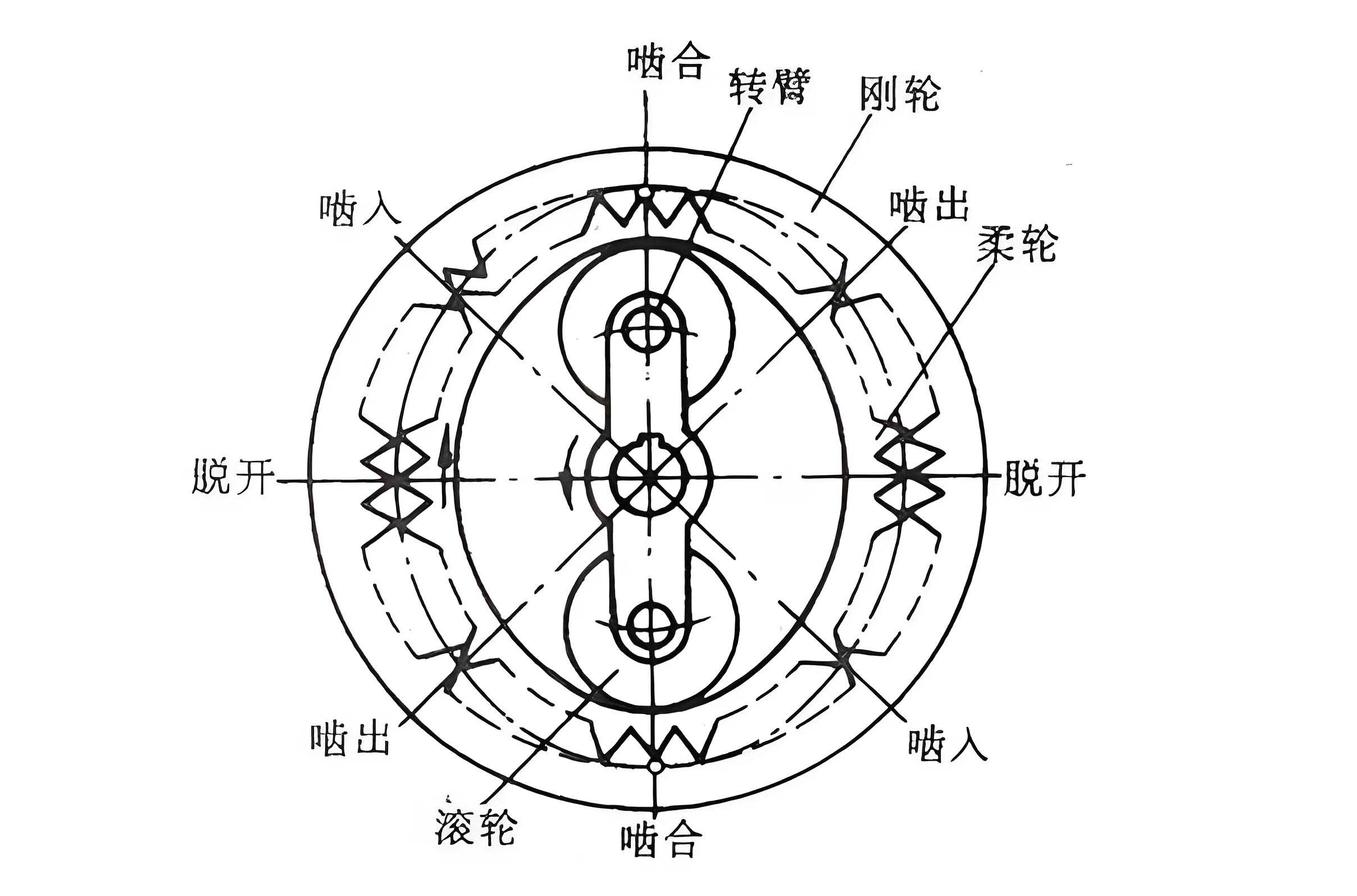
Understanding the kinematics requires defining key angular relationships. Let the fixed Circular Spline coordinate system be $S_b\{o_b, x_b, y_b\}$. The Wave Generator’s major axis initially aligns with the $y_b$-axis. As it rotates by an angle $\phi_w$, the Flexspline’s output end (the rim attached to the load) rotates relative to the Circular Spline by $\phi_g$. For a standard configuration with the Circular Spline fixed, the gear ratio is $i_{bhg} = z_b / (z_b – z_f)$, where $z_b$ and $z_f$ are the tooth numbers of the Circular Spline and Flexspline, respectively. The relationship is given by:
$$\phi_g = \frac{\phi_w}{i_{bhg}}$$
However, a tooth on the Flexspline does not simply rotate rigidly. Its root, located on the Flexspline’s neutral layer, undergoes a radial displacement $w(\phi)$ and a tangential (circumferential) displacement $v(\phi)$ due to the Wave Generator’s deformation. Here, $\phi$ is the angular position of the tooth’s root point on the undeformed Flexspline relative to the Wave Generator’s major axis. The deformed position of this root point is characterized by a new radial distance $\rho = r_m + w(\phi)$, where $r_m$ is the neutral layer radius of the undeformed Flexspline, and a new angular position $\phi_1$ relative to the major axis. The difference $\theta_v = \phi_1 – \phi$ is a crucial parameter known as the circumferential polar angle. Furthermore, the tooth’s symmetry axis rotates relative to the deformed radius vector by an angle $\mu(\phi)$, called the normal rotation angle. These displacements—$w$, $v$, and $\mu$—form the displacement field of the neutral layer and are the primary drivers of the changing tooth engagement geometry and, consequently, the backlash in a strain wave gear.
Calculating backlash in a strain wave gear is inherently more complex than in a rigid gear pair due to this continuous deformation. Backlash is not a single value but a distribution around the gear’s circumference, varying with the engagement phase. For a given Flexspline tooth at a position $\phi$, we define the circumferential backlash $j_t$ as the shortest arc length distance between the Flexspline tooth tip and the opposing Circular Spline tooth flank, measured along the pitch circle. Accurately predicting $j_t(\phi)$ is essential for design, interference checking, and performance prediction.
Early theoretical work, such as that by Ivanov, laid the foundation by deriving formulas for the displacement field under specific Wave Generator shapes (e.g., two-roller or four-roller). The radial displacement for a four-roller Wave Generator, with contact angle $\beta$, is given by a piecewise function:
$$
w(\phi) = \begin{cases}
\dfrac{w_0 \left( C\cos\phi + \phi \sin\beta \sin\phi – \frac{\pi}{4} \right)}{C – \frac{\pi}{4}}, & 0 \le \phi \le \beta \\[10pt]
\dfrac{w_0 \left[ D\sin\phi + \left( \frac{\pi}{2} – \phi \right) \cos\beta \cos\phi – \frac{\pi}{4} \right]}{C – \frac{\pi}{4}}, & \beta < \phi \le \pi/2
\end{cases}
$$
where $w_0$ is the nominal radial deformation, $C = \sin\beta + (\pi/2 – \beta)\cos\beta$, and $D = \cos\beta + \beta\sin\beta$. Assuming the neutral layer does not stretch, the circumferential displacement is found by integration: $v = -\int w \, d\phi$. The normal rotation angle is derived from geometry: $\mu = \arctan\left(\frac{1}{\rho}\frac{d\rho}{d\phi}\right)$. Ivanov’s method for backlash involved calculating the distance between specific points on the tooth centerlines, but it contained simplifications regarding tooth root positioning and did not use the full tooth profile equation.
A more rigorous approach, advanced by researchers like Shen Yunwen, uses the principle of “arc length constancy” to locate the deformed tooth root. This principle states that the length of the neutral layer arc from the major axis to the tooth root remains unchanged after deformation:
$$
r_m \phi = \int_{0}^{\phi_1} \sqrt{\rho^2 + \left(\frac{d\rho}{d\phi_1}\right)^2} \, d\phi_1
$$
Solving this integral equation for $\phi_1$ provides an accurate root location. The tooth profiles of both the Flexspline and Circular Spline are then defined in their respective coordinate systems and transformed into the fixed frame $S_b$ for comparison. The backlash $j_t$ is found as the minimum distance between the Flexspline tooth tip and the Circular Spline profile. However, the integral in the arc length equation is often complex, leading to the use of the approximation $\phi_1 \approx \phi + v/r_m$, which can introduce errors, especially under larger deformations.
To address the limitations of these traditional methods, I have focused on refining two key aspects: the tooth root positioning logic and the use of full coordinate-transformed profile equations instead of simplified centerline-based calculations. This leads to two improved algorithms for backlash calculation in a strain wave gear.
1. The Circumferential Displacement Positioning Method (Displacement Method):
This method improves upon Ivanov’s approach by using a more geometrically consistent root location. The circumferential polar angle $\theta_v$ is calculated directly from the tangential displacement: $\theta_v = \arcsin[v / (r_m + w)]$. The deformed root angle is then $\phi_1 = \phi_g – \theta_v$. The complete involute tooth profile for a Flexspline tooth initially on the major axis is defined in a local coordinate system attached to the deformed root. This local profile is then subjected to a series of rotations and translations to bring it into the global Circular Spline coordinate system $S_b$. The transformation chain accounts for the root radial position $(\rho, \phi_1)$, the normal rotation $\mu$, and the gear rotation $\phi_g$. The transformation matrix for a point $(x_1, y_1)$ on the local Flexspline profile to its global coordinates $(x_{a1}, y_{a1})$ is:
$$
\begin{bmatrix} x_{a1} \\ y_{a1} \\ 1 \end{bmatrix} =
\begin{bmatrix}
\cos(\pi/2) & -\sin(\pi/2) & -r_m \\
\sin(\pi/2) & \cos(\pi/2) & 0 \\
0 & 0 & 1
\end{bmatrix}
\cdot
\begin{bmatrix}
\cos\psi & -\sin\psi & \rho\cos\phi_1 \\
\sin\psi & \cos\psi & \rho\sin\phi_1 \\
0 & 0 & 1
\end{bmatrix}
\cdot
\begin{bmatrix} x_1 \\ y_1 \\ 1 \end{bmatrix}
$$
where $\psi = \theta_v – \phi_g + \mu$. Similarly, the Circular Spline tooth profile is defined and transformed. The backlash $j_t$ is computed as the Euclidean distance between the transformed Flexspline tooth tip $M_1(x_{a1}, y_{a1})$ and the corresponding point $M_2(x_{M2}, y_{M2})$ on the Circular Spline profile that lies at the same radial distance.
2. The Arc Length Positioning Method (Arc Length Method):
This method refines Shen’s approach by numerically solving the exact arc length constancy equation without approximation. Given $\phi$, a numerical root-finding algorithm (like the bisection method) is used to solve for $\phi_1$ in the equation $r_m \phi – \int_{0}^{\phi_1} \sqrt{\rho^2 + \dot{\rho}^2} \, d\phi_1 = 0$, where $\dot{\rho} = d\rho/d\phi_1$. This yields a highly accurate root position. The profile equations are then expressed directly in the global frame. For an involute Flexspline profile, the coordinates are:
$$
\begin{aligned}
x_{a1} &= r_1\left\{\sin[\psi – (u_{a1} – \theta_1)] + u_{a1}\cos\alpha_0 \cos[\psi – (u_{a1} – \theta_1 + \alpha_0)]\right\} + \rho\sin\phi_1 – r_m\sin\psi \\
y_{a1} &= r_1\left\{\cos[\psi – (u_{a1} – \theta_1)] – u_{a1}\cos\alpha_0 \sin[\psi – (u_{a1} – \theta_1 + \alpha_0)]\right\} + \rho\cos\phi_1 – r_m\cos\psi
\end{aligned}
$$
where $\psi = \phi_1 + \mu$, $r_1$ is the Flexspline pitch radius, $u_{a1}$ is the involute parameter at the tooth tip, $\theta_1$ is half the angular tooth thickness on the pitch circle, and $\alpha_0$ is the pressure angle. The Circular Spline profile is defined similarly. The backlash is again calculated as the minimum distance between these precise profile points.
The validity of these theoretical models must be tested against a more physically representative simulation. To this end, I constructed a detailed 2D planar finite element model of a strain wave gear tooth ring segment. The model parameters were: module $m=0.2$ mm, Flexspline teeth $z_f=140$, Circular Spline teeth $z_b=142$, Flexspline addendum coefficient $h_a^*=1$, pressure angle $\alpha=20^\circ$, and radial deformation factor $w_0^*=1$. A quarter-model was utilized, exploiting double symmetry. Crucially, the involute tooth profiles for both splines were accurately modeled by calculating multiple points along the profile using the involute equations and connecting them. The Flexspline was meshed with PLANE183 elements, and a four-roller Wave Generator was simulated by applying a radial displacement boundary condition derived from the theoretical $w(\phi)$ function to the Flexspline’s inner surface. After solving the static structural problem under this “no-load” assembly condition, the deformed coordinates of the Flexspline tooth tip nodes were extracted. For each Flexspline tip node, the corresponding point on the Circular Spline profile at the same radius was identified, and the distance between them was computed as the finite element model’s prediction of circumferential backlash $j_t^{FEM}(\phi)$.
The following table summarizes the core assumptions and characteristics of the four backlash calculation approaches discussed:
| Method | Tooth Root Positioning | Profile Representation | Key Inputs | Primary Output |
|---|---|---|---|---|
| Ivanov’s Original | Approximate, based on simplified geometry. | Uses tooth centerline and simple thickness. | $w(\phi)$, $v(\phi)$, $\mu(\phi)$ | Point-to-point distance on centerlines. |
| Shen’s Original (Approx.) | Arc length constancy, using $\phi_1 \approx \phi + v/r_m$. | Full parametric tooth profile equations. | $w(\phi)$, $v(\phi)$, $\mu(\phi)$ | Minimum distance between full profiles. |
| Displacement Method (Improved) | $\theta_v = \arcsin[v/(r_m+w)]$; $\phi_1 = \phi_g – \theta_v$. | Full profiles transformed via rotation matrices. | $w(\phi)$, $v(\phi)$, $\mu(\phi)$, $\phi_g$ | Distance between transformed tip and opposing profile. |
| Arc Length Method (Improved) | Exact numerical solution of arc length integral. | Full profiles expressed in global coordinates. | $w(\phi)$, $\mu(\phi)$, solved $\phi_1$ | Minimum distance between precisely located profiles. |
| Finite Element Model (FEM) | Emerges directly from elastic deformation solution. | Discretized but accurate CAD geometry. | Geometry, material properties (E, $\nu$), boundary conditions. | Distance between deformed mesh nodes on tooth surfaces. |
The results from the finite element simulation served as a benchmark. Comparing the theoretical methods against this benchmark revealed important insights. The original methods by Ivanov and the approximate Shen method showed significant deviations, particularly in the region where teeth were transitioning out of mesh (e.g., $\phi > 30^\circ$). The improved methods showed much better agreement. The Arc Length Method demonstrated the closest correlation with the FEM results across the entire engagement range. A typical comparison plot would show $j_t$ on the y-axis versus the angular position $\phi$ on the x-axis. The curves for the Arc Length Method and the FEM model would almost superimpose, while the Displacement Method would show slight deviations, and the original methods would diverge more noticeably.
To diagnose the source of the remaining discrepancies between the improved theoretical models and the FEM results, I extracted the neutral layer displacement field directly from the finite element solution. This involved querying the radial displacement $w^{FEM}(\phi)$, the circumferential displacement $v^{FEM}(\phi)$, and calculating the normal rotation $\mu^{FEM}(\phi)$ from the displacement gradients of elements on the neutral layer. I also computed the actual circumferential polar angle $\theta_v^{FEM}$ from the deformed nodal positions.
The comparison was revealing. The theoretical displacement fields ($w, v, \mu$), derived under assumptions of small deformations and a non-extending neutral layer, differed from those computed by the FEM, which captured the full nonlinear geometric response. Notably, the theoretical circumferential displacement $v(\phi)$ was consistently larger than $v^{FEM}(\phi)$ in certain zones. Similarly, the theoretical $\theta_v$ differed from $\theta_v^{FEM}$. These differences in the input displacement field directly propagate into the backlash calculation. For the Displacement Method, which explicitly uses $v$ to find $\theta_v$, an overestimation of $v$ leads to an overestimation of $\theta_v$, incorrectly positioning the tooth root and causing backlash error. For the Arc Length Method, which solves for $\phi_1$ independently, the error primarily enters through the assumed form of the radial displacement function $w(\phi)$ used in the arc length integral, which may not perfectly match the FEM-derived deformation.
The following table quantifies the typical parametric deviations observed between theory and FEM for a case with significant deformation:
| Parameter | Theoretical Value Range | FEM Value Range | Typical Max Deviation ($\Delta_{max}$) | Primary Cause of Deviation |
|---|---|---|---|---|
| Radial Disp. $w$ | 0 to $w_0$ (e.g., ~0.2mm) | Similar range | ~0.01-0.02 mm | Nonlinear deformation vs. linear assumption. |
| Circum. Disp. $v$ | Calculated from $- \int w d\phi$ | Directly from nodal motion | ~3.1 $\mu m$ (at $\phi \approx 59^\circ$) | Neutral layer may experience slight stretching/compression. |
| Normal Rotation $\mu$ | $\arctan(\dot{\rho}/\rho)$ | From element edge rotation | Small angular difference | Derived from $w(\phi)$, so inherits its error. |
| Polar Angle $\theta_v$ (Disp. Method) | $\arcsin[v/(r_m+w)]$ | From deformed geometry | ~2.24e-4 rad (at $\phi \approx 59^\circ$) | Propagated error from $v$ and $w$. |
| Root Angle $\phi_1$ (Arc Length Method) | Numerical solution of arc length eq. | From deformed geometry | ~3.28e-5 rad (at $\phi \approx 37^\circ$) | Error in the assumed $w(\phi)$ profile in the integral. |
This analysis conclusively shows that the primary source of backlash deviation in theoretical models for strain wave gears is the inaccuracy in predicting the circumferential displacement field of the Flexspline’s neutral layer. The assumption of an inextensible midline, while useful for simplification, is violated in practice, especially under the significant bending induced by the Wave Generator. This violation leads to errors in $v(\phi)$ and, consequently, in the positioning of teeth. The Arc Length Method, by relying on a more fundamental geometric constraint (arc length) and less directly on the calculated $v$, proves to be more robust and yields superior accuracy, as confirmed by its close match with the finite element analysis.
In conclusion, the pursuit of accurate backlash prediction in strain wave gears requires a multi-faceted approach. Theoretical models based on kinematic displacement fields provide invaluable insight and design tools, especially when refined with precise tooth root positioning logic and full profile equations. The Arc Length Positioning Method, employing a numerically exact solution for the deformed root location, represents a significant advancement in analytical accuracy. However, these models are ultimately limited by their underlying assumptions about the Flexspline’s deformation. High-fidelity finite element analysis serves as the crucial validation tool, revealing the subtle complexities of the real displacement field—particularly the neutral layer’s circumferential motion—that analytical models often miss. For the design of high-performance strain wave gears where minimal and predictable backlash is paramount, a combined strategy is recommended: using advanced theoretical algorithms for initial design and parameter optimization, followed by detailed finite element simulation for final verification and refinement. This integrated approach ensures both the high transmission accuracy and the reliability that make the strain wave gear a cornerstone of modern precision motion control systems.