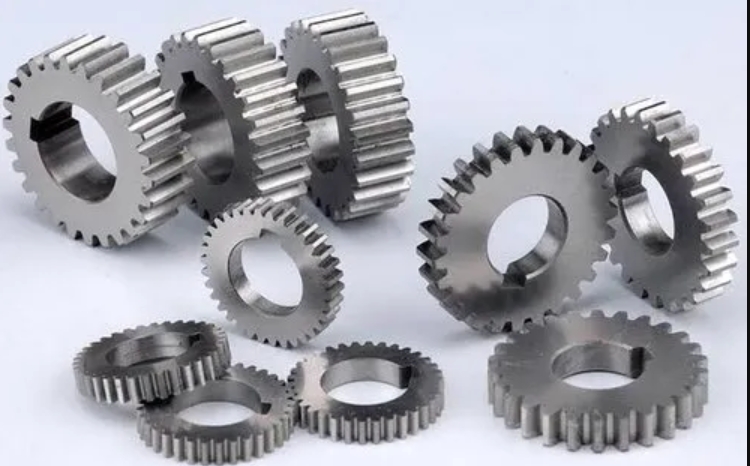
In this study, we investigate the complex nonlinear dynamics of single-stage spur gear pairs, focusing on the phenomenon of coexisting attractors. Spur gears are widely used in mechanical transmission systems due to their simplicity and efficiency, but their dynamic behavior is significantly influenced by nonlinear factors such as time-varying mesh stiffness, transmission errors, and backlash. These factors can lead to rich dynamical phenomena, including multi-stability, bifurcations, and chaos, which are critical for the design and optimization of gear systems. Our analysis employs a combination of numerical methods, including the initial cell mapping method, continuation shooting techniques, and Poincaré mapping, to unravel the global dynamics of the system. We emphasize the identification and tracking of both stable and unstable periodic attractors, which are often overlooked in conventional studies. By examining the stability and bifurcations of these attractors, we reveal hidden dynamical features, such as saddle-node grazing bifurcations and chaotic crises, that occur in极小 parameter intervals. The results provide valuable insights into the safe operation and fault预警 of spur gear systems, offering a theoretical foundation for parameter design and optimization.
The dimensionless equation of motion for a single-stage spur gear pair is derived considering factors like time-varying mesh stiffness, composite transmission error, and backlash. The system is modeled as a single-degree-of-freedom oscillator, and the equation is expressed as:
$$ \ddot{x} + 2\xi \dot{x} + (1 + k \cos(\omega t)) g(x, d) = F + \varepsilon \omega^2 \cos(\omega t) $$
Here, \(x\) represents the dimensionless displacement, \(\xi\) is the damping ratio, \(k\) is the amplitude of time-varying mesh stiffness, \(\omega\) is the dimensionless meshing frequency, \(F\) is the dimensionless torque, and \(\varepsilon\) is the error fluctuation amplitude. The backlash function \(g(x, d)\) is defined with a nominal scale \(d = 1\) as:
$$ g(x) =
\begin{cases}
x – 1, & x > 1 \\
0, & |x| \leq 1 \\
x + 1, & x < -1
\end{cases} $$
This piecewise nonlinearity divides the phase space into three regions: \(G_1 = \{u: x > 1\}\), \(G_2 = \{u: |x| \leq 1\}\), and \(G_3 = \{u: x < -1\}\), where \(u = (x, \dot{x})^T\) is the state vector. The non-smooth boundaries \(\Sigma_1 = \{u: x = 1\}\) and \(\Sigma_2 = \{u: x = -1\}\) induce complex dynamics, including grazing incidents and bifurcations. To analyze the system, we construct a Poincaré map \(P: \Pi_0 \to \Pi_0\) on the section \(\Pi_0 = \{(u, t) \in \mathbb{R}^2 \times S \mid \mod(t, 2\pi/\omega) = 0\}\). The map is composed of local mappings \(P_1\), \(P_2\), and \(P_3\) corresponding to motions in \(G_1\), \(G_2\), and \(G_3\), respectively. The Jacobian matrix of the Poincaré map is computed to determine the stability of periodic orbits using Floquet theory.
We employ the initial cell mapping method to identify coexisting attractors by discretizing the state space and solving for fixed points on the Poincaré section. For a given parameter set, such as \(k = 0.1\), \(\varepsilon = 0.2\), \(\xi = 0.04\), and \(F = 0.05\), we scan the frequency range \(\omega \in [0.20, 1.20]\). The continuation shooting method is then used to track the evolution of these attractors as parameters vary. Numerical simulations via the fourth-order Runge-Kutta method validate the results and capture chaotic responses. The stability of periodic attractors is assessed by calculating the eigenvalues of the Jacobian matrix; if all eigenvalues lie within the unit circle, the orbit is stable. Bifurcations, such as period-doubling (PD) and saddle-node (SN), are identified based on Floquet multipliers crossing critical values.
Our analysis reveals that spur gear systems exhibit extensive multi-attractor coexistence. For instance, at \(\omega = 0.3950\), up to nine periodic attractors coexist, including four stable period-1 orbits, three unstable period-1 orbits, one stable period-4 orbit, and one unstable period-4 orbit. The phase trajectories and Poincaré maps illustrate diverse motion patterns, such as full mesh, partial contact, and impacts with backlash boundaries. The bifurcation diagram summarizes the existence and stability of these attractors over \(\omega\), highlighting regions where multiple attractors overlap. Key bifurcation points include grazing-induced saddle-node (GR-SN) events, where a stable period-1 attractor undergoes a jump due to tangential contact with the backlash boundary. For example, at \(\omega \approx 0.47193160\), a grazing bifurcation transforms a full mesh motion into a mesh-separation motion, followed by a saddle-node bifurcation at \(\omega \approx 0.47247676\) that destabilizes the orbit. This induces hysteresis, as the system exhibits different attractors depending on the direction of parameter variation.
The table below summarizes the types of bifurcations observed in spur gear systems and their effects on attractor stability:
| Bifurcation Type | Symbol | Effect on Attractors | Parameter Example |
|---|---|---|---|
| Saddle-Node | SN | Pair creation or annihilation of periodic orbits | \(\omega = 0.47247676\) |
| Period-Doubling | PD | Loss or gain of stability via period doubling | \(\omega = 0.48173737\) |
| Grazing Saddle-Node | GR-SN | Jump and hysteresis due to boundary contact | \(\omega = 0.47193160\) |
| Boundary Crisis | BC | Sudden disappearance of chaotic attractors | \(\omega = 0.64033000\) |
Chaotic crises are another critical phenomenon in spur gear dynamics. For \(\omega \in (0.64033000, 0.93186868)\), a chaotic attractor coexists with a stable period-1 orbit. As \(\omega\) decreases, the chaotic attractor shrinks and collides with an unstable period-1 orbit on the basin boundary, leading to a boundary crisis at \(\omega = 0.64033000\). This results in the abrupt disappearance of the chaotic attractor, leaving only periodic motion. Similarly, for \(\omega \in (1.16921000, 1.20)\), a chaotic attractor coexists with a stable period-2 orbit, and a boundary crisis occurs at \(\omega = 1.16921000\). The basins of attraction are computed using the cell mapping method, revealing fractal boundaries and sensitivity to initial conditions. For example, at \(\omega = 0.70\), the basin of the stable period-1 attractor is globally stable, but as \(\omega\) increases, the chaotic attractor’s basin expands, compressing the periodic basin until the crisis.
To further illustrate the dynamics, we analyze the system under another parameter set: \(\omega = 0.50\), \(\varepsilon = 0.2\), \(\xi = 0.05\), and \(F = 0.1\), with \(k\) as the bifurcation parameter. The composite bifurcation diagram shows that saddle-node bifurcations at \(k = 0.21496768\) and \(k = 0.42925551\) introduce new period-2 attractors. Period-doubling cascades lead to chaos, and at \(k = 0.85997729\), a saddle-node bifurcation creates additional period-2 attractors that disrupt the chaotic basin. A boundary crisis at \(k \approx 1.06\) eliminates the chaotic attractor, while an interior crisis at \(k \approx 1.4591\) causes a sudden expansion of the chaotic attractor without collision with unstable periodic orbits—a distinct feature from smooth systems.
The rich dynamics of spur gear systems are governed by the interplay of nonlinearities and non-smooth effects. The coexistence of multiple attractors implies that the system’s final state depends on initial conditions, which is crucial for practical applications. For example, in gear design, parameters must be chosen to avoid undesirable attractors that could lead to noise, vibration, or failure. The following equation summarizes the Poincaré map Jacobian for a typical orbit crossing regions \(G_1 \to G_2 \to G_3 \to G_2 \to G_1\):
$$ P_D = P’_{D1} \times P’_{D2} \times P_{D3} \times P_{D2} \times P_{D1} $$
where \(P_{Di}\) is the solution of the matrix differential equation \(\frac{\partial u(t)}{\partial u_{i0}} = \frac{\partial f}{\partial u} \frac{\partial u(t)}{\partial u_{i0}}\) at transition times. The eigenvalues \(\lambda\) of \(P_D\) determine stability: if \(|\lambda| < 1\), the orbit is stable. Bifurcations occur when eigenvalues cross the unit circle, e.g., \(\lambda = -1\) for period-doubling and \(\lambda = 1\) for saddle-node.
In conclusion, our comprehensive analysis of spur gear dynamics reveals that these systems exhibit complex behaviors, including multi-attractor coexistence, grazing-induced bifurcations, and chaotic crises. These findings underscore the importance of considering both stable and unstable attractors in global dynamics studies. The methods employed here provide a framework for evaluating spur gear performance and optimizing parameters to enhance reliability and efficiency. Future work could extend this approach to multi-stage gear systems or incorporate additional factors like wear and thermal effects.