
In the field of mechanical power transmission, screw gear mechanisms, particularly worm drives, have been widely utilized due to their compact design and high reduction ratios. However, traditional screw gear systems often suffer from significant friction, low transmission efficiency, and excessive heat generation, which limit their performance in demanding engineering applications. To address these challenges, various novel screw gear configurations have been proposed. Among these, the single roller enveloping face worm drive, which incorporates a cylindrical roller that can rotate about its own axis in place of the traditional worm wheel teeth, has shown remarkable potential in reducing friction and improving efficiency. This study focuses on a detailed investigation of the contact characteristics and self-rotation behavior of such a screw gear system. The analysis is conducted from a first-person perspective, where I delve into the meshing theory, contact line distribution, self-rotation dynamics, and sliding velocity effects. The goal is to provide a comprehensive understanding that can inform the design and optimization of high-performance screw gear transmissions.
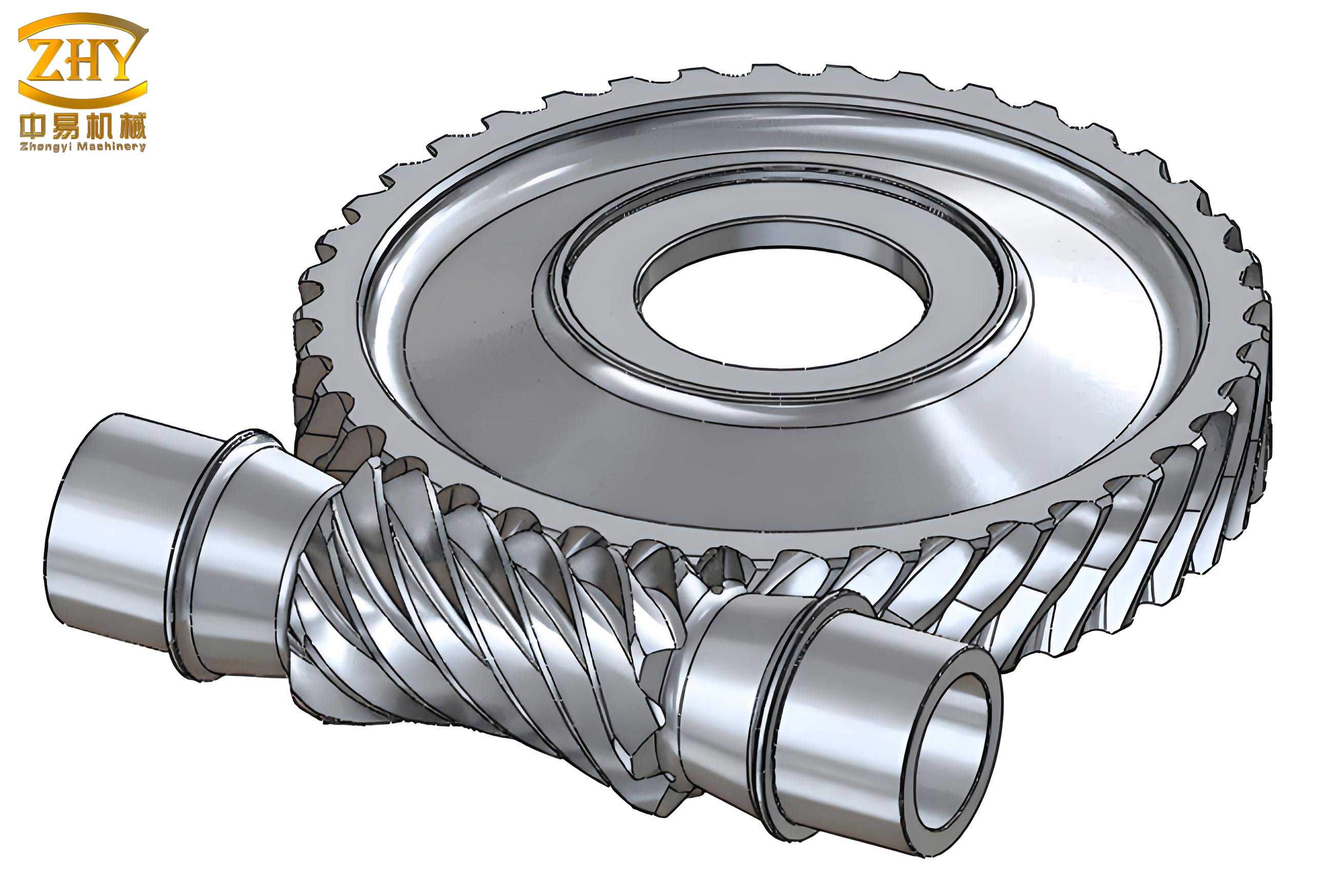
The single roller enveloping face screw gear drive operates on a unique principle where the worm, with its threads enveloping the roller, engages with a cylindrical roller that is free to rotate about its radial axis. This design transforms sliding friction into rolling friction, thereby enhancing the overall efficiency. In this analysis, I begin by establishing the coordinate systems and the mathematical framework necessary to describe the meshing action. The fundamental equations governing the contact between the worm and the roller are derived, leading to insights into the instantaneous contact lines, their spatial distribution, and the kinematic behavior of the roller. The self-rotation capability of the roller is a critical aspect, as it directly influences the wear and thermal characteristics of the screw gear system. By introducing concepts such as contact line wrap angle and contact line density, I quantify the complexity and distribution of contact lines on the roller surface. Furthermore, the analysis extends to the roller’s self-rotation angle and angular velocity, employing numerical integration techniques to compute average values over the engagement cycle. A comparative study of sliding velocities under fixed and free roller conditions highlights the anti-sliding efficacy of this screw gear design. Throughout this discussion, the term screw gear is emphasized to underscore the broader applicability of the findings to helical gear systems, though the specific configuration examined is a worm-driven mechanism.
To model the screw gear system accurately, a set of coordinate systems is defined. Let the fixed coordinate systems for the worm and the wheel be denoted as σ₁(i₁, j₁, k₁) and σ₂(i₂, j₂, k₂), respectively. The moving coordinate systems attached to the worm and the wheel are σ₁'(i₁’, j₁’, k₁’) and σ₂'(i₂’, j₂’, k₂’), where k₁’ and k₂’ represent the rotation axes of the worm and the wheel. The angular velocity vectors are ω₁ and ω₂. The roller, which serves as the wheel tooth, is positioned with its axis along the radial direction of the wheel. A coordinate system σ₀(i₀, j₀, k₀) is fixed at the center of the roller’s top surface, with k₀ aligned with the roller’s axis. The rotation displacements of the worm and wheel are φ₁ and φ₂, related by the transmission ratio i₁₂ = ω₁/ω₂ = Z₂/Z₁, where Z₁ and Z₂ are the number of threads on the worm and teeth on the wheel, respectively. The center distance is A. At the initial position where φ₁ = φ₂ = 0, the moving and fixed coordinate systems coincide. The position of the origin O₀ in σ₂’ is given by (a₂, b₂, c₂). At the contact point Oₚ, a moving frame σₚ(e₁, e₂, n) is established, where n is the common normal vector, and e₁ and e₂ lie in the tangent plane.
The relative velocity vector at the contact point is crucial for deriving the meshing conditions. Based on kinematic principles, the relative velocity V^{(1’2′)} between the worm and the roller can be expressed as:
$$ \mathbf{V}^{(1’2′)} = \frac{d\boldsymbol{\xi}}{dt} + \boldsymbol{\omega}^{(1’2′)} \times \mathbf{r}_{1′} – \boldsymbol{\omega}_{2′} \times \boldsymbol{\xi} $$
Here, ξ is the position vector from the origin of σ₁’ to the origin of σ₀, r₁’ is the position vector of the contact point in σ₁’, and ω^{(1’2′)} is the relative angular velocity. The relative velocity can be decomposed in the moving frame σₚ as:
$$ \mathbf{V}^{(1’2′)} = V^{(1’2′)}_1 \mathbf{e}_1 + V^{(1’2′)}_2 \mathbf{e}_2 + V^{(1’2′)}_n \mathbf{n} $$
The meshing equation requires that the relative velocity has no component along the common normal, i.e.,
$$ \mathbf{V}^{(1’2′)} \cdot \mathbf{n} = V^{(1’2′)}_n = 0 $$
Substituting the expressions and simplifying, the meshing function for this screw gear system is obtained:
$$ V^{(1’2′)}_n = M_1 \cos \varphi_2 + M_2 \sin \varphi_2 + M_3 = 0 $$
where:
$$ M_1 = \sin \theta (a_2 – u) $$
$$ M_2 = 0 $$
$$ M_3 = -i_{21} \cos \theta (a_2 – u) – A \sin \theta $$
In these equations, u is the height parameter along the roller axis, and θ is the angular parameter around the roller’s circumference. Solving the meshing equation yields a relationship between u and θ for a given φ₂:
$$ u = f(\theta, \varphi_2) = \frac{P_1}{P_2} $$
$$ P_1 = A \sin \theta + a_2 i_{21} \cos \theta – a_2 \sin \theta \cos \varphi_2 $$
$$ P_2 = i_{21} \cos \theta – \sin \theta \cos \varphi_2 $$
Alternatively, θ can be expressed as:
$$ \theta = \arctan\left( \frac{P_3}{P_4} \right) $$
$$ P_3 = i_{21} (a_2 – u) $$
$$ P_4 = (a_2 – u) \cos \varphi_2 – A $$
The surface equation of the worm can be derived through coordinate transformations. In σ₁’, the position vector of a point on the worm surface is:
$$ \mathbf{r}_{1′} = x_1 \mathbf{i}_{1′} + y_1 \mathbf{j}_{1′} + z_1 \mathbf{k}_{1′} $$
with:
$$ x_1 = -\cos \varphi_1 \cos \varphi_2 (a_2 – z_0) + \cos \varphi_1 \sin \varphi_2 x_0 – y_0 \sin \varphi_1 + A \cos \varphi_1 $$
$$ y_1 = \sin \varphi_1 \cos \varphi_2 (a_2 – z_0) – \sin \varphi_1 \sin \varphi_2 x_0 – y_0 \cos \varphi_1 – A \sin \varphi_1 $$
$$ z_1 = -\sin \varphi_2 (a_2 – z_0) – \cos \varphi_2 x_0 $$
where (x₀, y₀, z₀) are the coordinates of the contact point in σ₀, given by:
$$ x_0 = R \cos \theta, \quad y_0 = R \sin \theta, \quad z_0 = u $$
Here, R is the radius of the cylindrical roller. The parameter φ₂ is related to φ₁ by φ₂ = i₂₁ φ₁, and the engagement range is typically between -0.75π and -0.24π for φ₂.
The instantaneous contact line on the roller surface is determined by fixing φ₂ and combining the roller surface equation with the meshing equation. Thus, the contact line equation in σ₀ is:
$$ \mathbf{r}_0 = x_0 \mathbf{i}_0 + y_0 \mathbf{j}_0 + z_0 \mathbf{k}_0 $$
$$ u = f(\theta, \varphi_2), \quad \varphi_2 = \text{const} $$
The length of a contact line, denoted as lᵢ for the i-th line, can be computed by integrating the differential arc length. Parametrically, the contact line can be expressed as z = g(u, θ). Since u and θ are related via the meshing equation, we can write z = q(θ). The length element is:
$$ dl_i = \sqrt{(d\theta)^2 + (du)^2 + (dz)^2} $$
which simplifies to:
$$ dl_i = \sqrt{1 + \left( \frac{dz}{d\theta} \right)^2} d\theta = \sqrt{1 + \left( \frac{dq}{d\theta} \right)^2} d\theta $$
Integrating between the limits θᵢ₁ and θᵢ₂ (the starting and ending angular positions for the i-th contact line) gives:
$$ l_i = \int_{\theta_{i1}}^{\theta_{i2}} \sqrt{1 + \left( \frac{dq}{d\theta} \right)^2} d\theta $$
To characterize the contact line pattern, I introduce two concepts: the contact line wrap angle λ and the contact line density ε. The wrap angle λ is defined as the central angle subtended by the projection of a contact line onto the base plane of the roller. It indicates the spatial complexity of a single contact line. From the geometry, λ for a given instant is:
$$ \lambda_i = \theta_{i2} – \theta_{i1} $$
where θ is determined from the meshing relation. The contact line density ε measures how densely the contact lines are distributed on the roller surface; it is defined as the increment in wheel rotation angle φ₂ per unit increment in roller angle θ. From the meshing equation, φ₂ can be expressed as a function of θ and u:
$$ \varphi_2 = f(\theta, u) = \arccos\left( \frac{i_{21}}{\tan \theta} + \frac{A}{a_2 – u} \right) $$
Then, the density is:
$$ \varepsilon = \left| \frac{\Delta \varphi_2}{\Delta \theta} \right| $$
For numerical analysis, I consider a specific set of geometric parameters for the screw gear system, as summarized in Table 1.
| Parameter | Symbol | Value |
|---|---|---|
| Center Distance | A | 160 mm |
| Number of Worm Threads | Z₁ | 1 |
| Number of Wheel Teeth | Z₂ | 25 |
| Throat Diameter Coefficient | k₁ | 0.4 |
| Roller Radius | R | 9 mm |
| Worm Angular Velocity | ω₁ | 1 rad/s |
Using these parameters, numerical computations are performed to analyze the contact lines. The distribution of contact lines on the roller surface in the σ₀ space is visualized. The contact lines evolve as φ₂ changes during engagement. Initially, at the entry point, the contact lines are relatively dense, and they become sparser as the roller approaches the exit point. The length of the contact lines varies only slightly, with a total change of about 0.0015 mm over the entire engagement. The length remains nearly constant for the first two-thirds of the engagement, then increases rapidly in the final third. This behavior suggests a potential for mechanical vibration near the transition region. The wrap angle λ follows a similar trend, varying between 0.1° and 1.3°, with a total change of 1.2°. The small values of λ indicate that each contact line is spatially very narrow, which is beneficial for concentrating contact stresses in a small area, but may require careful lubrication design.
The contact line density ε is evaluated at different roller heights: at the tip (u = u_max), middle (u = u_mid), and root (u = u_min) of the roller. The density is highest at the tip, moderate in the middle, and lowest at the root. At the entry point, the difference between tip and root densities is about 15 units. As engagement progresses, the densities decrease rapidly, with a total drop of around 120 units for all heights. The decrease is steep in the initial phase and moderates later. This density variation affects the load distribution and wear patterns on the roller surface.
The area on the roller surface where all contact lines occur during a full engagement cycle is of particular interest. In the unfolded view of the roller cylinder, the entry contact line (curve c) and the exit contact line (curve d), along with the top and bottom edges of the roller, enclose a region. The area D of this region can be computed by integration:
$$ D = \int_{y_1}^{y_2} (x_c – x_d) dy $$
where x_c and x_d are the x-coordinates of curves c and d as functions of y (which corresponds to u). For the given parameters, the calculated area is 8.148 mm², which is only 0.88% of the total lateral surface area of the roller. This minuscule contact area underscores the precision required in manufacturing and alignment of this screw gear system.
The self-rotation capability of the roller is a defining feature of this screw gear design. The self-rotation angle μ is defined as the acute angle between the relative velocity vector V^{(1’2′)} and the roller’s axis (which is aligned with e₂). Since V^{(1’2′)} lies in the common tangent plane (as V_n = 0), its component along e₁ drives the roller’s rotation. Thus, μ is given by:
$$ \mu_{z0} = \arccos\left( \frac{ \mathbf{k}_0 \cdot \mathbf{V}^{(1’2′)} }{ |\mathbf{V}^{(1’2′)}| } \right) = \arccos\left( \frac{ V^{(1’2′)}_2 }{ \sqrt{ (V^{(1’2′)}_1)^2 + (V^{(1’2′)}_2)^2 } } \right) $$
A value of μ close to 90° indicates that most of the relative motion is converted into rolling, which minimizes sliding friction. Numerical analysis shows that μ remains above 89° throughout the engagement for all roller heights, confirming excellent self-rotation performance. The variation with roller height u is minimal in the first two-thirds of engagement but becomes more pronounced in the last third. Overall, the roller’s ability to turn freely is well maintained.
The self-rotation angular velocity ω₀ of the roller is derived from the kinematic relations. It depends on u, R, and φ₂:
$$ \omega_0 = \frac{E}{R} $$
$$ E = \sin \theta E_1 – \cos \theta E_2 $$
$$ E_1 = a_2 i_{21} – i_{21} u – R \sin \varphi_2 \sin \theta $$
$$ E_2 = R \sin \varphi_2 \cos \theta + \cos \varphi_2 (u – a_2) + A $$
Numerical results show that at the entry point, ω₀ ranges from 27.5 to 30 rad/s, depending on u. As engagement proceeds, ω₀ decreases to about 7.5 rad/s. The decrease is faster for smaller u (near the roller tip) and slower for larger u (near the root). The curves for different u intersect near φ₂ = -90°, indicating a shift in the trend. To obtain a unified measure, the average self-rotation angular velocity over the roller height, denoted ω₀ᵤ, is introduced:
$$ \omega_{0u} = \frac{ \int_{u_1}^{u_2} \omega_0 du }{ u_2 – u_1 } $$
where u₁ and u₂ are the minimum and maximum values of u (u₁ = 0, u₂ = 8c, with c being the tip clearance). Substituting the expressions and performing numerical integration yields ω₀ᵤ as a function of φ₂. The total angle rotated by the roller during a full engagement cycle is then:
$$ \theta_z = \int_{t_1}^{t_2} \omega_{0u} dt $$
with t₁ = 0, t₂ = (φ₂₂ – φ₂₁)/ω₂, and φ₂ = φ₂₁ + ω₂ t. For the given parameters, the computed total rotation is 749.8523 rad, equivalent to 119.3427 revolutions. This means each point on the roller surface contacts the worm surface about 119 times per engagement cycle, which has implications for fatigue life and lubrication replenishment.
The sliding velocity in the screw gear interface is a critical factor affecting efficiency and wear. Two scenarios are compared: when the roller is free to rotate (as designed) and when it is fixed (hypothetically). In the free-roller case, only the component of relative velocity along e₂ contributes to sliding, since the component along e₁ is converted into rolling. Thus, the sliding velocity vector is:
$$ \mathbf{V}_h = V^{(1’2′)}_2 \mathbf{e}_2 $$
From the geometry, with b₂ = 0 and c₂ = 0, we have:
$$ V^{(1’2′)}_2 = R \cos \varphi_2 \sin \theta – R i_{21} \cos \theta $$
Numerical evaluation shows that V_h varies between 0.2 mm/s and 0.95 mm/s, which is extremely low. The variation with u is small in the early engagement but increases later. The curves for different u intersect near φ₂ = -90°. Overall, the sliding speed is negligible, confirming the effective anti-sliding design of this screw gear system.
In contrast, if the roller is fixed, the entire relative velocity contributes to sliding. Then, the sliding velocity is:
$$ \mathbf{V}_h = V^{(1’2′)}_1 \mathbf{e}_1 + V^{(1’2′)}_2 \mathbf{e}_2 + V^{(1’2′)}_n \mathbf{n} $$
with V_n = 0, and:
$$ V^{(1’2′)}_1 = \sin \theta S_1 + \cos \theta S_2 – R \sin \varphi_2 $$
$$ S_1 = a_2 i_{21} – i_{21} u $$
$$ S_2 = a_2 \cos \varphi_2 – u \cos \varphi_2 – A $$
In this case, the sliding speed ranges from 55 mm/s to 265 mm/s, which is orders of magnitude higher than in the free-roller case. Specifically, the maximum sliding speed with a free roller is only 0.36% of that with a fixed roller, and the minimum is about 1.7%. This dramatic reduction highlights the efficacy of the self-rotation mechanism in minimizing sliding friction.
To summarize the key formulas and parameters, Table 2 provides a consolidated list of the main equations used in the analysis of this screw gear system.
| Description | Equation |
|---|---|
| Relative Velocity | $$ \mathbf{V}^{(1’2′)} = \frac{d\boldsymbol{\xi}}{dt} + \boldsymbol{\omega}^{(1’2′)} \times \mathbf{r}_{1′} – \boldsymbol{\omega}_{2′} \times \boldsymbol{\xi} $$ |
| Meshing Condition | $$ V^{(1’2′)}_n = M_1 \cos \varphi_2 + M_2 \sin \varphi_2 + M_3 = 0 $$ |
| Parameter Relation | $$ u = \frac{A \sin \theta + a_2 i_{21} \cos \theta – a_2 \sin \theta \cos \varphi_2}{i_{21} \cos \theta – \sin \theta \cos \varphi_2} $$ |
| Contact Line Length | $$ l_i = \int_{\theta_{i1}}^{\theta_{i2}} \sqrt{1 + \left( \frac{dq}{d\theta} \right)^2} d\theta $$ |
| Wrap Angle | $$ \lambda_i = \theta_{i2} – \theta_{i1} $$ |
| Contact Line Density | $$ \varepsilon = \left| \frac{\Delta \varphi_2}{\Delta \theta} \right| $$ |
| Self-Rotation Angle | $$ \mu_{z0} = \arccos\left( \frac{ V^{(1’2′)}_2 }{ \sqrt{ (V^{(1’2′)}_1)^2 + (V^{(1’2′)}_2)^2 } } \right) $$ |
| Self-Rotation Angular Velocity | $$ \omega_0 = \frac{ \sin \theta (a_2 i_{21} – i_{21} u – R \sin \varphi_2 \sin \theta) – \cos \theta (R \sin \varphi_2 \cos \theta + \cos \varphi_2 (u – a_2) + A) }{R} $$ |
| Average Angular Velocity | $$ \omega_{0u} = \frac{ \int_{u_1}^{u_2} \omega_0 du }{ u_2 – u_1 } $$ |
| Sliding Velocity (Free Roller) | $$ V_h = R \cos \varphi_2 \sin \theta – R i_{21} \cos \theta $$ |
| Sliding Velocity (Fixed Roller) | $$ V_h = \sqrt{ (V^{(1’2′)}_1)^2 + (V^{(1’2′)}_2)^2 } $$ |
The comprehensive analysis presented here underscores the advantages of the single roller enveloping face screw gear drive. The contact lines on the roller are confined to a very small area (less than 1% of the roller surface), which demands high precision in manufacturing but also allows for concentrated lubrication efforts. The roller exhibits excellent self-rotation performance, with self-rotation angles consistently near 90° and a total rotation of over 119 revolutions per engagement cycle. This extensive rotation promotes even wear distribution and reduces localized heating. Most importantly, the sliding velocity in the operational state is reduced to negligible levels compared to a fixed-roller scenario, indicating a highly effective conversion of sliding friction into rolling friction. These characteristics make this screw gear system promising for applications requiring high efficiency and durability. Future work could focus on optimizing the geometric parameters for specific load conditions, investigating thermal effects under continuous operation, and exploring advanced materials to further enhance the performance of such screw gear transmissions. The methodologies developed here can also be adapted to other types of gear systems where rolling contact is employed to mitigate friction.