
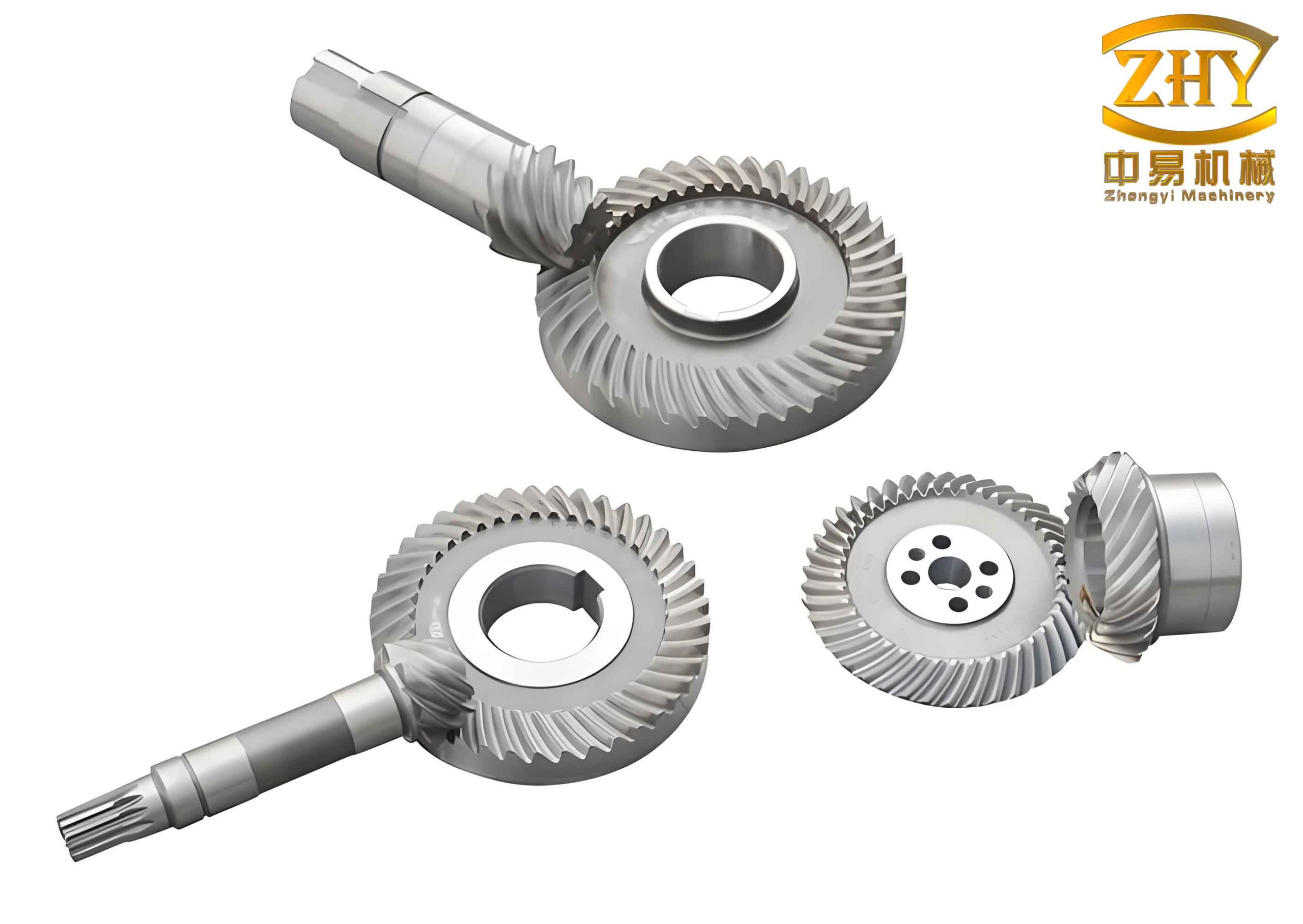
In modern mechanical systems, the demand for high power density, efficiency, and low-carbon performance is increasingly critical. Among core transmission components, hyperboloid gears play a vital role due to their ability to handle high reduction ratios and compact designs. As an engineer specializing in gear design, I have extensively studied the friction power loss and efficiency of hyperboloid gears, particularly focusing on high-reduction hyperboloid (HRH) gears with complex topological surfaces. This article delves into the geometric modeling, loaded tooth contact analysis (LTCA), elastohydrodynamic lubrication (EHL) characteristics, and experimental validation of hyperboloid gear efficiency. The goal is to provide a detailed framework for analyzing and optimizing hyperboloid gear performance, with an emphasis on minimizing friction losses. Throughout this discussion, the term “hyperboloid gear” will be frequently referenced to underscore its centrality in this research.
Hyperboloid gears, especially those with high reduction ratios, exhibit intricate topological surfaces that challenge traditional design methods. To address this, I employ a dual equitangent conjugate approach for geometric modeling. This method constructs the tooth surface model and ease-off surfaces, enabling precise control over contact patterns. The fundamental principle involves using a hypothetical generating gear—essentially a tool cutter—that simultaneously cuts both the pinion and gear teeth, ensuring conjugacy. The coordinate systems are set up with the pinion coordinate system $S_1$ embedded within the gear processing system, as illustrated in the mathematical framework. The transformation matrix between coordinate systems is given by:
$$ M_{1f} = \begin{bmatrix} 1 & 0 & 0 \\ 0 & \sin\phi_1 & \cos\phi_1 \\ 0 & -\cos\phi_1 & \sin\phi_1 \end{bmatrix} $$
where $\phi_1$ is the rotation angle of the pinion. The meshing equation for the pinion and generating gear is derived as:
$$ U \cos\phi_g – V \sin\phi_g = W $$
with parameters defined as $U = (n_{gy} z_t – n_z y_g) \sin\gamma_{m2} + n_{gy} X_d$, $V = (n_{gz} x_g – n_{gx} z_t) \sin\gamma_{m2} – n_{gx} X_d$, and $W = (n_{gy} x_g – n_{gz} y_g) m_t + n_{gz} E_{m1} \cos\gamma_{m1}$. Here, $n$ denotes the surface normal vector, and other terms represent machine settings and geometric parameters. Solving this equation yields the conjugate pinion tooth surface $r_{c1}(u_2, \theta_2)$, which is then used to compute the ease-off surface—a key element in hyperboloid gear topology modification. The ease-off surface represents the deviation between the theoretical and actual tooth surfaces, expressed as:
$$ z_d(u_2, \theta_2) = (r_{c1} – r_1) \cdot n_{c1} $$
This surface is crucial for analyzing contact patterns and transmission errors. For instance, in a 3:60 HRH gear set with a 40 mm offset, the ease-off surface reveals a controlled elliptical contact pattern near the tooth center, avoiding edge contact. The transmission error (TE) curves, derived from ease-off deviations, show a high overlap indicating a contact ratio exceeding 6, which is a hallmark of hyperboloid gears with high reduction ratios. This geometric foundation sets the stage for further kinematic and dynamic analyses.
The kinematic parameters of hyperboloid gears are essential for understanding their lubrication and friction behavior. For the gear tooth surface, represented by $r_2(u, \theta)$, the principal directions are along the curvilinear coordinates, with principal curvatures derived directly from the cutter geometry. The principal curvatures are given by $k_u = \cos\alpha / r_t$ and $k_\theta = a$, where $\alpha$ is the pressure angle and $a$ is a profile curvature parameter. At each contact point, the induced curvature along the direction perpendicular to the contact line (denoted as $p$) is calculated using second-order characteristic functions. The comprehensive curvature radius $R$ in the $p$-direction is then $R = 1 / K_p$, where $K_p = K_{sp} + K_{op}$, combining induced and ease-off curvatures. The distribution of $R$ across the tooth surface typically shows smaller radii at the toe and root regions, which influences contact stresses. Additionally, the relative motion velocities are analyzed. The linear velocities of the pinion and gear are $v_1 = \omega_1 \times r_1$ and $v_2 = \omega_2 \times r_2$, respectively. The relative sliding velocity $v_s$ and entrainment velocity $v_e$ are computed as:
$$ v_s = |u_1 – u_2|, \quad v_e = \frac{|u_1 + u_2|}{2} $$
where $u_1$ and $u_2$ are the velocity components in the $p$-direction. The slide-to-roll ratio $S_r$ is defined as $S_r = v_s / v_e$. In hyperboloid gears, $S_r$ tends to be relatively uniform across the tooth surface due to dominant longitudinal sliding, a characteristic feature that differentiates them from other gear types. The table below summarizes typical kinematic parameters for a hyperboloid gear pair under various operating conditions.
| Parameter | Symbol | Typical Range | Influence on Friction |
|---|---|---|---|
| Entrainment Velocity | $v_e$ | 0.5–5 m/s | Higher $v_e$ improves EHL film thickness |
| Slide-to-Roll Ratio | $S_r$ | 0.1–0.5 | Higher $S_r$ increases sliding friction |
| Comprehensive Curvature Radius | $R$ | 5–50 mm | Smaller $R$ raises contact pressure |
| Relative Sliding Velocity | $v_s$ | 0.1–2 m/s | Directly proportional to friction power loss |
Loaded tooth contact analysis (LTCA) is pivotal for determining the load distribution and contact stresses on hyperboloid gear teeth. Given the ease-off surface and initial gaps along contact lines, the deformation under load is modeled using a differential element approach. Each contact line is discretized into small segments, and the deformation $\delta_{i,j}$ for element $j$ on contact line $i$ is expressed as $\delta_{i,j} = \delta_i – z_{d(i,j)}$, where $\delta_i$ is the total deformation at the datum point and $z_{d(i,j)}$ is the combined gap from ease-off and transmission error. The force-deformation relationship follows a stiffness model: $f_{(i,j)} = D_{(i,j)} (\delta_i – z_{d(i,j)})$, where $D_{(i,j)}$ is the stiffness of the element. The total load equilibrium across all contacting elements is given by:
$$ \sum_{j=1}^m D_{(i,j)} (\delta_i – z_{d(i,j)}) = F $$
where $F$ is the applied load. Solving this equation iteratively for minimal deformation energy yields the load distribution $f_j$. For a hyperboloid gear pair under 200 N·m torque, the load is primarily concentrated in the central region of the tooth surface, avoiding edges. To compute contact stresses, the Hertzian theory for line contact is adapted using differential cylindrical elements. Each element of width $\Delta l$ is treated as a cylinder-plane contact, with contact half-width $b_j = 3.33 \sqrt{q_j R_j}$ and maximum Hertzian stress $\sigma_h = 182.38 \sqrt{q_j / R_j}$, where $q_j = f_j / \Delta l$ is the load per unit length. The stress distribution across the contact width $p$ is $\sigma_p = \sigma_h \sqrt{1 – p^2 / b_j^2}$. This method accounts for contact area distortions near tooth edges, common in hyperboloid gears. The results show maximum contact stresses around 1050 MPa for typical operating conditions, emphasizing the need for precise lubrication analysis to mitigate wear and friction.
The elastohydrodynamic lubrication (EHL) regime governs the friction behavior in hyperboloid gears. Using the differential element model, the minimum film thickness $h_0$ for each segment is calculated via the Dowson-Hamrock formula:
$$ h_0 = 3.06 \alpha^{0.56} \eta_0^{0.69} v_e^{0.69} E_q^{-0.03} R^{0.41} q^{-0.1} $$
where $\alpha$ is the pressure-viscosity coefficient, $\eta_0$ is the dynamic viscosity, and $E_q$ is the equivalent elastic modulus. For a hyperboloid gear with typical parameters, $h_0$ ranges from 0.4 to 0.5 µm, indicating a strong EHL effect. The film thickness ratio $\lambda = h_0 / S_c$, where $S_c$ is the composite surface roughness, determines the lubrication regime: boundary ($\lambda \leq 1$), mixed ($1 < \lambda \leq 3$), or full EHL ($\lambda > 3$). The friction coefficient $\mu$ is then estimated using empirical formulas tailored to each regime. For boundary lubrication:
$$ \mu = \exp(a_0 + H^{-(a_1 S_r + a_2 G^{-})} + a_3 \lambda^2) \cdot S_r^{a_4 \ln(G^{-}) + a_5 \ln(S_c^{-})} H^{-a_6 G^{-} + a_7 \lambda} \lambda^{a_8 \ln(\lambda) + a_9 \ln(S_c^{-})} S_q^{-a_{10}} $$
For mixed EHL:
$$ \mu = \exp(b_0 + b_1 S_r) S_r^{b_2 \ln(U^{-}) + b_3 \ln(G^{-}) + b_4 \ln(H^{-}) + b_5 H^{-}} \cdot U^{-b_6 H^{-}} G^{-b_7 + b_8 \ln(H^{-})} H^{-b_9 \ln(H^{-})} \lambda^{b_{10}} S_c^{-b_{11}} $$
And for full EHL:
$$ \mu = \exp(c_0 + c_1 G^{-} + c_2 S_r U^{-}) \cdot S_r^{c_3 \ln(G^{-}) + c_4 \ln(H^{-}) + c_5 H^{-} + c_6 \ln(\lambda) + c_7 \ln(S_c^{-})} \cdot U^{-c_8 G^{-} + c_9 \ln(H^{-})} H^{-c_{10}} G^{-c_{11}} S_c^{c_{12}} S_r^{c_{13}} $$
Here, dimensionless parameters are defined as $U^{-} = \eta_0 v_e / (E_q R)$, $H^{-} = \sigma_h / E_q$, $G^{-} = \alpha E_q$, $S_q^{-} = S_q / R$, and $S_c^{-} = S_c / R$, with coefficients from literature. The friction coefficient distribution on a hyperboloid gear tooth shows higher values in the central region due to the absence of pure rolling points. The friction power loss per element is $W_j = \mu_j f_j v_{s_j}$, and the total instantaneous power loss $W_\phi$ is summed over all contacting elements. For a hyperboloid gear with a contact ratio of 6.25, $W_\phi$ exhibits minimal fluctuation over a meshing cycle, reflecting stable lubrication conditions. The table below summarizes key EHL parameters and their impact on hyperboloid gear efficiency.
| EHL Parameter | Symbol | Typical Value | Role in Hyperboloid Gear Efficiency |
|---|---|---|---|
| Minimum Film Thickness | $h_0$ | 0.4–0.5 µm | Higher $h_0$ reduces asperity contact and wear |
| Friction Coefficient | $\mu$ | 0.04–0.08 | Lower $\mu$ decreases friction power loss |
| Film Thickness Ratio | $\lambda$ | 2–5 | $\lambda > 3$ indicates full EHL for smooth operation |
| Entrainment Velocity | $v_e$ | 1–3 m/s | Critical for building hydrodynamic pressure |
Experimental validation of hyperboloid gear efficiency is conducted using a dedicated test rig. The setup includes high-precision torque sensors (JC1A and JC2C) at the input and output shafts, with accuracies of ±0.1% and ±0.2%, respectively. The hyperboloid gear pair, with a 3:60 ratio and 40 mm offset, is tested under various speeds (e.g., 1500, 1800, 2400 rpm) and loads (83–295 N·m). Prior to testing, contact pattern inspection confirms an elliptical contact spot centered on the tooth, aligning with ease-off design predictions. The transmission efficiency $\eta$ is calculated as the ratio of output to input power, accounting for losses. Results show that efficiency increases with speed and decreases with load, consistent with EHL theory. For instance, at 1800 rpm and 200 N·m, the measured efficiency is approximately 80.5%, while the theoretical model predicts 80.3%. The average efficiency across tested conditions is 79.45%, with a maximum deviation of 2.8% from theoretical values, which falls within acceptable bounds considering bearing and seal losses. This close agreement validates the LTCA and EHL models for hyperboloid gears. The integration of geometric design, load analysis, and lubrication physics provides a robust framework for optimizing hyperboloid gear performance in real-world applications.
In conclusion, the analysis of hyperboloid gears reveals that their complex topology and high reduction ratios demand sophisticated modeling techniques. The dual equitangent conjugate method enables precise geometric control, while LTCA and differential element approaches effectively handle load distribution and contact stresses. EHL analysis, coupled with empirical friction formulas, accurately predicts film thickness and friction coefficients, key to estimating power loss. Experimental tests confirm the theoretical models, demonstrating that hyperboloid gears can achieve efficiencies around 80% under typical operating conditions. Future work could explore advanced materials or surface coatings to further reduce friction in hyperboloid gears. Ultimately, this comprehensive approach underscores the importance of integrated design and analysis in enhancing the performance and durability of hyperboloid gear systems, making them indispensable in high-power-density transmissions.