
In my extensive experience within the mechanical engineering and manufacturing sector, I have consistently observed that heat treatment defects pose a significant challenge to the integrity, performance, and longevity of critical components. These defects, arising from the complex interplay of thermal cycles, material transformations, and residual stresses, can lead to catastrophic failures if not properly managed. This article delves deeply into the nature, origins, and mitigation strategies for heat treatment defects, drawing upon principles of process planning and control systems. I will explore how advanced computational methodologies, akin to generative CAPP (Computer-Aided Process Planning) systems, can be leveraged to predict and prevent these imperfections. Throughout this discussion, the term ‘heat treatment defects’ will be frequently examined to underscore its centrality in quality assurance.
The fundamental goal of heat treatment processes such as quenching, tempering, carburizing, and annealing is to enhance material properties like hardness, strength, and wear resistance. However, the very mechanisms that confer these benefits—rapid cooling, phase transformations, and carbon diffusion—are also the primary sources of defects. The most prevalent heat treatment defects include distortion, cracking, residual stresses, soft spots, decarburization, and oxidation. To systematically categorize these, I present the following table, which summarizes key defects, their root causes, and typical manifestations.
| Defect Type | Primary Causes | Material/Process Factors | Potential Consequences |
|---|---|---|---|
| Distortion & Warping | Non-uniform heating/cooling, thermal gradients, phase transformation stresses | Component geometry, furnace atmosphere, quenchant selection | Dimensional inaccuracies, assembly issues, reduced fatigue life |
| Quench Cracking | Excessive thermal stress and transformation stress exceeding material’s ultimate strength | High carbon content, sharp section changes, inadequate tempering | Catastrophic component failure, scrap |
| Residual Stress | Plastic deformation from thermal gradients and volume changes during phase change | Cooling rate, material hardenability, part symmetry | Stress corrosion cracking, premature failure under load |
| Soft Spots | Inconsistent quenching, poor agitation, scale or vapor blanket formation | Quenchant contamination, low cooling power in certain areas | Non-uniform hardness, localized wear, reduced component performance |
| Decarburization | Reaction with oxygen or other gases at elevated temperatures, removing surface carbon | Faulty furnace atmosphere control, excessive time at temperature | Reduced surface hardness and fatigue strength, loss of case depth in carburized parts |
| Oxidation & Scaling | Reaction between metal surface and oxidizing furnace atmosphere | Lack of protective atmosphere, high temperature exposure | Material loss, poor surface finish, additional machining required |
The underlying physics of many heat treatment defects can be described mathematically. For instance, the thermal stress ($\sigma_{th}$) generated during quenching is a direct function of the temperature gradient. A simplified model for one-dimensional thermal stress is given by:
$$\sigma_{th} = E \cdot \alpha \cdot \Delta T$$
where $E$ is the Young’s modulus, $\alpha$ is the coefficient of thermal expansion, and $\Delta T$ is the temperature difference between the surface and core. During martensitic transformation, an additional stress component arises due to volumetric expansion. The total stress ($\sigma_{total}$) contributing to defects like distortion and cracking can be expressed as:
$$\sigma_{total} = \sigma_{th} + \sigma_{tr}$$
with $\sigma_{tr}$ representing transformation stress, which is proportional to the volume change $\Delta V/V$ associated with the austenite-to-martensite transformation and the constraint provided by the surrounding material. The risk of quench cracking, a severe heat treatment defect, is high when the following condition is met:
$$\sigma_{total} \geq \sigma_{UTS}$$
where $\sigma_{UTS}$ is the ultimate tensile strength of the material at the quench temperature. Furthermore, the case depth in carburizing processes, critical for gear performance, follows a diffusion-controlled relationship. The depth ($d$) where carbon concentration reaches a specified value can be estimated by:
$$d = k \sqrt{t}$$
where $k$ is a temperature-dependent diffusion parameter and $t$ is the time. Deviations from ideal diffusion cycles can lead to non-uniform case depth, itself a type of heat treatment defect.
In modern manufacturing, preventing heat treatment defects requires a proactive, integrated approach from the initial design and process planning stages. This is where generative CAPP systems become invaluable. In my work, I have utilized such systems to encode manufacturing logic and constraints, thereby creating optimized process sequences that minimize the factors leading to heat treatment defects. A well-structured CAPP system, like the one conceptually outlined for cylinder components, typically incorporates modules for material selection, blank design, machining method sequencing, and tolerance calculation. Each module plays a role in mitigating heat treatment defects. For example, the material selection module accesses a database to choose grades with optimal hardenability, reducing the risk of cracking and distortion. The blank design module calculates optimal stock allowances, ensuring sufficient material is present for subsequent finishing after predictable heat treatment distortion occurs. The selection of preliminary machining methods directly influences the state of residual stress before heat treatment, which can either aggravate or alleviate final distortion.
Let’s consider the specific sequence logic within a CAPP system aimed at controlling heat treatment defects. The system first extracts part geometry and specifications. Then, it consults a knowledge base of heat treatment responses for similar geometries and materials. A critical decision is positioning heat treatment within the overall process flow. The system might recommend stress-relieving anneals after rough machining to reduce initial stresses that could compound during final hardening. The following table illustrates a simplified, system-generated process plan for a shaft, highlighting decisions related to heat treatment defects.
| Operation Sequence | Process | Key Parameters | Rationale for Heat Treatment Defect Control |
|---|---|---|---|
| 10 | Turn (Rough) | Remove bulk material, uniform stock allowance | Creates symmetric geometry to promote uniform cooling later; reduces mass to moderate thermal gradients. |
| 20 | Stress Relieve | 650°C for 2 hours, furnace cool | Eliminates machining-induced residual stress, a precursor to exacerbated heat treatment defects. |
| 30 | Turn (Semi-finish) | Establish critical diameters close to final size | Allows for predictable distortion allowance during final hardening. |
| 40 | Carburize & Harden | 925°C, Cp=0.8%, Oil quench | System selects quenchant based on geometry database to balance hardness and distortion risk. |
| 50 | Temper | 180°C for 2 hours | Mandatory to relieve quench stresses and reduce brittleness, directly addressing quench cracking heat treatment defects. |
| 60 | Grind (Finish) | Remove distortion allowance, achieve final tolerance | Corrects the expected and controlled distortion from operation 40. |
The economic impact of heat treatment defects is profound, influencing scrap rates, rework costs, and warranty claims. A CAPP system with an integrated economic precision database ensures that specified tolerances are compatible with the expected distortion from the chosen heat treatment cycle. The relationship between cost ($C$) and tolerance ($\tau$) often follows an exponential trend:
$$C(\tau) \approx A \cdot e^{-B\tau}$$
where $A$ and $B$ are constants. Specifying an overly tight tolerance on a dimension that is highly susceptible to heat treatment defects forces the use of excessive finishing stock or expensive corrective processes like precision grinding. The CAPP system’s process sequencing module uses such cost models to propose the most economical route that still guarantees the containment of heat treatment defects within acceptable limits.
A quintessential case where control of heat treatment defects is paramount is in the manufacturing of large, carburized and hardened gears. These components, essential for heavy machinery, are extremely prone to distortion during the carburizing and quenching cycles. The distortion manifests as changes in bore diameter, tooth profile (lead and profile error), and pitch diameter. In my involvement with such projects, the strategy involves a combination of predictive allowance and specialized tooling. For instance, before carburizing, gear teeth are rough-cut with a deliberate negative allowance on the tooth thickness, anticipating the predictable expansion that occurs during the high-temperature carburizing phase and the subsequent contraction and distortion during quenching. The management of these heat treatment defects is not left to chance.
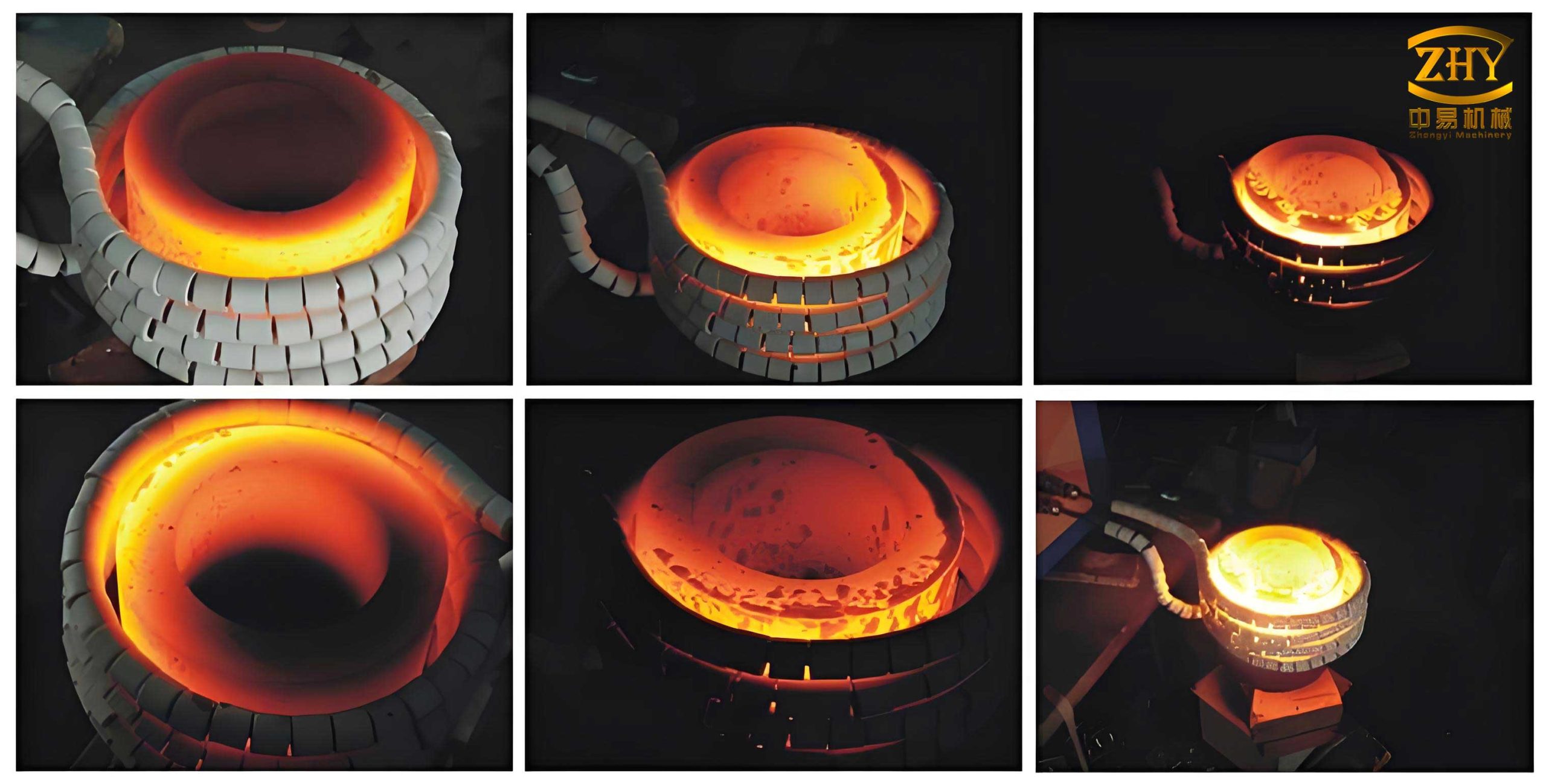
The image above illustrates the scale and complexity involved in the heat treatment of large gears, a process where meticulous control is essential to minimize heat treatment defects. A key innovation in combating distortion-type heat treatment defects in large ring gears is the use of a dedicated process mandrel or support. This tooling is inserted into the bore during the entire heat treatment cycle. Its primary function is to provide a controlled constraint, guiding the inevitable deformation into a more uniform and predictable pattern. The mandrel is often designed with a slight taper or incorporates adjustable elements. This allows it to accommodate the differential expansion between the mandrel material and the gear steel, and more importantly, to prevent the gear from collapsing or ovalizing uncontrollably during quenching. The effectiveness of such a support can be quantified by measuring the reduction in out-of-roundness and lead error post-treatment. Let $D_{nom}$ be the nominal bore diameter, and $D_{max}$, $D_{min}$ be the measured maximum and minimum diameters after treatment. The ovality ($O$), a direct measure of this heat treatment defect, is:
$$O = D_{max} – D_{min}$$
Without support, $O$ can be unacceptably high (e.g., several millimeters), rendering the part unusable. With a properly designed process support, $O$ can be reduced to a manageable level (e.g., a few tenths of a millimeter), which can then be removed in a final boring or honing operation. This practical solution directly targets the root cause of geometric heat treatment defects.
Furthermore, the selection of quenching medium and agitation is a critical decision point to avoid heat treatment defects like soft spots and excessive distortion. The cooling intensity of a quenchant can be characterized by its heat transfer coefficient ($h$). The temperature evolution during quenching can be modeled using the lumped capacitance method or more advanced finite element analysis (FEA). The governing equation for a simplified lumped system is:
$$\frac{dT}{dt} = -\frac{hA}{\rho V c} (T – T_{\infty})$$
where $T$ is the part temperature, $t$ is time, $A$ is surface area, $V$ is volume, $\rho$ is density, $c$ is specific heat, and $T_{\infty}$ is the quenchant temperature. Non-uniform $h$ across the part surface, caused by poor agitation or part orientation, leads to different cooling rates and thus promotes thermal stress and distortion—classic heat treatment defects. Modern CAPP systems can integrate with FEA simulation databases to recommend an optimal quench orientation and agitation scheme for a given part geometry, thereby proactively minimizing these heat treatment defects.
The phenomenon of residual stress, a subsurface heat treatment defect, is particularly insidious because it is not immediately visible. It can be either tensile or compressive. While surface compressive stresses are often desirable for fatigue resistance, subsurface tensile stresses are dangerous. The distribution of residual stress ($\sigma_{rs}(z)$) as a function of depth ($z$) can be complex. A common technique to measure it, like X-ray diffraction, relies on Bragg’s law:
$$n\lambda = 2d\sin\theta$$
where lattice strain causes a shift in the diffraction angle $\theta$, allowing calculation of stress. To counteract harmful tensile stresses from heat treatment defects, processes like shot peening are employed to induce a beneficial compressive layer. The depth of this compressive layer should be greater than the depth of any tensile residual stress zone from quenching to effectively neutralize this heat treatment defect.
In conclusion, the battle against heat treatment defects is multifaceted, requiring a deep understanding of materials science, thermodynamics, and mechanical design. From my perspective, the integration of intelligent process planning systems represents the most robust forward path. These systems allow for the virtual prototyping of the entire manufacturing sequence, including heat treatment, enabling engineers to identify and rectify potential sources of heat treatment defects before any metal is cut or heated. By consistently applying the principles discussed—predictive allowance, strategic process sequencing, controlled constraint via tooling, and optimized quenching parameters—the incidence and severity of heat treatment defects can be dramatically reduced. This leads not only to higher quality and more reliable components but also to significant cost savings by minimizing scrap and rework. Ultimately, mastering the control of heat treatment defects is a cornerstone of advanced, competitive mechanical manufacturing.
The ongoing research in this field focuses on even more precise predictive models. Machine learning algorithms are now being trained on vast datasets of historical manufacturing records, where process parameters are correlated with measured post-treatment distortion and hardness maps. These models aim to predict heat treatment defects with high accuracy for novel geometries. The ultimate goal is a fully autonomous CAPP system that not only generates a process plan but also iteratively simulates the heat treatment outcome, adjusting the plan until the predicted level of heat treatment defects falls below a defined threshold. This represents the next frontier in the relentless pursuit of perfection in manufacturing, where the term ‘heat treatment defects’ becomes a quantifiable risk to be managed algorithmically rather than an inevitable nuisance.