
The planetary roller screw assembly represents a pivotal high-precision transmission component for converting rotary motion into linear motion. Characterized by high power density, superior accuracy, and exceptional reliability, it finds extensive applications in demanding fields such as marine engineering, including propulsion systems, ship control mechanisms, and offshore platform actuators. As performance requirements for load capacity, transmission efficiency, and service life continue to escalate, in-depth research into the static and dynamic behavior of these assemblies becomes increasingly critical. A specific variant, the Differential Planetary Roller Screw (DPRS), offers distinct structural and meshing characteristics compared to the standard design, warranting focused investigation, particularly regarding its load distribution which is fundamental to its承载能力和 longevity.
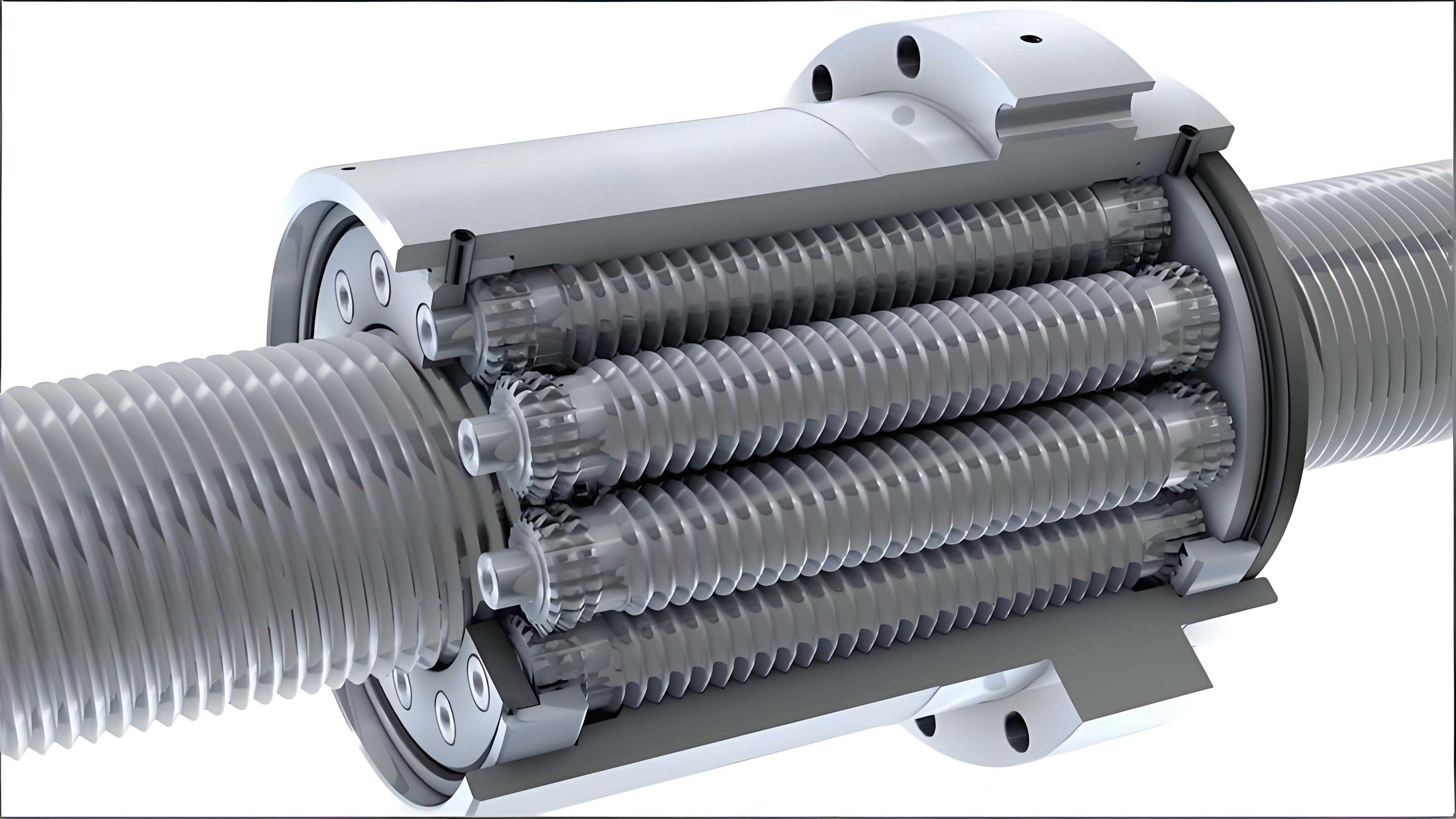
The core function of any planetary roller screw assembly is based on the planetary motion of rollers between a central screw and an outer nut. In the DPRS configuration, the system comprises a central screw, multiple rollers, a nut, and a retainer (or planetary carrier). A key distinguishing feature is the simplification of the gear train; the traditional ring gear is eliminated. The rollers themselves possess a unique three-segment thread profile. The two end segments engage with the screw thread, while the central segment meshes with the nut. Crucially, the central segment of the roller and the nut feature a ring-like groove structure with zero helix angle, while the screw-roller engagement maintains a conventional helical thread. The nominal diameters of these segments follow a specific ratio to ensure a constant and consistent lead during operation. Kinematically, when the screw rotates and the nut is rotationally constrained, the rollers undergo a planetary motion around the screw axis while also translating axially relative to it. The nut and the central segment of the roller remain axially stationary relative to each other.
The meshing characteristics of the DPRS are fundamentally different on the two contact interfaces. The engagement between the screw and the roller is a crossed-axes helical meshing. The thread flanks are in an “interleaved” state, meaning the two contact points on a single thread are not coplanar with the axis shared by the roller and the screw. Conversely, the engagement between the nut and the roller is an “embedded” meshing of ring structures. Contact points are located on opposite flanks of the thread teeth for both interfaces. This asymmetric meshing directly influences the force transmission and resulting load distribution across the multiple contact points in the planetary roller screw assembly.
To model the static load distribution, we begin with a force equilibrium analysis. Assuming an ideal assembly with no manufacturing or mounting errors, and a static axial load \(T\) applied to the screw with the nut fixed, the force balance for the screw-side and nut-side contacts can be established. Let \(m\) be the number of rollers, \(z_S\) the number of engaged threads per roller on the screw side, and \(z_N\) the number of engaged threads per roller on the nut side. The sum of axial force components on all screw-side contact points must equal the total external load, and similarly for the nut-side contacts which react the same load:
$$
\sum_{i=1}^{m \cdot z_S} F_{Sa,i} = T
$$
$$
\sum_{i=1}^{m \cdot z_N} F_{Na,i} = T
$$
Here, \(F_{Sa,i}\) and \(F_{Na,i}\) represent the axial force component at the i-th contact point on the screw and nut side, respectively. Due to the thread geometry, these axial forces are related to the normal contact forces. For the screw-roller interface with helix angle \(\lambda\) and thread profile angle \(\alpha\), the relationships are:
$$
F_{Sa} = F_{Sn} \cos \alpha \cos \lambda, \quad F_{Sr} = F_{Sn} \sin \alpha
$$
where \(F_{Sn}\) is the normal contact force, and \(F_{Sr}\) is its radial component. For the nut-roller interface with zero helix angle, the relations simplify to:
$$
F_{Na} = F_{Nn} \cos \alpha, \quad F_{Nr} = F_{Nn} \sin \alpha
$$
The foundation for calculating load distribution lies in understanding the compliance or stiffness of the entire planetary roller screw assembly. The total axial deflection under load stems from three primary sources: Hertzian contact deformation at the thread interfaces, axial deformation of the load-bearing shaft sections (of the screw, nut, and roller), and structural bending/shearing deformation of the thread teeth themselves. The overall stiffness model is a series-parallel combination of these elements.
The Hertzian contact deflection \(\delta\) for a general point contact is given by:
$$
\delta = \left[ \frac{3}{2} \frac{K(e)}{m_a^{1/2}} \left( \frac{1-\mu_1^2}{E_1} + \frac{1-\mu_2^2}{E_2} \right)^{2/3} \frac{F_a^{2/3}}{(\sum \rho)^{1/3}} \right] \frac{1}{\cos \Phi}
$$
where \(K(e)\) is the first kind elliptic integral, \(m_a\) and \(e\) are parameters related to the contact ellipse, \(\mu\) and \(E\) are Poisson’s ratio and Young’s modulus of the contacting bodies, \(\sum \rho\) is the sum of principal curvatures, \(F_a\) is the axial force at the contact, and \(\Phi\) is the relevant angle (\(\alpha\) for nut side, \(\alpha \cos \lambda\) for screw side). From this, the axial contact stiffness \(K_{c}\) for a specific contact pair can be derived as a function of the contact force:
$$
K_{c, S} = \frac{3 (\sin \alpha \cos \lambda)^{5/3}}{2 K_S} F_{Sa}^{1/3}, \quad K_{c, N} = \frac{3 (\sin \alpha)^{5/3}}{2 K_N} F_{Na}^{1/3}
$$
Here, \(K_S\) and \(K_N\) are contact coefficients consolidating material properties and curvature terms for the screw and nut sides, respectively.
The axial stiffness of the shaft sections (screw, roller, nut) under tension/compression is given by the standard formula:
$$
K_{pa} = \frac{E_p A_p}{L_p}
$$
where \(p\) denotes the component (S, R, N), \(A_p\) is the effective cross-sectional area, and \(L_p\) is the effective length of the loaded segment.
The thread tooth deformation is more complex, encompassing bending (\(\delta_1\)), shear (\(\delta_2\)), tooth root tilt (\(\delta_3\)), tooth base shear (\(\delta_4\)), and radial expansion-induced deformation (\(\delta_5\)). The formulas for these components, based on elastic theory for a cantilever beam model, are summarized below. For a thread tooth loaded with an axial force component \(F_a\):
| Deformation Component | Formula (Simplified Representation) |
|---|---|
| Bending (\(\delta_1\)) | $$ \delta_1 \propto \frac{F_a}{E} \left[ \frac{b^3}{3I} + \frac{a b^2}{2I}(1+2\ln\frac{c}{a}) \right] $$ |
| Shear (\(\delta_2\)) | $$ \delta_2 \propto \frac{F_a}{E} \frac{6}{5} (1+\mu) \frac{b}{A_s} \ln\frac{c}{a} $$ |
| Root Tilt (\(\delta_3\)) | $$ \delta_3 \propto \frac{F_a}{E} \frac{12 c^2}{\pi a^4} \left( 1 + \frac{b}{c} \tan^2 \alpha \right) $$ |
| Base Shear (\(\delta_4\)) | $$ \delta_4 \propto \frac{F_a (1+\mu)}{E} \frac{\ln(C_1)}{A_{base}} $$ |
| Radial Expansion (\(\delta_5\)) | $$ \delta_5 \propto \frac{F_a \mu d_0 \tan \alpha}{E A_{cyl}} $$ |
Where \(a\), \(b\), \(c\) are thread root thickness, pitch line thickness, and tooth top thickness, respectively; \(I\) and \(A_s\) are area moment of inertia and shear area; \(C_1\), \(A_{base}\), \(d_0\), \(A_{cyl}\) are geometry-dependent constants and areas. The total thread tooth axial compliance is the sum \(\delta_{tooth} = \sum_{x=1}^{5} \delta_x\), and its stiffness is \(K_{tooth} = F_a / \delta_{tooth}\).
Building the load distribution model requires applying deformation compatibility conditions along the engaged length. The fundamental principle is that the difference in axial deformation between two adjacent engaged threads must be equal to the axial deformation experienced by the intervening shaft section (including the threaded portion and any non-contact shaft) under the load carried by all threads “inboard” of that section. This leads to an iterative relationship for the axial force on successive threads.
For the planetary roller screw assembly nut side, the model is relatively straightforward as it resembles a stacked series of contacts. The force on the (i-1)-th thread, \(F_{Na, i-1}\), is related to the force on the i-th thread, \(F_{Na, i}\), by:
$$
F_{Na, i-1}^{2/3} = F_{Na, i}^{2/3} + \left( \frac{1}{K_{R,shaft}} + \frac{1}{K_{N,shaft}} + \frac{nP}{\frac{1}{K_{c,N}} + \frac{1}{K_{tooth,N}} + \frac{1}{K_{tooth,R}}} \right) \cdot \frac{\omega_n}{\sin \alpha}
$$
Here, \(K_{R,shaft}\) and \(K_{N,shaft}\) are the axial shaft stiffnesses of the roller and nut segments between threads, \(P\) is the pitch, \(n\) is a summation index, and \(\omega_n\) represents the load increment from the deformation compatibility equation.
The screw side of the DPRS presents a unique challenge due to its segmented roller design. The load distribution on the screw side is influenced not only by the local screw-roller stiffness but also by the deformation state of the central nut-engaged segment of the roller. To account for this cross-coupling effect, an axial segment influence factor, denoted as \(M\), is introduced into the model for the screw-side thread segments that are axially aligned with the nut-roller contact zone. The modified iterative equation for these affected screw-side threads becomes:
$$
F_{Sa, i-1}^{2/3} = F_{Sa, i}^{2/3} + M \cdot \left( \frac{1}{K_{R,shaft}} + \frac{1}{K_{S,shaft}} + \frac{nP}{\frac{1}{K_{c,S}} + \frac{1}{K_{tooth,S}} + \frac{1}{K_{tooth,R}}} \right) \cdot \frac{\omega_n}{\sin \alpha \cos \lambda}
$$
The factor \(M\) (\(>1\)) effectively increases the compliance term, correcting for the additional deflection path through the nut-engaged roller segment, leading to a more accurate prediction of the load distribution on the screw side. This correction is a critical aspect of modeling the differential planetary roller screw assembly.
To analyze the results, a Load Distribution Unevenness Coefficient \(\eta\) is defined for each contact point as the ratio of its load to the average load on that side:
$$
\eta = \frac{L’}{\bar{L’}}
$$
This coefficient clearly visualizes the uniformity of load sharing. Analyses using the model reveal significant trends. First, increasing the number of rollers \(m\), while beneficial for total capacity, worsens load distribution unevenness. The first engaged thread (closest to the load application) carries a disproportionately high load, and this effect amplifies with more rollers. Secondly, increasing the total axial load \(T\) also increases unevenness, but the rate of increase diminishes at higher loads because the contact stiffness, which grows with \(F^{1/3}\), makes the system effectively stiffer and more uniformly loaded. Crucially, in all cases, the load distribution on the screw side is markedly more uneven than on the nut side. This asymmetry arises from the screw’s helix angle, which induces complex force components, and the typically lower bending stiffness of the screw compared to the nut housing.
To validate the theoretical load distribution model for the planetary roller screw assembly, a detailed Finite Element Analysis (FEA) was conducted. A 3D model of a DPRS with key parameters listed in the table below was created. Due to cyclic symmetry, a 60-degree sector (for a 6-roller assembly) was analyzed to reduce computational cost.
| Parameter | Value | Parameter | Value |
|---|---|---|---|
| Screw Pitch, \(P\) | 3 mm | Number of Rollers, \(m\) | 6 |
| Screw Thread Starts | 1 | Thread Profile Angle, \(\alpha\) | 90° |
| Screw Pitch Diameter | 20 mm | Material (Screw/Nut/Roller) | GCr15 Bearing Steel |
| Roller Major Pitch Diameter | 9.3 mm | Young’s Modulus, \(E\) | 207 GPa |
| Roller Minor Pitch Diameter | 7.5 mm | Poisson’s Ratio, \(\mu\) | 0.3 |
| Nut Pitch Diameter | 38.6 mm | Applied Axial Load (Full Model), \(T\) | 18 kN |
The nut was fixed in all degrees of freedom except axial translation, and a concentrated axial force equivalent to 3000 N (18 kN / 6) was applied to the screw end of the sector model. Contact elements were defined between all threaded surfaces. The FEA results showed the expected stress concentration on the first engaged threads. The maximum contact stress occurred on the nut thread, followed by the roller and screw threads. More importantly, the contact force at each thread node could be extracted and converted to an axial force component.
The comparison between the FEA-derived unevenness coefficients and those calculated from the theoretical model (both with and without the influence factor \(M\) for the screw side) is decisive. The results are summarized conceptually below:
| Contact Side | Theoretical Model (No M) | Theoretical Model (With M) | FEA Results |
|---|---|---|---|
| Nut Side | Shows relatively uniform distribution. Closely matches FEA trend. | N/A (M not applied) | Exhibits the most uniform load sharing across threads. |
| Screw Side | Predicts unevenness but underestimates the severity, especially for threads in the central roller segment. | Predicts higher unevenness, showing a steeper load gradient from the first thread. | Shows the highest unevenness. The load gradient is steeper than the basic model but aligns well with the M-corrected model prediction. |
The agreement between the M-corrected model and FEA validates the necessity of the axial segment influence factor \(M\). The remaining minor discrepancies can be attributed to simplifications in the theoretical model, such as assuming perfectly rigid connections at the roller ends and neglecting the constraining effect of the retainer/cage on the rollers, which the FEA model partially captures through boundary conditions.
In conclusion, the load distribution within a differential planetary roller screw assembly is complex and inherently uneven. A robust analytical model must account for the distinct stiffness contributions of Hertzian contact, shaft elasticity, and thread tooth flexure. For the DPRS, the unique three-segment roller design necessitates the introduction of an axial segment influence factor to accurately capture the load coupling between the nut-side and screw-side engagement zones. This model successfully predicts key trends: increased unevenness with more rollers and higher loads, and a consistently more severe load concentration on the screw side compared to the nut side. Finite Element Analysis confirms the model’s validity, highlighting the first engaged thread as the critical point for potential fatigue failure. This comprehensive understanding of load distribution is essential for optimizing the design, improving load capacity, and ensuring the reliability of high-performance differential planetary roller screw assemblies in advanced mechanical systems.