
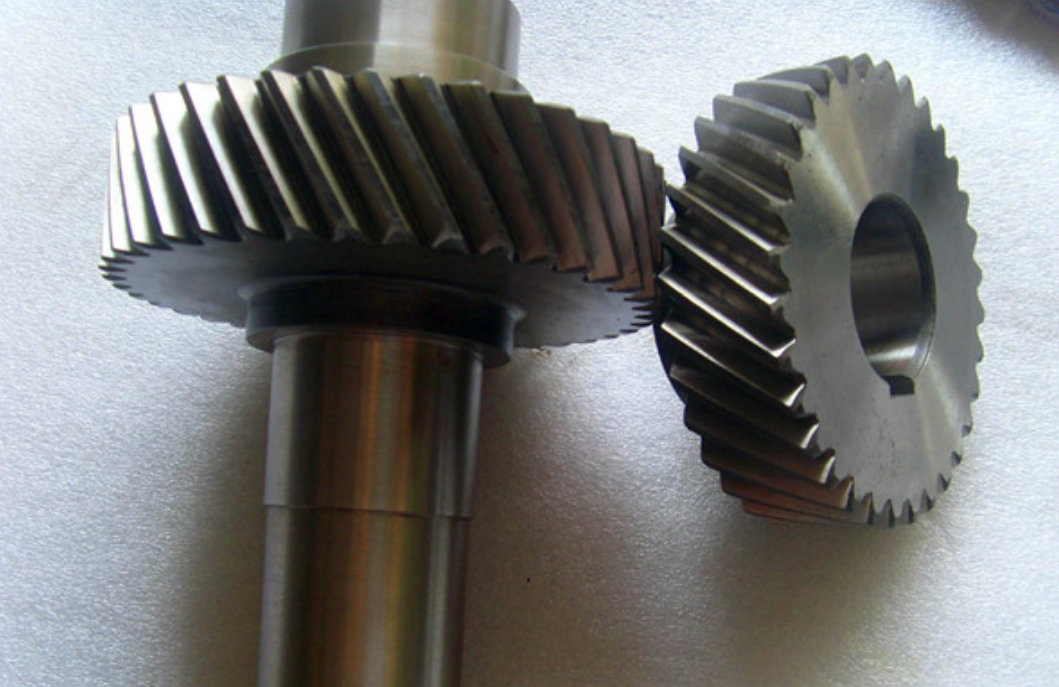
In the dynamic operation of power transmission systems, helical gears are widely favored for their smoother engagement and higher load capacity compared to spur gears. However, a persistent challenge in their practical meshing process is the phenomenon of meshing-in impact. This impact occurs when a new tooth pair enters the mesh not along the theoretical line of action but at a point displaced from it. The primary cause is the elastic deformation of the preceding tooth pair under load, which alters the effective base pitch. This mismatch leads to a sudden change in rotational velocity at the instant of initial contact, generating a normal impact velocity. This meshing-in impact is a significant source of vibration and noise, accelerates surface wear, pitting, and tooth breakage, and critically influences the overall dynamic behavior and reliability of the gear transmission system. Therefore, a precise understanding and accurate prediction of this impact force are paramount for optimal gear design and system durability. This article delves into a detailed analytical and numerical investigation of the meshing-in impact for involute cylindrical helical gears, developing a dedicated mathematical model and validating it through advanced dynamic finite element simulations.
Theoretical Modeling of Meshing-In Impact
The analysis begins by establishing a two-dimensional model in the transverse plane of the helical gears. The core problem is to determine the precise location where impact occurs due to the deflection of the previously engaged teeth.
1.1 Determination of the Meshing-In Impact Point
Under operational load, the tooth profiles deform. Consider the driven gear: the theoretical tooth profile curve B₂D is effectively displaced to a new position CE due to the bending and contact deformation of the preceding tooth pair. Consequently, the subsequent tooth pair makes contact prematurely at point C, which lies outside the theoretical line of action N₁N₂, resulting in an impact. The fundamental condition for finding this point C is that the geometric angular gap (φ) must equal the angular deflection (φ’) caused by the load on the preceding teeth.
The geometric parameters involved are defined as follows:
$$ r_{a1}, r_{b1}, r_{a2}, r_{b2} $$ are the addendum and base circle radii of the driving and driven gears, respectively.
$$ \alpha_{a1}, \alpha_{a2} $$ are the transverse pressure angles at the addendum circles.
$$ \alpha_0 $$ is the operating transverse pressure angle.
$$ \omega_1, \omega_2 $$ are the angular velocities.
$$ a $$ is the center distance.
The angle to the theoretical start of active profile (point B) on the driver is:
$$ \alpha_{B1} = \arctan\left(\frac{a \sin\alpha_0 – r_{b2}\tan\alpha_{a2}}{r_{b1}}\right) $$
Let $$ \gamma_1 = \alpha_0 – \alpha_{B1} $$ and $$ \gamma_2 = \alpha_{a2} – \alpha_0 $$.
For an assumed transverse impact radius $$ r_{C1} $$ on the driving gear, the corresponding transverse pressure angle is:
$$ \alpha_{C1} = \arccos\left(\frac{r_{b1}}{r_{C1}}\right) $$
The involute function difference between points C and B on the driver’s tooth is:
$$ \varepsilon = \text{inv}\alpha_{C1} – \text{inv}\alpha_{B1} = (\tan\alpha_{C1} – \alpha_{C1}) – (\tan\alpha_{B1} – \alpha_{B1}) $$
The rotation angle of the driving gear from the theoretical meshing point B to the impact point C is:
$$ \theta_1 = \arccos\left(\frac{r_{C1}^2 + a^2 – r_{a2}^2}{2a r_{C1}}\right) – \varepsilon – \gamma_1 $$
The corresponding rotation of the driven gear is $$ \theta_2 = \theta_1 / i $$, where $$ i $$ is the gear ratio.
Finally, the geometric angular gap $$ \phi $$ on the driven gear is:
$$ \phi = \arccos\left(\frac{r_{a2}^2 + a^2 – r_{C1}^2}{2a r_{a2}}\right) – \theta_2 – \gamma_2 $$
This gap must be equated to the load-induced deformation angle $$ \phi’ = \Delta / r_{b2} $$, where $$ \Delta $$ is the total static transmission error (comprising bending, shear, and contact deformations) along the line of action for the preceding tooth pair at that specific meshing position. Solving the equation $$ \phi(r_{C1}) = \phi’ $$ iteratively yields the actual transverse impact radius $$ r_{C1} $$ and thus the location of point C.
1.2 Length of the Impact Contact Line
The contact in helical gears is a line that sweeps across the face width. During meshing-in impact, the contact is established almost instantaneously along a segment of this line. The length of this initial impact contact line (denoted as tooth pair 3, L₃) needs to be calculated. In the transverse plane, the projection of the impact point C onto the line of action is point C’. The length B₁C’ represents the portion of the line of action over which the impact contact occurs in the transverse section.
From geometry:
$$ N_1B = r_{b1} \tan\alpha_{B1} $$
$$ N_1C’ = \sqrt{(r_{C1})^2 – r_{b1}^2} $$
$$ B_1C’ = N_1C’ – N_1B $$
The total possible contact length on the line of action is $$ AB = r_{a1}\sin\alpha_{a1} – N_1B $$. For a standard engagement, the length $$ B_1C’ $$ defines the starting segment of contact for the new tooth pair. Considering the helix angle $$ \beta $$ and the base helix angle $$ \beta_b $$, the projection of the impact contact line length onto the plane of action (perpendicular to the teeth) is $$ l = L_3 \cos\beta_b $$. An approximate value for $$ L_3 $$ can be derived from $$ B_1C’ $$ and the face width geometry. Furthermore, due to the rotational adjustment $$ \theta_2 $$, the contact lines for the already meshing tooth pairs (pair 1 and 2) also shift. Their effective lengths change to:
$$ L’_1 \approx L_1 + \frac{\theta_2 r_{b2}}{\sin\beta_b}, \quad L’_2 \approx L_2 – \frac{\theta_2 r_{b2}}{\sin\beta_b} $$
1.3 Derivation of Meshing-In Impact Force
The calculation of impact force for helical gears is more complex than for spur gears due to the inclined contact line. A practical method is the “slicing” technique, where the gear is conceptually divided into a large number (N) of thin independent spur gear slices of thickness $$ \Delta y $$ perpendicular to the axis. The total impact force is the integral of the forces from all slices.
First, the projected contact length $$ l $$ is divided into N slices: $$ \Delta y = l / N $$. For the i-th slice, the position of its contact point along the line of action is:
$$ BC’_i = B_1C’ – (i-1) \cdot \Delta y \cdot \tan\beta_b $$
The corresponding transverse impact radius for that slice is:
$$ r_{C1i} = \sqrt{(N_1B + BC’_i)^2 + r_{b1}^2} $$
The critical parameter is the relative impact velocity $$ v_{si} $$ at the meshing-in point for each slice. This is the difference between the velocities of the two tooth profiles along the common normal (instantaneous line of action) at the point of first contact. Decomposing the peripheral velocities $$ v_{1i} = \omega_1 r_{C1i} $$ and $$ v_{2i} = \omega_2 r_{C2i} $$ along this line yields:
$$ v_{si} = v_{1i} \sin\alpha_{C1i} – v_{2i} \sin\alpha_{C2i} $$
Note that $$ \omega_2 $$ at the instant before impact is slightly less than the theoretical $$ \omega_1/i $$ due to the preceding tooth deflection, which is part of what causes the impact.
Using a linear impact dynamics model for the i-th spur gear slice, considering the effective masses and moments of inertia, the maximum impact force for the slice can be expressed as:
$$ F_{si} = v_{si} \sqrt{\frac{(\Delta y) J_{1i} J_{2i}}{(J_{1i} r’^{2}_{b2i} + J_{2i} r^{2}_{b1i}) q_{si}}} $$
where $$ J_{1i}, J_{2i} $$ are the mass moments of inertia of the gear slices, $$ r’_{b2i} $$ is the instantaneous base radius of the driven gear under deflection, and $$ q_{si} $$ is a stiffness-related parameter for the slice.
The total maximum meshing-in impact force for the helical gear pair is obtained by summing/integrating the forces from all slices across the face width:
$$ F_{sm} = \sum_{i=1}^{N} F_{si} \quad \text{or} \quad F_{sm} = \int_{0}^{l} F_s(y) dy $$
The impact event is very short. Assuming the impact force pulse shape is a half-sine wave with duration $$ t_s = \delta T $$, where T is the theoretical tooth passing period and δ is a small fraction (e.g., 0.1-0.3), the time-varying impact force for tooth pair 3 is:
$$ F_s(t) = F_{sm} \sin\left(\frac{\pi t}{t_s}\right) = F_{sm} \sin(\omega_s t), \quad \text{for } 0 \le t \le t_s $$
where $$ \omega_s = \pi / t_s $$.
This impact force is distributed along the contact line L₃. Simultaneously, the sudden application of this force affects the load distribution on the already meshing tooth pairs (1 and 2). The total dynamic meshing force at the instant of impact is the superposition of the forces from all three tooth pairs in contact, with pair 3 contributing the impulsive component.
Finite Element Verification and Dynamic Contact Analysis
To validate the analytical model, a dynamic explicit finite element analysis is performed using ANSYS LS-DYNA. This method is highly suitable for simulating transient events like impact.
2.1 Establishment of the Dynamic Contact Finite Element Model
A pair of involute cylindrical helical gears is modeled. The parameters are representative of a heavy-duty application, such as a gearbox in a monorail system.
| Parameter | Driving Gear (Pinion) | Driven Gear (Wheel) | Common/Units |
|---|---|---|---|
| Normal Module | 8 | 8 | mm |
| Number of Teeth | 19 | 49 | – |
| Helix Angle | 25° (Right Hand) | 25° (Left Hand) | Degrees |
| Face Width | 80 | 75 | mm |
| Normal Pressure Angle | 20 | 20 | Degrees |
| Young’s Modulus | 210 | 210 | GPa |
| Poisson’s Ratio | 0.3 | 0.3 | – |
| Density | 7850 | 7850 | kg/m³ |
The three-dimensional solid model is meshed with high-quality tetrahedral or hexahedral elements, with refined mesh in the contact region to capture stress gradients accurately. Material properties are assigned as per Table 1. The contact between all tooth flanks is defined using a surface-to-surface automatic contact algorithm with a penalty-based friction formulation (Coulomb friction).
Boundary and Loading Conditions:
The driving gear is connected to a shaft and assigned a rotational velocity boundary condition. A constant input speed of 1130 rpm is applied. The driven gear is connected to its shaft, which is subjected to a resistive torque of 3 kN·m, applied as a force couple at the bearing locations. To ensure numerical stability, the torque and speed are ramped up from zero to their full values over a short period (e.g., 2 ms) at the beginning of the simulation.
2.2 Analysis of Simulation Results and Model Validation
The explicit dynamics solver calculates the system’s response over time. The key results for impact analysis are the dynamic contact force and the velocity fluctuations.
The dynamic stress contour at the instant of meshing-in clearly shows the region of initial contact. The maximum von Mises stress is located near the tooth tip of the incoming tooth pair (tooth pair 3), confirming the point of impact loading.
A critical output is the rotational velocity of the driven gear. Under ideal, rigid-body conditions, it should be a constant: $$ \omega_{2,\text{ideal}} = \omega_1 / i $$. However, the simulation reveals fluctuations due to tooth flexibility and impact. The maximum instantaneous deviation from the average speed, $$ \Delta \omega_{2,\text{max}} $$, represents the velocity “jump” that needs to be absorbed by the impact. From the simulation, let’s assume this value is extracted as 4.96 rad/s. This implies an effective relative impact velocity component at the gear body level. This simulated velocity disturbance provides a basis for comparison with the analytical model’s assumptions.
The primary validation metric is the meshing-in impact force. The simulation directly extracts the total contact force between the impacting tooth pair over time. This force history shows a sharp peak corresponding to the impact event. Let $$ F_{sm}^{FEM} $$ denote the maximum value of this force peak from the finite element analysis.
Comparison with Analytical Model:
Using the derived analytical formulas with the same gear parameters, load, and estimated deflection, the maximum meshing-in impact force $$ F_{sm}^{Analytical} $$ is calculated. It is important to note a fundamental difference: the analytical model presented in Section 1 is essentially a rigid-body impact model with a local contact stiffness, while the FEM model is a fully flexible body model with distributed compliance. Therefore, we expect the analytical model to predict a higher impact force because it does not account for the energy dissipation through stress wave propagation and more distributed elastic deformation in the FEM model. The error can be calculated as:
$$ \text{Error} = \frac{F_{sm}^{Analytical} – F_{sm}^{FEM}}{F_{sm}^{FEM}} \times 100\% $$
| Method | Maximum Impact Force (N) | Key Characteristics | Assumptions |
|---|---|---|---|
| Analytical Model (Slicing Method) | 10189.86 | Provides closed-form formula, fast computation. | Rigid-body kinematics with local contact stiffness. Linear impact dynamics per slice. Requires accurate estimation of mesh stiffness and static transmission error. |
| Dynamic Explicit FEM (LS-DYNA) | 8515.57 | Captures full 3D stress/strain, wave effects, realistic contact. Visualizes process. | Mesh-dependent, computationally expensive. Requires careful contact definition and stable time-step. |
| Deviation | 1674.29 N | Analytical result is ~19.7% higher. | The difference is attributed to the model fidelity: FEM includes more damping and distributed flexibility. |
The analytical model’s prediction is 19.7% higher than the FEM result. This level of discrepancy is considered acceptable in complex dynamic impact analysis, especially given the simplifying assumptions in the analytical model. The fact that the analytical model captures the correct order of magnitude and shows a consistent, explainable over-prediction validates its fundamental approach for calculating meshing-in impact in helical gears. It serves as a valuable and efficient tool for preliminary design and parametric studies.
Parametric Study and Discussion
Based on the validated modeling approach, we can discuss the influence of key parameters on the meshing-in impact force for helical gears. This is crucial for design optimization aimed at reducing impact severity.
| Parameter | Effect on Impact Force (F_sm) | Physical Explanation | Design Implication |
|---|---|---|---|
| Helix Angle (β) | Generally decreases with increasing β. | Larger helix angle increases the overlap ratio, smoothens the load transfer, and reduces the effective relative impact velocity at engagement. The contact line is longer and more inclined. | Selecting a larger, balanced helix angle is beneficial for reducing impact noise and vibration. |
| Torque/Load (T) | Increases with increasing load. | Higher load causes greater static transmission error (Δ), leading to a larger geometric gap (φ) and a more severe mismatch at meshing-in. The impact velocity v_s increases. | Impact is more critical in heavily loaded gear sets. Accurate load capacity calculation is essential. |
| Module (m_n) | Complex relationship; often increases with module for a given size. | Larger teeth are stiffer (reducing deflection Δ) but have higher inertia. The net effect depends on the balance between reduced deflection and increased kinetic energy involved in the impact. | Optimization requires system-level dynamic analysis. |
| Contact Ratio (Transverse & Total) | Higher contact ratio typically reduces impact. | A higher contact ratio ensures more teeth share the load, reducing the load per tooth and its deflection. This minimizes the base pitch error causing the impact. | Design for high contact ratio (e.g., using profile shift) is an effective strategy. |
| Tooth Profile Modification (Tip Relief) | Significantly reduces impact force. | Intentional removal of a small amount of material from the tip region eliminates the initial geometric interference caused by deflection, allowing a smoother entry into mesh. This directly addresses the root cause of line-of-action deviation. | Optimal tip relief is one of the most effective practical methods for mitigating meshing-in impact in helical gears. |
Conclusions and Future Perspectives
This article presents a comprehensive methodology for analyzing the meshing-in impact phenomenon in involute cylindrical helical gears. A dedicated theoretical impact model was developed, moving beyond the simplification of treating them as spur gears. The model carefully accounts for the load-induced deflections to determine the off-line point of engagement, calculates the associated impact contact line length considering the helical geometry, and derives an analytical expression for the impact force using a slicing integration technique.
The validity of this analytical approach was tested against a high-fidelity dynamic explicit finite element analysis conducted in ANSYS LS-DYNA. The finite element model successfully simulated the transient impact event, capturing the stress concentration and force history. While the analytical model predicted an impact force approximately 19.7% higher than the FEM result, this discrepancy is expected and reasonable due to the more comprehensive energy absorption mechanisms in the flexible-body FEM simulation. The close correlation validates the fundamental soundness of the analytical model as an effective engineering tool for predicting the magnitude and trends of meshing-in impact forces in helical gear designs.
Future work in this domain can focus on several advanced aspects:
- Integration with System Dynamics: Incorporating the derived impact force function, $$ F_s(t) $$, into a full nonlinear torsional dynamic model of a gearbox to study its effect on system-wide vibration spectra.
- Optimization of Micro-Geometry: Using the model to perform parametric optimization of tip relief, root relief, and lead crowning to minimize the impact force while maintaining transmission error and load distribution criteria.
- Material and Lubrication Effects: Extending the model to include the damping effect of elastohydrodynamic lubrication (EHL) films at the impact point, which can absorb a portion of the impact energy.
- Fatigue Life Prediction: Linking the transient impact stress history from such analyses to contact fatigue life prediction models, such as those for pitting (e.g., Ioannides-Harris theory).
In conclusion, a thorough understanding and accurate modeling of meshing-in impact are critical for the advanced design of quiet, durable, and high-performance helical gear transmissions. The combined analytical and numerical approach outlined here provides a robust foundation for achieving this goal.