
In the field of mechanical engineering, gear shafts are critical components that transmit torque and motion in various machinery, such as reducers, turbines, and automotive systems. The integrity of a gear shaft is paramount for operational safety and efficiency. However, failures like cracks at the tooth root can lead to catastrophic breakdowns, resulting in downtime and economic losses. In this analysis, I will delve into a detailed investigation of crack formation in a gear shaft, focusing on root cracks observed in a large reducer gear shaft. The initial suspicion pointed toward forging stock quality, but through rigorous testing and examination, the root cause was identified as improper heat treatment. This article presents a first-person perspective on the analytical process, incorporating extensive data, tables, and formulas to elucidate the mechanisms behind crack initiation and propagation. The keyword “gear shaft” will be emphasized throughout to highlight its centrality in this study.
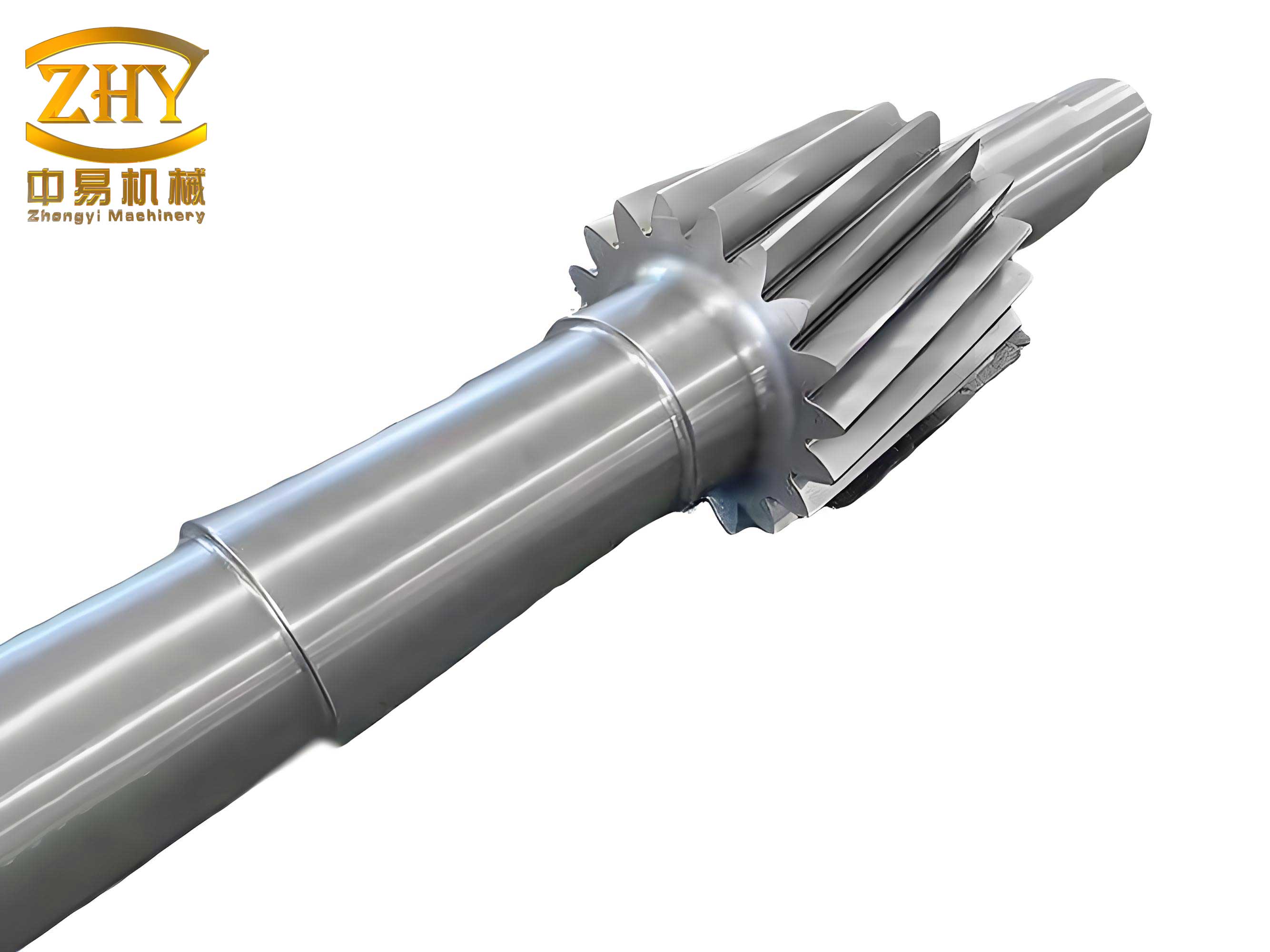
The gear shaft in question was manufactured for a heavy-duty reducer application, with the material specified as 42CrMo steel in the forging stock. During post-production inspection, cracks were detected at the tooth root region, raising concerns about potential material defects. As part of a quality assessment team, I conducted a multi-faceted analysis to determine the origin of these cracks. The approach included macroscopic examination, chemical composition analysis, microstructural evaluation, scanning electron microscopy (SEM), and mechanical property testing. Each step was crucial in building a comprehensive understanding of the failure mode. Gear shafts, due to their complex geometry and loading conditions, are prone to stress concentrations at root fillets, making them susceptible to crack initiation under improper processing conditions. This analysis aims to underscore the importance of controlled manufacturing processes, particularly heat treatment, in ensuring the durability of gear shafts.
Macroscopic observations revealed that the cracks were predominantly located at the R-angle (fillet) of the tooth root, appearing as discontinuous lines along the shaft’s length. The cracks measured approximately 200–300 mm in length, with a narrow opening, and extended inward to depths of up to 15 mm upon cross-sectional examination. The gear shaft’s mating surfaces showed no signs of excessive wear or overloading, indicating that operational stresses were not the primary driver of failure. Fracture surfaces, when exposed, exhibited a flat and fine texture near the root surface, transitioning to a rougher morphology inward. Crack propagation markings suggested that initiation occurred at the surface and progressed inward, with the overall appearance being dull and slightly oxidized, lacking significant plastic deformation. This macroscopic evidence pointed toward a manufacturing-related issue rather than service-induced damage, prompting further investigation into the material and processing history of the gear shaft.
To rule out material incompliance, chemical composition analysis was performed using spectroscopy. The results, summarized in Table 1, confirmed that the gear shaft conformed to the 42CrMo steel specifications per standard JB/T6396-2006. This eliminated forging stock quality as a direct cause, shifting focus to subsequent processing steps. Gear shafts often undergo heat treatment to achieve desired surface hardness and core toughness, and any deviation in these processes can introduce detrimental microstructural features.
| Element | Measured Value | Standard Requirement for 42CrMo |
|---|---|---|
| C | 0.41 | 0.38–0.45 |
| Si | 0.24 | 0.17–0.37 |
| Mn | 0.68 | 0.50–0.80 |
| P | 0.013 | ≤0.035 |
| S | 0.002 | ≤0.035 |
| Cr | 0.98 | 0.90–1.20 |
| Mo | 0.18 | 0.15–0.30 |
Microstructural analysis provided critical insights into the crack origins. Samples were sectioned from the tooth root region, polished, and etched to reveal the grain structure. The gear shaft had undergone surface hardening, resulting in a hardened layer at the root surface. The microstructure varied from surface to core: the surface layer consisted of martensite, indicative of rapid cooling during quenching; the subsurface region showed a mix of ferrite, martensite, and pearlite, with partial Widmannstatten structure characteristics; and the core exhibited a ferrite-pearlite matrix, typical of normalized or tempered states. The Widmannstatten structure, characterized by acicular ferrite formations, is often associated with overheating or improper cooling rates during heat treatment. In gear shafts, such structures can reduce toughness and promote crack initiation due to increased brittleness.
The cracks were observed to initiate precisely at the R-angle, propagating inward in a discontinuous manner. At the interface between the surface and subsurface layers, crack paths showed offset features, suggesting the presence of high residual stresses. Notably, the crack edges displayed no oxidation or decarburization, ruling out forging defects that typically involve high-temperature exposure. The microstructural uniformity around the cracks, including the Widmannstatten features, indicated that the cracking occurred after heat treatment, likely during cooling or subsequent handling. This aligns with the theory that thermal gradients and transformation stresses in gear shafts can lead to crack formation if not properly managed.
Scanning electron microscopy (SEM) was employed to examine the fracture surfaces in detail. The crack initiation zones exhibited intergranular fracture patterns, where cracks propagated along grain boundaries. This mode of failure is common in materials subjected to high thermal stresses or embrittlement. In contrast, the crack propagation regions showed predominantly cleavage fracture, with river markings indicative of brittle failure. Localized areas contained dimple patterns and quasi-cleavage features, along with secondary cracks. These SEM observations further support the absence of fatigue or corrosion mechanisms, focusing attention on thermal processing flaws. The interplay between microstructure and stress in gear shafts can be modeled using fracture mechanics principles. For instance, the stress intensity factor \(K\) for a surface crack in a gear shaft tooth root can be approximated as:
$$ K = Y \sigma \sqrt{\pi a} $$
where \(Y\) is a geometric factor dependent on the crack and component shape, \(\sigma\) is the applied stress, and \(a\) is the crack depth. In this case, residual stresses from heat treatment likely contributed to \(\sigma\), driving crack growth even under nominal loads.
Mechanical property testing was conducted to assess the gear shaft’s compliance with design specifications. Tensile, impact, and hardness tests were performed on samples extracted from the core and surface regions. The results, presented in Table 2, demonstrate that the gear shaft met the required mechanical properties for 42CrMo steel in a quenched and tempered condition. The surface hardness values aligned with specifications for case hardening, while the core hardness indicated proper tempering. However, the presence of cracks despite adequate properties underscores the role of microstructural anomalies, such as Widmannstatten structure, in compromising integrity. Gear shafts must balance surface hardness for wear resistance with core toughness for load-bearing capacity, and heat treatment deviations can disrupt this balance.
| Property | Measured Value | Standard Requirement (Quenched & Tempered) | Drawing Specification |
|---|---|---|---|
| Yield Strength, \(\sigma_s\) (MPa) | 425, 455, 420 | ≥390 | — |
| Tensile Strength, \(\sigma_b\) (MPa) | 775, 790, 760 | ≥590 | — |
| Elongation, \(\delta\) (%) | 44.5, 40.5, 41.5 | ≥16 | — |
| Surface Hardness (HRC) | 49.0, 51.0, 48.5 | — | 45–52 |
| Core Hardness (HBS) | 255, 266, 255 | — | 229–269 |
To further analyze the heat treatment effect, consider the cooling rate during quenching, which influences phase transformations. The formation of Widmannstatten structure is often linked to moderate cooling rates that allow for sideplate ferrite growth. The time-temperature-transformation (TTT) diagram for 42CrMo steel can be used to predict microstructural outcomes. For instance, the critical cooling rate \(V_c\) to avoid undesirable structures can be expressed as:
$$ V_c = \frac{T_A – T_M}{t_s} $$
where \(T_A\) is the austenitizing temperature, \(T_M\) is the martensite start temperature, and \(t_s\) is the time spent in the sensitive temperature range. If the actual cooling rate \(V\) falls below \(V_c\), structures like Widmannstatten ferrite may form. In this gear shaft, improper cooling likely resulted in \(V < V_c\) in subsurface regions, leading to embrittlement. The heat treatment process for gear shafts typically involves austenitizing, quenching, and tempering, with precise control over temperatures and times to achieve optimal properties. Deviations, such as uneven heating or cooling, can introduce thermal stresses that, when combined with transformational stresses, exceed the material’s fracture toughness.
The comprehensive analysis converges on heat treatment as the root cause of crack formation. The absence of oxidation at crack edges rules out forging defects, while the intergranular and cleavage fracture modes exclude service-related fatigue or corrosion. The Widmannstatten structure in the subsurface layer is a direct indicator of thermal processing issues. In gear shafts, the tooth root is a stress concentration zone, and any microstructural weakness can act as a crack initiator. Residual stresses from quenching, compounded by phase transformation volumes, can create tensile stresses at the surface, driving crack propagation. This is particularly critical in gear shafts where dynamic loads are present, but in this case, the cracks formed prior to service.
To mitigate such failures, heat treatment parameters must be optimized. For 42CrMo gear shafts, recommended practices include controlled austenitizing at 850–870°C, followed by oil quenching to achieve a uniform cooling rate, and tempering at 550–600°C to relieve stresses. Computational models can aid in predicting temperature distributions and stress fields during heat treatment. For example, the heat conduction equation for a gear shaft during quenching can be written as:
$$ \frac{\partial T}{\partial t} = \alpha \nabla^2 T $$
where \(T\) is temperature, \(t\) is time, and \(\alpha\) is thermal diffusivity. Solving this with boundary conditions for cooling media can help design processes that minimize thermal gradients. Additionally, non-destructive testing (NDT) methods, such as ultrasonic or magnetic particle inspection, should be employed post-heat treatment to detect subsurface flaws in gear shafts before they enter service.
In conclusion, the crack formation at the tooth root of this gear shaft was attributable to improper heat treatment, which induced Widmannstatten structure and residual stresses, leading to brittle fracture initiation. The gear shaft’s material composition and mechanical properties were compliant, highlighting that processing controls are as crucial as material selection. This analysis underscores the need for stringent quality assurance in manufacturing gear shafts, especially for high-stress applications. Future work could involve finite element analysis to simulate heat treatment effects on gear shaft performance, or advanced metallurgical studies to optimize microstructures. Gear shafts remain pivotal components in machinery, and their reliability hinges on integrated design, material science, and processing expertise.
Expanding on this, let’s consider the broader implications for gear shaft design and maintenance. Gear shafts are often subjected to cyclic loading, which can exacerbate pre-existing cracks. The Paris’ law for fatigue crack growth is relevant here:
$$ \frac{da}{dN} = C (\Delta K)^m $$
where \(da/dN\) is the crack growth per cycle, \(C\) and \(m\) are material constants, and \(\Delta K\) is the stress intensity factor range. In this gear shaft, if cracks had gone undetected, they could have propagated under operational loads, leading to fatigue failure. Therefore, understanding the initial crack mechanism is vital for preventive maintenance. Gear shafts in reducers, for instance, experience torsional and bending stresses, making root regions critical for design. The bending stress \(\sigma_b\) at a gear tooth root can be calculated using the Lewis formula:
$$ \sigma_b = \frac{W_t}{F m Y} $$
where \(W_t\) is the tangential load, \(F\) is face width, \(m\) is module, and \(Y\) is the Lewis form factor. Combining this with residual stresses from heat treatment can result in equivalent stresses that exceed the material’s yield strength, initiating cracks.
Moreover, the role of alloying elements in 42CrMo steel for gear shafts deserves attention. Chromium and molybdenum enhance hardenability and temper resistance, but they also influence phase transformation kinetics. The ideal microstructure for a gear shaft is tempered martensite in the core and a hardened case, providing a good balance of strength and toughness. Deviations, such as the formation of upper bainite or Widmannstatten ferrite, can reduce impact resistance. This can be quantified using hardness conversions; for example, the relationship between hardness and tensile strength for steel is often approximated as:
$$ \sigma_b \approx 3.45 \times \text{HB} $$
where HB is Brinell hardness. In this gear shaft, the core hardness of ~255 HBS translates to a tensile strength of ~880 MPa, which is consistent with the measured values. However, microstructural inhomogeneities can lead to localized weakness, not captured by bulk properties.
To prevent such issues, statistical process control (SPC) in heat treatment is essential. Monitoring parameters like furnace temperature, quenching medium temperature, and agitation can reduce variability. For gear shafts, especially large ones, differential cooling can cause distortion and stress, so techniques like press quenching or induction hardening might be alternatives. Additionally, post-heat treatment inspections should include microstructural analysis to detect anomalies like Widmannstatten structure early on.
In summary, this analysis of gear shaft crack formation demonstrates the interplay between material properties, processing, and design. Gear shafts are complex components where failures can have significant repercussions. By integrating metallurgical analysis with engineering principles, we can enhance the reliability and lifespan of gear shafts in demanding applications. The key takeaway is that heat treatment must be meticulously controlled to avoid microstructural defects that compromise performance. As technology advances, simulation tools and real-time monitoring could further optimize gear shaft manufacturing, ensuring they meet the rigorous standards of modern industry.