
In my years of engineering practice, I have often encountered the challenges associated with designing and inspecting straight bevel gears. These components are crucial in transmitting power between intersecting shafts, typically at a 90-degree angle, and their precision directly impacts the efficiency and noise levels of mechanical systems. The traditional method of measuring chordal tooth thickness on the back cone is prone to errors due to reliance on the apex as a datum. This article presents a detailed, first-person perspective on an alternative approach: the measurement of the common normal length, or “span measurement,” for straight bevel gears. This method, derived from spherical involute geometry, offers superior accuracy and repeatability. I will delve into the fundamental geometry, derive the necessary formulas, and provide practical guidance for implementation, all while emphasizing the unique properties of straight bevel gears.
The core of this analysis lies in understanding the tooth flank of a straight bevel gear. Unlike cylindrical gears where the involute is planar, the tooth profile of a straight bevel gear is a spherical involute. Imagine a plane rolling without slip on a base cone. Any point on this plane, maintaining a constant distance from the cone’s apex, traces a curve on a sphere centered at that apex. This curve is the spherical involute. The entire tooth flank is a surface generated by a family of these spherical involutes radiating from the apex. For analysis, we focus on the spherical involute at the gear’s large end, which lies on what I will term the “back sphere”—a conceptual spherical surface that later simplifies to the practical back cone.
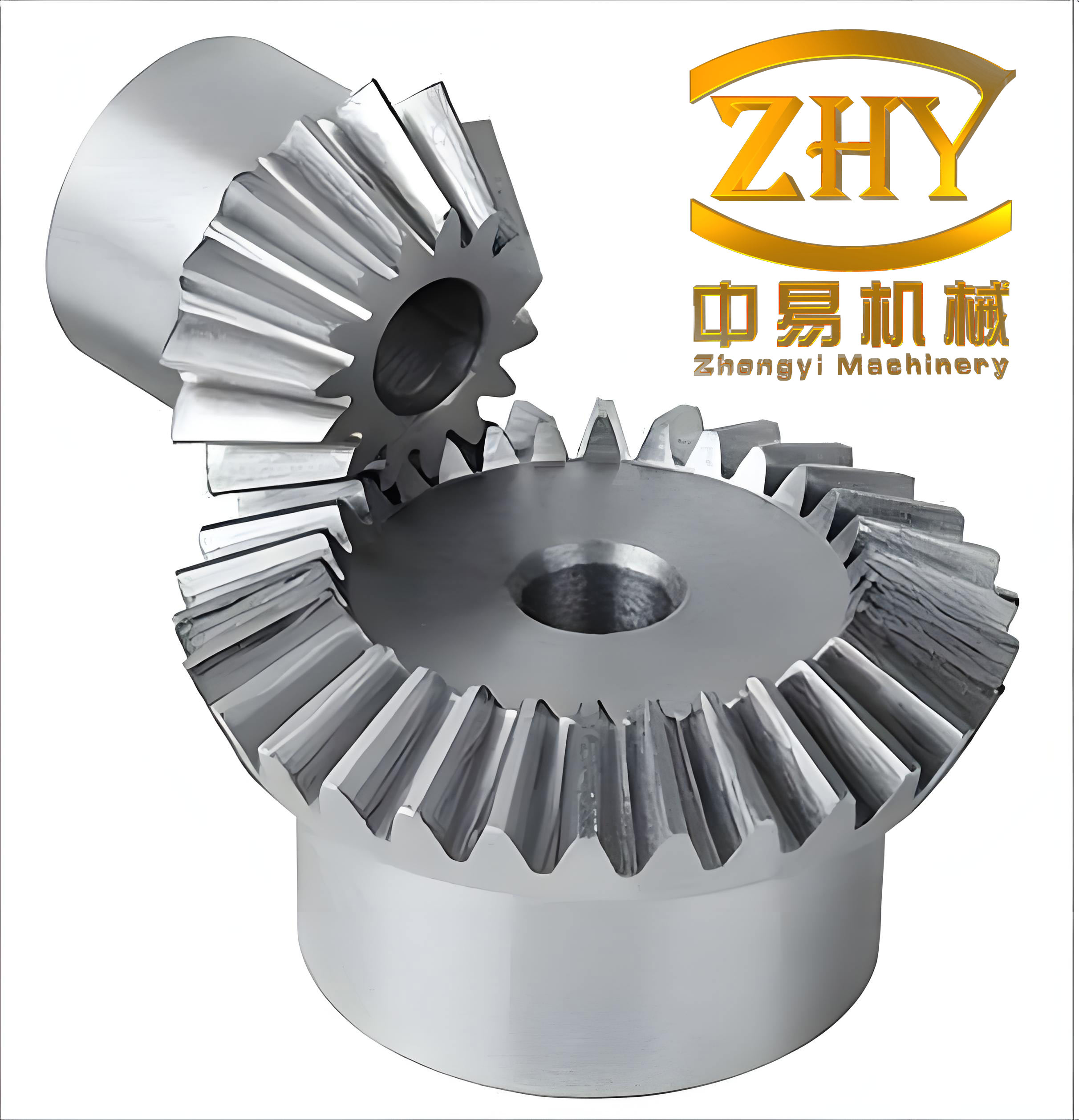
To establish the geometry, we start with the design parameters of a straight bevel gear: the number of teeth \(z\), module \(m\) at the large end, pitch cone angle \(\delta\), and pressure angle \(\alpha\). The pitch circle radius at the large end is \(R = m z / 2\). The base cone, from which the spherical involute unwinds, is defined by its angle \(\delta_b\) and the base circle radius \(r_b\) on the back sphere. Through spherical trigonometric relationships, I have derived the following fundamental formulas:
The base cone angle is given by:
$$ \delta_b = \arcsin(\cos \alpha \cdot \sin \delta) $$
The base circle radius on the back sphere is:
$$ r_b = R \cos \alpha $$
These parameters are the foundation for all subsequent calculations related to straight bevel gears. The spherical involute itself can be described parametrically. Let us define a coordinate system with the apex at the origin and the gear axis along the Z-axis. A point on the spherical involute at the back sphere (radius \(R\)) can be expressed using an unwinding angle parameter \(\theta\). After derivation, the coordinates \((x, y, z)\) are:
$$ x = R \sin \delta_b \cos \theta + R \theta \cos \delta_b \sin \delta_b \sin \theta $$
$$ y = R \sin \delta_b \sin \theta – R \theta \cos \delta_b \sin \delta_b \cos \theta $$
$$ z = R \cos \delta_b – R \theta \sin^2 \delta_b $$
This parametric description, while complex, is essential for understanding the true shape of the tooth flank on straight bevel gears. A more compact and useful concept is the spherical involute function, denoted as \(\text{inv}_s(\zeta, \delta_b)\), which generalizes the planar involute function to the sphere. For a point on the spherical involute at cone angle \(\zeta\), the function relates the azimuthal angle on the base circle plane. It is defined as:
$$ \text{inv}_s(\zeta, \delta_b) = \tan \delta_b \cdot (\cos^{-1}(\frac{\cos \delta_b}{\cos \zeta}) – \sqrt{\tan^2 \zeta – \tan^2 \delta_b}) $$
At the pitch cone (\(\zeta = \delta\)), this function becomes a characteristic parameter for the straight bevel gear, analogous to the involute function in cylindrical gears. For practical calculations, an approximate form with sufficient accuracy is:
$$ \text{inv}_s(\delta, \delta_b) \approx \tan \alpha – \alpha + \frac{\tan^2 \delta_b}{3} (\tan \alpha – \alpha)^3 $$
The measurement of the common normal length hinges on the concept of the “common tangent dihedral angle.” Consider two opposite tooth flanks of a straight bevel gear. There exists a plane that is common normal to both flanks—the common normal plane. The dihedral angle formed by the two planes tangent to the flanks along lines from the apex, with its edge perpendicular to the common normal plane, is the common tangent dihedral angle, \(2\psi_0\). This angle is central to calculating the span measurement. Through geometric construction and using the spherical involute function, I have derived its value:
$$ \psi_0 = \frac{\pi}{2z} + \text{inv}_s(\delta, \delta_b) + \frac{2x \tan \alpha}{z} $$
Here, \(x\) is the profile shift coefficient (often zero for standard straight bevel gears). The term \(\frac{\pi}{2z}\) is half the angular tooth thickness at the base circle on the base plane. The number of teeth spanned, \(n\), must be chosen appropriately. For straight bevel gears, an empirical formula based on cylindrical gear analogies and adjusted for the cone angle is:
$$ n \approx \frac{z \cdot \alpha}{180^\circ} \cdot \frac{\cos \delta_b}{\cos \delta} + 0.5 $$
This value should be rounded to the nearest integer. The following table summarizes key formulas for the geometry of straight bevel gears:
| Parameter | Symbol | Formula |
|---|---|---|
| Pitch Circle Radius | \(R\) | \(R = \frac{m z}{2}\) |
| Base Cone Angle | \(\delta_b\) | \(\delta_b = \arcsin(\cos \alpha \sin \delta)\) |
| Base Circle Radius | \(r_b\) | \(r_b = R \cos \alpha\) |
| Spherical Involute Function (approx.) | \(\text{inv}_s(\delta, \delta_b)\) | \(\approx \tan \alpha – \alpha + \frac{\tan^2 \delta_b}{3}(\tan \alpha – \alpha)^3\) |
| Common Tangent Dihedral Angle (half) | \(\psi_0\) | \(\psi_0 = \frac{\pi}{2z} + \text{inv}_s(\delta, \delta_b) + \frac{2x \tan \alpha}{z}\) |
| Span Number of Teeth | \(n\) | \(n \approx \frac{z \alpha}{180^\circ} \cdot \frac{\cos \delta_b}{\cos \delta} + 0.5\) |
Now, let’s address the core measurement: the common normal length, or span measurement, denoted as \(W\). On the theoretical back sphere, the common normal length \(W_0\) between two opposite flanks is simply the chordal distance subtended by the angle \(2\psi_0\) on the base circle of radius \(r_b\). However, straight bevel gears are manufactured with a back cone—a conical surface tangent to the back sphere at the pitch circle—for ease of production. The measurement is actually taken on this back cone. Therefore, a correction is needed to convert the back sphere measurement to the back cone measurement. After a detailed derivation involving series expansion and maximizing the coordinate along the gear axis, I arrived at the following practical formula:
$$ W = W_0 + \Delta W $$
Where \(W_0\) is the common normal length on the back sphere:
$$ W_0 = 2 r_b \sin \psi_0 = 2 R \cos \alpha \sin \psi_0 $$
And \(\Delta W\) is the correction for the back cone:
$$ \Delta W \approx \frac{R \sin^2 \delta_b \cos \delta_b \sin^2 \psi_0}{\cos \delta} $$
This correction term, \(\Delta W\), is typically very small. For most industrial straight bevel gears with quality grades of 8 or better, its relative value is often less than \(10^{-4}\), meaning it can be neglected for many practical applications without significant loss of accuracy. This simplifies the measurement process for straight bevel gears considerably. The full expression for the common normal length on the back cone of straight bevel gears is thus:
$$ W \approx 2 R \cos \alpha \sin \left( \frac{\pi}{2z} + \text{inv}_s(\delta, \delta_b) + \frac{2x \tan \alpha}{z} \right) + \frac{R \sin^2 \delta_b \cos \delta_b \sin^2 \psi_0}{\cos \delta} $$
To illustrate the magnitude of the correction, I have computed values for a range of common straight bevel gear configurations. The table below shows examples for a pressure angle \(\alpha = 20^\circ\), module \(m=1\) (for relative scaling), and no profile shift (\(x=0\)). The span number \(n\) is calculated and rounded.
| Gear Pair (z1/z2) | Pitch Cone Angle \(\delta\) (deg) | Base Cone Angle \(\delta_b\) (deg) | Span Number \(n\) | \(\psi_0\) (rad) | \(W_0\) (mm) | \(\Delta W\) (mm) | Relative Correction \(\Delta W / W_0\) |
|---|---|---|---|---|---|---|---|
| 20/40 | 26.565 | 24.791 | 3 | 0.0902 | 16.987 | 0.0012 | 7.1e-5 |
| 30/30 | 45.000 | 42.031 | 5 | 0.0611 | 25.663 | 0.0038 | 1.5e-4 |
| 25/25 | 45.000 | 42.031 | 4 | 0.0733 | 21.389 | 0.0027 | 1.3e-4 |
| 16/16 | 45.000 | 42.031 | 3 | 0.0916 | 17.241 | 0.0042 | 2.4e-4 |
| 20/20 | 45.000 | 42.031 | 4 | 0.0733 | 21.389 | 0.0027 | 1.3e-4 |
As evident, the correction \(\Delta W\) is indeed negligible for many precision requirements involving straight bevel gears. This validates the common practice of using the simpler back sphere formula for inspection of straight bevel gears. However, for the highest accuracy applications or when establishing calibration standards, the full formula should be employed.
The practical implementation of this measurement method for straight bevel gears requires attention to detail. First, the measuring instrument (e.g., a vernier caliper or a dedicated span micrometer) must be positioned correctly. Because the common normal length is the maximum distance between two opposite flanks symmetrical about the tooth space centerline, the anvils of the measuring tool must contact the flanks at points symmetric with respect to the plane of symmetry of the tooth space. Furthermore, the tool must be held level, meaning its measuring scale should be parallel to the gear axis to ensure the measurement is taken along the true common normal direction on the back cone. This is a critical step specific to straight bevel gears due to their conical geometry.
Tolerancing is another vital aspect. To adopt common normal length measurement for quality control of straight bevel gears, appropriate tolerances must be defined. Drawing from analogies with cylindrical gear standards (such as AGMA or ISO), tolerances can be derived based on ensuring proper backlash. The tooth thickness on the back sphere is reduced by a tolerance amount \(\Delta s\). This reduction relates to the common normal length reduction \(\Delta W\) by the geometry of the common tangent dihedral angle:
$$ \Delta W = \cos \psi_0 \cdot \Delta s $$
Therefore, the minimum common normal length \(W_{min}\) and the tolerance \(T_W\) can be specified as:
$$ W_{min} = W_{nom} – \Delta W_{max} $$
$$ T_W = \Delta W_{max} – \Delta W_{min} $$
Where \(\Delta W_{max}\) corresponds to the minimum tooth thickness (maximum reduction), and \(\Delta W_{min}\) corresponds to the maximum tooth thickness (minimum reduction), accounting for other errors like tooth runout. A comprehensive tolerance table for straight bevel gears would require extensive data, but a proposed framework based on common quality grades might look like this for a sample module:
| Quality Grade (AGMA/ISO equivalent) | Tooth Thickness Tolerance \(T_s\) (µm per mm of module) | Runout Tolerance \(F_r\) (µm) | Estimated \(T_W\) factor (× module) |
|---|---|---|---|
| 6 (Fine) | 5 | 15 | 0.004 – 0.006 |
| 8 (Commercial) | 10 | 25 | 0.008 – 0.012 |
| 10 (Coarse) | 20 | 40 | 0.015 – 0.022 |
These values are illustrative. In practice, one would consult or develop specific standards for straight bevel gears. The measurement of the common tangent dihedral angle \(\psi_0\) itself can be a valuable inspection technique for verifying the gear geometry along the entire tooth length. This requires a specialized fixture that ensures the axis of a dihedral angle gauge passes through the virtual apex of the gear and makes an angle of \(90^\circ – \delta_b\) with the base cone axis. While such fixtures are more complex, they offer a direct check on the tooth flank geometry of straight bevel gears, complementing the span measurement.
In my experience, the transition from chordal thickness measurement to common normal length measurement for straight bevel gears brings significant benefits. It eliminates errors associated with referencing the tooth apex, reduces sensitivity to alignment errors during measurement, and provides a direct measure of the functional tooth form. The mathematical foundation, while rooted in spherical trigonometry, yields surprisingly simple and practical formulas. The key formulas are summarized again for clarity, emphasizing their application to straight bevel gears:
1. Base Cone Angle: $$ \delta_b = \arcsin(\cos \alpha \sin \delta) $$
2. Common Tangent Dihedral Angle (half): $$ \psi_0 = \frac{\pi}{2z} + \text{inv}_s(\delta, \delta_b) + \frac{2x \tan \alpha}{z} $$
3. Common Normal Length (Back Sphere): $$ W_0 = 2 R \cos \alpha \sin \psi_0 $$
4. Back Cone Correction: $$ \Delta W \approx \frac{R \sin^2 \delta_b \cos \delta_b \sin^2 \psi_0}{\cos \delta} $$
5. Final Span Measurement: $$ W = W_0 + \Delta W $$
To further explore the behavior of these formulas, let’s consider the sensitivity of the common normal length to changes in pressure angle for a typical straight bevel gear. The partial derivative \(\frac{\partial W}{\partial \alpha}\) can be derived, but a numerical example is more instructive. For a gear with \(z=20\), \(\delta=45^\circ\), \(m=5\) mm, and nominal \(\alpha=20^\circ\), a change of 0.1° in pressure angle changes \(W\) by approximately 0.02 mm. This highlights the importance of precise pressure angle control in manufacturing straight bevel gears.
The spherical involute function itself can be approximated with high accuracy using series expansion to avoid iterative calculations. A more refined approximation than the one given earlier is:
$$ \text{inv}_s(\delta, \delta_b) \approx (\tan \alpha – \alpha) \left[ 1 + \frac{\tan^2 \delta_b}{3} (\tan \alpha – \alpha)^2 + \frac{2\tan^4 \delta_b}{15} (\tan \alpha – \alpha)^4 \right] $$
This series converges rapidly for typical straight bevel gears where \(\delta_b\) is less than 50°. The error is well below \(10^{-8}\) for common configurations, making it perfectly suitable for computational purposes.
In conclusion, the analysis and measurement of straight bevel gears via the common normal length method provide a robust and accurate framework for quality assurance. This first-person account has detailed the geometric principles, from the generation of the spherical involute to the derivation of the span measurement formula. I have shown that the correction for the back cone is often negligible, simplifying industrial inspection of straight bevel gears. The use of tables and formulas, as presented, offers a concise reference for engineers. Adopting this method enhances the reliability of straight bevel gear inspections, contributing to better performance in applications ranging from automotive differentials to industrial machinery. Future work could focus on standardizing tolerance tables specifically for straight bevel gears and developing more accessible fixtures for measuring the common tangent dihedral angle. Nonetheless, the foundational mathematics presented here establishes a solid basis for precision metrology of straight bevel gears.
Finally, it is worth noting that while the focus has been on straight bevel gears, the spherical involute concept extends to other bevel gear types, such as spiral bevel gears, though with added complexity due to the curved tooth lines. The principles established here for straight bevel gears serve as a critical stepping stone for understanding those more advanced geometries. I encourage practitioners working with straight bevel gears to implement these calculations and measurement techniques to achieve higher levels of quality and performance in their power transmission systems.