
As a researcher in the field of mechanical engineering, particularly in tribology and gear design, I have dedicated significant effort to understanding the complex lubrication mechanisms within gear contacts. The performance and longevity of modern machinery are profoundly dependent on the effectiveness of these mechanisms. Among various gear types, the helical gear stands out for its smooth and quiet operation, high load capacity, and superior power transmission capabilities compared to spur gears. This superiority stems from the gradual engagement of their angled teeth, which reduces impact loads and noise. However, even standard helical gear designs have inherent limitations, such as potential undercutting with low pinion tooth counts, fixed center distance constraints, and non-optimal load distribution along the tooth flank. To overcome these limitations and tailor gear performance for specific applications, profile shift modification, or “gearing correction,” is a widely adopted and powerful technique.
Profile shift involves altering the distance between the cutting tool and the gear blank during manufacturing. A positive shift moves the tool away from the blank, effectively increasing the dedendum and tooth thickness at the root, while a negative shift moves the tool closer, having the opposite effect. This simple geometric adjustment leads to significant changes in the meshing geometry of a helical gear pair. It can prevent undercutting, adjust the center distance for assembly requirements, improve bending strength by thickening the tooth root, and optimize the sliding conditions between mating tooth surfaces. While the mechanical benefits—such as increased load capacity and reduced stress concentration—are well-documented, the implications for the lubrication regime are equally critical but less explored in a holistic manner. The lubrication state within the elastohydrodynamic (EHD) contact of a helical gear directly influences friction, wear, pitting resistance, and efficiency. Therefore, a thorough investigation into how profile shift modification affects the Thermal Elastohydrodynamic Lubrication (TEHL) state is essential for optimal gear design.
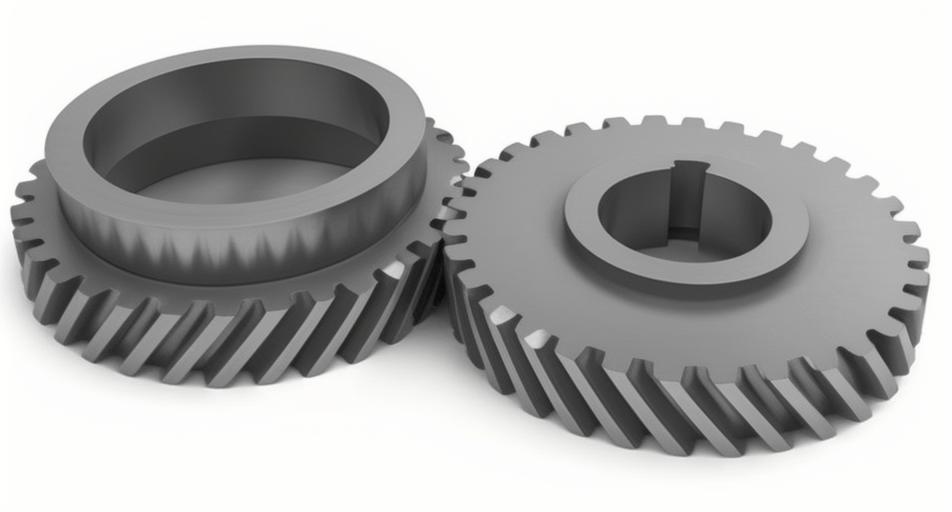
The contact between mating teeth of a helical gear is theoretically a line contact that moves along the tooth flank. However, due to elastic deformation under load, this line expands into a narrow, elongated rectangular area. Furthermore, the three-dimensional nature of the contact, influenced by the helix angle, means that the lubrication problem cannot be accurately modeled using infinite line contact theory, which neglects crucial end-leakage effects. A more realistic approach is the finite line contact model. For analysis, especially at the instant of longest contact line, the complex contact between two helical gear teeth can be effectively approximated by the contact between two reversed, finite-length tapered rollers. This simplification captures the essential geometry: the contact length is finite, and the equivalent radii of curvature vary along the contact line, being largest at the center and tapering towards the ends. The key geometric parameters for a modified helical gear pair differ from those of a standard pair, primarily in the operating pressure angle and the resulting contact geometry. The operating pressure angle for a modified pair is given by:
$$ \alpha_{wt} = \arccos\left(\frac{a}{a’}\cos\alpha_t\right) $$
where \(a\) is the standard center distance, \(a’\) is the actual center distance, and \(\alpha_t\) is the transverse pressure angle. The contact line length and the equivalent radii of curvature along this line are consequently altered. The variation in equivalent radius \(R(y)\) and slide-to-roll ratio \(SRR(y)\) along the contact line (y-direction) are critical inputs to the TEHL model. These parameters for different modification setups can be summarized as follows:
| Parameter | Standard Gear Pair (x1=0, x2=0) | Positive Modification (e.g., x1=+0.3, x2=+0.1) | Negative Modification (e.g., x1=-0.2, x2=-0.3) | Equal Modification (x1=+0.2, x2=-0.2) |
|---|---|---|---|---|
| Operating Pressure Angle (\(\alpha_{wt}\)) | Equal to standard pressure angle | Increased | Decreased | May increase or decrease based on center distance |
| Typical Contact Line Length | Baseline length L | Often similar or slightly varied | Often similar or slightly varied | Determined by effective face width |
| Trend of Equivalent Radius \(R(y)\) | Symmetric, max at center | Generally larger values, less symmetric | Generally smaller values, less symmetric | Asymmetric profile |
| Slide-to-Roll Ratio \(SRR(y)\) Profile | Symmetric about center | Lower absolute magnitude | Higher absolute magnitude | Asymmetric, average may be lower |
The mathematical foundation for analyzing the TEHL of a modified helical gear contact is built upon a system of coupled equations. The core is the generalized Reynolds equation that governs pressure generation for a non-Newtonian fluid. Considering the Ree-Eyring fluid model to account for shear-thinning behavior, the equation in its dimensional form for steady-state conditions is highly complex. For numerical solution, it is typically rendered in a dimensionless form. The film thickness equation accounts for both the geometric gap (which includes the equivalent radii variation \(R(y)\) and the crowning/surface features) and the elastic deformation of the gear teeth:
$$ h(x,y) = h_0(t) + \frac{x^2}{2R_x(y)} + \frac{y^2}{2R_y} + v(x,y,t) – \delta(y) $$
Here, \(h_0\) is the rigid central film thickness, \(R_x(y)\) is the equivalent radius in the rolling direction (varying with y), \(R_y\) is a transverse radius, \(v\) is the elastic deformation calculated using the Boussinesq integral, and \(\delta\) represents any intentional crowning or manufacturing deviations.
The pressure-viscosity and pressure-density relationships are critical for EHL. The commonly used Barus and Dowson-Higginson relations are:
$$ \eta(p) = \eta_0 e^{\alpha p} $$
$$ \rho(p) = \rho_0 \left(1 + \frac{0.6 \times 10^{-9} p}{1 + 1.7 \times 10^{-9} p}\right) $$
where \(\eta_0\) and \(\rho_0\) are the ambient viscosity and density, and \(\alpha\) is the pressure-viscosity coefficient. The thermal analysis introduces the energy equation, which must be solved for the fluid film and the bounding gear tooth surfaces. The simplified energy equation for the lubricant film, assuming conduction across the film and convection/advection along it, is:
$$ \rho_f c_f \left( u \frac{\partial T}{\partial x} + v \frac{\partial T}{\partial y} \right) = k_f \frac{\partial^2 T}{\partial z^2} + \eta \left[ \left( \frac{\partial u}{\partial z} \right)^2 + \left( \frac{\partial v}{\partial z} \right)^2 \right] + \frac{T}{\rho} \frac{\partial \rho}{\partial T} \left( u \frac{\partial p}{\partial x} + v \frac{\partial p}{\partial y} \right) $$
The heat transfer into the solid gears (subscripts a and b) is governed by: \( k_s \nabla^2 T_s = \rho_s c_s \frac{\partial T_s}{\partial t} \), where the surface temperatures are coupled at the fluid-solid interfaces. Finally, the entire pressure distribution must satisfy the equilibrium condition, balancing the integrated pressure with the applied load per unit width along the contact line: \( \iint_{\Omega} p(x,y) \,dx\,dy = w \).
Solving this fully coupled, nonlinear system for a finite line contact model of a helical gear requires robust numerical methods. A multi-grid technique is exceptionally efficient for solving the Reynolds equation and the elastic deformation integral on hierarchically refined grids. The temperature field is typically solved using a column-by-column scanning method, iteratively coupling it with the pressure solution. Convergence is checked for pressure, load, and temperature with stringent relative error tolerances (e.g., \(10^{-5}\) for pressure, \(10^{-6}\) for temperature). The domain is discretized with a fine mesh in the central contact region (e.g., 129 nodes in the x-direction, 513 in the y-direction on the finest grid level) and extends sufficiently in the inlet and outlet regions to capture the full pressure build-up and decay. Standard parameters for the lubricant (e.g., ISO VG 100) and gear steel are used, as shown in the consolidated table below:
| Category | Parameter | Symbol | Value / Specification |
|---|---|---|---|
| Helical Gear Geometry | Number of Teeth (Pinion/Wheel) | \(z_1, z_2\) | e.g., 25 / 40 |
| Normal Module | \(m_n\) | e.g., 4 mm | |
| Helix Angle | \(\beta\) | e.g., 15° | |
| Face Width | \(F\) | e.g., 30 mm | |
| Profile Shift Coefficients | \(x_1, x_2\) | Variable (e.g., 0, ±0.3, etc.) | |
| Operating Center Distance | \(a’\) | Calculated based on modification | |
| Material Properties | Elastic Modulus | \(E\) | 206 GPa |
| Poisson’s Ratio | \(\nu\) | 0.3 | |
| Density | \(\rho_s\) | 7850 kg/m³ | |
| Thermal Conductivity | \(k_s\) | 46 W/(m·K) | |
| Specific Heat | \(c_s\) | 470 J/(kg·K) | |
| Lubricant Properties | Ambient Dynamic Viscosity | \(\eta_0\) | 0.08 Pa·s |
| Ambient Density | \(\rho_0\) | 870 kg/m³ | |
| Pressure-Viscosity Coefficient | \(\alpha\) | \(2.2 \times 10^{-8}\) Pa⁻¹ | |
| Thermal Conductivity | \(k_f\) | 0.14 W/(m·K) | |
| Specific Heat | \(c_f\) | 2000 J/(kg·K) | |
| Thermal Exp. Coefficient (for density) | \(\beta_T\) | 0.00065 K⁻¹ | |
| Eyring Stress | \(\tau_0\) | 10 MPa | |
| Ambient Temperature | \(T_0\) | 40°C (313 K) | |
| Operating Conditions | Input Power/Speed/Torque | \(P/\omega/T\) | e.g., 100 kW, 1500 rpm |
| Maximum Hertzian Pressure (Nominal) | \(p_H\) | ~1.0 – 1.5 GPa | |
| Slide-to-Roll Ratio Range | \(SRR\) | Varies along contact line (e.g., -30% to +30%) |
My analysis focuses on the instant when the contact line is at its maximum length, a critical moment for load distribution. Comparing the TEHL results for standard and modified helical gear pairs reveals significant trends. The most striking effect of profile shift modification is observed on the film thickness. For a pair with a positive modification (e.g., pinion \(x_1 > 0\)), the operating pressure angle increases. This leads to a larger equivalent radius of curvature \(R_x\) at the pitch point and an increased entrainment velocity \(u_e = (u_1 + u_2)/2\). Since the central film thickness in EHL contacts famously scales with \(h_c \propto (u_e \eta_0 \alpha)^{0.67} R_x^{0.53} W^{-0.067}\), the increases in both \(u_e\) and \(R_x\) directly contribute to a thicker lubricant film. Conversely, a negative modification reduces the pressure angle, leading to smaller \(R_x\) and often a lower \(u_e\), resulting in a thinner film. The pressure distribution, while dominated by the Hertzian contact, shows subtler changes. Positive modification tends to slightly reduce the peak pressure and the severity of the secondary pressure spike within the contact zone due to the more favorable geometry and thicker film, whereas negative modification can lead to slightly elevated pressures.
The thermal behavior is profoundly influenced. The slide-to-roll ratio \(SRR\), which dictates the shear rate and thus the frictional heating, is altered by modification. Positive modification generally leads to lower absolute \(SRR\) values along the contact line, implying less sliding and therefore less viscous shear heating. Negative modification increases sliding, raising the heat generation. Consequently, the mid-film temperature rise \(\Delta T\) for a positively modified helical gear pair is noticeably lower than that for a standard or negatively modified pair under identical load and speed conditions. The temperature profile across the film and into the solids is also flatter. This reduction in operating temperature is crucial, as it helps maintain a higher effective viscosity within the contact, further supporting the film thickness and protecting the surface coatings or material properties from thermal degradation.
The influence of the magnitude of the positive modification coefficient is systematic. For a fixed gear ratio and load, increasing the positive modification coefficient on the driving helical gear (while adjusting the driven gear’s coefficient to maintain a proper tooth shape and backlash) continues the trend: film thickness increases, contact pressure decreases slightly, and the maximum flash temperature decreases. This can be expressed through parametric sensitivity relations derived from the numerical results:
$$ \frac{\partial h_{c,min}}{\partial x_1} > 0, \quad \frac{\partial p_{max}}{\partial x_1} < 0, \quad \frac{\partial T_{max,flash}}{\partial x_1} < 0 $$
for \(x_1 > 0\) within practical design limits. It is important to note that excessive positive shift can lead to other issues like a pointed tooth tip or reduced contact ratio, so an optimization is always necessary. The end-leakage effects, inherent to the finite line contact model of the helical gear, are present in all cases but are somewhat mitigated with thicker films from positive modification, as the side flow becomes a smaller fraction of the central flow.
To summarize the comparative performance, the following table encapsulates the key TEHL performance indicators for different profile shift configurations in a helical gear pair, relative to a standard design baseline:
| Performance Indicator | Standard Helical Gear (Baseline) | Positively Modified Helical Gear | Negatively Modified Helical Gear | Equal/Zero-Modified Helical Gear* |
|---|---|---|---|---|
| Minimum Film Thickness | \(h_{min,0}\) | \( \approx (1.15 \text{ to } 1.35) \times h_{min,0} \) | \( \approx (0.85 \text{ to } 0.95) \times h_{min,0} \) | ~ \(h_{min,0}\), depends on \(a’\) |
| Maximum Contact Pressure | \(p_{max,0}\) | Slightly lower (1-3%) | Slightly higher (1-3%) | Similar to baseline |
| Mid-Film Temp. Rise | \(\Delta T_0\) | Lower (10-25% reduction) | Higher (10-25% increase) | Similar or slightly asymmetric |
| Traction Coefficient | \(\mu_0\) | Generally lower | Generally higher | Similar to baseline |
| Lambda Ratio (\(\lambda\))** | \(\lambda_0\) | Higher → better fluid film condition | Lower → increased asperity contact risk | Similar to \(\lambda_0\) |
| Primary Influence Mechanism | N/A | ↑ \(R_x\), ↑ \(u_e\), ↓ |SRR| | ↓ \(R_x\), ↓ \(u_e\), ↑ |SRR| | Altered load distribution, asymmetry |
*Equal modification where \(x_1 = -x_2\) alters the center distance but not the tooth thickness sum. ** \(\lambda = h_{min} / \sigma\), where \(\sigma\) is the composite surface roughness.
In conclusion, the comprehensive TEHL analysis of a helical gear pair using a finite line contact model provides deep insights into the critical role of profile shift modification. The numerical evidence strongly indicates that a well-chosen positive modification offers substantial lubrication advantages. It consistently promotes a thicker EHL film, reduces contact pressures marginally, and most importantly, significantly lowers the operating temperature within the contact by reducing sliding friction. This triad of benefits—thicker film, lower pressure, and cooler running—directly enhances the gear’s resistance to wear, pitting, and scuffing, thereby improving its durability and operational efficiency. Therefore, when designing a high-performance helical gear transmission, especially for demanding applications involving high speeds and loads, leveraging positive profile shift should be considered not just for geometric and strength reasons, but as a fundamental strategy for optimizing the thermal elastohydrodynamic lubrication regime. This integrated approach to design, combining mechanical and tribological principles, is key to developing more reliable and efficient power transmission systems.