
In modern industrial automation, precision and reliability are paramount, especially in applications such as robotics where high accuracy is required for tasks like assembly, welding, and material handling. The RV reducer, a type of precision gear reducer, plays a critical role in these systems due to its compact design, high torque capacity, and excellent backlash characteristics. However, transmission error—the deviation between the theoretical and actual output motion—can significantly impact the performance of robotic arms and other machinery. Understanding and minimizing this error is essential for enhancing the overall efficiency and accuracy of industrial systems. In this study, we aim to develop a comprehensive framework for analyzing the transmission error in RV reducers by integrating mathematical modeling, dynamic simulation, and experimental validation. Our approach considers various factors such as gear meshing stiffness, clearance, contact deformation, and manufacturing tolerances, which are often overlooked in simpler models. By leveraging advanced simulation tools and empirical data, we seek to provide insights that can guide the design and optimization of RV reducers for improved precision.
The RV reducer combines a planetary gear stage with a cycloidal drive stage, resulting in a high reduction ratio and robust load-bearing capacity. This two-stage configuration allows for compact size while delivering high torque output, making it ideal for servo motors in robotics. The transmission error in an RV reducer arises from multiple sources, including gear tooth profile errors, assembly misalignments, bearing clearances, and elastic deformations under load. These errors can lead to positional inaccuracies, vibration, and noise, ultimately affecting the performance of the entire system. Therefore, a detailed analysis of the transmission error is crucial for identifying critical parameters and implementing corrective measures. In this paper, we present a holistic investigation that begins with the derivation of a dynamic mathematical model, followed by simulation using ADAMS software, and concludes with experimental measurements. Our goal is to validate the model and simulation results against real-world data, thereby establishing a reliable method for predicting and reducing transmission error in RV reducers.
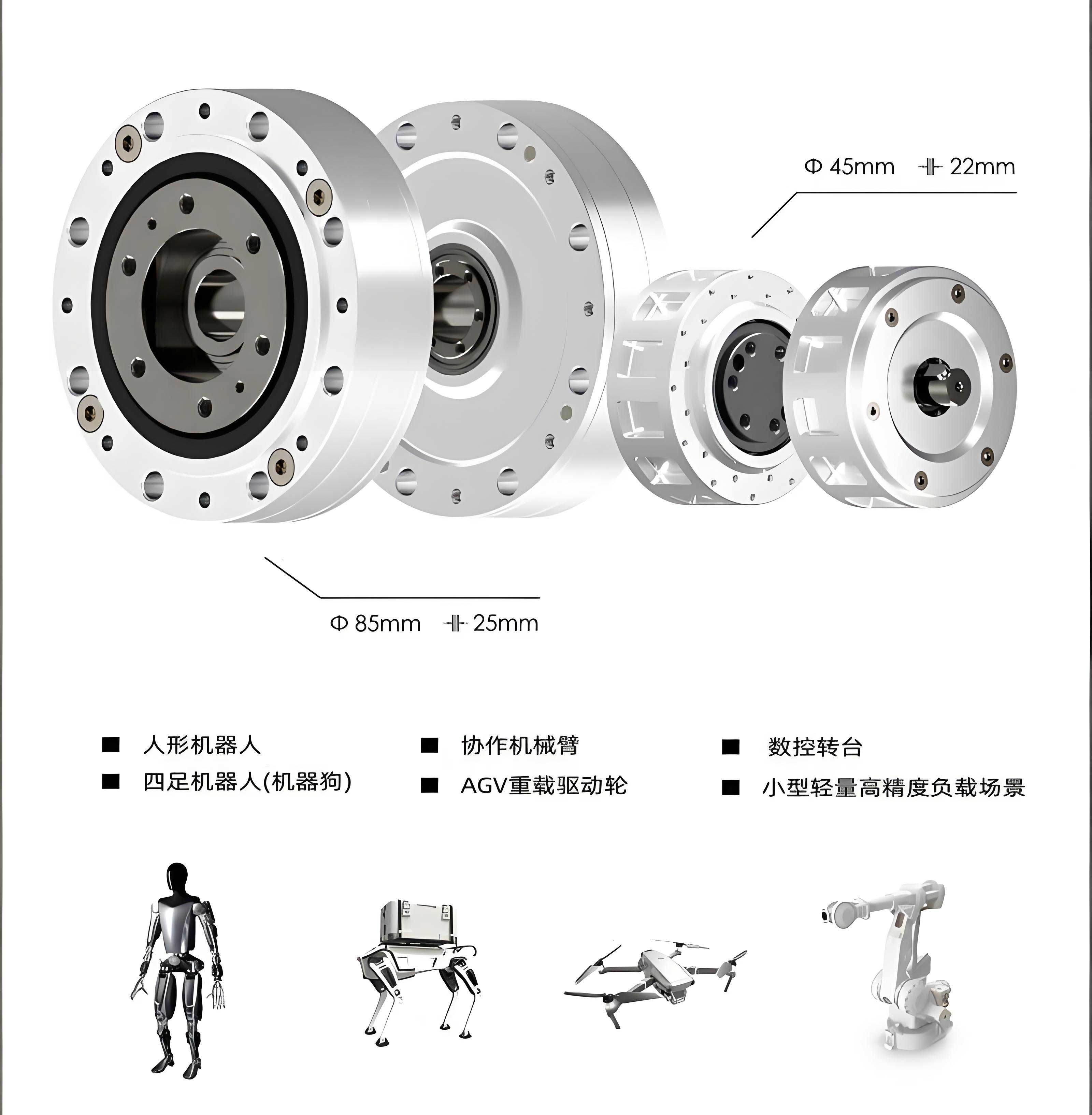
To set the stage for our analysis, we first review the basic structure and operating principle of the RV reducer. The RV reducer consists of an input shaft connected to a sun gear, which meshes with multiple planet gears. These planet gears are mounted on crankshafts that drive cycloidal discs (also known as摆线轮 in Chinese literature) through eccentric bearings. The cycloidal discs then engage with a stationary ring gear (or针齿壳) to produce the output motion via a carrier. This unique design provides high reduction ratios, often exceeding 100:1, with minimal backlash. The figure below illustrates the internal components of a typical RV reducer, highlighting the interaction between the planetary and cycloidal stages.
The transmission ratio of the RV reducer is a key parameter that influences its performance. Using the “fixed carrier method” for planetary gear trains, we can derive the overall reduction ratio. For the planetary stage, the relationship between the sun gear, planet gears, and carrier is given by:
$$ i_{sp} = \frac{\omega_s – \omega_j}{\omega_p – \omega_j} = -\frac{z_p}{z_s} $$
where \( \omega_s \), \( \omega_p \), and \( \omega_j \) are the angular velocities of the sun gear, planet gear, and carrier (output) respectively, and \( z_s \) and \( z_p \) are the number of teeth on the sun gear and planet gear. The negative sign indicates opposite rotation directions. For the cycloidal stage, the interaction between the cycloidal disc and the ring gear can be expressed as:
$$ i_{wb} = \frac{\omega_b – \omega_p}{\omega_w – \omega_p} = -\frac{z_w}{z_b} $$
where \( \omega_b \) and \( \omega_w \) are the angular velocities of the cycloidal disc and ring gear, \( z_b \) is the number of teeth on the cycloidal disc, and \( z_w \) is the number of pins on the ring gear, typically \( z_w = z_b + 1 \). Assuming the ring gear is fixed (\( \omega_w = 0 \)) and the carrier is the output, the overall transmission ratio of the RV reducer is derived as:
$$ i_{sw} = \frac{\omega_s – \omega_j}{\omega_w – \omega_j} = -\frac{z_p}{z_s} \cdot \frac{z_w}{z_w – z_b} $$
In practice, this ratio is often simplified to \( i = 1 + \frac{z_p}{z_s} z_w \) for design purposes. For instance, in our study, we consider an RV reducer with a reduction ratio of 162, which is common in industrial robots. Understanding this ratio is essential for analyzing the transmission error, as any deviation from the ideal motion will be amplified by the high reduction factor.
To model the dynamic behavior of the RV reducer, we employ a lumped parameter approach combined with a dynamic substructure method. This involves representing each component as a mass with associated inertia and stiffness, and the interactions between components as spring-damper elements. The physical model accounts for six degrees of freedom for rotating bodies and includes effects such as gear mesh stiffness, bearing clearances, and contact deformations. The following table summarizes the key stiffness parameters used in our model, which correspond to the elastic interactions between various parts of the RV reducer.
| Stiffness Parameter | Description |
|---|---|
| \( k_{spi} \) | Sun gear and planet gear mesh stiffness |
| \( k_s \) | Sun gear support stiffness |
| \( k_{ca} \) | Carrier and ring gear housing stiffness |
| \( k_{dcji} \) | Crankshaft and cycloidal disc connection stiffness |
| \( k_{djk} \) | Pin gear and cycloidal disc mesh stiffness |
| \( k_{bi} \) | Bearing stiffness between crankshaft and carrier |
The dynamic equations are derived from Newton’s second law and torque balance principles. For the sun gear, the equations of motion in the x and y directions are:
$$ m_s (\ddot{X}_s – 2\omega_c \dot{Y}_s – \omega_c^2 X_s) + F_{sx} + \sum_{i=1}^{3} F_{spi} \cos A_i = 0 $$
$$ m_s (\ddot{Y}_s + 2\omega_c \dot{X}_s – \omega_c^2 Y_s) + F_{sy} + \sum_{i=1}^{3} F_{spi} \sin A_i = 0 $$
$$ J_s \ddot{\theta}_s – R_s \sum_{i=1}^{3} (F_{spi} + F_{sp}) = 0 $$
where \( m_s \) and \( J_s \) are the mass and moment of inertia of the sun gear, \( \omega_c \) is the carrier angular velocity, \( F_{sx} \) and \( F_{sy} \) are support forces, \( F_{spi} \) is the mesh force between the sun gear and planet gear i, \( A_i \) is the engagement angle, and \( R_s \) is the pitch radius of the sun gear. The mesh force \( F_{spi} \) is given by:
$$ F_{spi} = k_{spi} \left[ X_s \cos A_i + Y_s \sin A_i – X_{pi} \cos A_i – Y_{pi} \sin A_i – R_p (\theta_{pi} – \theta_p) + E_s \cos(\theta_s + \beta_{sa} – A_i) – E_{pi} \cos(\beta_{pi} – \theta_p – A_i) \right] $$
Here, \( X_{pi} \) and \( Y_{pi} \) are the displacements of the planet gear, \( R_p \) is the planet gear radius, \( E_s \) and \( E_{pi} \) are eccentricity errors, and \( \beta_{sa} \) and \( \beta_{pi} \) are their phase angles. Similar equations are developed for the planet gears, crankshafts, cycloidal discs, and carrier. For the planet gear and crankshaft assembly, the forces include contributions from the sun gear mesh and the connection to the cycloidal disc:
$$ F_{dcjix} = k_{dcji} \left[ R_m (\theta_{doj} – \theta_{pi}) \sin(\theta_p + \psi_j) + X_{pi} – \eta_{dj} \cos(\theta_p + \psi_j) + R_{cd} (\theta_{dj} – \theta_c) \sin(\theta_{dj} – \theta_c) – E_{hji} \cos(\theta_c + \phi_i + \beta_{hji}) + E_{cji} \cos(\theta_p + \psi_j + \beta_{cji}) + \delta_c \right] $$
$$ F_{dcjiy} = k_{dcji} \left[ R_m (\theta_{doj} – \theta_{pi}) \cos(\theta_p + \psi_j) + Y_{pi} – \eta_{dj} \cos(\theta_p + \psi_j) + R_{cd} (\theta_{dj} – \theta_c) \cos(\theta_{dj} – \theta_c) – E_{hji} \sin(\theta_c + \phi_i + \beta_{hji}) + E_{cji} \sin(\theta_p + \psi_j + \beta_{cji}) + \delta_c \right] $$
where \( R_m \) is the eccentricity of the crankshaft, \( \eta_{dj} \) is the displacement of the cycloidal disc, \( \theta_{doj} \) and \( \theta_{dj} \) are angular displacements, \( E_{hji} \) and \( E_{cji} \) are errors in the crankshaft hole and cam, and \( \delta_c \) is the clearance in bearings. The equations for the cycloidal discs involve the mesh forces with the pin gears:
$$ F_{dijs} = \delta_A k \left\{ \left[ R_m (\theta_{doj} – \theta_p) – R_d (\theta_{dj} – \theta_c) \right] \sin \alpha_{js} + \eta_{dj} \cos \alpha_{js} – P_{jk} \cos(\phi_{pdjs} – \alpha_{js}) – A_{Pjk} \sin(\phi_{pjs} – \alpha_{js}) – E_{Rk} \cos(\alpha_{js} – \phi_{Rjs}) – E_{ARk} \sin(\alpha_{js} – \phi_{Rjs}) \right\} $$
Here, \( R_d \) is the radius of the cycloidal disc, \( P_{jk} \) is the tooth profile deviation, \( A_{Pjk} \) is the cumulative pitch error, \( E_{Rk} \) and \( E_{ARk} \) are radial and tangential errors of the pin gear, and \( \alpha_{js} \) is the pressure angle. Finally, for the carrier, the equations account for the connection to the crankshafts and the output load:
$$ m_{ca} (\ddot{X}_{ca} – 2\omega_c \dot{Y}_{ca} – \omega_c^2 X_{ca}) – F_{cax} + \sum_{i=1}^{3} F_{ccxi} = 0 $$
$$ m_{ca} (\ddot{Y}_{ca} + 2\omega_c \dot{X}_{ca} – \omega_c^2 Y_{ca}) – F_{cay} – \sum_{i=1}^{3} F_{ccyi} = -m_{ca} g $$
$$ J_{ca} \ddot{\theta}_{ca} – R_{dc} \sum_{i=1}^{3} \left[ F_{ccxi} \sin(\theta_c + \phi_i) + F_{ccyi} \cos(\theta_c + \phi_i) \right] = -T_{out} $$
where \( m_{ca} \) and \( J_{ca} \) are the mass and inertia of the carrier, \( F_{cax} \) and \( F_{cay} \) are support forces, \( F_{ccxi} \) and \( F_{ccyi} \) are forces from the crankshaft connections, and \( T_{out} \) is the output torque. These equations form a system of nonlinear differential equations that capture the dynamic interactions within the RV reducer. To solve them, we use the Newmark integration method in MATLAB, which is suitable for transient dynamic analysis. The material properties of the components, such as Young’s modulus and density, are listed in the following table, as they influence the stiffness and inertial parameters.
| Component | Material | Poisson’s Ratio | Moment of Inertia (kg·m²) | Elastic Modulus (GPa) |
|---|---|---|---|---|
| Input Shaft | CrMo | 0.284 | 3.81 × 10⁻⁴ | 211 |
| Sun Gear | CrMo | 0.284 | 3.14 × 10⁻⁵ | 212 |
| Planet Gear | CrMoAl | 0.277 | 8.05 × 10⁻⁴ | 212 |
| Crankshaft | GCr15 | 0.300 | 1.84 × 10⁻⁴ | 219 |
| Cycloidal Disc | CrMo | 0.292 | 2.89 × 10⁻² | 211 |
| Ring Gear Housing | GCr15 | 0.300 | 0.11 × 10⁻⁵ | 218 |
| Carrier | GCr45 | 0.269 | 8.25 × 10⁻² | 210 |
After solving the mathematical model, we obtain the transmission error, defined as the difference between the actual output rotation and the ideal output based on the input rotation and reduction ratio. For one complete revolution of the output carrier, the transmission error curve shows variations due to the dynamic effects. The error ranges from -35.9 arcseconds to 38.8 arcseconds, where negative values indicate lagging error and positive values indicate leading error. The frequency spectrum of the error reveals peaks at specific frequencies, such as 260 Hz and 400 Hz, which correspond to mesh frequencies and structural resonances. This mathematical analysis provides a baseline for understanding the error sources in the RV reducer, but it requires validation through simulation and experiment.
To complement the mathematical model, we conduct a dynamic simulation using ADAMS (Automatic Dynamic Analysis of Mechanical Systems), a multi-body dynamics software. The 3D assembly model of the RV reducer is imported into ADAMS, and constraints are applied to represent the mechanical connections. The following table lists the constraint types used for different components, ensuring realistic motion transmission.
| Component Pair | Constraint Type |
|---|---|
| Input Shaft and Ground | Revolute Joint |
| Input Shaft and Sun Gear | Fixed Joint |
| Sun Gear and Planet Gears | Gear Contact Force |
| Planet Gears and Crankshafts | Fixed Joint |
| Crankshafts and Cycloidal Discs | Impact Contact Force |
| Cycloidal Discs and Pin Gears | Impact Contact Force |
| Carrier and Ground | Revolute Joint |
For contact forces, such as between the cycloidal discs and pin gears, we use the impact function in ADAMS, which models both elastic and damping effects. The force is given by:
$$ F_{\text{impact}} = \begin{cases}
k (q_1 – q)^e – c_{\text{max}} \dot{q} \cdot \text{step}(q, q_1 – d, 1, q_1, 0) & \text{if } q < q_1 \\
0 & \text{if } q \geq q_1
\end{cases} $$
where \( q \) is the distance between contact points, \( q_1 \) is the free distance, \( k \) is the stiffness coefficient, \( e \) is the force exponent, \( c_{\text{max}} \) is the maximum damping coefficient, and \( d \) is the damping ramp-up distance. The parameters are tuned based on material properties and experimental data to ensure accurate simulation. The input shaft is driven at a constant speed of 1600 rpm, corresponding to an ideal output speed of 9.87 rpm for a reduction ratio of 162. The simulation runs for over 6 seconds to capture one full output revolution. The output speed curve from ADAMS shows an average of 9.9 rpm, closely matching the theoretical value, with small fluctuations due to dynamic effects.
The transmission error from the simulation is calculated by comparing the simulated output angle with the ideal output angle derived from the input. The error curve exhibits a range from -36.23 arcseconds to 38.72 arcseconds, which aligns well with the mathematical model results. The frequency spectrum also shows peaks at 260 Hz and 400 Hz, with amplitudes of 4.43 arcseconds and 0.62 arcseconds respectively, consistent with the model predictions. This agreement validates the accuracy of our mathematical model and confirms that the simulation captures the essential dynamics of the RV reducer. However, to fully verify these findings, we proceed to experimental measurements.
We design and construct an experimental test bench to measure the transmission error of the RV reducer under controlled conditions. The test bench consists of a drive system, a loading system, and a measurement system. The drive system includes a servo motor connected to the input shaft of the RV reducer, capable of providing precise speed control. The loading system uses a magnetic powder brake attached to the output carrier to apply a controllable torque load, simulating real operating conditions. The measurement system employs high-resolution rotary encoders (圆光栅 in Chinese) mounted on both the input and output shafts to capture angular positions with accuracy up to arcseconds. The data acquisition system records the encoder signals at a high sampling rate, allowing for detailed analysis of the transmission error. The experimental setup is calibrated to minimize external influences, such as misalignment and vibration, ensuring reliable data.
During the experiment, the RV reducer is operated at an input speed of 1600 rpm with a load torque applied to the output. The transmission error is computed from the encoder data using the same definition as in the simulation and model. The measured error curve shows a range from -36.1 arcseconds to 41.7 arcseconds, which is slightly wider than the model and simulation results but still in close agreement. The frequency spectrum reveals peaks at 260 Hz and 400 Hz, with amplitudes of 4.78 arcseconds and 0.65 arcseconds, respectively. These values match the trends observed in the mathematical model and simulation, indicating that the dynamic behavior is accurately captured. The minor discrepancies can be attributed to factors not fully modeled, such as temperature effects, lubrication variations, and higher-order manufacturing errors. Nonetheless, the consistency across all three methods—mathematical modeling, simulation, and experiment—demonstrates the robustness of our approach.
To further analyze the results, we compare the key metrics from the mathematical model, ADAMS simulation, and experimental measurement in the following table. This comparison highlights the effectiveness of our integrated methodology for assessing transmission error in RV reducers.
| Method | Transmission Error Range (arcseconds) | Peak Frequency 1 (Hz) | Amplitude at 260 Hz (arcseconds) | Peak Frequency 2 (Hz) | Amplitude at 400 Hz (arcseconds) |
|---|---|---|---|---|---|
| Mathematical Model | -35.9 to 38.8 | 260 | 4.40 | 400 | 0.62 |
| ADAMS Simulation | -36.23 to 38.72 | 260 | 4.43 | 400 | 0.62 |
| Experimental Measurement | -36.1 to 41.7 | 260 | 4.78 | 400 | 0.65 |
The close alignment among the three datasets confirms that our mathematical model accurately represents the dynamic behavior of the RV reducer, and the ADAMS simulation reliably replicates the physical system. The experimental validation provides confidence in using these tools for predictive analysis and design optimization. The transmission error in the RV reducer is primarily influenced by gear mesh stiffness variations, clearances in bearings and joints, and manufacturing imperfections. By identifying these factors through our analysis, we can suggest improvements such as tighter tolerances, enhanced lubrication, or advanced gear tooth profiling to reduce error. For instance, optimizing the cycloidal disc tooth profile through modification techniques like equidistant correction can minimize mesh-induced fluctuations. Additionally, preloading bearings and using stiffer materials can mitigate clearance-related errors.
In conclusion, our comprehensive study on the transmission error of RV reducers demonstrates the value of combining mathematical modeling, dynamic simulation, and experimental testing. The mathematical model, derived using lumped parameters and dynamic substructures, successfully captures the complex interactions within the RV reducer, accounting for stiffness, clearances, and errors. The ADAMS simulation validates the model by reproducing similar error patterns and frequencies. Finally, experimental measurements corroborate both the model and simulation, with minor deviations attributable to real-world uncertainties. This integrated approach provides a reliable framework for analyzing and improving the precision of RV reducers, which are critical components in high-accuracy applications like industrial robotics. Future work could focus on extending the model to include thermal effects, wear over time, and more detailed contact mechanics, further enhancing the predictive capability. By continuously refining these methods, we can contribute to the development of next-generation RV reducers with even lower transmission error and higher performance, supporting advancements in automation and manufacturing.