
Spur gears are foundational components in mechanical power transmission systems, serving critical functions in a vast array of machinery including vehicles, marine vessels, and machine tools. Their performance, longevity, and reliability are directly tied to the manufacturing processes employed in their production. Traditionally, machining methods such as hobbing, shaping, and grinding have been the standard. While capable of producing precise geometries, these subtractive processes are inherently inefficient, generating significant material waste in the form of chips and swarf. Furthermore, they sever the natural grain flow of the material, potentially creating stress concentration points and compromising the component’s overall mechanical integrity.
In contrast, precision plastic forming, particularly warm forging, presents a compelling alternative for manufacturing spur gears. This net-shape or near-net-shape technology offers substantial advantages, primarily through dramatically improved material utilization. More importantly, the forging process allows for the preservation and beneficial alignment of the material’s fibrous microstructure—the forging flow lines. This results in components with superior comprehensive mechanical properties, including enhanced fatigue strength, impact toughness, and wear resistance compared to their machined counterparts. The pursuit of high-performance, cost-effective manufacturing has thus driven significant research interest into the精密塑性成形 (precision plastic forming) of spur gears.
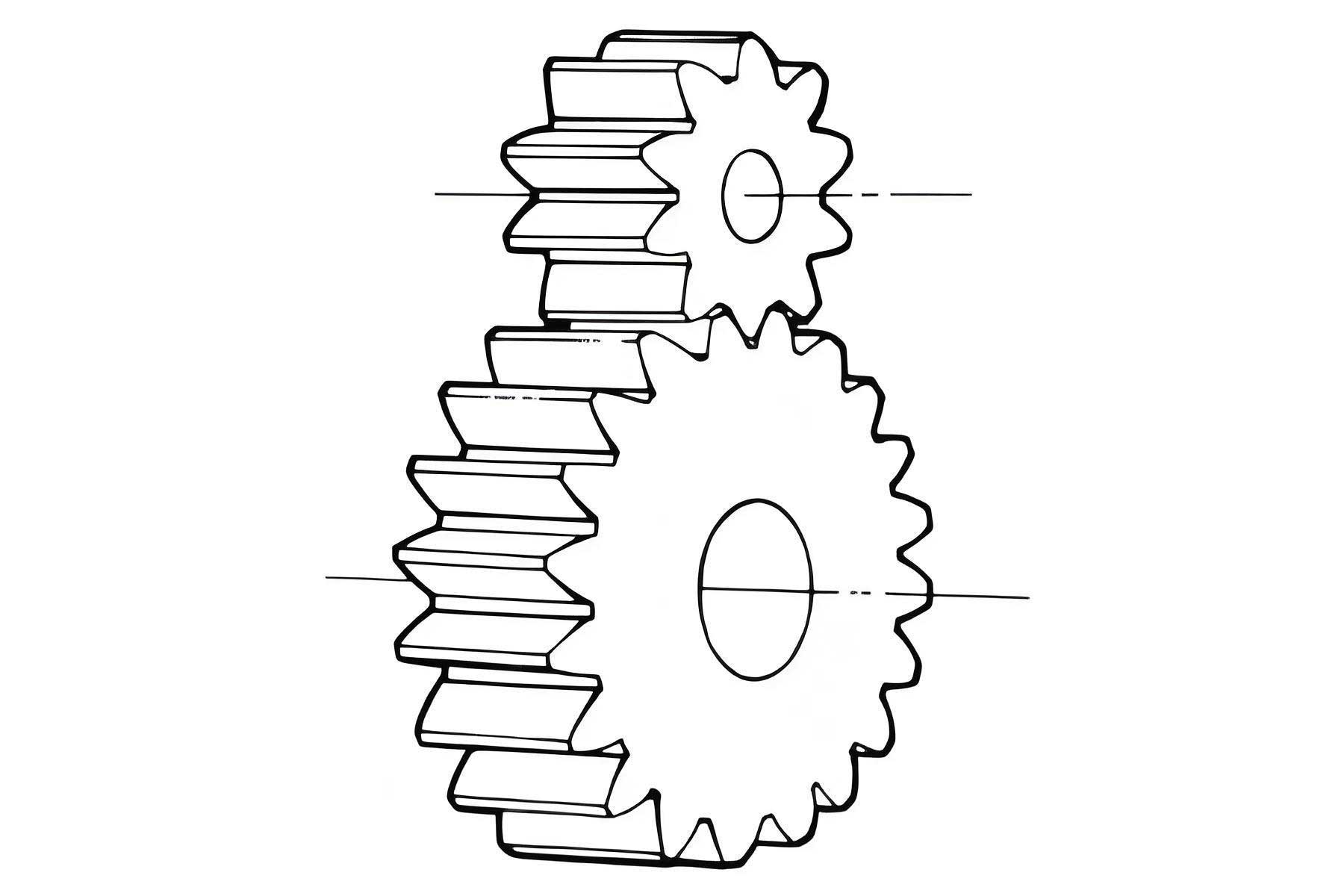
The successful implementation of warm precision forging for complex parts like spur gears hinges on overcoming two primary technical challenges: ensuring complete die cavity filling without defects and managing the exceptionally high forming loads to prevent premature die failure. This article delves into a detailed analysis of the warm fine forging process for a specific spur gear, employing advanced numerical simulation to understand metal flow and subsequently applying mechanical theory to design a robust, reliable die system capable of withstanding the process stresses.
Warm Precision Forging Process for Spur Gears
The forging of a spur gear involves transforming a simple cylindrical billet into a complex shape with precise tooth profiles. Achieving complete filling of the tooth cavities, especially the sharp corners at the tooth tip and root, is a classical challenge in closed-die forging. High friction between the workpiece and the die wall impedes metal flow into these extremities. To address this, a floating die configuration is often employed. In this design, the central die cavity containing the tooth profile is not fixed but is allowed to move (“float”) vertically within a surrounding pressure ring or housing.
During the forging operation, both the upper punch and the floating die move towards the stationary lower punch. This relative motion introduces a beneficial shear force at the die-workpiece interface. The frictional forces, which typically resist metal flow, are transformed into a driving force that assists in pushing material into the difficult-to-fill regions, particularly the lower corners of the tooth cavities. This mechanism significantly improves cavity fillability and can simultaneously reduce the overall maximum forming load required.
The process parameters for warm forging are carefully selected to balance formability, load, and final properties. For the subject spur gear, the key parameters are summarized below:
| Parameter | Specification / Value |
|---|---|
| Spur Gear Module | 2 mm |
| Number of Teeth | 18 |
| Pressure Angle | 20° |
| Workpiece Material | 20Cr (Low-Carbon Alloy Steel) |
| Workpiece Temperature | 750°C |
| Die Material | H13 Hot-Work Tool Steel |
| Die Temperature | 250°C |
| Punch Speed | 10 mm/s |
| Friction Model | Shear Friction, coefficient m=0.25 |
Three-Dimensional Finite Element Modeling and Analysis
To accurately predict the forming behavior, a three-dimensional finite element model was developed. Utilizing the symmetry of the spur gear, only a 1/18th sector (corresponding to one tooth space) was modeled to drastically reduce computational time while maintaining accuracy.
The model components include:
- A cylindrical billet as the initial workpiece.
- An upper punch (simple cylinder).
- A floating die with the negative tooth profile cavity.
- A stationary lower punch with the positive tooth profile.
The floating die and upper punch were assigned a velocity of 10 mm/s downwards. The thermomechanical properties of 20Cr steel at 750°C were critical inputs, defining the material’s flow stress, which governs its resistance to deformation. The flow stress $\sigma_f$ is often represented by a constitutive equation of the form:
$$ \sigma_f = K \cdot \varepsilon^n \cdot \dot{\varepsilon}^m $$
where $K$ is the strength coefficient, $\varepsilon$ is the true strain, $n$ is the strain-hardening exponent, and $m$ is the strain-rate sensitivity exponent. Accurate determination of these parameters for 20Cr at the forging temperature is essential for a valid simulation.
The simulation revealed the deformation sequence in clear stages:
| Stage | Description | Key Observation |
|---|---|---|
| 1. Upsetting | The initial compression of the cylindrical billet, increasing its diameter. | Uniform deformation before contacting tooth cavities. |
| 2. Cavity Filling | Metal begins to flow radially into the tooth profiles of the die and lower punch. | Floating die action aids filling; lower tooth corners fill faster than upper corners due to frictional effects. |
| 3. Final Filling & Corner Radii Formation | The final stages where the last, sharp corners of the die are filled. | Load increases dramatically as material is forced into small, confined volumes, generating high hydrostatic pressure. |
The load-stroke curve extracted from the simulation for the single-tooth model is characteristic of closed-die forging. After a steady rise during the filling stage, the load exhibits a sharp, almost linear increase in the final millimeters of stroke. This corresponds to Stage 3, where the remaining free surface area is minimal and enormous pressure is required to make the material conform to the final die geometry. The final simulated load for the single-tooth sector was 26.3 kN. Extrapolating for the full spur gear with 18 teeth gives a total forging load $F_{total}$:
$$ F_{total} = 18 \times 26.3 \text{ kN} \approx 473.4 \text{ kN} $$
The unit pressure $P$ on the die cavity is calculated by dividing the final punch force by the projected area of the forging in the single-tooth sector. With a simulated force $F_{sector}=27.6 \text{ kN}$ and an area $A_{sector}=55 \text{ mm}^2$, the unit pressure is:
$$ P = \frac{F_{sector}}{A_{sector}} = \frac{27.6 \times 10^3 \text{ N}}{55 \text{ mm}^2} \approx 502 \text{ MPa} $$
This value aligns well with empirical rules-of-thumb, which state that forging pressures for such processes are typically 4 to 6 times the material’s yield stress $\sigma_S$ at the forming temperature. For 20Cr at 750°C, $\sigma_S \approx 100 \text{ MPa}$, giving an empirical pressure range of 400-600 MPa.
Die Strength Analysis and Design Optimization
The high internal pressure $P$ (≈502 MPa) exerted on the die cavity during forging poses a significant risk of die failure, most commonly through radial fatigue fracture originating at the root of the tooth profile (the point of highest stress concentration). Therefore, die strength is not merely a consideration but the paramount factor in process viability.
Analysis of a Monobloc Die
As a baseline, the stress state in a single-layer (monobloc) die is analyzed. The critical section at the tooth root can be approximated as a thick-walled cylinder under internal pressure. The tangential (hoop) stress $\sigma_t$ and radial stress $\sigma_r$ at any radius $r$ within the die wall ($r_1 \leq r \leq r_2$) are given by the Lame equations:
$$ \sigma_t = \frac{r_1^2 P}{r_2^2 – r_1^2} \left( 1 + \frac{r_2^2}{r^2} \right) $$
$$ \sigma_r = \frac{r_1^2 P}{r_2^2 – r_1^2} \left( 1 – \frac{r_2^2}{r^2} \right) $$
where $r_1$ is the inner radius (die cavity), $r_2$ is the outer radius of the die, and $P$ is the internal working pressure.
The maximum tensile stress, which drives fracture, occurs at the inner surface where $r = r_1$. Using the von Mises yield criterion, the equivalent stress $\sigma_{eq}$ is calculated as:
$$ \sigma_{eq} = \sqrt{\sigma_t^2 + \sigma_r^2 – \sigma_t \sigma_r} $$
For a die with $r_1 = 40 \text{ mm}$ and an outer radius $r_2 = 80 \text{ mm}$ (a common ratio of 2:1), and $P=502 \text{ MPa}$, the stresses at the bore are:
$\sigma_t = 569 \text{ MPa}$ (tensile) and $\sigma_r = -502 \text{ MPa}$ (compressive). The equivalent stress is:
$$ \sigma_{eq} = \sqrt{569^2 + (-502)^2 – (569)(-502)} \approx 877 \text{ MPa} $$
The die material H13 steel has a yield strength $\sigma_{0.2} \approx 1430 \text{ MPa}$ at the operating temperature of 250°C. Applying a safety factor $n=1.7$, the allowable stress $[\sigma_1]$ is:
$$ [\sigma_1] = \frac{\sigma_{0.2}}{n} = \frac{1430}{1.7} \approx 841 \text{ MPa} $$
Since $\sigma_{eq} (877 \text{ MPa}) > [\sigma_1] (841 \text{ MPa})$, the monobloc die is predicted to fail. This necessitates the use of a prestressed, multi-layer (compound) die assembly.
Design and Analysis of a Compound Die
A compound die consists of an inner die insert (or cavity ring) and one or more outer prestressing rings that are shrunk onto the insert with a calculated interference fit. This assembly induces compressive tangential (hoop) stresses in the inner die insert *before* any working pressure is applied. During forging, the internal pressure $P$ generates tensile hoop stresses. These service-induced tensile stresses are partially or fully offset by the pre-existing compressive stresses, thereby lowering the net tensile stress in the critical inner die material and pushing the maximum stress outward into the prestress rings, which are made of tough, high-strength alloy steel.
The design of a two-layer compound die involves determining the optimal interference $\Delta d_2$ (diametral) or $\Delta r_2$ (radial) between the die insert and the prestress ring. One design philosophy aims to fully utilize both materials: when the die is under the maximum working pressure $P$, the equivalent stresses in both the insert and the ring simultaneously reach their respective allowable limits. The required radial interference $\Delta r_2$ for this condition can be derived as:
$$ \Delta r_2 = \frac{r_2}{E} \cdot \frac{2P – [\sigma_1]\left(1 – \frac{r_1}{r_3}\right)}{1 – \frac{r_2}{r_3}} $$
where $E$ is Young’s modulus, $[\sigma_1]$ is the allowable stress for the insert, and $r_3$ is the outer radius of the prestress ring.
For our spur gear die, selecting $r_3 = 160 \text{ mm}$ ($=4r_1$) and using the previously calculated $[\sigma_1] = 841 \text{ MPa}$, the formula gives $\Delta r_2 \approx 0.12 \text{ mm}$ ($\Delta d_2 \approx 0.24 \text{ mm}$).
The complete stress analysis of the compound die under both prestress and working pressure involves superposition:
- Prestress State: Calculate the contact pressure $P_{2k}$ at the interface due to shrinkage. Use Lame’s equations to find the stresses ($\sigma_t’, \sigma_r’$) in the insert and ($\sigma_t”, \sigma_r”$) in the ring caused by $P_{2k}$ acting as an internal or external pressure on each component.
- Working State: Treat the entire compound die as a monobloc cylinder with outer radius $r_3$ under internal pressure $P$. Use Lame’s equations to find the stresses ($\sigma_t^\ddagger, \sigma_r^\ddagger$) throughout the thickness.
- Superposition: The final stress state is the sum of the prestress and working stresses.
- For the die insert: $\sigma_t = \sigma_t’ + \sigma_t^\ddagger$; $\sigma_r = \sigma_r’ + \sigma_r^\ddagger$.
- For the prestress ring: $\sigma_t = \sigma_t” + \sigma_t^\ddagger$; $\sigma_r = \sigma_r” + \sigma_r^\ddagger$.
Applying this procedure with $\Delta r_2 = 0.12 \text{ mm}$ and a ring material of 30CrMnSi (yield strength $\sigma_{0.2} = 858 \text{ MPa}$ at 250°C, safety factor $n=1.5$, so $[\sigma_2] = 572 \text{ MPa}$) yields the following equivalent stresses:
| Component | Inner Surface Equivalent Stress ($\sigma_{eq}$) | Allowable Stress | Status |
|---|---|---|---|
| H13 Die Insert | 483 MPa | 841 MPa | Safe |
| 30CrMnSi Prestress Ring | 789 MPa | 572 MPa | FAILS ($\sigma_{eq} > [\sigma_2]$) |
The analysis shows that while the die insert is well within its safe limit, the prestress ring is overstressed. The initial “full utilization” design pushes too much load onto the ring.
Optimization via Interference Adjustment
The solution is to reduce the interference fit. A smaller $\Delta r_2$ results in lower prestress, which in turn:
1. Increases the net tensile hoop stress in the die insert during operation (making it work harder).
2. Decreases the combined stress in the prestress ring (relieving it).
The goal is to find an interference value that brings the equivalent stresses in both components below their allowable limits, achieving a balanced and safe design. Iterative analysis finds that with $\Delta r_2 = 0.07 \text{ mm}$:
| Component | Inner Surface Equivalent Stress ($\sigma_{eq}$) | Allowable Stress | Status |
|---|---|---|---|
| H13 Die Insert | 635 MPa | 841 MPa | Safe |
| 30CrMnSi Prestress Ring | 565 MPa | 572 MPa | Safe (marginally) |
This optimized design ensures both components operate within their safe stress envelopes. The die insert material is utilized effectively (635/841 ≈ 75% of its allowable stress), and the prestress ring is at its near-maximum capacity. The stress distribution across the die assembly is more uniform and efficient compared to the initial over-designed interference fit.
Summary and Conclusions
The warm precision forging of spur gears represents a significant advancement over traditional machining, offering benefits in material savings, mechanical properties, and production efficiency. This analysis systematically addressed the core challenges of the process:
- Process Design: The adoption of a floating die mechanism was identified as crucial for improving the filling of complex tooth profiles, particularly the lower root corners, by converting detrimental frictional forces into beneficial driving forces for metal flow.
- Numerical Simulation: 3D finite element analysis provided a powerful tool to visualize the multi-stage deformation sequence (upsetting, cavity filling, final corner filling) and to accurately quantify the forming load. For the specific spur gear studied, the total forging load was predicted to be approximately 473 kN, with a unit die pressure of 502 MPa.
- Die Strength as a Critical Constraint: Analysis confirmed that a monobloc die for this spur gear application would be inadequate, as the equivalent stress (877 MPa) would exceed the allowable stress for H13 steel (841 MPa), leading to probable fatigue failure.
- Robust Die System Design: The implementation of a prestressed compound die assembly was proven essential. Through the application of thick-walled cylinder theory (Lame equations) and stress superposition, the design was optimized. The key finding was that the interference fit between the die insert and the prestress ring must be carefully calibrated. An initial fit designed for “full material utilization” overstressed the outer ring. By reducing the radial interference from 0.12 mm to 0.07 mm, a balanced design was achieved where both the H13 insert (σ_eq = 635 MPa) and the 30CrMnSi prestress ring (σ_eq = 565 MPa) operate within their respective safe limits.
In conclusion, the successful warm forging of high-quality spur gears is a synergistic combination of intelligent process design (like the floating die), accurate predictive modeling via FEM, and rigorous mechanical design of the tooling system based on solid mechanics principles. The compound die, with its optimized interference fit, is the enabling technology that makes the process viable by managing the extreme stresses involved, ensuring die life, and ultimately making the precision forging of spur gears a reliable and economical manufacturing solution.