
As a mechanical engineer specializing in gear design and analysis, I have long been fascinated by the unique capabilities and challenges presented by bevel gears. Among them, the zero spiral bevel gear holds a particularly interesting position. Characterized by a mean spiral angle of zero degrees, it occupies a middle ground between straight bevel gears and fully spiral bevel gears. In this extensive article, I will share my perspective and detailed technical exploration into the geometric design, simulation, and meshing performance analysis of zero spiral bevel gears. The goal is to present a comprehensive methodology for optimizing their performance, focusing on a modified roll machining process controlled via the local synthesis method.
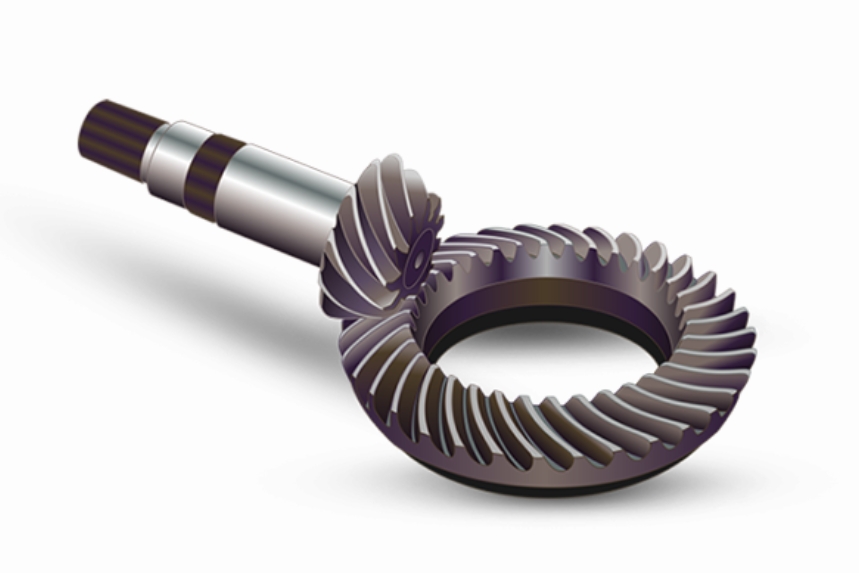
The zero spiral bevel gear offers distinct advantages. Compared to straight bevel gears, it features point contact under ideal conditions, which provides a degree of insensitivity to misalignments. This reduces the risk of edge-loading, stress concentration, and uneven load distribution that can plague line-contact gears when assembly errors are present. Furthermore, the convex-concave contact pattern between the mating teeth generally offers superior bending strength. However, achieving optimal contact patterns and controlled transmission error for these gears requires sophisticated design techniques. My approach centers on using the local synthesis method to derive the pinion machine-tool settings for a modified roll process, followed by rigorous tooth contact analysis (TCA) to evaluate performance under both ideal and misaligned conditions.
1. Pinion Design Philosophy: The Local Synthesis Method
The foundation for high-performance zero spiral bevel gears lies in precise pinion design. I employ the local synthesis method, which allows for direct control over the second-order contact parameters at a chosen design point on the gear tooth surface. This method is predicated on a fundamental principle: by knowing the gear’s complete geometry and machine settings, we can calculate its surface curvature properties at a reference point. By presetting desired kinematic and contact conditions at that point (for the gear pair), we can solve for the required curvature properties on the mating pinion tooth. Finally, these pinion curvatures are used to calculate the specific machine-tool settings—including cutter parameters and modified roll coefficients—needed to generate that precise pinion surface.
The process begins with the gear (often the larger wheel). Its tooth surface, generated via a face-milling process, is fully defined by its basic parameters, cutter geometry, and machine settings (e.g., radial distance, machine root angle, cradle angle). For a given point $M_0$ on the gear tooth surface, the position vector $\vec{r_2}$ and unit normal vector $\vec{n_2}$ are known functions of the surface parameters $u_2$ (generation parameter) and $\phi_2$ (cradle rotation angle).
The core of local synthesis involves defining three key second-order contact parameters at the design point $M_0$ on the gear surface:
- Derivative of Transmission Ratio, $m_{21}’$: This controls the shape of the transmission error curve. A negative value typically induces a convex parabolic function, which is beneficial for absorbing linear errors caused by misalignments.
- Direction of Contact Path on Gear, $\eta_2$: This is the angle between the tangent to the contact path on the gear surface and the root line. For zero spiral bevel gears, a direction nearly perpendicular to the root line is often chosen.
- Semi-Major Axis of Contact Ellipse, $a$: This parameter, combined with an assumed elastic approach $\delta$, influences the size of the instantaneous contact patch.
The mathematical formulation requires establishing the relationship between the gear’s surface curvatures and these desired contact parameters. The gear surface’s first and second fundamental forms, principal curvatures ($\kappa_2^{(I)}, \kappa_2^{(II)}$), and principal directions are calculated. The kinematic conditions for meshing (shared velocity at $M_0$) and the requirement for continuous contact (equality of normal curvatures along the contact path direction) yield a system of equations. This system relates the known gear curvatures and preset parameters ($m_{21}’, \eta_2, a$) to the unknown pinion principal curvatures ($\kappa_1^{(I)}, \kappa_1^{(II)}$) and their principal directions relative to the gear.
The essential equations derived from differential geometry and gear meshing theory can be summarized as follows. The relative normal curvature $\kappa_\nu$ along the potential contact line direction $\vec{v}$ is given by the difference between the normal curvatures of the two surfaces in that direction:
$$\kappa_\nu = \kappa_\nu^{(1)} – \kappa_\nu^{(2)}$$
where $\kappa_\nu^{(i)} = \kappa^{(i)I} \cos^2\sigma_i + \kappa^{(i)II} \sin^2\sigma_i$, and $\sigma_i$ is the angle between direction $\vec{v}$ and the first principal direction on surface $i$. For point contact with a prescribed instantaneous ellipse size $a$, under an elastic approach $\delta$, the relative normal curvature relates to the ellipse dimensions:
$$ a = \sqrt{\frac{\delta}{\kappa_\nu}} \quad \text{(for the major axis, assuming high contact ratio conditions)} $$
The condition for the contact path direction $\eta_2$ provides another equation linking the principal directions and the transmission ratio derivative $m_{21}’$. Solving this nonlinear system provides the target pinion surface curvatures at $M_0$.
Finally, with the pinion’s desired curvatures known, the inverse problem of determining the generating machine settings is solved. For a modified roll process on a face-milling machine (like a Gleason-type machine), this involves calculating the basic machine settings (cutter radius $r_{c1}$, blade angle $\alpha_{c1}$, radial setting $S_{r1}$, etc.) and the polynomial coefficients for the modified roll function, which defines the relationship between the workpiece rotation $\phi_1$ and the cradle rotation $\phi_{c1}$:
$$ \phi_1 = \frac{1}{R_{m1}} \phi_{c1} + C_2 \phi_{c1}^2 + D_3 \phi_{c1}^3 + … $$
Here, $R_{m1}$ is the basic ratio, and $C_2$, $D_3$ are the second- and third-order modified roll coefficients. These coefficients are crucial for imparting the designed crowning and controlled transmission error to the pinion tooth surface of the spiral bevel gear.
2. Mathematical Model for Tooth Contact Analysis (TCA)
Once the pinion and gear surfaces are fully defined by their respective machine-tool settings, the next critical step is to simulate their meshing action through Tooth Contact Analysis (TCA). The objective of TCA is to predict the contact pattern (or path) on the tooth surface, the transmission error under load, and the influence of assembly misalignments, all without requiring physical prototypes. I construct a rigorous mathematical model for this purpose.
The pinion and gear tooth surfaces, $\Sigma_1$ and $\Sigma_2$, are defined in their own coordinate systems attached to the rotating parts. Their vector equations are results of the gear generation simulation:
$$ \vec{r}_1 = \vec{r}_1(u_1, \theta_1), \quad \vec{n}_1 = \vec{n}_1(u_1, \theta_1) $$
$$ \vec{r}_2 = \vec{r}_2(u_2, \theta_2), \quad \vec{n}_2 = \vec{n}_2(u_2, \theta_2) $$
Here, $u_i$ are surface parameters related to the cutter blade profile, and $\theta_i$ are the generating motion parameters (related to the work or cradle rotation).
To simulate meshing, we must bring both surfaces into a fixed reference space, accounting for their respective rotations ($\phi_1$, $\phi_2$) and any potential assembly errors. A typical coordinate system setup includes body-fixed frames $S_1(x_1, y_1, z_1)$ and $S_2(x_2, y_2, z_2)$, and a fixed reference frame $S_f$. The transformation from $S_2$ to $S_f$ involves a sequence of rotations and translations: first aligning the gear shaft, then applying misalignments, and finally rotating the gear about its own axis. Common assembly errors for a spiral bevel gear pair include:
| Misalignment | Symbol | Description |
|---|---|---|
| Pinion Offset | $\Delta H$ | Axial displacement of the pinion. |
| Gear Offset | $\Delta G_H$ | Axial displacement of the gear. |
| Offset | $\Delta E$ | Change in the shortest distance between shafts. |
| Shaft Angle Error | $\Delta \Sigma$ | Deviation from the nominal shaft intersection angle. |
The position and normal vectors of both surfaces in the fixed system $S_f$ are:
$$ \vec{r}_f^{(1)}(u_1, \theta_1, \phi_1) = \mathbf{M}_{f1}(\phi_1, \Delta H, \Delta E, \Delta\Sigma) \cdot \vec{r}_1(u_1, \theta_1) $$
$$ \vec{n}_f^{(1)}(u_1, \theta_1, \phi_1) = \mathbf{L}_{f1} \cdot \vec{n}_1(u_1, \theta_1) $$
$$ \vec{r}_f^{(2)}(u_2, \theta_2, \phi_2) = \mathbf{M}_{f2}(\phi_2, \Delta G_H, \Delta E, \Delta\Sigma) \cdot \vec{r}_2(u_2, \theta_2) $$
$$ \vec{n}_f^{(2)}(u_2, \theta_2, \phi_2) = \mathbf{L}_{f2} \cdot \vec{n}_2(u_2, \theta_2) $$
where $\mathbf{M}_{fi}$ are 4×4 homogeneous transformation matrices and $\mathbf{L}_{fi}$ are the corresponding 3×3 rotation matrices.
The fundamental conditions for contact at any instant are: 1) The position vectors of the contacting points on both surfaces coincide, and 2) The unit normals to the surfaces at that point are collinear (opposite in direction for driving and driven surfaces). This yields the system of TCA equations:
$$ \vec{r}_f^{(1)}(u_1, \theta_1, \phi_1) – \vec{r}_f^{(2)}(u_2, \theta_2, \phi_2) = \vec{0} $$
$$ \vec{n}_f^{(1)}(u_1, \theta_1, \phi_1) + \vec{n}_f^{(2)}(u_2, \theta_2, \phi_2) = \vec{0} $$
The second vector equation provides only two independent scalar equations because $|\vec{n}_f^{(1)}| = |\vec{n}_f^{(2)}| = 1$. Therefore, we have a system of five independent scalar equations with six unknowns: $u_1, \theta_1, \phi_1, u_2, \theta_2, \phi_2$. We can treat the pinion rotation angle $\phi_1$ as the input parameter and solve the system for the remaining five unknowns at each increment of $\phi_1$.
Solving this nonlinear system numerically (e.g., using the Newton-Raphson method) provides the coordinates of the contact point on both teeth and the corresponding gear rotation angle $\phi_2$. The sequence of these points forms the contact path. The transmission error (TE) is then computed as the deviation from perfectly conjugate motion:
$$ \Delta \phi_2 (\phi_1) = (\phi_2(\phi_1) – \phi_2^0) – \frac{N_1}{N_2} (\phi_1 – \phi_1^0) $$
where $N_1, N_2$ are the tooth numbers of the pinion and gear, and $\phi_1^0, \phi_2^0$ are the initial contact angles. A parabolic-shaped TE function, often achieved with modified roll, is highly desirable.
To visualize the contact pattern, we calculate the instantaneous contact ellipse at each point. Under a specified total elastic deformation $\delta$ (comprising both teeth and housing), the contact ellipse dimensions are governed by the principal relative curvatures at the contact point. The orientation and lengths of the semi-major ($a_{ell}$) and semi-minor ($b_{ell}$) axes are given by:
$$ a_{ell} = \sqrt{\frac{\delta}{|\kappa_I – \kappa_{II}|}}, \quad b_{ell} = \sqrt{\frac{\delta}{|\kappa_I + \kappa_{II}|}} $$
where $\kappa_I$ and $\kappa_{II}$ are the principal relative curvatures, found by analyzing the difference between the surface curvature tensors of the pinion and gear at the contact point. Plotting these ellipses along the contact path simulates the loaded contact pattern on the spiral bevel gear tooth.
3. Case Study: Design and Performance Evaluation
To demonstrate the application of the described methodology, I present a detailed case study of a zero spiral bevel gear pair. The basic design parameters are summarized in the table below. Note the zero-degree spiral angle and the specific pressure angle, which are characteristic of this gear type.
| Parameter | Pinion | Gear |
|---|---|---|
| Number of Teeth | 23 | 39 |
| Module (mm) | 3.0 | |
| Pressure Angle (deg) | 20 | |
| Mean Spiral Angle (deg) | 0 (Zero) | |
| Hand of Spiral | Left | Right |
| Shaft Angle (deg) | 100.0 | |
| Face Width (mm) | 16.0 | |
| Working Depth (mm) | 6.0 | |
For this analysis, I focus on the drive side (pinion concave, gear convex). The gear machine settings were obtained from a standard source (e.g., Gleason SB summary data). The pinion settings were derived using the local synthesis method with the target second-order parameters listed below. A negative $m_{21}’$ was chosen to target a convex parabolic transmission error.
| Parameter | Symbol | Value |
|---|---|---|
| Contact Path Direction on Gear | $\eta_2$ | -85° |
| 1st Deriv. of Transmission Ratio | $m_{21}’$ | -0.005 |
| Semi-Major Axis of Contact Ellipse | $a$ | 6.4 mm |
| Elastic Deformation | $\delta$ | 0.00635 mm |
The calculated machine-tool settings for the gear convex side and the pinion concave side are detailed in the following tables. Note the presence of the modified roll coefficients $C_2$ (2C) and $D_3$ (6D) for the pinion, which are critical for achieving the desired localized tooth contact and transmission error for this spiral bevel gear.
| Setting Item | Value |
|---|---|
| Cutter Blade Angle (deg) | 20 |
| Cutter Diameter (mm) | 152.4 |
| Radial Setting (mm) | 94.2971 |
| Machine Root Angle (deg) | 67.543 |
| Machine Center to Back (mm) | 2.6007 |
| Setting Item | Value |
|---|---|
| Cutter Blade Angle (deg) | 20 |
| Cutter Radius (mm) | 80.9474 |
| Radial Setting (mm) | 97.9427 |
| Machine Root Angle (deg) | 32°54’17” |
| Modified Roll Coefficient, $C_2$ | -1.50e-2 |
| Modified Roll Coefficient, $D_3$ | -7.83e-3 |
Implementing the TCA model with these parameters yields the meshing performance under ideal, aligned conditions. The results are significant:
- Contact Path: The path runs nearly perpendicular to the root line, akin to a cylindrical gear. This design choice for the zero spiral bevel gear prioritizes reduced sensitivity to axial misalignments over maximizing contact ratio, as the transmitted torque is typically moderate.
- Transmission Error: The TE curve exhibits a symmetric, convex parabolic shape with a peak-to-peak amplitude of approximately 2.2 arc-seconds. This low-amplitude, smooth parabolic function is ideal for ensuring quiet operation and absorbing inevitable linear errors from small misalignments without causing discontinuous motion or impact.
4. Sensitivity Analysis: The Impact of Shaft Angle Misalignment
A critical aspect of spiral bevel gear performance is its sensitivity to installation errors. Among all misalignments, the shaft angle error $\Delta \Sigma$ is often the most critical for bevel gears. I performed TCA simulations introducing small shaft angle errors of $\Delta \Sigma = +0.01$ arc (increasing the angle) and $\Delta \Sigma = -0.01$ arc (decreasing the angle). The results clearly demonstrate the sensitivity of the zero spiral bevel gear pair.
Positive Shaft Angle Error ($\Delta \Sigma = +0.01$ arc):
- Contact Pattern: The contact path shifts significantly towards the toe (outer edge) of the gear tooth. This risks edge loading at the toe, which can lead to premature wear or failure.
- Transmission Error: The smooth parabolic curve is distorted. Notably, the curve becomes discontinuous near the pinion tip, indicating a potential for loss of contact or impact during the mesh transition. The number of simultaneous contact points decreases, reducing load-sharing capacity.
Negative Shaft Angle Error ($\Delta \Sigma = -0.01$ arc):
- Contact Pattern: The contact path shifts towards the heel (inner edge) of the gear tooth.
- Transmission Error: The discontinuity in the TE curve appears near the pinion root. While the number of contact points might slightly increase, the risk of interference or stress concentration at the root is heightened.
This analysis unequivocally shows that the meshing performance of the zero spiral bevel gear is highly sensitive to shaft angle errors. The designed parabolic TE and centralized contact pattern are easily compromised. In practice, this underscores the paramount importance of precise control over housing bores, bearing preloads, and shimming procedures during the assembly of spiral bevel gear units. Avoiding a positive shaft angle error (which opens the angle) is especially crucial, as it leads to toe-loading and a more severe degradation in transmission error continuity.
5. Conclusion
Through this detailed exploration, I have outlined a complete engineering methodology for the design and analysis of high-performance zero spiral bevel gears. The integration of the local synthesis method for pinion design provides direct control over second-order contact parameters, enabling the targeted achievement of a low-amplitude, convex parabolic transmission error—a key indicator of smooth and quiet gear operation. The subsequent Tooth Contact Analysis forms a powerful virtual tool for predicting contact patterns and transmission error under both ideal and misaligned conditions.
The case study results validate the approach: the modified roll process successfully generated a tooth surface that yields a desirable, centralized contact path and a controlled parabolic TE function. More importantly, the sensitivity analysis revealed the critical influence of shaft angle misalignment. Even minute errors can cause significant contact path migration and introduce damaging discontinuities into the transmission error curve. Therefore, while the point contact nature of the zero spiral bevel gear offers some advantage over straight bevel gears, it does not eliminate the need for exceptionally precise manufacturing and assembly. The design and analysis techniques discussed here are essential for unlocking the full potential of the zero spiral bevel gear, ensuring reliable performance, longevity, and efficiency in demanding power transmission applications.