
In modern mechanical transmission systems, spiral bevel gears play a pivotal role due to their ability to transmit power between intersecting shafts with high efficiency and smooth operation. These gears are extensively employed in aerospace, automotive, marine, and machine tool industries, where precision, reliability, and minimal noise are paramount. However, the complex geometry and loaded tooth contact behavior of spiral bevel gears pose significant challenges in design and manufacturing. Traditional methods for evaluating gear meshing, such as physical prototyping and trial-and-error cutting, are time-consuming and costly. Consequently, computational simulation techniques like Tooth Contact Analysis (TCA) have become essential for predicting contact patterns and transmission errors before physical production. This article, from my perspective as a researcher in gear dynamics, presents a detailed investigation into the contact analysis of spiral bevel gears using MATLAB programming, with a focus on the local synthesis method. The aim is to elucidate the process of simulating contact traces and transmission error curves across various points on the tooth flank—specifically at the midpoint, inner end, and outer end—and to analyze the implications for gear performance. By leveraging MATLAB’s robust numerical computation and graphical capabilities, this approach simplifies the intricate mathematical formulations involved in TCA, thereby enhancing computational efficiency and accuracy. Throughout this discussion, the term ‘spiral bevel gear’ will be frequently emphasized to underscore its centrality in this study.
The fundamental challenge in spiral bevel gear analysis stems from their curved tooth profiles and the spatial kinematics of meshing. The tooth surfaces are generated through complex machining processes, such as face milling or face hobbing, which involve multiple parameters including cutter geometry, machine tool settings, and workpiece positioning. To ensure optimal performance, it is crucial to control the contact pattern—the area where teeth make contact under load—and the transmission error, which quantifies deviations from ideal motion transfer. Transmission error is defined as the difference between the actual angular position of the driven gear and its theoretical position based on the gear ratio. Excessive transmission error can lead to noise, vibration, and premature failure. Therefore, advanced analytical methods are required to model and optimize these aspects.
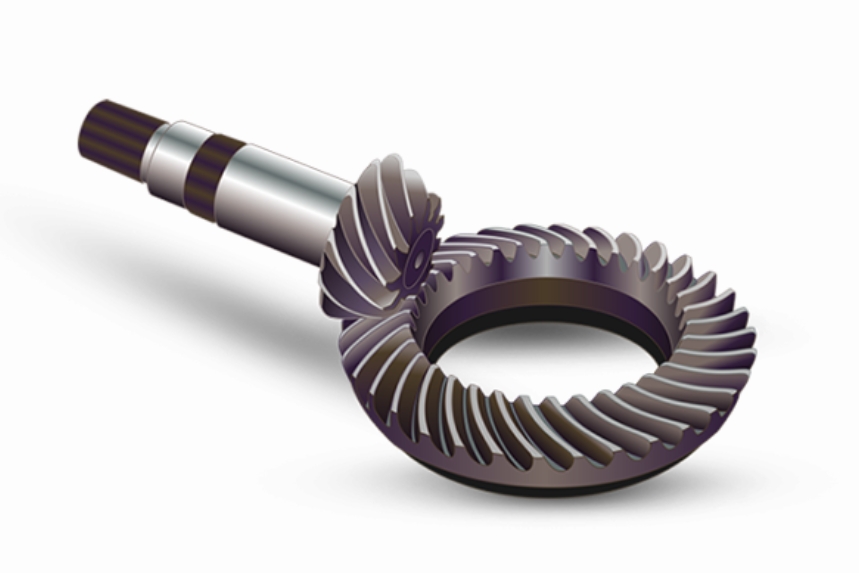
In this work, I adopt the local synthesis method as a foundation for TCA. Unlike global TCA, which involves solving nonlinear equations for entire tooth surfaces, local synthesis focuses on a specific reference point on the gear tooth and its immediate vicinity. This method allows for precise control over first-order and second-order contact parameters at the reference point, enabling tailored design of contact patterns and transmission error functions. The local synthesis procedure begins by selecting a point on the drive gear tooth surface (typically the concave side for a spiral bevel gear pair) and computing its second-order geometric parameters, such as principal curvatures and directions. Subsequently, desired performance criteria are imposed at this point: the first derivative of the transmission error function, the tangent direction of the contact path, and the semi-major axis length of the instantaneous contact ellipse. Based on these inputs, the corresponding second-order parameters for the driven gear tooth surface are derived, which in turn inform the machining parameters for that gear. This targeted approach reduces computational complexity and facilitates rapid iteration during design optimization.
The mathematical framework for local synthesis and TCA relies on differential geometry and coordinate transformations. Consider a pair of spiral bevel gears in mesh, where Gear 1 (pinion) and Gear 2 (gear) have tooth surfaces represented by vector functions $\mathbf{r}_1(u_1, \theta_1)$ and $\mathbf{r}_2(u_2, \theta_2)$, respectively, with $(u_i, \theta_i)$ being surface parameters. The meshing condition requires that the surfaces are in point contact and that their unit normals are collinear at the contact point. This can be expressed via the equation of meshing:
$$ \mathbf{n}_1 \cdot \mathbf{v}_{12} = 0 $$
where $\mathbf{n}_1$ is the unit normal to the pinion tooth surface, and $\mathbf{v}_{12}$ is the relative velocity between the two surfaces at the contact point. In a fixed coordinate system attached to the gear housing, the position vectors and normals undergo a series of transformations that account for the gear assembly settings, such as shaft angle, offset, and mounting distances. These transformations are efficiently handled in MATLAB using matrix operations. For instance, the transformation from the pinion coordinate system $S_1$ to the fixed system $S_f$ can be represented by a homogeneous transformation matrix $\mathbf{M}_{f1}$:
$$ \mathbf{M}_{f1} = \begin{bmatrix}
\mathbf{R}_{f1} & \mathbf{d}_{f1} \\
0 & 1
\end{bmatrix} $$
where $\mathbf{R}_{f1}$ is a 3×3 rotation matrix and $\mathbf{d}_{f1}$ is a translation vector. Similar matrices are defined for the gear. The contact analysis then involves solving for parameters $(u_1, \theta_1, \phi_1)$ and $(u_2, \theta_2, \phi_2)$ that satisfy the meshing condition across incremental rotations, where $\phi_1$ and $\phi_2$ are the rotation angles of the pinion and gear, related by the gear ratio $N = z_2 / z_1$ (with $z_i$ being tooth numbers).
To implement this in MATLAB, I developed a program that automates the local synthesis and TCA process. The code defines symbolic variables for all geometric and machining parameters, performs symbolic computations to derive tooth surface equations, and then substitutes numerical values for simulation. This symbolic approach minimizes rounding errors and allows for flexible parameter adjustments. The key steps in the program flow are outlined below:
- Input Parameters: Define gear geometry, cutter specifications, and machine tool settings.
- Tooth Surface Generation: Compute the pinion and gear tooth surfaces based on generation principles.
- Local Synthesis: Select a reference point on the gear tooth, calculate second-order parameters, and impose desired contact conditions.
- TCA Simulation: Solve the meshing equations iteratively for small angular increments to trace contact points and compute transmission error.
- Output Visualization: Plot contact traces on tooth flanks and transmission error curves.
For the specific spiral bevel gear pair studied here, the geometric dimensions are derived from design calculations. The table below summarizes the primary parameters, which serve as inputs to the MATLAB program. This data is essential for understanding the gear pair under analysis.
| Parameter | Symbol | Pinion (Driving) | Gear (Driven) | Unit |
|---|---|---|---|---|
| Number of Teeth | $z$ | 22 | 55 | – |
| Module (Transverse) | $m_t$ | 9.2 | 9.2 | mm |
| Normal Pressure Angle | $\alpha_n$ | 20.0 | 20.0 | ° |
| Mean Spiral Angle | $\beta$ | 30 | 30 | ° |
| Hand of Spiral | – | Left | Right | – |
| Shaft Angle | $\Sigma$ | 90 | ° | |
| Face Width | $b$ | 85 | mm | |
| Pitch Diameter | $d$ | 202.4 | 506.0 | mm |
| Pitch Cone Angle | $\delta$ | 21.801 | 68.199 | ° |
| Addendum | $h_a$ | 10.106 | 4.320 | mm |
| Dedendum | $h_f$ | 6.049 | 11.836 | mm |
| Outer Cone Distance | $R_e$ | 272.49 | mm | |
| Tangential Modification Coefficient | $\chi_t$ | 0.11 | -0.11 | – |
| Profile Shift Coefficient | $\xi$ | 0.3276 | -0.3276 | – |
The local synthesis method requires specifying a transmission error function at the reference point. I chose a parabolic function to ensure a smooth, low-noise operation. The transmission error $\Delta \phi_2$ as a function of pinion rotation $\phi_1$ is predefined as:
$$ \Delta \phi_2(\phi_1) = -a (\phi_1 – \phi_{1,0})^2 + c $$
where $a$ controls the curvature, $\phi_{1,0}$ is the reference pinion angle, and $c$ is a constant. The first derivative at the reference point is set to zero to achieve a stationary point, aligning with desired contact conditions. The contact ellipse dimensions are influenced by the principal curvatures and the applied load, but for simplicity in TCA, a semi-major axis length is预设 based on typical contact elasticity models.
Using the MATLAB program, I conducted TCA for three critical locations on the tooth flank of the spiral bevel gear: the midpoint, the outer end (heel), and the inner end (toe). These locations correspond to different radii along the tooth length and are crucial for assessing contact pattern stability under varying loads. The contact trace, which is the path of contact points on the tooth surface during meshing, was computed for each location. Additionally, the transmission error curves were generated by plotting the difference between the actual gear rotation and the ideal rotation against the pinion angle.
The results for the midpoint of the tooth flank reveal a contact trace that is nearly straight but exhibits a slight inward bias, often referred to as “inner diagonal” contact. This characteristic is visualized in the output plots. Mathematically, the contact trace can be represented as a curve on the tooth surface parameterized by the pinion angle. Let the surface coordinates be $(u, \theta)$, then the trace is given by solutions to the meshing equation over $\phi_1$. For the midpoint, the trace deviates from the ideal line by a small angle $\gamma$, which can be calculated from the second-order parameters. The transmission error curve at the midpoint shows a parabolic shape with a maximum error of approximately $1.1 \times 10^{-3}$ radians. The curve is asymmetric, indicating a controlled modification to the tooth profile, commonly known as crowning. This asymmetry helps in achieving a smooth entry and exit of teeth into mesh, reducing impact and noise.
At the outer end of the spiral bevel gear tooth, the contact trace tends to curve more significantly due to edge effects. The transmission error here reaches a peak of about $1.2 \times 10^{-3}$ radians. The curvature of the trace at the outer end can be analyzed using the differential geometry of surfaces. The normal curvature $\kappa_n$ along the contact path direction $\mathbf{T}$ is given by:
$$ \kappa_n = \mathbf{T}^T \cdot \mathbf{II} \cdot \mathbf{T} $$
where $\mathbf{II}$ is the second fundamental form of the tooth surface. Variations in $\kappa_n$ along the tooth length affect the contact pressure distribution. For the inner end, the contact trace shows a similar pattern but with a lower transmission error peak of $0.98 \times 10^{-3}$ radians. The consistency in transmission error magnitude across the three points suggests a well-balanced design for the spiral bevel gear, avoiding localized stress concentrations.
To further elucidate the geometric relationships, consider the equation of the tooth surface for a spiral bevel gear generated by a face-mill cutter. The surface vector $\mathbf{r}$ in the workpiece coordinate system can be expressed as:
$$ \mathbf{r}(u, \theta) = \mathbf{M}_{wc}(\theta) \cdot \mathbf{r}_c(u) $$
where $\mathbf{r}_c(u)$ is the cutter blade profile, and $\mathbf{M}_{wc}(\theta)$ is the transformation matrix from cutter to workpiece, incorporating the rolling motion during generation. This equation is fundamental to simulating tooth geometry in MATLAB. By differentiating with respect to parameters, one obtains the first and second fundamental forms, which are essential for curvature analysis.
The transmission error curves for all three locations were plotted on the same graph to compare their shapes. The parabolic nature is evident, with the vertex shifted depending on the reference point. The mathematical representation of transmission error for a pair of meshing spiral bevel gears can be derived from the kinematic relationship:
$$ \Delta \phi_2 = \phi_2 – \frac{z_1}{z_2} \phi_1 $$
where $\phi_2$ is computed from the TCA solution. In ideal conditions, $\Delta \phi_2 = 0$, but due to manufacturing adjustments and intentional modifications, it varies. The parabolic function imposed in local synthesis ensures that $\Delta \phi_2$ is continuous and smooth over the meshing cycle, which is critical for dynamic performance.
Another important aspect is the contact ellipse, which represents the instantaneous area of contact under light load. The size and orientation of the ellipse are determined by the relative curvatures of the mating surfaces. For two surfaces in point contact, the contact ellipse semi-axes $a$ and $b$ are given by Hertzian theory:
$$ a = \alpha \sqrt[3]{\frac{3F \rho}{4E^*}}, \quad b = \beta \sqrt[3]{\frac{3F \rho}{4E^*}} $$
where $F$ is the normal load, $\rho$ is the effective relative curvature, $E^*$ is the combined modulus of elasticity, and $\alpha, \beta$ are coefficients dependent on the curvature difference. In TCA, the contact ellipse is often approximated for visualization, and its major axis should align with the contact trace for optimal performance.
The MATLAB program also computes the path of contact on the tooth flank by solving the system of equations:
$$ \begin{cases}
\mathbf{r}_1(u_1, \theta_1, \phi_1) = \mathbf{r}_2(u_2, \theta_2, \phi_2) \\
\mathbf{n}_1(u_1, \theta_1, \phi_1) = \mathbf{n}_2(u_2, \theta_2, \phi_2)
\end{cases} $$
This is done iteratively for discrete values of $\phi_1$. The algorithm uses Newton-Raphson method for fast convergence, leveraging MATLAB’s matrix inversion capabilities. The output includes coordinates of contact points in both pinion and gear tooth surfaces, which are then transformed to a common coordinate system for plotting.
In discussing the results, it is noteworthy that the slight inner diagonal contact observed at the midpoint is actually beneficial for spiral bevel gears. This orientation increases the overlap ratio, enhancing smoothness and reducing noise. However, excessive inner diagonal can lead to edge loading and reduced load capacity. Therefore, the design achieved through local synthesis strikes a balance. The transmission error curves demonstrate that the gear pair has a low-error parabolic function, which is desirable for high-speed applications where vibration control is critical. The asymmetry in the curve allows for gradual engagement and disengagement, minimizing shocks.
To put this into perspective, the overall contact ratio of the spiral bevel gear pair, which includes transverse and face overlap, is computed from the geometry. The total contact ratio $\varepsilon$ is given by:
$$ \varepsilon = \varepsilon_t + \varepsilon_\alpha $$
where $\varepsilon_t$ is the transverse contact ratio and $\varepsilon_\alpha$ is the face contact ratio. For this gear pair, $\varepsilon_t = 1.270$ and $\varepsilon_\alpha = 1.961$, yielding $\varepsilon = 2.336$. This high contact ratio contributes to the smooth transmission error characteristics observed.
The advantages of using MATLAB for spiral bevel gear TCA are multifaceted. First, the symbolic toolbox allows for exact derivation of equations, reducing errors from numerical approximations. Second, the graphical output functions enable clear visualization of contact traces and error curves, aiding in design interpretation. Third, the program can be easily modified to explore different design parameters, such as pressure angle or spiral angle, and their effects on contact performance. This flexibility is invaluable for iterative design processes.
In conclusion, this detailed analysis underscores the effectiveness of combining local synthesis methodology with MATLAB programming for tooth contact analysis of spiral bevel gears. By focusing on key points along the tooth flank, I have demonstrated how contact traces and transmission error curves can be predicted and optimized. The results indicate that the studied spiral bevel gear pair exhibits favorable contact patterns with controlled transmission error, suitable for demanding applications. Future work could extend this approach to include loaded tooth contact analysis (LTCA) to account for elastic deformations under heavy loads, further enhancing the realism of simulations. Nonetheless, the current methodology provides a robust foundation for designing high-performance spiral bevel gears with minimal physical prototyping.
Throughout this exploration, the centrality of the spiral bevel gear in power transmission systems remains evident. Its complex geometry demands sophisticated analytical tools, and the integration of MATLAB with advanced mathematical methods like local synthesis offers a powerful solution. By repeatedly emphasizing the spiral bevel gear, this article highlights its significance and the ongoing need for precision in its design and analysis. The tables and equations presented herein serve as a comprehensive reference for engineers and researchers working on similar challenges, ultimately contributing to the advancement of gear technology.