
As an engineer and researcher deeply fascinated by the intricacies of mechanical systems, I have spent considerable time studying the nonlinear dynamic behaviors of spur gears. These components are fundamental in power transmission across industries, from automotive to aerospace, yet their performance is often compromised by phenomena like backlash-induced vibrations. In this article, I will delve into a comprehensive analysis of a single-stage spur gear system, focusing on how parameters such as backlash and meshing frequency interact to influence dynamic characteristics like bifurcation, impact, disengagement, and dynamic load coefficients. My goal is to provide a detailed exploration that not only highlights the complexities but also offers insights for optimizing spur gear designs. The nonlinear nature of spur gears, stemming from clearance effects, can lead to undesirable outcomes like noise, wear, and even failure, making this study crucial for advancing reliability in mechanical transmissions.
To begin, let me introduce the foundational model used in this analysis. The dynamics of a single-stage spur gear system are often represented using a lumped-parameter approach, which simplifies the gears into masses, springs, and dampers. This model captures essential nonlinearities, particularly the piecewise-linear function due to backlash. The system comprises two spur gears with associated bearings, and the equations of motion are derived considering torsional and translational degrees of freedom. The dimensionless form of these equations facilitates analysis across various operating conditions. For spur gears, the meshing stiffness is time-varying, and internal excitations like transmission errors add to the complexity. The dynamic transmission error, denoted as $y_{g3}$, is a key variable defined as:
$$ y_{g3}(\tau) = r_{g1}\theta_{g1}(\tau) – r_{g2}\theta_{g2}(\tau) + y_{g1} – y_{g2} – e(\tau) $$
Here, $r_{gi}$ are base circle radii, $\theta_{gi}$ are angular displacements, $y_{gi}$ are radial displacements, and $e(\tau)$ is the composite error. The dimensionless state-space equations are expressed as:
$$ \begin{aligned}
\dot{x}_1 &= x_2 \\
\dot{x}_2 &= -f_{b1} – 2\zeta_{11}x_2 – 2\zeta_{13}x_6 – k_{11} f(x_1, b_1) – k_{13}(\tau) f(x_5, b_3) \\
\dot{x}_3 &= x_4 \\
\dot{x}_4 &= f_{b2} – 2\zeta_{22}x_4 + 2\zeta_{23}x_6 – k_{22} f(x_3, b_2) + k_{23}(\tau) f(x_5, b_3) \\
\dot{x}_5 &= x_6 \\
\dot{x}_6 &= f_m + f_{ah}\Omega^2 \cos(\Omega\tau) + \dot{x}_2 – \dot{x}_4 – 2\zeta_{33}x_6 – k_{33}(\tau) f(x_5, b_3)
\end{aligned} $$
In these equations, $x_i$ represent dimensionless states (e.g., displacements and velocities), $\zeta_{ij}$ are damping ratios, $k_{ij}$ are stiffness coefficients, $f_{bi}$ are bearing preload factors, $f_m$ is the external load factor, and $f_{ah}$ is the internal excitation factor due to errors. The frequency ratio $\Omega = \Omega_h / \Omega_n$ compares the meshing frequency to the natural frequency, and $\tau$ is dimensionless time. The backlash nonlinearity $f(x, b)$ is defined piecewise:
$$ f(x, b) =
\begin{cases}
x – b & \text{if } x > b \\
0 & \text{if } |x| \le b \\
x + b & \text{if } x < -b
\end{cases} $$
This function is critical for spur gears, as it models the clearance between teeth that leads to impacts and disengagement. The parameters $b_1$, $b_2$, and $b_3$ correspond to bearing and gear backlash, with $b_3$ being the primary gear mesh backlash. To analyze such systems, numerical methods are essential, and I employ the CPNF (Continue Poincaré-Newton-Floquet) method, which efficiently tracks periodic solutions and assesses stability via Floquet multipliers. This method is particularly suited for low-degree-of-freedom systems with piecewise-smooth nonlinearities, like those in spur gears. The Jacobian matrix $\mathbf{f_X}(\mathbf{X}, \tau)$ is derived for stability analysis, and in non-smooth points, finite differences approximate the derivatives. The CPNF algorithm involves solving for periodic orbits, checking stability, and continuing solutions across parameter ranges, all while embedding calculations for impact events, disengagement duty cycle (DC1), back-side contact duty cycle (DC2), and dynamic load coefficient (DLC). These metrics are vital for evaluating spur gear performance: DC1 measures the proportion of time teeth are disengaged, DC2 indicates back-side contact, and DLC quantifies load fluctuations relative to static loads.
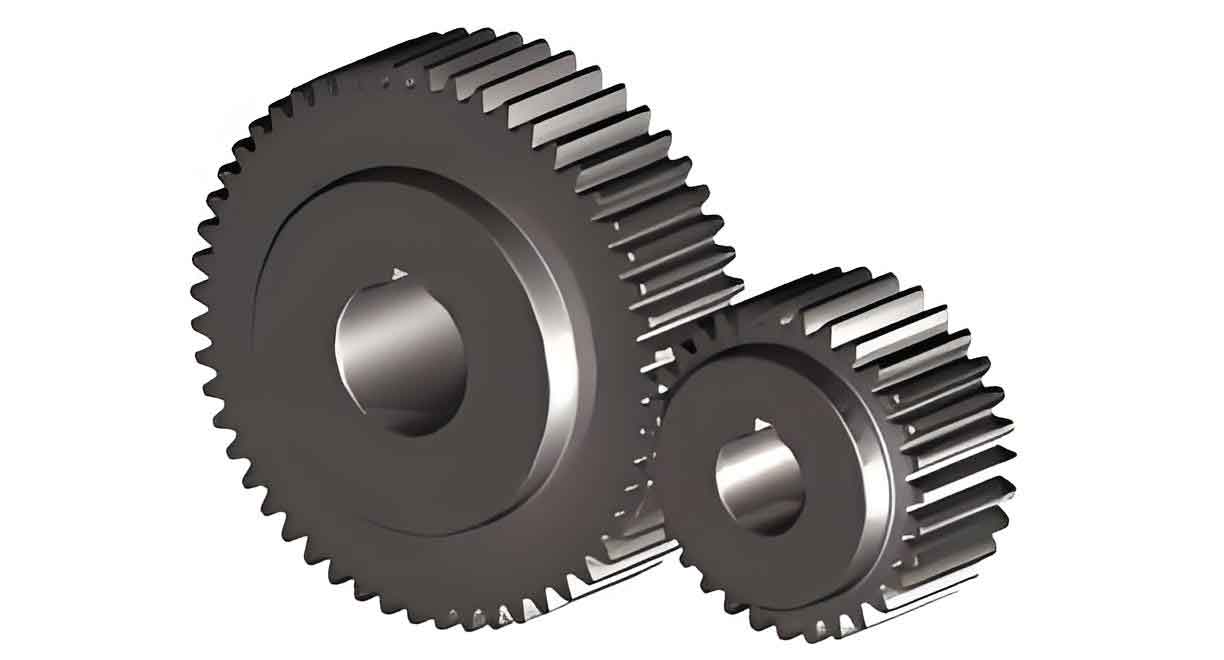
The visual above illustrates a typical spur gear pair, highlighting the meshing teeth where backlash and dynamic interactions occur. In my analysis, I focus on the parameter plane of dimensionless backlash $b$ (specifically $b_3$) and frequency ratio $\Omega$. This dual-parameter approach reveals coupling effects that single-parameter studies might miss. For instance, varying $\Omega$ simulates changes in operational speed, while adjusting $b$ reflects design tolerances or wear in spur gears. I set baseline parameters based on common spur gear configurations: damping ratios $\zeta_{11} = \zeta_{22} = 0.02$, $\zeta_{13} = \zeta_{23} = 0.0125$, $\zeta_{33} = 0.05$; stiffness ratios $k_{11} = k_{22} = 1.25$; load factors $f_m = 0.20$, $f_{ah} = 0.05$; time-varying stiffness coefficient $\alpha = 0.20$; and bearing preloads $f_{b1} = f_{b2} = 0.10$ with zero bearing clearance ($b_1 = b_2 = 0.00$). These values represent a realistic spur gear system under moderate loading.
Using the CPNF method, I first examine bifurcation behavior for fixed backlash values. For $b = 0.1$, the system undergoes a period-doubling cascade leading to a period-bubbling phenomenon as $\Omega$ increases from 1 to 2. Specifically, stable period-1 (P1) motion transitions to period-2 (P2), then period-4 (P4), back to P2, and finally returns to P1. This is confirmed by Floquet multipliers; for example, at $\Omega = 1.330$, a multiplier crosses -1, indicating a period-doubling bifurcation. Additionally, grazing events occur where the dynamic transmission error $x_5$ touches the backlash boundary $b$, causing sudden changes in impact states. The impact state is classified as 0 (no impact), 1 (single-sided impact), or 2 (double-sided impact), with the denominator denoting the period. For spur gears, double-sided impacts are particularly detrimental as they involve teeth contacting both flanks, leading to severe loads. At $b = 0.2$, the dynamics become more complex: Hopf bifurcations give rise to quasi-periodic motions, and saddle-node bifurcations induce chaotic behaviors via crises. These bifurcations are validated through Floquet multiplier calculations, as summarized in Table 1.
| Point | Parameters $(b, \Omega)$ | Tracked Period | Floquet Multipliers $\lambda$ | $|\lambda_{\text{max}}|$ | Bifurcation Type |
|---|---|---|---|---|---|
| A | (0.1, 1.330) | P1 | (-1.0492, -0.7736, 0.4214 ± 0.8080i, 0.6957, 0.7326) | 1.0492 | Period-Doubling |
| B | (0.1, 1.5275) | P1 | (0.5260 ± 0.5293i, -0.1050 ± 0.9150i, -1.0015, -0.8207) | 1.0015 | Period-Doubling |
| C | (0.2, 1.3900) | P4 | (0.0683 ± 1.2729i, 0.1440 ± 0.6815i, 0.0602 ± 0.1273i) | 1.2747 | Hopf |
| D | (0.2, 1.3450) | P4 | (1.0556, 0.3104 ± 0.6142i, -0.3078 ± 0.4265i, 0.0591) | 1.0556 | Saddle-Node |
The table underscores how spur gears exhibit diverse bifurcations under varying conditions. To further quantify dynamic characteristics, I compute duty cycles and load coefficients. The disengagement duty cycle DC1 is defined as the fraction of time when $|x_5| > b$, indicating teeth are out of contact. For back-side contact, DC2 measures the time when $x_5 < -b$, meaning teeth engage on the non-driving flank. The dynamic load coefficient DLC is the ratio of maximum dynamic meshing force to static force, given by:
$$ \text{DLC} = \frac{\max(|k_{33}(\tau) f(x_5, b_3)|)}{f_m} $$
For $b = 0.1$, DC1 peaks around $\Omega = 1.505$ with a value of 0.5748, coinciding with a transition from single-to double-sided impact. DLC reaches up to 2.655 near resonance ($\Omega \approx 1.5$), showing significant load amplification. At $b = 0.2$, DC1 extremes occur in chaotic regions, reaching 0.5783, while DLC peaks at 2.640 during saddle-node bifurcations. These results highlight that spur gears experience severe disengagement and loading under specific parameter combinations, especially near resonance with small backlash.
Extending to the two-parameter plane $\Omega \times b \in [1, 2] \times [0, 0.5]$, I generate pseudo-color maps to visualize global dynamics. The impact/period (I/P) map, shown conceptually, reveals rich structures: for small $b < 0.2$, period-bubbling patterns appear with sequences like P1-P2-P4-…-chaos-…-P4-P2-P1 as $\Omega$ varies. As $b$ increases, Hopf bifurcations lead to quasi-periodic orbits, and grazing bifurcations create sharp boundaries between impact states. Notably, for $b > 0.35$, the system stabilizes to single-sided impact regimes, indicating that larger backlash mitigates double-sided impacts but may increase other nonlinearities. The DC1, DC2, and DLC maps further elucidate these trends. DC1 values are low (near 0) in no-impact zones but jump to over 0.6 in chaotic regions. DC2 is mostly zero except in double-sided impact areas, where it can exceed 0.3, particularly at small $b$ and $\Omega \approx 1.5$. DLC is moderate (1.0–1.4) in stable P1 regions but surges above 2.2 near grazing bifurcations and resonance. These maps are summarized in Table 2, which categorizes parameter regions based on dynamic behaviors for spur gears.
| Parameter Region | Backlash $b$ Range | Frequency $\Omega$ Range | Dominant Motion | Impact State | DC1 Range | DC2 Range | DLC Range |
|---|---|---|---|---|---|---|---|
| Stable No-Impact | 0–0.5 | 1.0–1.3, 1.75–2.0 | P1 | 0/1 | 0–0.1 | 0 | 1.0–1.4 |
| Period-Bubbling | 0–0.2 | 1.3–1.75 | P1, P2, P4, … | 1/1, 2/1 | 0.1–0.6 | 0–0.3 | 1.4–2.2 |
| Quasi-Periodic & Chaos | 0.2–0.35 | 1.3–1.6 | Quasi-P, Chaos | 1/n, 2/n | 0.2–0.6+ | 0–0.2 | 1.8–2.6 |
| Large Backlash Stable | >0.35 | 1.3–1.75 | P1, P2, Chaos | 1/1, 1/n | 0.1–0.4 | 0 | 1.4–2.0 |
The underlying mechanisms for these behaviors in spur gears relate to nonlinear resonance and clearance effects. Near $\Omega = 1.5$, the system approaches its natural frequency, amplifying responses and triggering bifurcations. Small backlash restricts motion, causing teeth to frequently hit boundaries, leading to double-sided impacts and high DLC. As backlash increases, teeth have more room to move, reducing impacts but potentially allowing larger displacements that induce chaos via grazing or Hopf bifurcations. The CPNF method effectively captures these transitions by solving periodic orbits and their stability without simulating full transients, saving computational effort. For instance, the Jacobian in non-smooth regions is approximated as:
$$ \mathbf{f_X}(\mathbf{X}, \tau) \approx \begin{bmatrix}
f_{11} & f_{12} & \cdots & f_{1n} \\
f_{21} & f_{22} & \cdots & f_{2n} \\
\vdots & \vdots & \ddots & \vdots \\
f_{n1} & f_{n2} & \cdots & f_{nn}
\end{bmatrix}, \quad f_{ij} = \frac{f_i(\mathbf{X} + \Delta \mathbf{X}_j)}{\Delta x_j} $$
where $\Delta \mathbf{X}_j$ is a small perturbation. This allows precise tracking of bifurcations like grazing, where $x_5$ touches $b$, causing sudden changes in system topology. In spur gears, such events are critical as they correlate with noise and wear onset.
To deepen the analysis, I explore mathematical aspects of the dimensionless equations. The time-varying meshing stiffness $k_{33}(\tau) = 1 + \alpha \cos(\Omega \tau)$ models the fluctuating rigidity as teeth engage and disengage in spur gears. This parametric excitation, combined with backlash, creates a Mathieu-type equation with piecewise nonlinearity. The natural frequency $\Omega_n = \sqrt{k_m / m_e}$ depends on mean stiffness $k_m$ and equivalent mass $m_e$, setting the scale for resonance. Damping ratios $\zeta_{ij}$ are typically small (0.01–0.05) for spur gears, allowing sustained vibrations. The external load $f_m$ represents torque inputs; higher loads tend to suppress disengagement but may increase stress. Internal excitation $f_{ah}$ from errors acts as a forced term, driving responses at meshing frequency. By non-dimensionalizing, these parameters are scaled, enabling general insights across different spur gear sizes.
Now, let’s consider the implications for spur gear design. The results suggest that to minimize dynamic issues, parameters should avoid resonance regions and extreme backlash values. For example, operating at $\Omega < 1.3$ or $\Omega > 1.75$ with moderate backlash ($b \approx 0.2–0.3$) yields stable P1 motion with low impact, disengagement, and DLC. This aligns with practical guidelines where spur gears are designed with controlled backlash to balance thermal expansion and noise. However, my analysis quantifies these trade-offs: too small backlash ($b < 0.1$) causes double-sided impacts near resonance, escalating DLC and wear; too large backlash ($b > 0.35$) may reduce impacts but can lead to chaotic motions under certain frequencies. Therefore, optimal design involves selecting $b$ and $\Omega$ in the “safe” zones identified in the maps.
Furthermore, the CPNF method’s efficiency allows for extensive parameter sweeps, which I demonstrate by computing additional metrics. For instance, the root-mean-square (RMS) of dynamic transmission error $x_5$ can be derived as a function of $b$ and $\Omega$:
$$ \text{RMS}(x_5) = \sqrt{\frac{1}{T} \int_0^T x_5^2(\tau) d\tau} $$
where $T$ is the period. This RMS value correlates with vibration levels in spur gears. Similarly, the contact ratio, defined as the fraction of time teeth are in contact (i.e., $|x_5| \le b$), is simply $1 – \text{DC1}$. These derived metrics offer a more holistic view of spur gear performance. I also examine the effect of varying other parameters, such as damping or stiffness asymmetry, but for brevity, focus on the primary backlash-frequency plane.
In terms of numerical implementation, the CPNF algorithm involves iterative Newton-Raphson steps on Poincaré sections. For spur gears with periodic forcing, the Poincaré section is taken at $\tau \mod 2\pi/\Omega = 0$. The Floquet multipliers $\lambda$ are eigenvalues of the monodromy matrix $\mathbf{\Phi}(T)$, where $T$ is the period, computed via numerical integration of the variational equation. Stability requires all $|\lambda| \le 1$, with equality indicating bifurcation. The continuation step uses parameter derivatives like:
$$ \mathbf{f_\Omega}(\mathbf{X}, \Omega, \tau) = \frac{\partial \mathbf{f}}{\partial \Omega} = \begin{bmatrix} 0 \\ -1 \\ 0 \\ 1 \\ 0 \\ -6 \end{bmatrix} \frac{\alpha \sin(\Omega \tau)}{4} + \begin{bmatrix} 0 \\ 0 \\ 0 \\ 0 \\ 0 \\ 1 \end{bmatrix} f_{ah} \Omega [2 \cos(\Omega \tau) + \Omega \sin(\Omega \tau)] $$
to adjust solutions along $\Omega$. This approach reliably tracks branches even through bifurcations, though care is needed at non-smooth points. For spur gears, the piecewise nature requires detecting boundary crossings, which I handle by monitoring $x_5$ relative to $\pm b$.
To contextualize, these findings for spur gears resonate with broader nonlinear dynamics literature. Period-bubbling and grazing bifurcations are common in systems with clearances, such as impact oscillators or mechanical joints. However, the addition of time-varying stiffness and multiple degrees of freedom in spur gears enriches the behavior. My work extends prior studies by providing a comprehensive two-parameter analysis, revealing how backlash and frequency interplay to govern dynamics. This is crucial for predictive maintenance and condition monitoring of spur gear transmissions, where changes in backlash due to wear can shift operational points into hazardous zones.
In conclusion, the dynamic characteristics of spur gears are profoundly influenced by backlash and meshing frequency. Through detailed analysis using the CPNF method, I have mapped out regions of stable operation, bifurcations, and extreme events in the parameter plane. Key takeaways include: small backlash coupled with resonance frequencies leads to severe impacts, high disengagement, and elevated dynamic loads; increasing backlash beyond a threshold (around $b=0.35$) mitigates double-sided impacts but may introduce quasi-periodic or chaotic motions; and stable, low-vibration operation is achievable by avoiding resonance and selecting moderate backlash. These insights can guide the design and optimization of spur gear systems, enhancing reliability and longevity. Future work could explore additional parameters like error profiles or bearing nonlinearities, but the foundational understanding presented here provides a robust framework for analyzing spur gears in engineering applications.
Throughout this article, I have emphasized the importance of spur gears in mechanical systems and how their nonlinear dynamics can be managed through parameter selection. The interplay between backlash and frequency is a critical aspect that designers must consider to avoid undesirable behaviors. By leveraging advanced numerical methods like CPNF, we can predict and mitigate issues, ensuring that spur gears operate smoothly and efficiently. As technology advances, such analyses will become integral to developing next-generation transmissions with higher performance and durability. I hope this detailed exposition sparks further interest in the fascinating world of spur gear dynamics and its applications across industries.