
The transmission of motion and power is a fundamental requirement in mechanical systems, and among the various methods available, gear-based transmission stands as the most critical and widespread. Within this domain, the spur cylindrical gear represents the most extensively utilized type. Its simplicity, ease of manufacturing, and ability to provide precise speed and torque conversion make it indispensable across a vast spectrum of industrial applications, from automotive transmissions and industrial gearboxes to precision instruments. The primary function of a spur cylindrical gear pair is to bear substantial loads and transmit rotational motion efficiently between parallel shafts, making its operational performance paramount to the reliability of the entire machinery.
In high-speed or heavy-duty operational scenarios, spur cylindrical gears are subjected to significant dynamic loads, high-frequency meshing cycles, and potential impact forces. These conditions can lead to increased vibration, elevated noise levels, accelerated wear, and in extreme cases, catastrophic failure. The dynamic interaction between meshing teeth is complex, governed by time-varying stiffness, manufacturing errors, and load fluctuations. Therefore, moving beyond static analysis to conduct a thorough dynamic performance analysis is of immense importance for predicting real-world behavior, optimizing design for longevity and quiet operation, and preventing unforeseen downtimes.
Traditionally, physical prototyping and testing have been the mainstays for such analyses. However, these approaches are often characterized by long development cycles, high costs, significant measurement uncertainties, and limited scope for investigating parametric variations. The advent of sophisticated virtual simulation technology has revolutionized this process. Modern simulation software offers a powerful, cost-effective, and accurate alternative, enabling researchers and engineers to build detailed digital prototypes, subject them to realistic operating conditions, and extract a wealth of performance data that would be difficult or impossible to obtain experimentally.
This article employs advanced multibody dynamics simulation to conduct an in-depth investigation into the dynamic performance of a spur cylindrical gear pair. The process involves the creation of a high-fidelity virtual prototype model. This model is then subjected to dynamic simulation under conditions mimicking actual operation. The analysis focuses on key dynamic indicators: the transmission ratio to validate kinematic accuracy, the dynamic meshing force between contacting teeth to assess load-sharing and impact severity, and the system’s vibrational response. The findings aim to provide a robust theoretical foundation for improving the transmission performance, optimizing meshing characteristics to reduce vibration and noise, and enhancing the overall durability of spur cylindrical gear drives.
1. Geometric Modeling and Virtual Prototype Development
The foundation of an accurate dynamic simulation lies in a precise geometric model. The gear pair under investigation is a standard single-stage reduction set, comprising a smaller driving pinion and a larger driven gear. The fundamental geometric parameters defining the spur cylindrical gears are summarized in Table 1.
| Component Name | Number of Teeth (z) | Module (m) in mm | Pressure Angle (α) in ° | Face Width (b) in mm |
|---|---|---|---|---|
| Pinion (Driver) | 17 | 10 | 20 | 100 |
| Gear (Driven) | 25 | 10 | 20 | 100 |
These parameters allow for the calculation of other critical dimensions. The pitch diameter (d) for each spur cylindrical gear is given by:
$$ d = m \times z $$
Thus, for the pinion, $$ d_{pinion} = 10 \text{ mm} \times 17 = 170 \text{ mm} $$, and for the gear, $$ d_{gear} = 10 \text{ mm} \times 25 = 250 \text{ mm} $$.
The theoretical center distance (a) between the shafts is:
$$ a = \frac{m \times (z_1 + z_2)}{2} = \frac{10 \times (17 + 25)}{2} = 210 \text{ mm} $$
Using these parameters, detailed three-dimensional solid models of the individual spur cylindrical gears were created in a modern CAD software. The models accurately represent the involute tooth profile, root fillets, and hub geometry. These components were then virtually assembled with their shafts and housing to ensure proper alignment and meshing, resulting in the complete gear pair assembly.
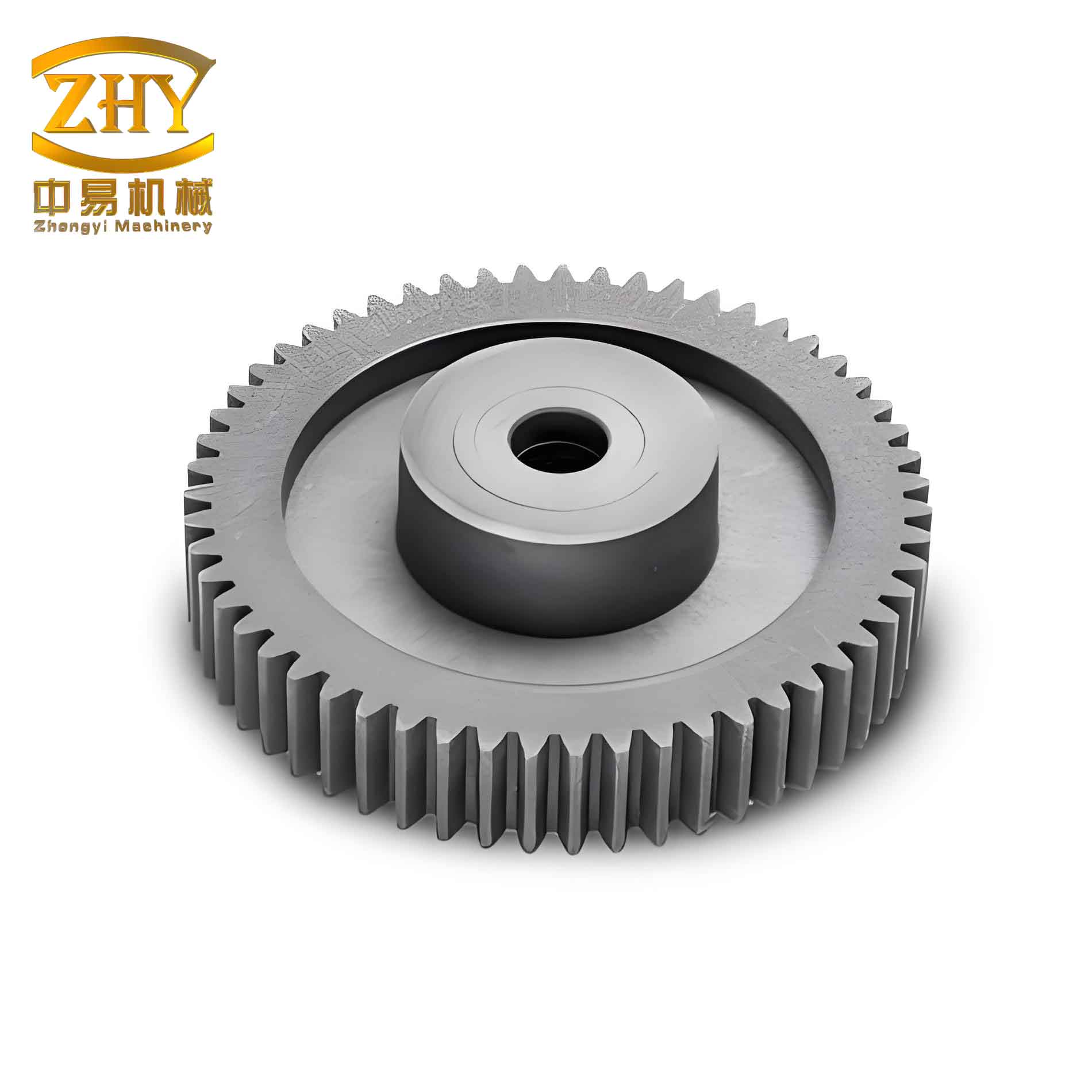
The transition from a static CAD model to a dynamic virtual prototype is a crucial step. The assembled model was exported in the Parasolid (*.x_t) format, a robust geometric kernel format, and imported into a multibody dynamics simulation environment, ADAMS/View. Upon import, a model validation check was performed to identify any redundant or conflicting constraints carried over from the CAD assembly. Any such issues were rectified at the CAD stage, and the model was re-imported until it passed the validation test without errors.
To simulate real-world physics, material properties were assigned. Both spur cylindrical gears and their shafts were assigned the properties of steel, with a density (ρ) of $$ 7.85 \times 10^{-6} \text{ kg/mm}^3 $$, a Young’s Modulus (E) of $$ 2.07 \times 10^{5} \text{ MPa} $$, and a Poisson’s ratio (ν) of 0.29. The virtual prototype’s kinematic structure was defined by applying appropriate joints (also known as kinematic pairs) between the bodies, as detailed in Table 2.
| Component Pair | Joint Type | Degrees of Freedom Constrained |
|---|---|---|
| Pinion & Ground (Frame) | Revolute Joint | 5 (All except rotation about its axis) |
| Gear & Ground (Frame) | Revolute Joint | 5 (All except rotation about its axis) |
| Pinion & Gear | Contact Force | 0 (Defines force interaction, not a kinematic constraint) |
The most critical element for dynamic analysis is the definition of the contact force between the meshing teeth of the spur cylindrical gears. Unlike a kinematic joint that prescribes motion, a contact force law calculates the interaction force based on the penetration and relative velocity of the contacting geometries. This allows for the simulation of impacts, separation, and the time-varying nature of meshing. The “Impact” function, based on a spring-damper model, was used. The normal force component is calculated as:
$$ F_n = k \cdot \delta^e + STEP(\delta, 0, 0, d_{max}, c_{max}) \cdot \dot{\delta} $$
where:
– $$ k $$ is the contact stiffness.
– $$ \delta $$ is the penetration depth of one geometry into another.
– $$ e $$ is the force exponent (typically >1 for metals).
– $$ STEP $$ is a function that ramps the damping coefficient (c) from 0 to $$ c_{max} $$ as penetration increases from 0 to $$ d_{max} $$.
– $$ \dot{\delta} $$ is the penetration velocity.
A tangential friction force based on the Coulomb model was also included. The parameters used for the contact force definition are listed in Table 3.
| Parameter | Symbol | Value |
|---|---|---|
| Stiffness (k) | k | 1.0e+05 N/mm |
| Force Exponent (e) | e | 1.5 |
| Max. Damping (c_max) | $$ c_{max} $$ | 100 N·s/mm |
| Penetration Depth for Full Damping (d_max) | $$ d_{max} $$ | 0.1 mm |
| Static Coefficient of Friction (μ_s) | $$ \mu_s $$ | 0.08 |
| Dynamic Coefficient of Friction (μ_d) | $$ \mu_d $$ | 0.05 |
| Stiction Transition Velocity (v_s) | $$ v_s $$ | 0.01 mm/s |
| Friction Transition Velocity (v_d) | $$ v_d $$ | 0.10 mm/s |
2. Dynamic Simulation Setup and Kinematic Analysis
To simulate the operational cycle of the spur cylindrical gear pair, motion and load inputs were applied to the virtual prototype. A rotational motion was applied to the pinion’s revolute joint. To avoid numerical instabilities caused by instantaneous acceleration, a smooth step function was used to ramp up the angular velocity from 0 to a steady-state value. The driving function was defined as:
$$ \text{STEP}(time, 0, 0, 1, 3000) $$
This function commands the pinion to accelerate from 0 deg/s at time=0s to 3000 deg/s at time=1s, maintaining that speed thereafter. To simulate a loaded condition, a resistive torque (load) was applied to the pinion’s axis of rotation, opposing the driving motion. Similarly, this load was ramped up smoothly:
$$ \text{STEP}(time, 0, 0, 1, 4.5\text{e+05}) $$
This applies a load torque increasing from 0 N·mm to 450,000 N·mm (450 N·m) over the first second. The complete, fully constrained virtual prototype model was now ready for dynamic simulation. A simulation was run for 5 seconds with a high output step count of 1000 to ensure detailed data capture, particularly of the fast meshing events.
The primary kinematic output is the angular velocity of both gears. The applied drive function successfully resulted in the pinion’s velocity profile ramping up smoothly in the first second and holding steady at 3000 deg/s (or 50 rev/s, 314.16 rad/s). The corresponding angular velocity of the driven spur cylindrical gear is shown in the following plot (conceptually described, as per the user’s instruction not to reference image numbers).
The driven gear’s velocity increases during the acceleration phase. In the steady-state phase (1-5 seconds), it fluctuates around a mean value. The theoretical speed of the driven gear can be calculated from the gear ratio (i):
$$ i = \frac{z_{gear}}{z_{pinion}} = \frac{25}{17} \approx 1.4706 $$
$$ \omega_{gear, theoretical} = \frac{\omega_{pinion}}{i} = \frac{3000 \text{ deg/s}}{1.4706} \approx 2040.8 \text{ deg/s} $$
The simulation output shows the mean value of the driven gear’s angular velocity is approximately 2040 deg/s, which matches the theoretical calculation perfectly. This close agreement serves as a critical validation of the virtual prototype’s kinematic accuracy, confirming that the geometric modeling, assembly constraints, and joint definitions are correct. The small, periodic fluctuations observed in the steady-state velocity are a direct consequence of the dynamic meshing process of the spur cylindrical gears, including effects like tooth deflection and contact loss, which are not captured in a simple kinematic ratio calculation.
3. Analysis of Dynamic Meshing Forces and System Response
With the kinematics validated, the focus shifts to dynamics, primarily the forces generated at the tooth contact interface. The meshing force between the spur cylindrical gears is the single most important dynamic metric, as it directly dictates stress levels, wear rates, and vibrational excitation. The applied load torque of 450 N·m on the pinion creates a nominal tangential force (F_t) at the pitch circle, which can be estimated statically:
$$ F_t = \frac{2T}{d_{pinion}} = \frac{2 \times 450 \text{ N·m}}{0.170 \text{ m}} \approx 5294 \text{ N} $$
However, the actual dynamic meshing force computed by the simulation, which accounts for inertia, impact, and time-varying mesh stiffness, is significantly different and richer in information.
The simulation extracts the contact force vector from the defined contact pair. The magnitude of this force over the 5-second simulation is shown in a conceptual plot. During the 0-1 second ramp-up phase, the force magnitude increases but exhibits pronounced oscillatory behavior due to the transient accelerations and repeated impacts as teeth come into contact. After 1 second, under steady-state speed and load, the meshing force settles into a clear, repeating periodic pattern. The force does not remain constant; instead, it pulses with each new tooth engagement. A peak force is observed at the moment of initial contact (when contact occurs away from the theoretical line of action due to deflection, potentially causing impact), followed by a variation as the contact point moves along the tooth flank, and a drop to zero as the pair disengages before the next pair makes contact. The peak dynamic meshing force observed in the simulation is substantially higher than the static estimate of ~5300 N, often reaching values over 8000 N in this model. This highlights the critical importance of dynamic analysis for spur cylindrical gears; static calculations can severely underestimate the actual peak loads experienced during operation, leading to under-designed components.
The frequency of this force pulsation is the Gear Mesh Frequency (GMF). It is calculated as:
$$ \text{GMF} = f_{pinion} \times z_{pinion} = (\frac{3000 \text{ deg/s}}{360 \text{ deg/rev}}) \times 17 = (8.333 \text{ rev/s}) \times 17 \approx 141.7 \text{ Hz} $$
The periodic oscillation observed in both the driven gear speed and the meshing force corresponds to this fundamental mesh frequency and its harmonics. This dynamic excitation is the primary source of vibration and noise in spur cylindrical gear systems. The magnitude and shape of the force pulse are influenced by factors like the contact stiffness parameter (k), damping, and the precise involute profile geometry.
4. Extended Analysis: Stress, Modal Analysis, and Parametric Study
While multibody dynamics provides excellent force and motion data, a comprehensive analysis of spur cylindrical gears often requires integration with other simulation methods. The dynamic meshing forces extracted from the ADAMS simulation can be used as boundary conditions for a detailed Finite Element Analysis (FEA) to obtain precise stress distributions on the gear teeth. The time-history of the contact force can be applied to an FE model to visualize the bending stress at the tooth root and the contact (Hertzian) stress on the tooth flank throughout the meshing cycle. This combined approach is powerful for fatigue life prediction and identifying potential failure zones in the spur cylindrical gear design.
Furthermore, a modal analysis of the gear-shaft assembly can be performed, either within a multibody framework using flexible bodies or in a dedicated FEA package. This analysis determines the natural frequencies and mode shapes of the system. The results are typically summarized in a table:
| Mode Number | Natural Frequency (Hz) | Description of Mode Shape |
|---|---|---|
| 1 | f1 | Torsional oscillation of pinion shaft |
| 2 | f2 | Torsional oscillation of gear shaft |
| 3 | f3 | Bending (rocking) of pinion about its axis |
| 4 | f4 | Bending (rocking) of gear about its axis |
| 5 | f5 | Planar vibration of the entire gear pair |
It is crucial to ensure that the Gear Mesh Frequency (GMF) and its significant harmonics do not coincide with any of these system natural frequencies. Resonance, which occurs when an excitation frequency matches a natural frequency, can lead to dramatically amplified vibration levels and rapid failure. For example, if the GMF of 141.7 Hz were close to, say, mode 4’s frequency f4, it would indicate a high risk of resonance, necessitating a design change such as altering the gear tooth count, module, or support stiffness.
The virtual prototype model enables efficient parametric studies to optimize the spur cylindrical gear design. Key geometric and material parameters can be varied, and their effect on dynamic performance metrics can be assessed systematically. Table 5 shows a conceptual summary of such a study.
| Parameter Varied | Effect on Peak Dynamic Meshing Force | Effect on Vibration Amplitude | Comments |
|---|---|---|---|
| Increase Module (m) | Decreases | Decreases | Larger, stronger teeth have higher stiffness and lower deflection. |
| Increase Pressure Angle (α) | Minor Increase | Variable | Stronger tooth root but potentially higher sliding friction. |
| Increase Face Width (b) | Decreases | Decreases | Reduces nominal stress, improves load distribution. |
| Increase Contact Stiffness (k) | Increases Impact Peaks | Increases High-Freq. Noise | Softer contact can dampen impact but increases deflection. |
| Introduge Profile Modification (Tip Relief) | Reduces Initial Impact Peak | Significantly Reduces | Compensates for deflection, smoothens tooth engagement. |
5. Conclusion
This comprehensive analysis demonstrates the power of multibody dynamics simulation as an indispensable tool for understanding and optimizing the performance of spur cylindrical gears. By constructing and simulating a detailed virtual prototype, it was possible to accurately replicate the kinematic behavior, validating the model against fundamental gear theory. More importantly, the simulation provided deep insights into the dynamic phenomena that govern real-world operation: the time-varying, impact-laden nature of the meshing force, and the resulting vibrational excitation at the gear mesh frequency.
The results underscore a critical engineering principle: static load calculations are insufficient for designing reliable spur cylindrical gear systems for dynamic applications. The peak dynamic forces can be significantly higher due to inertial and impact effects. Furthermore, the periodic meshing force acts as an excitation source, and its relationship with the system’s natural frequencies must be carefully managed to avoid resonant conditions that lead to excessive noise and accelerated fatigue.
The methodology outlined—combining rigid multibody dynamics for system-level motion and force prediction, with finite element analysis for localized stress analysis and modal characterization—provides a robust virtual engineering workflow. This integrated approach, complemented by parametric studies, offers a powerful framework for improving the transmission performance, durability, and acoustic characteristics of spur cylindrical gear drives. It enables designers to proactively address dynamic issues, optimize gear geometry and system parameters, and develop more reliable, efficient, and quieter gear transmissions without relying solely on costly and time-consuming physical prototypes.