
The analysis of vibration characteristics in geared rotor systems is fundamental to the design and reliable operation of modern rotating machinery. Among various gear types, the helical gear is widely employed due to its superior load-carrying capacity, smoother engagement, and quieter operation compared to spur gears. However, the very geometry that grants these advantages—the helix angle—introduces complex three-dimensional dynamic coupling between translational and rotational degrees of freedom (DOFs). This coupling, encompassing bending, torsion, axial, and tilting motions, significantly influences the system’s natural characteristics and forced response. This article presents a detailed investigation into the vibration behavior of a parallel-shaft rotor system coupled by multiple helical gear pairs, with a specific focus on the effects arising from different levels of freedom coupling.
The core of an accurate dynamic analysis lies in a faithful mathematical model. A three-parallel-shaft system, interconnected by two helical gear pairs, serves as the exemplar for this study. The rotor shafts are modeled using finite beam elements based on Timoshenko beam theory, accounting for shear deformation and rotary inertia. Each shaft element possesses twelve degrees of freedom, representing displacements and rotations at each node:
$$
\mathbf{u}^e = [x_A, y_A, z_A, \theta_{xA}, \theta_{yA}, \theta_{zA}, x_B, y_B, z_B, \theta_{xB}, \theta_{yB}, \theta_{zB}]^T
$$
where the superscript \( e \) denotes the element. Supporting bearings are modeled as linear spring-damper elements at specified nodes.
The unique dynamic interaction is introduced through the helical gear mesh. A three-dimensional, six-DOF-per-gear dynamic model for a generic helical gear pair is developed. This model comprehensively considers factors such as static transmission error (STE), gear geometric eccentricity, helix angle, pressure angle, and rotational direction. The model treats the gears as rigid disks connected along the line of action by a spring-damper element representing the meshing stiffness \(k_{ij}\) and damping \(c_{ij}\).
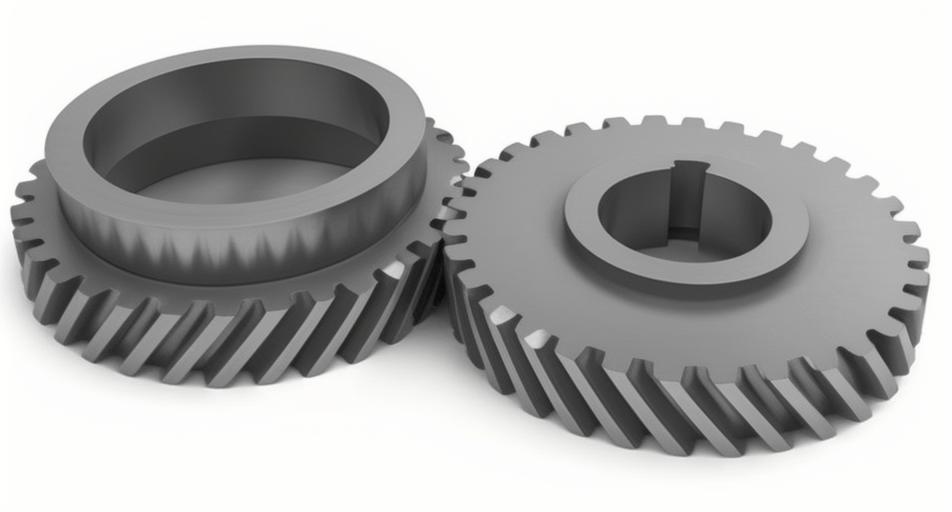
The relative displacement along the line of action, \(p_{ij}(t)\), is the fundamental coordinate governing the mesh force. For a helical gear pair between gear \(i\) and gear \(j\), this displacement is a function of all twelve DOFs, the helix angle \(\beta_{ij}\), the orientation angle \(\psi_{ij}\), base circle radii \(r_i, r_j\), eccentricities \(e_i, e_j\), and the static transmission error \(e_{ij}(t)\):
$$
\begin{aligned}
p_{ij}(t) = & \big[ – (x_i – e_i(1-\cos(\Omega_i t)))\sin\psi_{ij} + (x_j – e_j(1-\cos(\Omega_j t)))\sin\psi_{ij} \\
& + (y_i + e_i\sin(\Omega_i t))\cos\psi_{ij} – (y_j + e_j\sin(\Omega_j t))\cos\psi_{ij} \\
& + \text{sgn} \cdot r_i \theta_{zi} + \text{sgn} \cdot r_j \theta_{zj} \big] \cos\beta_{ij} \\
& + \big[ \text{sgn} \cdot (z_i – z_j) + (r_i\sin\psi_{ij} + \text{sgn} \cdot e_i\sin(\Omega_i t)) \theta_{xi} \\
& + (r_j\sin\psi_{ij} – \text{sgn} \cdot e_j\sin(\Omega_j t)) \theta_{xj} \\
& – (r_i\cos\psi_{ij} + \text{sgn} \cdot e_i\cos(\Omega_i t)) \theta_{yi} \\
& – (r_j\cos\psi_{ij} – \text{sgn} \cdot e_j\cos(\Omega_j t)) \theta_{yj} \big] \sin\beta_{ij} – e_{ij}(t)
\end{aligned}
$$
Here, \(\text{sgn}\) is a direction factor (+1 for counter-clockwise rotation of the driving gear, -1 for clockwise). The STE is typically modeled as a sinusoidal function: \(e_{ij}(t) = e_{0} + e_{ij} \sin(N_i \Omega_i t + \phi)\).
Applying Newton’s second law and considering the kinematic relationships between geometric center and mass center coordinates, the linearized equations of motion for a single helical gear pair can be derived. These equations can be cast into a compact matrix form for the generalized coordinate vector \(\mathbf{X}_{ij} = [x_i, y_i, z_i, \theta_{xi}, \theta_{yi}, \theta_{zi}, x_j, y_j, z_j, \theta_{xj}, \theta_{yj}, \theta_{zj}]^T\):
$$
\mathbf{M}_{ij} \ddot{\mathbf{X}}_{ij} + (\mathbf{C}_{ij} + \mathbf{G}_{ij}) \dot{\mathbf{X}}_{ij} + \mathbf{K}_{ij} \mathbf{X}_{ij} = \mathbf{F}_{1ij} + \mathbf{F}_{sij} + \mathbf{F}_{w}
$$
where \(\mathbf{M}_{ij}\) is the diagonal mass/inertia matrix, \(\mathbf{G}_{ij}\) is the gyroscopic matrix, and \(\mathbf{F}_{w}\) is the vector of external torques. The excitation force vectors \(\mathbf{F}_{1ij}\) and \(\mathbf{F}_{sij}\) stem from the static transmission error and gear eccentricities, respectively. Crucially, the stiffness and damping matrices are formulated as:
$$
\mathbf{K}_{ij} = k_{ij} \cdot \boldsymbol{\alpha}_{ij}^T \cdot \boldsymbol{\alpha}_{ij}, \quad \mathbf{C}_{ij} = c_{ij} \cdot \boldsymbol{\alpha}_{ij}^T \cdot \boldsymbol{\alpha}_{ij}
$$
The transformation vector \(\boldsymbol{\alpha}_{ij}\), defined below, is the key that encodes the coupling between all six DOFs of each gear in the pair through the geometry of the helical gear mesh:
$$
\boldsymbol{\alpha}_{ij} = [-\sin\psi_{ij}\cos\beta_{ij}, \cos\psi_{ij}\cos\beta_{ij}, \text{sgn}\sin\beta_{ij}, r_i\sin\psi_{ij}\sin\beta_{ij}, -r_i\cos\psi_{ij}\sin\beta_{ij}, \text{sgn} r_i\cos\beta_{ij}, \sin\psi_{ij}\cos\beta_{ij}, -\cos\psi_{ij}\cos\beta_{ij}, -\text{sgn}\sin\beta_{ij}, r_j\sin\psi_{ij}\sin\beta_{ij}, -r_j\cos\psi_{ij}\sin\beta_{ij}, \text{sgn} r_j\cos\beta_{ij}]
$$
This formulation yields a fully populated 12×12 stiffness matrix for the gear pair, linking every degree of freedom. The global finite element model of the complete helical gear rotor system is assembled by combining the shaft beam element matrices, bearing matrices, and the gear pair matrices at the appropriate nodal locations. The final system equation of motion is:
$$
\mathbf{M}\ddot{\mathbf{u}} + \mathbf{D}\dot{\mathbf{u}} + \mathbf{K}\mathbf{u} = \mathbf{F}_u
$$
where \(\mathbf{M}\), \(\mathbf{D}\), and \(\mathbf{K}\) are the global mass, damping (including Rayleigh damping and bearing damping), and stiffness matrices, respectively; \(\mathbf{u}\) is the global displacement vector; and \(\mathbf{F}_u\) is the global force vector containing all excitations.
The primary objective is to understand the impact of inter-DOF coupling introduced by the helical gear. This is achieved by strategically manipulating the gear mesh stiffness matrix \(\mathbf{K}_{ij}\). By selectively zeroing out certain terms in the \(\boldsymbol{\alpha}_{ij}\) vector before computing \(\mathbf{K}_{ij}\), one can simulate different coupling scenarios. The following five cases are defined and analyzed:
| Case | Description | Active Coupling Terms in α |
|---|---|---|
| Case 1 | No Gear Coupling (Baseline) | None. Gear matrices omitted. |
| Case 2 | Lateral-Lateral (Bending-Bending) Coupling | Terms related to \(x_i, y_i, x_j, y_j\) only. |
| Case 3 | Torsional-Torsional Coupling | Terms related to \(\theta_{zi}, \theta_{zj}\) only. |
| Case 4 | Full Bending-Torsional Coupling | Terms related to \(x_i, y_i, \theta_{zi}, x_j, y_j, \theta_{zj}\). |
| Case 5 | Full Bending-Torsional-Axial-Tilting Coupling | All terms in α (the complete model). |
The natural characteristics of the system under these five coupling cases are first examined by solving the undamped eigenvalue problem (neglecting gyroscopic effects at zero speed). The complex eigenvalues, \(\lambda = -\sigma \pm j\omega_d\), are computed, where \(\omega_d\) represents the damped natural frequency. A summary of the first six natural frequencies for each case is presented below:
| Mode | Case 1: No Coupling | Case 2: Bending-Bending | Case 3: Torsion-Torsion | Case 4: Bending-Torsion | Case 5: Full Coupling |
|---|---|---|---|---|---|
| 1 | 1467.34 | 1467.34 | 1095.11 | 836.68 | 807.96 |
| 2 | 1467.34 | 1661.29 | 1467.34 | 1359.71 | 1345.04 |
| 3 | 2056.04 | 2056.04 | 1467.34 | 1467.34 | 1467.34 |
| 4 | 2332.75 | 2332.75 | 1702.25 | 1678.88 | 1676.19 |
| 5 | 2332.75 | 2350.69 | 2332.75 | 2332.75 | 2332.75 |
| 6 | 2350.69 | 2412.77 | 2332.75 | 2350.69 | 2347.65 |
The results reveal significant insights. Case 1 shows repeated frequencies, indicating degenerate modes from identical uncoupled shafts. Introducing gear coupling (Cases 2-5) breaks this degeneracy and creates new system-level modes. Cases 2 and 3, with limited coupling, show the fewest changes relative to the baseline. The most pronounced shifts occur in Cases 4 and 5, where bending-torsion interaction is present. The first natural frequency drops substantially, indicating a more compliant system mode when torsional and lateral motions are linked. The frequencies for Case 4 and Case 5 are very close for higher modes, but notable differences exist in the first two modes, underscoring the influence of axial and tilting motions present in the full helical gear model.
For the forced response analysis, multiple excitation sources are considered simultaneously to reflect practical conditions: static transmission error for both helical gear pairs, mass unbalance on the rotors, and geometric eccentricity of the helical gears. The system’s steady-state frequency response is computed over a speed range from 0 to 5000 rpm. The response, typically the magnitude of displacement or bearing force at a critical location, is plotted against the rotational speed of the input shaft.
The forced response curves for the different coupling cases exhibit distinct characteristics. The peaks in these curves correspond to rotational speeds where an excitation frequency (primarily the gear mesh frequency, \(f_{mesh} = N \cdot \Omega / 60\)) coincides with a system natural frequency.
- Case 2 (Bending-Bending): Predicts only one major resonance peak in the analyzed speed range, potentially missing critical excitations.
- Case 3 (Torsion-Torsion): Shows several peaks in the torsional response but fails to accurately predict lateral response amplitudes and may miss peaks visible in other directions.
- Case 4 (Bending-Torsion): Captures four distinct resonance peaks. At lower speeds, its predictions are reasonable. However, as speed increases, the predicted peak locations and amplitudes begin to deviate from the more complete model.
- Case 5 (Full Coupling): Also reveals four primary resonance peaks (labeled A, B, C, D). Each peak can be traced to a specific helical gear mesh frequency exciting a specific system natural mode. For instance, Peak A occurs when the mesh frequency of the first helical gear pair nears the first system natural frequency (~808 Hz). The response amplitudes and precise critical speeds predicted by this model are considered the most accurate, as it incorporates all potential energy pathways and coupling mechanisms inherent to the helical gear geometry.
The following table correlates the resonance peaks from the full coupling model (Case 5) with the excitation source and the excited system mode.
| Peak | Input Shaft Speed (rpm) | Exciting Mesh Frequency | Proximate System Natural Freq. (Case 5) | Primary Nature of Excited Mode |
|---|---|---|---|---|
| A | ~920 | Helical Gear Pair 1-2 | 1st Mode (808 Hz) | Coupled Bending-Torsion |
| B | ~1550 | Helical Gear Pair 1-2 | 2nd Mode (1345 Hz) | Coupled Bending-Torsion |
| C | ~1930 | Helical Gear Pair 1-2 | 4th Mode (1676 Hz) | Coupled Bending-Torsion |
| D | ~1000 | Helical Gear Pair 3-4 | 1st Mode (808 Hz) | Coupled Bending-Torsion |
The analysis clearly demonstrates that simplified coupling models can lead to non-conservative designs. A bending-only analysis might completely miss torsional resonances that can induce high lateral loads. A torsion-only model underestimates lateral vibration levels. While the bending-torsion model is a significant improvement, the full helical gear model (bending-torsion-axial-tilting) provides the highest fidelity, especially for predicting the response near the fundamental modes where axial/tilting coupling through the helix angle is most influential. This model is essential for high-speed, high-precision applications where helical gears are prevalent.
Parametric studies further highlight the sensitivity of the helical gear rotor system. Key parameters include:
1. Helix Angle (\(\beta\)): The helix angle is the primary driver of axial-tilting coupling. Its variation significantly affects the stiffness matrix \(\mathbf{K}_{ij}\).
$$
\frac{\partial \mathbf{K}_{ij}}{\partial \beta} = k_{ij} \left( \frac{\partial \boldsymbol{\alpha}_{ij}^T}{\partial \beta} \cdot \boldsymbol{\alpha}_{ij} + \boldsymbol{\alpha}_{ij}^T \cdot \frac{\partial \boldsymbol{\alpha}_{ij}}{\partial \beta} \right)
$$
As \(\beta\) increases, the axial component (\(\sin\beta\)) grows, strengthening the coupling between axial displacement \(z\) and bending/torsion, while the transverse component (\(\cos\beta\)) slightly decreases. This trade-off can shift natural frequencies and alter the mode shapes, potentially moving critical speeds into or out of the operating range.
2. Mesh Stiffness (\(k_{ij}\)): The average meshing stiffness of the helical gear pair, often considered constant for simplification, directly scales the coupling stiffness matrix. Its value depends on gear geometry, tooth modifications, and load.
3. Eccentricity and Transmission Error: These are major sources of parametric excitation. Their combined effect in the excitation vector can be expressed as:
$$
\mathbf{F}_{ex} \propto k_{ij} (e_j – e_i) \boldsymbol{\alpha}_{ij}^T \cos\beta_{ij} \sin\psi_{ij} + k_{ij} e_{ij} \sin(N_i \Omega_i t) \boldsymbol{\alpha}_{ij}^T + \text{(damping and velocity terms)}
$$
This shows how manufacturing and assembly errors (eccentricity \(e\), STE amplitude \(e_{ij}\)) directly generate oscillating forces at the mesh frequency and its harmonics, exciting the system’s coupled modes.
4. Damping: Damping in the gear mesh (\(c_{ij}\)) and bearings plays a crucial role in attenuating resonance peaks. The proportional (Rayleigh) damping model is often used: \(\mathbf{C} = \alpha \mathbf{M} + \beta \mathbf{K}\). The coefficients \(\alpha\) and \(\beta\) are determined from modal damping ratios \(\xi_n\) for two specific modes:
$$
\alpha = \frac{2 \omega_1 \omega_2 (\xi_1 \omega_2 – \xi_2 \omega_1)}{\omega_2^2 – \omega_1^2}, \quad \beta = \frac{2 (\xi_2 \omega_2 – \xi_1 \omega_1)}{\omega_2^2 – \omega_1^2}
$$
In conclusion, the dynamic analysis of a helical gear coupled rotor system necessitates a modeling approach that accounts for the intrinsic coupling between bending, torsion, axial, and tilting degrees of freedom. The simplified models (bending-only, torsion-only) are insufficient for accurate prediction of natural frequencies and, more importantly, for forecasting forced vibration response under combined excitations. The full six-DOF-per-gear coupling model, derived from the fundamental geometry of the helical gear mesh, provides a comprehensive and reliable tool for such analysis. It enables engineers to identify all potential resonance conditions, accurately assess vibration amplitudes, and optimize system parameters—such as helix angle, support stiffness, and damping—to ensure reliable operation away from critical speeds and to minimize dynamic loads. This understanding is paramount in the design of advanced power transmission systems, turbomachinery, and automotive drivetrains where helical gears are extensively employed for their performance benefits.