
The reliable performance of gear shafts is paramount in power transmission systems across diverse industries, including automotive, aerospace, and heavy machinery. These components are routinely subjected to high cyclical contact stresses and bending loads, necessitating exceptional surface hardness for wear resistance coupled with a tough, ductile core to withstand impact and fatigue. To achieve this combination of properties, low-carbon alloy steels like 20Cr2Ni4A are commonly employed, undergoing a thermochemical treatment process of carburizing followed by quenching and tempering. This process enriches the surface with carbon, transforming it into a high-carbon martensite upon quenching, while the core develops a strong, lower-carbon martensitic or bainitic microstructure. However, the very phase transformation that confers strength also generates significant internal stresses. When these quench-induced stresses exceed the material’s local fracture strength, catastrophic failure can occur, often manifesting as through-cracking. This article presents a detailed first-person metallurgical investigation into the root causes of such a failure in a production batch of 20Cr2Ni4A gear shafts, integrating analytical data, theoretical stress analysis, and preventive metallurgical principles.
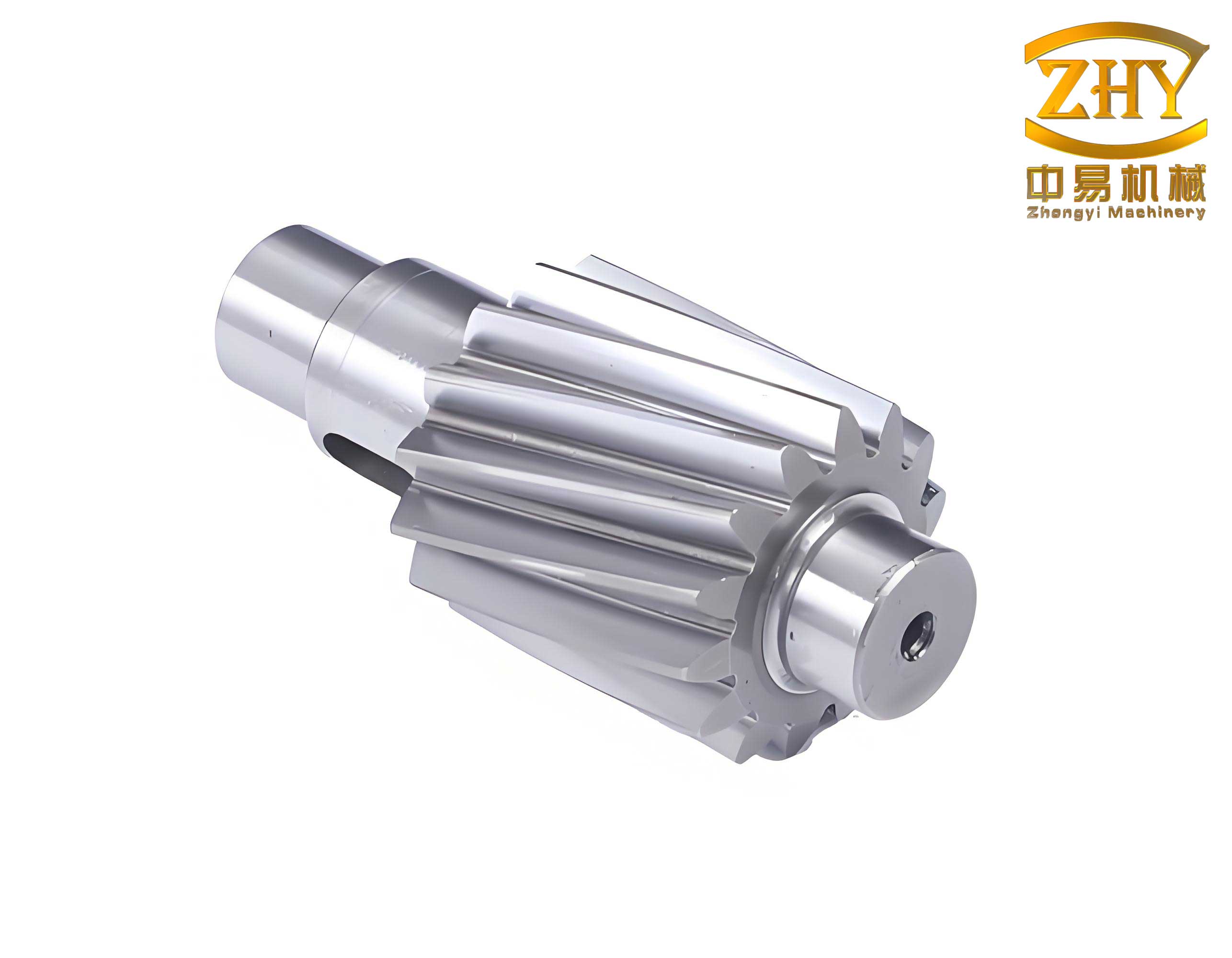
The failed gear shafts in question were approximately 480 mm in length, with stepped diameters of about 80 mm and 66 mm at either end. The documented manufacturing sequence was: cutting → forging → first normalizing → rough machining → second normalizing → finish machining → carburizing and quenching → gear grinding. The failure was identified immediately post-quench, characterized by severe longitudinal cracks that originated at the surface and propagated radially inwards, completely traversing the component’s core and extending axially along its entire length. This mode of failure is indicative of quenching cracks, typically driven by a combination of thermal gradients (thermal stress) and transformational volume changes (transformational stress). My investigation began with a macroscopic examination, confirming the crack’s orientation and completeness, before proceeding to systematic laboratory analysis to uncover the metallurgical anomalies that predisposed these gear shafts to crack.
The initial step involved verifying the base material conformity. Spectrochemical analysis was performed on a sample extracted from the cracked gear shaft. The results, compared against the standard specification for alloy structural steels, are presented below:
| Element | Measured (wt.%) | Standard Spec. (Typical) |
|---|---|---|
| C | 0.21 | 0.17-0.23 |
| Si | 0.30 | 0.17-0.37 |
| Mn | 0.45 | 0.30-0.60 |
| Cr | 1.35 | 1.25-1.65 |
| Ni | 3.45 | 3.25-3.65 |
| P | 0.003 | ≤ 0.025 |
| S | 0.002 | ≤ 0.025 |
The composition was well within specification, ruling out material mix-up or gross compositional deviation as a primary cause. The high nickel and chromium content confirms the high hardenability of this steel grade, a key factor in the subsequent analysis.
Metallographic examination commenced with the core microstructure. A sample sectioned from the end of the failed gear shaft was prepared, polished, and etched with 4% nital. Observation under an optical microscope revealed a predominantly martensitic structure throughout the core region. The absence of significant pro-eutectoid ferrite or upper transformation products like bainite indicated that the quenching process was sufficiently rapid to fully transform the core to martensite, confirming the component was through-hardened. The core hardness was measured and found to be in the expected range for low-carbon martensite in this alloy, as will be detailed later. This through-hardening is critical because it maximizes transformational volume expansion in the core, contributing to high internal tensile stresses at the surface during the later stages of quenching.
The investigation then focused intensely on the carburized case, the region where the crack initiated. Transverse samples were carefully extracted from the cracked section using wire electrical discharge machining to avoid introducing additional thermal damage. Meticulous preparation was undertaken to preserve the extreme edge of the case. The etched samples revealed several alarming microstructural features in the near-surface region (approximately the first 300 µm).
Firstly, the prior austenite grain boundaries in the carburized case were conspicuously coarse and deeply etched, appearing as prominent dark networks. Using standard intercept methods, the prior austenite grain size was quantified. The grain size was non-uniform but significantly large, with many grains measuring over 30 µm and some reaching up to 40.4 µm, corresponding to an ASTM grain size number of 6-7. This represents a relatively coarse microstructure for a high-strength case. The relationship between grain size and yield strength is often described by the Hall-Petch equation:
$$
\sigma_y = \sigma_0 + k_y d^{-1/2}
$$
where $\sigma_y$ is the yield strength, $\sigma_0$ is the friction stress, $k_y$ is the strengthening coefficient, and $d$ is the average grain diameter. For martensite, the relationship is more complex but the trend holds: coarse grains generally lead to lower strength and, more importantly for crack initiation, reduced fracture toughness and increased susceptibility to intergranular failure. The coarse grains in these gear shafts provided a favorable path for crack propagation.
Secondly, and more critically, these coarse grain boundaries were decorated with continuous or semi-continuous networks of light-etching constituents. Micro-hardness mapping using a low load (10 gf) was performed directly on these features. The results were revealing:
| Location | Microhardness (HV0.01) | Interpretation |
|---|---|---|
| Grain Interior (Martensite) | 549 – 599 | High-carbon martensite |
| Grain Boundary Network | 294 – 469 | Weakened zone |
| Light-etching phase at boundary | 301 – 422* | Very soft phase (e.g., ferrite) |
*Note: The measured hardness of the thin boundary phase includes a contribution from the surrounding harder matrix, meaning its true hardness is even lower.
The hardness of the light-etching phase (300-422 HV) is far below that expected for carbides (which typically exceed 700 HV for cementite and are much higher for alloy carbides) and is consistent with non-martensitic transformation products like ferrite or very low-carbon bainite. This phenomenon is identified as intergranular oxidation (IGO) or, more broadly, internal oxidation. During gas carburizing at high temperatures (often above 930°C), oxygen from the furnace atmosphere diffuses along austenite grain boundaries. This oxygen reacts with strong oxide-forming elements in the steel, primarily chromium, manganese, and silicon, depleting these elements from the adjacent matrix. The depletion of alloying elements, especially chromium, significantly lowers the hardenability of the austenite in a very localized zone along the grain boundaries. Upon quenching, this alloy-depleted zone transforms not into hard martensite but into softer products like ferrite or pearlite. This creates a continuous weak path along the grain boundaries, severely embrittling the case. The depth of this affected zone (≈300 µm) suggested prolonged exposure to a high-temperature, oxidizing carburizing atmosphere.
A microhardness traverse from the surface to the core was performed to assess the effectiveness of the carburizing and quenching process. The results are plotted below, with key zones summarized in a table.
| Zone | Distance from Surface | Microhardness (HV0.2) | Comment |
|---|---|---|---|
| Outer Case | 0 – 300 µm | 532 – 541 | Lower than expected |
| Sub-surface Case | 300 – 2200 µm | 590 – 749 | As expected for high-carbon martensite |
| Transition & Core | > 2200 µm | 404 – 473 | As expected for low-carbon martensite |
The most striking finding was the abnormally low surface hardness. For a properly processed 20Cr2Ni4A gear shaft, the surface hardness should typically be ≥ 700 HV. The severe depression to ~540 HV indicated a fundamental issue with the surface microstructure. This led to the final critical measurement: quantification of retained austenite. Using X-ray diffraction analysis on multiple surface locations of the failed gear shaft, the retained austenite content was found to be exceptionally high.
| Measurement Point | Retained Austenite Content (wt.%) |
|---|---|
| 1 | 39.8 |
| 2 | 43.4 |
| 3 | 43.7 |
The specification for carburized and quenched components typically mandates a retained austenite content below 25%, and often aims for less than 15-20%. The measured values, averaging above 40%, represent a severe deviation. Retained austenite is a soft, metastable phase. Its excessive presence directly explains the low surface hardness. High retained austenite content is a direct consequence of a high austenitizing temperature and/or excessive time at temperature during the quench heating stage, which increases the carbon and alloy content in solution in the austenite, thereby depressing its Martensite Start (Ms) temperature. The relationship between Ms and composition can be approximated by:
$$
M_s (^{\circ}C) = 539 – 423C – 30.4Mn – 17.7Ni – 12.1Cr – 7.5Mo
$$
where the element symbols represent weight percent. An elevated carburizing or quench temperature leads to higher carbon concentration in the austenite, significantly lowering Ms and increasing the amount of austenite that fails to transform upon quenching.
With all experimental data gathered, a comprehensive failure mechanism for these gear shafts can be constructed. The root cause was a combination of process-induced microstructural defects that catastrophically reduced the fracture resistance of the carburized case, coinciding with the peak tensile quenching stresses.
1. Stress State During Quenching: For a cylindrical component like these gear shafts, the stress evolution is complex. Initially, during rapid cooling, the surface cools and contracts faster than the hot core, placing the surface in tension and the core in compression (thermal stress dominant). As the core subsequently transforms to martensite, it expands volumetrically. In a through-hardening steel, this core expansion occurs while the surface is already cold and rigid, placing the surface under a severe state of biaxial or triaxial tensile stress (transformation stress dominant). The maximum principal tensile stress at the surface, $\sigma_{max}$, can be conceptualized as a superposition of thermal and transformational components. A simplified model for the transformational stress contribution considers the volume strain, $\Delta V/V$, associated with the martensitic transformation in the core acting against the elastic constraint of the case:
$$
\sigma_{trans} \approx \frac{E}{1-\nu} \cdot \frac{\Delta V}{V} \cdot f
$$
where $E$ is Young’s modulus, $\nu$ is Poisson’s ratio, and $f$ is a geometric constraint factor close to 1 for a fully hardened section. This stress can easily reach levels exceeding the ultimate tensile strength of a compromised material.
2. The Role of Microstructural Defects: The abnormal microstructure in the case of these gear shafts created a perfect storm for failure under this stress.
* Coarse Austenite Grains: Reduced grain boundary area, lowering toughness and providing a straighter path for crack propagation (higher stress intensity factor for a given crack size).
* Intergranular Oxidation & Grain Boundary Softening: This was the most critical defect. The continuous network of soft ferrite along grain boundaries acted as pre-existing micro-cracks or regions of extremely low cohesive strength. The fracture strength of the boundary, $\sigma_{gb}$, was drastically reduced from that of the martensitic matrix. When the quenching stress $\sigma_{quench}$ exceeded $\sigma_{gb}$, intergranular crack initiation became inevitable. The phenomenon can be likened to a severely weakened grain boundary cohesion energy, $\gamma_{gb}$.
* Excessive Retained Austenite: The soft, unstable retained austenite lowered the overall yield and tensile strength of the surface material, reducing its ability to plastically accommodate the quenching stresses. Furthermore, any subsequent transformation of this retained austenite to martensite (e.g., during grinding or in service) can induce additional untempered martensite and associated stresses.
The failure sequence is thus reconstructed: During the quench, as the core transformed and expanded, high tensile stresses developed in the case. These stresses localized at the embrittled, oxidized prior austenite grain boundaries, which had the lowest fracture resistance. Multiple micro-cracks initiated along these boundaries. Given the continuous network and the high stress level, these micro-cracks readily linked up, forming a macroscopic crack front. The crack then propagated radially inward through the case and into the core, and axially along the direction of maximum tensile stress, resulting in the observed complete longitudinal fracture of the gear shafts. The crack path was predominantly intergranular in the case, transitioning to a transgranular mode in the tougher core material.
In conclusion, the catastrophic quench cracking of the 20Cr2Ni4A gear shafts was not due to a single error but a synergistic combination of microstructural anomalies all stemming from suboptimal thermal processing parameters. The primary root causes were:
1. Excessive carburizing or austenitizing temperature and/or time, leading to coarsening of the prior austenite grains and promoting intense internal oxidation along these boundaries.
2. The internal oxidation caused depletion of hardenability-enhancing elements (Cr, Mn) at grain boundaries, resulting in the formation of soft, non-martensitic phases (ferrite) that severely embrittled the case.
3. The same high temperature cycle led to excessive carbon dissolution in the austenite, depressing the Ms temperature and resulting in dangerously high levels of soft retained austenite in the case, further reducing its strength.
4. The high hardenability of the steel ensured full martensitic transformation in the core, generating maximum transformational tensile stresses in the already critically weakened surface layer.
To prevent recurrence in future production of similar gear shafts, the following corrective and preventive actions are essential:
* Review and Tighten Thermal Cycle Parameters: Lower the carburizing temperature (e.g., to 910-930°C) and strictly control time at temperature to minimize austenite grain growth and internal oxidation potential. Implement controlled atmosphere carburizing with low oxygen potential (e.g., using endothermic gas with precise air-to-gas ratio or nitrogen-methanol based atmospheres).
* Optimize Quench Practice: For high-hardenability steels like 20Cr2Ni4A, consider using a quenching medium with lower severity (e.g., a fast oil instead of a brine or severe polymer) to moderate thermal gradients. If feasible, implement interrupted or martempering quenching to reduce transformational stresses.
* Implement Post-Quench Deep Cryogenic Treatment: To transform the excessive retained austenite, a deep cryogenic treatment (e.g., at -80°C to -196°C) followed by a low-temperature temper should be incorporated into the process flow. This will increase surface hardness and dimensional stability.
* Enhance Quality Control: Establish mandatory metallurgical checks for critical batches. This should include case depth verification, surface hardness testing, and periodic audit of case microstructure for grain size and absence of continuous grain boundary networks. Quantitative retained austenite measurement via XRD should be a standard checkpoint.
* Consider Steel Cleanliness: Specify steels with lower oxygen content and controlled levels of strong oxide formers (Si, Mn) where possible, to inherently reduce susceptibility to internal oxidation.
This investigation underscores that the performance of critical components like gear shafts is dictated not just by the nominal chemistry and prescribed heat treatment cycle, but by the precise control of the metallurgical state achieved at each process step. A deviation leading to a weakened grain boundary network can nullify all other design advantages, leading to sudden and total failure.