
The reliable operation of mechanical transmissions is fundamentally dependent on the integrity of its core rotating components. Among these, the gear shaft serves as a critical load-bearing element, simultaneously transmitting torque while withstanding complex dynamic loads. These loads include forces from rotating masses, cyclical gas pressures, and inertial forces from reciprocating parts. The failure of such a component not only halts the machinery but can also lead to catastrophic secondary damage. This report provides a detailed first-person analysis of a fracture failure encountered in a transmission gear shaft after approximately eight months of service. The objective is to determine the root cause of failure through a systematic investigation encompassing macro- and micro-fractography, material characterization, and mechanical property evaluation, thereby providing a basis for preventive measures.
1. Introduction and Background
The gear shaft under investigation was fabricated from medium-carbon steel, nominally equivalent to AISI 1035 or Chinese grade 35# steel. This material is commonly selected for its favorable combination of strength, toughness, and manufacturability, typically achieved through processes like quenching and tempering to produce a tempered martensite or sorbitic microstructure. The specific failed component was a shaft integrating a threaded section for assembly. The fracture occurred at the transition region between the threaded portion and the main body of the shaft, a classic location for stress concentration. The service history indicated exposure to significant cyclic operational stresses, which immediately directed the investigation towards fatigue as a potential failure mode.
2. Analytical Procedure and Methodology
A multi-technique approach was employed to dissect the failure sequence. The initial and crucial step was a thorough macroscopic examination of the fracture surface and the adjacent areas to identify fracture origin(s) and mode. Subsequently, material from the failed gear shaft was sampled for comprehensive laboratory testing. Chemical composition was verified using plasma emission spectrometry against standard specifications. Mechanical properties, including tensile strength, yield strength, elongation, reduction of area, and Charpy V-notch impact energy, were measured at room temperature following standardized test methods (e.g., ASTM E8/E8M and ASTM E23).
The heart of the failure analysis lay in microscale investigation. Fractography was conducted using a Scanning Electron Microscope (SEM) to reveal the fine details of the fracture initiation and propagation zones. Energy Dispersive Spectroscopy (EDS) was utilized on the SEM to perform spot chemical analysis if any anomalies were detected. Finally, metallographic samples were sectioned transversely and longitudinally near the fracture origin, prepared via standard grinding, polishing, and etching techniques (typically with Nital), and examined using optical microscopy to evaluate the base metal microstructure and the presence of any manufacturing or material defects such as decarburization, inclusions, or abnormal grain growth.
3. Results and Discussion
3.1 Macroscopic Fractography
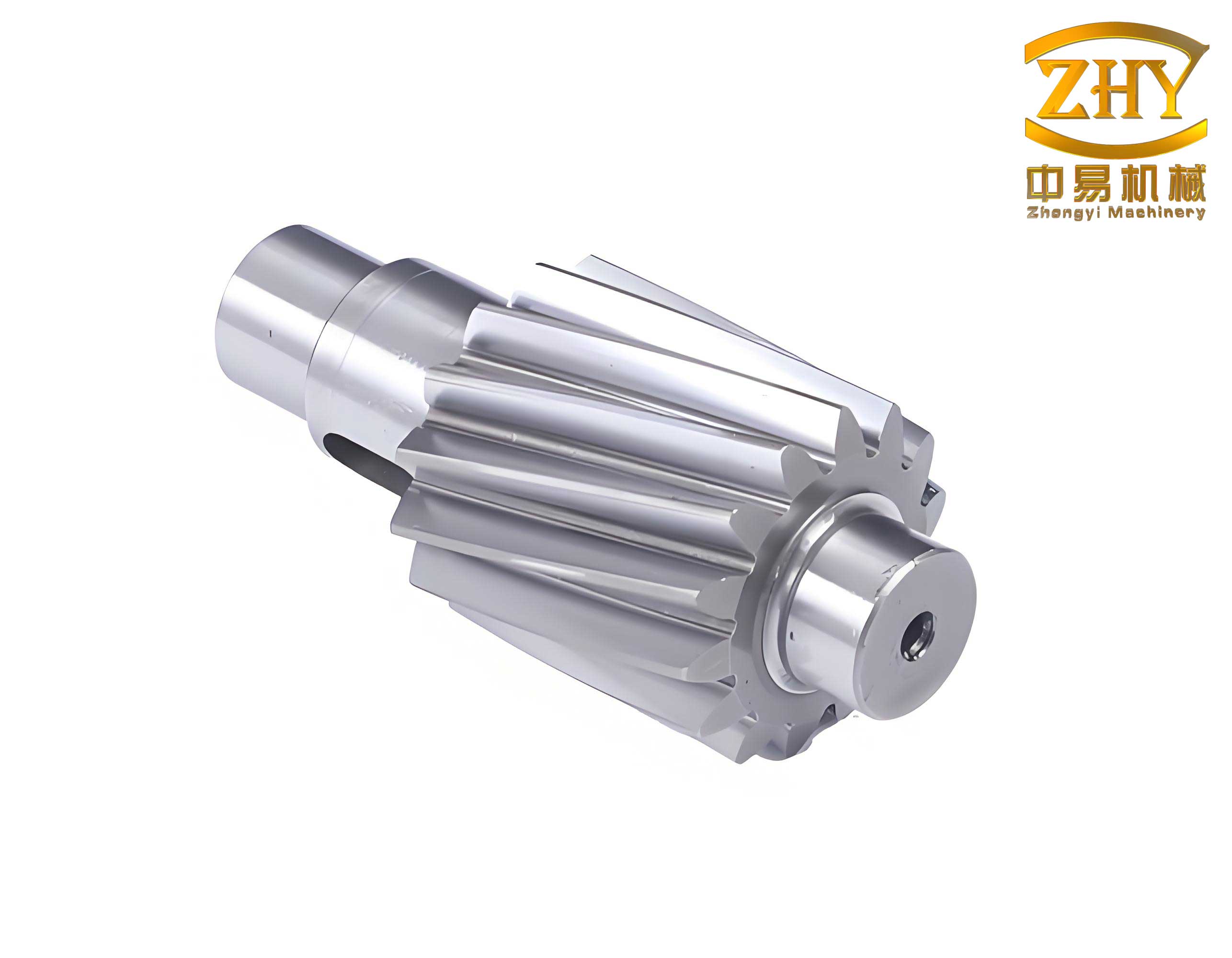
The overall appearance of the fractured gear shaft is shown in the accompanying figure. The fracture plane is located precisely at the root of the first engaged thread, where the shaft diameter changes. Macroscopic examination reveals clear indicators of a fatigue failure process:
- Origin: The fatigue crack initiated at a single point on the surface, at the root of a thread. This location represents a potent stress concentration feature. The stress concentration factor (Kt) for a thread root can be approximated for preliminary assessment:
$$K_t \approx 1 + 2\sqrt{\frac{h}{r}}$$
where \(h\) is the thread depth and \(r\) is the root radius. A small root radius significantly increases \(K_t\), elevating local stresses well above the nominal applied stress. - Beach Marks: The fracture surface shows a smooth, relatively flat region emanating from the origin. Closer inspection reveals subtle, curved progression lines or “beach marks,” which are macroscopic markers of successive positions of the crack front during cyclic loading. This region constitutes the stable fatigue crack growth zone.
- Final Fracture Zone: After the fatigue crack propagated through approximately one-third to one-half of the cross-sectional area, the remaining ligament became insufficient to carry the load. This led to a sudden, fast fracture. The morphology of this zone is rougher and often exhibits shear lips, indicative of final overload. The transition from the fatigue zone to the fast fracture zone was abrupt.
- No Gross Defects: No signs of significant plastic deformation prior to failure, gross machining flaws, or corrosion were visually apparent at the origin site.
The macroscopic evidence strongly points to a high-cycle fatigue failure originating from a stress concentrator (the thread root), under conditions where the cyclic stress amplitude was a substantial fraction of the material’s capability.
3.2 Material Conformance: Chemistry and Mechanical Properties
Material verification is essential to rule out improper grade selection or significant compositional deviations as primary causes.
Chemical Composition: The results of the spectroscopic analysis are summarized in Table 1. The weight percentages of carbon (C), silicon (Si), manganese (Mn), phosphorus (P), and sulfur (S) all fall within the specified limits for standard 35#/1035 steel. Phosphorus and sulfur levels are particularly low, which is beneficial for toughness. Therefore, the failure cannot be attributed to a gross chemical non-conformity.
| Element | C | Si | Mn | P | S | Fe |
|---|---|---|---|---|---|---|
| Measured Value | 0.37 | 0.25 | 0.71 | 0.008 | 0.006 | Balance |
| Standard Range (GB/T 699) | 0.32-0.39 | 0.17-0.37 | 0.50-0.80 | ≤0.035 | ≤0.035 | Balance |
Mechanical Properties: The results from tensile and impact testing, presented in Table 2, reveal a critical finding. While the yield strength and ductility parameters (elongation and reduction of area) meet or exceed the common requirements for quenched and tempered 35# steel, the ultimate tensile strength (UTS) and, more notably, the Charpy impact energy are below the expected values for a properly heat-treated component of this type.
| Property | Yield Strength (Rp0.2) | Ultimate Tensile Strength (Rm) | Elongation (A) | Reduction of Area (Z) | Charpy V-Notch Impact Energy (KV2) |
|---|---|---|---|---|---|
| Measured Value | 330 MPa | 525 MPa | 32% | 48% | 32 J |
| Typical Specified Minimum* | ≥315 MPa | ≥530 MPa | ≥20% | ≥45% | ≥55 J |
*Values based on common specifications for quenched & tempered 35# steel.
The sub-standard UTS and significantly low impact toughness (approx. 42% below spec) are highly significant. The tensile strength is directly related to the material’s fatigue strength (endurance limit), which is often estimated as a fraction of UTS (e.g., for steel, endurance limit Se’ ≈ 0.5*UTS for rotating bending). A lower UTS implies a lower inherent fatigue resistance. More critically, low impact energy indicates poor fracture toughness and an increased susceptibility to crack initiation and propagation under dynamic or shock loading. This degradation in mechanical properties points directly to a potential issue with the heat treatment process (e.g., improper austenitizing temperature, insufficient quench, or excessive tempering temperature/time) applied to this gear shaft.
3.3 Microstructural and Micro-fractographic Analysis
To understand the property deficiency and confirm the failure mechanism, microscopic evaluation was paramount.
Metallography: Samples taken from the thread root region and the core of the gear shaft were examined. The microstructure, consistent in both locations, consisted of tempered sorbitte. This is a fine aggregate of ferrite and cementite, resulting from the tempering of martensite at a sufficiently high temperature. While this is generally the desired structure for a hardened and tempered steel, the specific morphological details (e.g., prior austenite grain size, carbide size and distribution) can vary with processing. No significant microstructural anomalies were observed:
- No evidence of excessive non-metallic inclusions (e.g., stringers of sulfides or oxides).
- No discernible decarburization layer on the surface at the thread root. Surface decarburization, which softens the surface, can be a potent initiator of fatigue cracks.
- No pre-existing microcracks, seams, or voids were found in the thread root or the bulk material.
The absence of major metallurgical defects shifts focus towards the combination of stress and material strength.
Scanning Electron Microscopy (SEM) Fractography: The SEM examination provided definitive evidence of the failure mode at a microscopic scale (refer to conceptual descriptions as specific image numbering is omitted per instructions).
- Crack Origin Area: The initiation site showed signs of mild fretting or rubbing, likely from post-fracture contact. However, adjacent to this, distinct fatigue striations were observed. These are microscopic, semi-parallel lines marking the advance of the crack front with each stress cycle. The presence of striations is a definitive fingerprint of fatigue crack propagation. The early growth region showed a very fine striation spacing, indicating a relatively high crack growth rate per cycle (da/dN), consistent with a high applied stress intensity factor range (ΔK). The relationship is often described by the Paris Law:
$$\frac{da}{dN} = C(\Delta K)^m$$
where \(da/dN\) is the crack growth rate, \(C\) and \(m\) are material constants, and \(\Delta K\) is the stress intensity factor range. - Stable Fatigue Growth Zone: Moving away from the origin, the fracture surface was characterized by a mixture of fatigue striations and micro-void coalescence (dimpled rupture), the latter becoming more prevalent as the crack grew and local stresses increased. The area was largely flat, typical of Stage II fatigue growth.
- Final Fast Fracture Zone: This area was dominated by ductile dimples, confirming the final failure was by overload. The dimples were equiaxed in the center of the fracture, transitioning to elongated shear dimples near the edges. No cleavage facets, indicative of brittle fracture, were prominent, which aligns with the steel’s basic behavior despite its low impact energy.
The entire fracture path was free from large inclusions or clusters that could have acted as alternative internal crack starters. The evidence conclusively shows the failure initiated at the surface stress concentrator and propagated by fatigue.
4. Root Cause Analysis and Synthesis
Integrating all findings, the fracture of the transmission gear shaft is diagnosed as a high-cycle bending fatigue failure. The root cause is identified as the synergistic effect of three primary factors:
- Stress Concentration (Geometric Factor): The threaded section of the gear shaft inherently creates a severe stress concentration at the root of the threads. This localizes the cyclic stress, raising it significantly above the nominal shaft stress. Even a well-made thread has a stress concentration factor typically between 2.5 and 5. Any minor tooling mark or deviation from an ideal root radius within this geometry can further exacerbate this effect, serving as the perfect incubator for fatigue crack initiation.
- Inadequate Material Mechanical Properties (Material Factor): The measured mechanical properties of the gear shaft material, specifically its ultimate tensile strength and, most critically, its Charpy impact toughness, were below specification. This deficiency is attributed to sub-optimal heat treatment. The lower UTS directly reduces the fatigue endurance limit (Se) of the material. The relationship can be approximated for steels as:
$$S_e = k_a k_b k_c k_d k_e S’_e$$
where \(S’_e\) = 0.5*UTS (for R=-1), and \(k\) factors account for surface condition, size, load, temperature, and reliability. A lower UTS reduces \(S’_e\).
The poor impact toughness (32 J vs. a typical expectation of >55 J) indicates low fracture toughness (K_IC). A material with lower toughness has a smaller critical crack size (a_c) before unstable fracture occurs, as per:
$$K_{IC} = Y \sigma \sqrt{\pi a_c}$$
where \(Y\) is a geometric factor and \(\sigma\) is the applied stress. This means the fatigue crack had less distance to grow before causing catastrophic failure, reducing the component’s tolerance for damage. - High Cyclic Operating Stresses (Load Factor): The service conditions involved substantial dynamic loads. The macroscopic fractography indicated that the fatigue zone occupied only about one-third of the total fracture area. A small fatigue zone relative to the final fast fracture zone is a classic indicator of high-stress, low-cycle fatigue conditions (though still in the high-cycle regime, typically >10,000 cycles). The applied stress amplitude was a high percentage of the material’s (already compromised) fatigue strength. The combination of high local stress (from concentration) and a material with lowered resistance created a scenario where crack initiation and propagation were inevitable within the observed service life.
The sequence of failure is thus reconstructed as follows:
1. During service, the threaded section of the gear shaft experienced high cyclic bending stresses.
2. Due to the geometric stress concentration at the thread root, the local stress exceeded the (lowered) endurance limit of the material.
3. A fatigue microcrack initiated at the most critical point on the thread root surface.
4. The crack propagated in a stable manner (Stage II growth) through the cross-section under the influence of the cyclic stress. The growth rate was likely accelerated by the material’s lower toughness.
5. Once the crack reached a critical size (determined by the applied stress and the material’s fracture toughness), the remaining ligament could no longer support the load, resulting in instantaneous ductile overload fracture of the remainder of the section.
5. Conclusions and Preventive Recommendations
The fracture failure of the transmission gear shaft was caused by fatigue crack initiation and propagation from the stress-concentrating thread root. The primary contributing factors were the sub-standard mechanical properties of the gear shaft material, particularly its low impact toughness and ultimate tensile strength, coupled with the high cyclic operational stresses acting on the component. The chemical composition was within specification, and no significant metallurgical defects were present in the microstructure.
To prevent recurrence of such failures in future production, the following measures are recommended:
| Root Cause Category | Specific Issue Identified | Recommended Corrective & Preventive Actions |
|---|---|---|
| Material & Processing | Insufficient Ultimate Tensile Strength and Low Impact Toughness. |
|
| Design & Geometry | High Stress Concentration at Thread Root. |
|
| Quality Assurance | Potential for machining defects exacerbating stress concentration. |
|
| Application | High Cyclic Operational Stresses. |
|
By addressing the material quality through rigorous heat treatment control and mitigating the stress concentration through design or manufacturing improvements, the fatigue life and reliability of the transmission gear shaft can be significantly enhanced, preventing similar field failures.