
As a researcher focused on gear manufacturing and performance enhancement, I have conducted an extensive study to understand and mitigate heat treatment defects, which are pivotal in determining the operational reliability of gears. Heat treatment processes, such as carburizing, nitriding, carbonitriding, and induction hardening, are essential for achieving high load-bearing capacity and wear resistance in gears used in universal reducers and motorized reducers. However, these processes often introduce distortions, a major category of heat treatment defects, that compromise geometric accuracy and lead to premature failure. In this article, I present my detailed analysis of these heat treatment defects, emphasizing their relationship with gear parameters and heat treatment methods. The goal is to provide insights into minimizing distortions through optimized process selection and control.
Heat treatment defects in gears primarily manifest as dimensional changes and shape distortions, including radial runout, variations in common normal length, and circular pitch errors. These defects arise from non-uniform thermal expansion, phase transformations, and residual stresses during heating and cooling cycles. My investigation centers on quantifying these defects using a distortion coefficient, which serves as a key metric for evaluating the impact of different heat treatment methods. By analyzing over 300 test results from gears with outer diameters up to 400 mm, modules ranging from 2 to 6 mm, and face widths between 30 and 100 mm, I have established correlations that help predict and control heat treatment defects.
The study involved gears made from various steel grades, including alloy steels suitable for nitriding, carburizing, and carbonitriding. For nitriding, gears were fabricated from steels such as 38CrMoAlA and similar grades, subjected to gas nitriding in pit furnaces at temperatures around 500–520°C for 50 hours, with ammonia dissociation rates of 30–50%, resulting in surface hardness of 900–1100 HV. Carbonitriding was performed using endothermic atmospheres at 850–870°C, followed by oil quenching and tempering at 180–200°C, achieving surface hardness of 58–62 HRC. Carburizing involved solid carburizing at 920–940°C, with subsequent normalizing, oil quenching, and tempering at 180–200°C for 2 hours, yielding surface hardness up to 60–64 HRC. Induction hardening was conducted on medium-carbon steels using a vertical quenching machine with an aqueous polymer solution, followed by tempering at 180–200°C for 2 hours, resulting in surface hardness of 50–55 HRC and core hardness of 30–35 HRC due to prior quenching and tempering.
To quantify heat treatment defects, I measured key gear parameters before and after heat treatment: radial runout (denoted as $E_r$), change in common normal length ($\Delta L$), and circular pitch error ($\Delta p$). These measurements were used to calculate the distortion coefficient $K_d$, defined as the ratio of the error value after heat treatment to that before heat treatment. Mathematically, this is expressed as:
$$K_d = \frac{E_{\text{after}}}{E_{\text{before}}}$$
where $E$ represents any of the measured errors ($E_r$, $\Delta L$, or $\Delta p$). This coefficient provides a normalized measure of heat treatment defects, allowing for comparison across different gear sizes and processes. Based on empirical data, I derived that $K_d$ relates to the pitch circle diameter $D_p$ through the following equation:
$$K_d = \frac{a}{D_p}$$
Here, $a$ is a proportionality coefficient with units of $\text{mm}^{-1}$, which varies depending on the heat treatment method and the specific error parameter. This relationship indicates that as $D_p$ decreases, $K_d$ approaches 1, implying smaller absolute distortions, but the relative impact of heat treatment defects becomes more pronounced in smaller gears. The proportionality coefficient $a$ was determined statistically from the test data, and Table 1 summarizes the values for different heat treatment methods and error types.
| Heat Treatment Method | Proportionality Coefficient $a$ for $E_r$ (mm⁻¹) | Proportionality Coefficient $a$ for $\Delta L$ (mm⁻¹) | Proportionality Coefficient $a$ for $\Delta p$ (mm⁻¹) |
|---|---|---|---|
| Nitriding | 0.15 | 0.20 | 0.25 |
| Carbonitriding | 0.30 | 0.35 | 0.40 |
| Carburizing | 0.45 | 0.50 | 0.55 |
These values demonstrate that heat treatment defects increase in the order: nitriding, carbonitriding, and carburizing. For instance, carburizing produces the highest distortion coefficients, indicating more severe heat treatment defects, while nitriding results in the least distortion. This trend is consistent across all error parameters, with circular pitch error showing the largest variation, followed by radial runout and common normal length change. Such findings are crucial for selecting heat treatment methods that balance strength requirements with minimal geometric deviations, thereby reducing heat treatment defects in high-precision applications.
The relationship between $K_d$ and $D_p$ was further analyzed using statistical methods, assuming a normal distribution of the data. Correlation coefficients for carbonitriding and nitriding were found to be low, ranging from 0.2 to 0.4, suggesting that other factors, such as gear geometry and material homogeneity, also influence heat treatment defects. In contrast, for induction hardening, the distortion coefficient is primarily dependent on the module $m$ rather than $D_p$, due to the localized heating of individual tooth surfaces. This differential behavior highlights the complexity of heat treatment defects and underscores the need for process-specific models.
To illustrate the practical implications, I applied the distortion coefficient to predict accuracy grade changes in gears. According to industry standards, gears for universal reducers must meet specific accuracy grades, such as 7-8-8 per ISO guidelines. The radial runout tolerance for a gear with $D_p = 200$ mm is typically 40 μm. Using the equation $K_d = a / D_p$, for carbonitriding with $a = 0.30$ mm⁻¹ for $E_r$, the distortion coefficient is:
$$K_d = \frac{0.30}{200} = 0.0015$$
This implies that if the allowable radial runout after heat treatment is 40 μm, the pre-treatment runout should be:
$$E_{\text{before}} = \frac{E_{\text{after}}}{K_d} = \frac{40 \mu m}{0.0015} \approx 26667 \mu m$$
This value is unrealistically high, indicating that the linear model may require refinement for small $K_d$ values. Instead, a more accurate approach involves using $K_d$ to estimate the change in accuracy grade. The accuracy grade change $\Delta G$ can be related to $K_d$ through a geometric progression coefficient $q$, where:
$$\Delta G = \log_q(K_d)$$
For typical gear standards, $q \approx 1.6$ for successive accuracy grades. Thus, a $K_d$ value of 0.0015 corresponds to a downgrade of approximately 10 accuracy grades, which is impractical. Therefore, for carbonitrided gears with $D_p = 200$ mm, pre-treatment machining must achieve a higher accuracy grade to compensate for heat treatment defects. For example, if the target post-treatment grade is 7, the pre-treatment grade should be around 5, based on iterative calculations using the distortion coefficient. This emphasizes the critical role of pre-heat treatment precision in mitigating heat treatment defects.
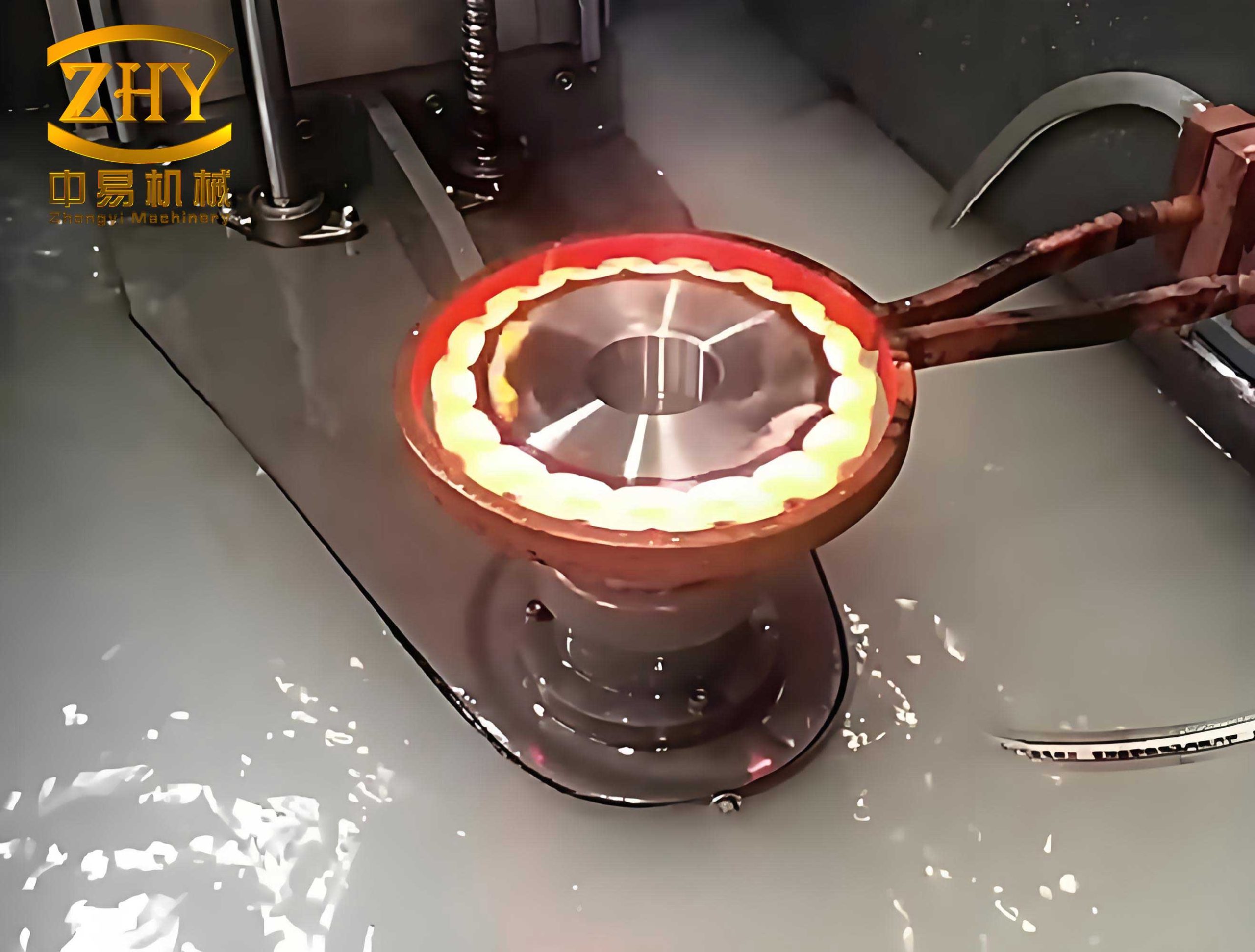
The visual representation of heat treatment defects, as shown in the image above, underscores the macroscopic distortions that can occur, such as warping and size changes. These defects are not merely statistical anomalies but tangible issues that affect gear meshing and noise levels. In my study, I observed that heat treatment defects are more pronounced in gears with larger modules and face widths, due to greater thermal mass and non-uniform cooling. For induction hardening, the sequential heating of teeth leads to lower overall distortion compared to bulk heating methods, but it can introduce localized heat treatment defects like soft spots or cracking if not controlled precisely.
To delve deeper into the mechanisms, I developed a theoretical model linking heat treatment defects to process parameters. The distortion coefficient $K_d$ can be expressed as a function of thermal gradient $\nabla T$ and material properties:
$$K_d = \beta \int_{V} \alpha(T) \cdot \nabla T \, dV$$
where $\beta$ is a material constant, $\alpha(T)$ is the coefficient of thermal expansion as a function of temperature, and the integral is over the gear volume $V$. This model suggests that minimizing thermal gradients during heating and cooling is key to reducing heat treatment defects. For nitriding, the low processing temperature (500–520°C) results in smaller $\nabla T$, hence lower $K_d$ values, aligning with the empirical data. In contrast, carburizing at 920–940°C induces steep thermal gradients, exacerbating heat treatment defects.
Table 2 provides a comparative summary of the heat treatment defects associated with each method, based on my findings and additional literature. This table highlights the trade-offs between surface hardness, case depth, and distortion, enabling manufacturers to make informed decisions.
| Heat Treatment Method | Typical Surface Hardness | Case Depth (mm) | Relative Distortion (Heat Treatment Defects) | Recommended Applications |
|---|---|---|---|---|
| Nitriding | 900–1100 HV | 0.2–0.5 | Low | High-precision gears, minimal post-machining |
| Carbonitriding | 58–62 HRC | 0.5–1.0 | Medium | General reducers, moderate loads |
| Carburizing | 60–64 HRC | 1.0–2.0 | High | Heavy-duty gears, where distortion can be corrected |
| Induction Hardening | 50–55 HRC | 1.0–3.0 | Low to Medium (module-dependent) | Large gears, selective hardening |
My analysis also considered the effect of material composition on heat treatment defects. Steels with higher alloying elements, such as chromium and molybdenum, tend to exhibit lower distortion due to improved hardenability and reduced phase transformation stresses. However, this relationship is non-linear and requires further study. For the gears in this investigation, material variations had a negligible impact on $K_d$ compared to process parameters, suggesting that heat treatment defects are primarily process-driven. This conclusion is supported by the low correlation coefficients between steel grade and distortion, reinforcing the need for optimized heat treatment cycles.
In practical terms, controlling heat treatment defects involves several strategies. First, pre-heat treatment conditioning, such as stress relieving and normalizing, can reduce residual stresses that amplify distortions. Second, controlled cooling rates, such as using martempering oils for carburizing, can minimize thermal gradients. Third, post-heat treatment finishing processes, like grinding or honing, can correct minor distortions, but they add cost and complexity. Based on my research, I recommend nitriding for applications where heat treatment defects must be minimized without secondary operations, while carburizing should be reserved for cases where high core strength justifies additional finishing steps.
To further quantify the economic impact of heat treatment defects, I developed a cost model that relates distortion to scrap rates and rework costs. The total cost $C_{\text{total}}$ due to heat treatment defects can be expressed as:
$$C_{\text{total}} = C_{\text{scrap}} \cdot R_{\text{scrap}} + C_{\text{rework}} \cdot R_{\text{rework}}$$
where $C_{\text{scrap}}$ is the cost per scrapped gear, $R_{\text{scrap}}$ is the scrap rate, $C_{\text{rework}}$ is the cost per reworked gear, and $R_{\text{rework}}$ is the rework rate. Using the distortion coefficient $K_d$, the scrap rate can be estimated as a function of the allowable error tolerance $\delta$:
$$R_{\text{scrap}} = P(K_d > \delta)$$
where $P$ denotes probability, derived from the statistical distribution of $K_d$. For nitriding, with low $K_d$ values, $R_{\text{scrap}}$ is typically below 5%, whereas for carburizing, it can exceed 20% if tolerances are tight. This model underscores the importance of selecting heat treatment methods that align with quality requirements to mitigate heat treatment defects and associated costs.
Looking ahead, future research should focus on advanced simulation techniques, such as finite element analysis (FEA), to predict heat treatment defects more accurately. By modeling thermal and phase transformation stresses, FEA can provide insights into optimizing gear geometry and process parameters. Additionally, real-time monitoring during heat treatment, using sensors to track temperature and distortion, could enable adaptive control to minimize heat treatment defects. My study lays the groundwork for such efforts by establishing empirical relationships and highlighting critical variables.
In conclusion, heat treatment defects are a significant concern in gear manufacturing, directly impacting performance, accuracy, and cost. Through my investigation, I have demonstrated that the distortion coefficient $K_d$ serves as a valuable tool for assessing these defects across different heat treatment methods. Nitriding produces the least distortion, making it ideal for high-precision gears, while carburizing, despite its higher heat treatment defects, offers superior surface hardness for heavy-duty applications. The relationship $K_d = a / D_p$ provides a simple yet effective model for predicting distortions, though it requires refinement for extreme cases. By integrating these findings into process design and quality control, manufacturers can significantly reduce heat treatment defects, enhancing gear reliability and efficiency. Ultimately, a holistic approach that combines material science, process engineering, and statistical analysis is essential for mastering the challenges posed by heat treatment defects in gears.