
In modern mechanical transmission systems, miter gears play a critical role due to their ability to transmit power between intersecting shafts, typically at a 90-degree angle. As a researcher focused on gear dynamics, I have undertaken an in-depth study to analyze the modal characteristics of miter gears, which is essential for preventing resonance and ensuring operational reliability. Miter gears, being a subset of bevel gears, are widely employed in aerospace, automotive, and marine applications where compact design and high efficiency are paramount. However, their complex spatial geometry and susceptibility to dynamic loads necessitate a thorough understanding of their vibrational behavior. This article presents a detailed modal analysis of miter gears utilizing finite element simulation, with an emphasis on deriving natural frequencies and mode shapes to inform design optimization and avoid resonant conditions.
The analysis begins with the creation of a precise three-dimensional solid model of a miter gear. I employed a bottom-up modeling approach, starting from points, progressing to curves, then surfaces, and finally solid bodies, to ensure accuracy in gear tooth profile generation. This step is crucial because the fidelity of the tooth flank geometry directly impacts the finite element results. The modeling was performed using advanced CAD software, which facilitates parametric design and easy modification of gear parameters such as module, number of teeth, and pressure angle. For this study, a standard miter gear with a 1:1 ratio was considered, assuming a module of 3 mm, 20 teeth, and a 20-degree pressure angle. The completed 3D solid model accurately represents the intricate geometry of the miter gear, including the tapered teeth and back cone.
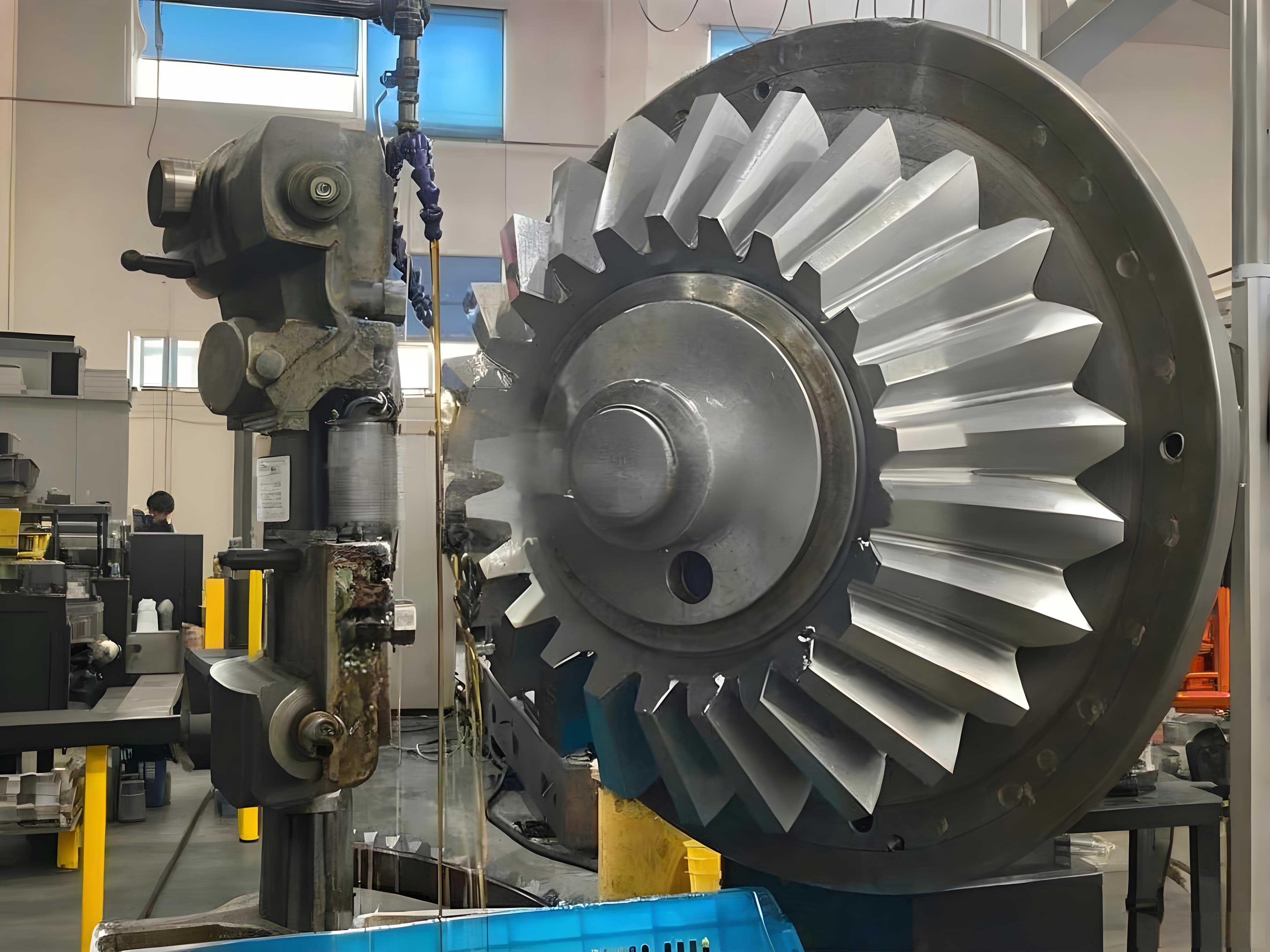
Following the geometric modeling, the 3D model was imported into a finite element analysis (FEA) software environment. The import process utilized a standard neutral file format to ensure compatibility and preserve geometric integrity. Within the FEA software, I assigned material properties representative of high-strength alloy steel commonly used for miter gears. The material properties are summarized in Table 1.
| Property | Symbol | Value | Unit |
|---|---|---|---|
| Elastic Modulus | E | 207 | GPa |
| Poisson’s Ratio | ν | 0.25 | – |
| Density | ρ | 7.85 × 10³ | kg/m³ |
| Yield Strength | σy | 850 | MPa |
Subsequently, the finite element mesh was generated. I selected a higher-order solid element, specifically a 3D 8-node brick element with displacement degrees of freedom, to balance computational accuracy and efficiency. A free meshing technique with a global element size control was applied, refining the mesh near the tooth roots and contact areas where stress concentrations are expected. The mesh statistics are presented in Table 2. This detailed discretization transforms the continuous miter gear geometry into a finite element model suitable for dynamic analysis.
| Description | Count |
|---|---|
| Number of Nodes | 120,734 |
| Number of Elements | 639,010 |
| Element Type | SOLID185 |
| Mesh Quality (Average Aspect Ratio) | 1.8 |
The core of this investigation lies in modal analysis, which is a fundamental technique in structural dynamics to identify inherent vibration characteristics. The theoretical foundation is derived from the equations of motion for a multi-degree-of-freedom system. The general dynamic equation is expressed as:
$$ [M]\{\ddot{x}\} + [C]\{\dot{x}\} + [K]\{x\} = \{F(t)\} $$
where $[M]$ is the mass matrix, $[C]$ is the damping matrix, $[K]$ is the stiffness matrix, $\{x\}$ is the displacement vector, and $\{F(t)\}$ is the time-dependent excitation force vector. For modal analysis, we are interested in the free vibration characteristics, meaning the external force vector is zero: $\{F(t)\} = \{0\}$. Furthermore, damping has a negligible effect on the natural frequencies and mode shapes in most preliminary analyses, so it is often omitted. This leads to the undamped free vibration equation:
$$ [M]\{\ddot{x}\} + [K]\{x\} = \{0\} $$
Assuming a harmonic solution of the form $\{x\} = \{\phi\} e^{i \omega t}$, where $\{\phi\}$ is the mode shape vector and $\omega$ is the circular natural frequency, we substitute into the undamped equation to obtain the classical eigenvalue problem:
$$ \left( [K] – \omega^2 [M] \right) \{\phi\} = \{0\} $$
For a non-trivial solution, the determinant must vanish:
$$ \det\left( [K] – \omega^2 [M] \right) = 0 $$
Solving this eigenvalue problem yields $n$ eigenvalues, $\omega_i^2$ (where $i=1, 2, …, n$), and corresponding eigenvectors $\{\phi_i\}$. The natural frequency $f_i$ in Hertz is related to the circular frequency by $f_i = \omega_i / (2\pi)$. The eigenvectors describe the deformed shape of the structure when vibrating at the corresponding natural frequency, known as mode shapes. For the miter gear, solving this problem reveals how it deforms under its own inertial forces, which is critical for identifying potential resonance points.
To perform the finite element modal analysis, boundary conditions must be applied to simulate a realistic support condition. In this study, I constrained all degrees of freedom on the inner bore surface and keyway faces of the miter gear model, simulating a fixed connection to a shaft. This represents a common mounting scenario. The Block Lanczos eigenvalue extraction method was employed due to its efficiency and accuracy for large models. The analysis was set to extract the first ten modes, as lower-order modes are typically most significant for resonance avoidance. The solution process involved generating the reduced mass and stiffness matrices, solving the eigenvalue problem, and expanding the results to obtain full-field mode shapes.
The results of the modal analysis for the miter gear are tabulated below. Table 3 lists the first ten natural frequencies obtained from the finite element simulation. It is important to note that some frequencies are very close in value; this is a result of the symmetrical geometry of the miter gear leading to degenerate modes (modes with identical frequencies but different spatial orientations).
| Mode Order | Natural Frequency (Hz) | Remarks |
|---|---|---|
| 1 | 14.494 | First torsional mode |
| 2 | 19.891 | First bending (sway) |
| 3 | 20.120 | Second bending (sway) |
| 4 | 23.068 | Local tooth bending |
| 5 | 28.079 | Complex bending |
| 6 | 28.282 | Complex bending (paired) |
| 7 | 30.877 | Symmetric torsional |
| 8 | 31.828 | Symmetric torsional (paired) |
| 9 | 44.394 | Higher-order complex bending |
| 10 | 44.427 | Higher-order complex bending (paired) |
The mode shapes corresponding to these frequencies provide visual insight into the deformation patterns. The first-order mode shape is characterized by a rigid-body-like rotation of the entire miter gear about its axis within the X-Z plane. This is a pure torsional mode where the gear twists along its central axis. The second and third modes, with nearly identical frequencies, represent bending or swaying motions along the axis. In these modes, the miter gear oscillates as if the axis is pivoting, causing the gear body to tilt. The fourth mode shows a more localized deformation, specifically a bending vibration concentrated on one side of the gear in the X-Y plane, indicative of flexure in the gear web or rim.
Modes five and six exhibit complex three-dimensional bending vibrations. The deformation involves multiple nodal lines and appears as a combination of web bending and slight tooth deflection. A key observation for the miter gear is that modes seven and eight represent a different type of torsional vibration compared to the first mode. Here, the deformation pattern is symmetric about a central tooth, with adjacent teeth moving in opposite directions radially—some moving outward while others move inward in an alternating pattern around the circumference. This symmetric torsional mode is significant as it can be excited by certain mesh harmonics.
The ninth and tenth modes are higher-order complex bending modes. The deformation pattern becomes even more intricate, featuring three primary anti-nodes (peaks) and three nodes (valleys) when viewed along the gear axis. This contrasts with modes five and six, which typically exhibit two peaks and two valleys. The progression of mode shapes from simple global torsion and bending to localized complex deformations underscores the importance of analyzing multiple modes for a comprehensive understanding of the miter gear’s dynamic response.
To further quantify the modal participation, the effective mass for each mode can be calculated. The effective mass indicates how much of the total mass participates in a given mode shape for a specific direction. This is crucial for assessing the contribution of each mode to the dynamic response under base excitation. The formula for effective mass $m_{eff,i}$ for mode $i$ in direction $j$ is:
$$ m_{eff,i}^{(j)} = \frac{(\{\phi_i\}^T [M] \{L_j\})^2}{\{\phi_i\}^T [M] \{\phi_i\}} $$
where $\{L_j\}$ is the influence vector for direction $j$. While a full effective mass calculation is extensive, it is a recommended step for complete dynamic assessment of miter gear systems.
The avoidance of resonance is a primary goal in miter gear design. Resonance occurs when an external excitation frequency coincides with or approaches one of the natural frequencies listed in Table 3. Excitations in miter gear drives can arise from various sources, such as motor speed harmonics, torque fluctuations, and most importantly, meshing frequency $f_m$ and its harmonics. The meshing frequency is given by:
$$ f_m = N \cdot \frac{n}{60} $$
where $N$ is the number of teeth on the miter gear and $n$ is the rotational speed in revolutions per minute (RPM). For instance, if our miter gear with 20 teeth operates at 1800 RPM, the meshing frequency is $f_m = 20 \times (1800/60) = 600$ Hz. This is far above the first ten natural frequencies, suggesting that the fundamental mesh excitation may not directly excite these lower modes. However, lower-order harmonics of manufacturing errors (like pitch error) or sidebands due to modulation could generate excitation frequencies in the lower range. Therefore, I recommend maintaining a safety margin between any potential excitation frequency and the identified natural frequencies. A common rule is to ensure a separation of at least 15-20%. This analysis provides the critical data needed to apply such rules during the design phase of a miter gear transmission.
Furthermore, the mode shapes inform potential design modifications for structural optimization. For example, if a particular bending mode is identified as problematic, reinforcing the gear web or modifying the rim thickness could shift that natural frequency away from critical excitation bands. The parametric nature of the initial CAD model allows for quick exploration of such design changes and subsequent re-analysis. This iterative process is fundamental to achieving an optimized miter gear design that is both strong and quiet in operation.
In conclusion, this detailed modal analysis of a miter gear using the finite element method has successfully identified its fundamental dynamic characteristics. I have demonstrated the complete workflow from 3D parametric modeling and mesh generation to solving the eigenvalue problem for free vibration. The results, including the first ten natural frequencies and their corresponding mode shapes, provide essential data for engineers. This data serves as a theoretical reference to prevent resonance in miter gear applications by ensuring operational speeds and excitation frequencies do not coincide with these inherent frequencies. The analysis also lays a solid foundation for subsequent dynamic response studies, such as harmonic or transient analysis, and for structural optimization aimed at enhancing the performance and longevity of miter gear systems in demanding mechanical applications. Future work could involve coupled modal analysis of a miter gear pair considering contact stiffness or experimental validation through impact hammer testing to correlate with these simulation results.