
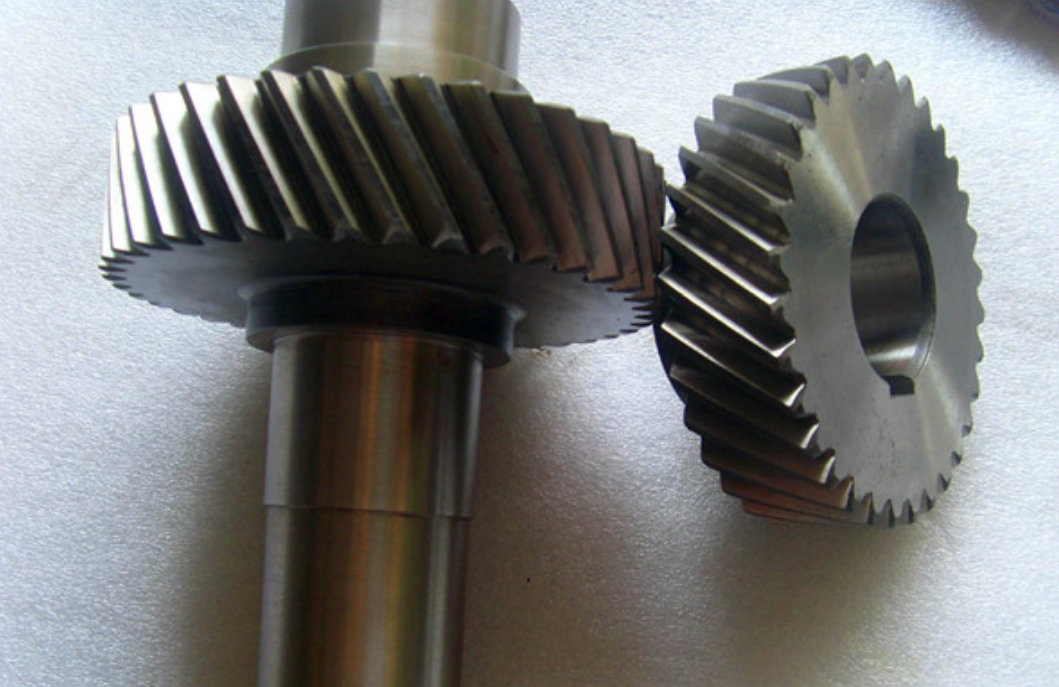
As a mechanical engineer focused on power transmission systems, I find helical gears to be one of the most fascinating and critical components in modern machinery. Their unique geometry, characterized by teeth that are cut at an angle to the gear axis, provides significant advantages over their spur gear counterparts. The primary benefit is the smoother and quieter operation due to a more gradual engagement process where multiple teeth are in contact at any given time. This inherent characteristic makes helical gears exceptionally suitable for high-speed and high-load applications, such as in automotive transmissions, industrial gearboxes, and marine propulsion systems. The central challenge in designing these components lies in accurately predicting and managing the complex stress states that develop during operation, particularly the contact stresses at the tooth interfaces, which are the primary drivers for common failure modes like pitting and spalling. This article details my methodology for creating a precise digital model of a helical gear pair and performing a rigorous contact stress analysis using modern engineering software, bridging the gap between theoretical calculation and numerical simulation.
Fundamental Geometry and Parameters of Helical Gears
The design of helical gears involves a more complex set of parameters compared to spur gears, primarily due to the introduction of the helix angle. One must distinguish between parameters in the transverse plane (perpendicular to the gear axis) and the normal plane (perpendicular to the tooth). A standard set of input parameters is required to define the gear geometry completely. For the purpose of this analysis, I considered a gear pair designed for a high-speed reduction stage. The key geometric and operational parameters are summarized in the table below.
| Parameter | Symbol | Value | Unit |
|---|---|---|---|
| Normal Module | mn | 2.0 | mm |
| Normal Pressure Angle | αn | 20 | ° |
| Helix Angle | β | 14 | ° (Right-hand for pinion) |
| Number of Teeth (Pinion) | z1 | 31 | – |
| Number of Teeth (Gear) | z2 | 99 | – |
| Center Distance | a | Calculated | mm |
| Face Width (Pinion/Gear) | b1 / b2 | 70 / 65 | mm |
| Addendum Coefficient | ha* | 1.0 | – |
| Dedendum Coefficient | c* | 0.25 | – |
| Input Power | P | 10 | kW |
| Input Speed (Pinion) | n1 | 960 | rpm |
| Transmission Ratio | u | 3.2 | – |
From these basic parameters, several derived dimensions are calculated. The transverse module, which is critical for spatial modeling, is given by:
$$ m_t = \frac{m_n}{\cos\beta} $$
The pitch diameters for the pinion and gear are:
$$ d_1 = m_t \cdot z_1 \quad \text{and} \quad d_2 = m_t \cdot z_2 $$
The theoretical center distance is then:
$$ a = \frac{d_1 + d_2}{2} = \frac{m_n (z_1 + z_2)}{2 \cos\beta} $$
For the given parameters, this results in a center distance of approximately 134 mm. The helix angle induces an axial thrust force, and the direction of this force depends on the hand of the helix and the direction of rotation. The face width must be sufficient to ensure adequate contact ratio while considering manufacturing and alignment constraints. The choice of a 14° helix angle represents a common balance between axial force generation and smoothness of operation for general industrial applications.
Parametric 3D Modeling Strategy
Creating an accurate and parametric 3D model is the foundational step for any subsequent finite element analysis. The complexity of helical gears lies in generating the correct involute tooth profile in the normal plane and then sweeping it along a helical path. I utilize a feature-based CAD system, with the process broken down into logical steps.
Generating the Involute Tooth Profile
The tooth flank of standard helical gears is based on an involute curve. In the normal plane, this curve is defined by the normal module and normal pressure angle. The equation of an involute in a parametric form, starting at the base circle, is essential for digital modeling. The coordinates of any point on the involute can be expressed as a function of the roll angle θ:
$$ x = r_b (\cos\theta + \theta \sin\theta) $$
$$ y = r_b (\sin\theta – \theta \cos\theta) $$
Where \( r_b \) is the base circle radius, calculated from the transverse pitch diameter and transverse pressure angle \( \alpha_t \):
$$ r_b = \frac{d \cos\alpha_t}{2}, \quad \text{and} \quad \alpha_t = \arctan\left(\frac{\tan\alpha_n}{\cos\beta}\right) $$
Within the CAD environment, I implement these equations using the software’s expression or formula editor. By defining the parameters (m_n, α_n, β, z) as named variables, I create a law-driven curve. This approach ensures full parametric control; changing a core parameter like the module or number of teeth automatically updates the entire gear geometry. The generated involute segment is then mirrored and trimmed with root fillet curves and top land to form a complete tooth space profile in a reference plane.
Helical Sweep and Solid Creation
This 2D tooth space profile must be transformed into a 3D helical gear tooth. A simple extrude operation would create a spur gear. The defining feature of helical gears is created using a sweep operation, where the 2D profile is guided along a helical path. The lead of the helix, which is the axial distance for one complete revolution, is:
$$ L = \pi d \cot\beta $$
The critical challenge here is to ensure the swept geometry is accurate and free of distortion. Using a single helical path as a guide can sometimes lead to twisted geometry, especially for wide-face gears. A more robust method I employ is to use multiple guide curves. Typically, I define three helical paths: one at the inner (root) boundary of the profile, one at the pitch point, and one at the outer (tip) boundary. The sweep operation using these parallel, synchronous helical guides ensures the tooth maintains its correct cross-sectional shape throughout the face width. After successfully sweeping a single tooth space (creating a solid cut), I perform a circular pattern around the gear axis to create all teeth. Finally, features like the gear bore, keyway, hub, and web are added to complete the functional helical gear model for both the pinion and the gear, ensuring they are positioned at the correct operational center distance.
Finite Element Analysis Setup for Contact Stress
With accurate 3D models of the mating helical gears in place, the next phase involves setting up the finite element analysis to simulate the meshing action and extract contact stresses. I use an integrated simulation environment that streamlines the preprocessing steps, allowing a focus on the physics of the problem rather than intricate solver settings.
Material Properties and Mesh Generation
Material selection directly influences the stress results and fatigue life prediction. For this analysis, I chose common case-hardening steel grades. The pinion, which experiences more loading cycles, is assigned a material with slightly higher core strength to match common design practice. The properties are defined as follows:
| Component | Material | Young’s Modulus (E) | Poisson’s Ratio (ν) | Yield Strength |
|---|---|---|---|---|
| Pinion | 40Cr (Quenched & Tempered) | 211 GPa | 0.277 | > 550 MPa |
| Gear | 45 Steel (Quenched & Tempered) | 209 GPa | 0.269 | > 355 MPa |
Mesh generation is a crucial step influencing both accuracy and computational cost. A global element size is set for the entire assembly, but a critical refinement is applied locally. I define local mesh controls on the active tooth flanks of both helical gears, specifying a significantly smaller element size in these regions. This is because the highest stress gradients occur at and just below the contact surface. The contact analysis also benefits from a relatively uniform mesh size on the two contacting surfaces. The resulting mesh typically consists of tetrahedral or hex-dominant elements, with the refined contact zone containing several element layers through the thickness of the tooth to capture the subsurface stress field accurately. The body mesh away from the contact zone remains coarser to reduce the total number of nodes and elements.
Defining Contacts and Boundary Conditions
The interaction between the teeth of the helical gears is the core of the simulation. I define a surface-to-surface contact pair. The contact formulation is frictional, with a coefficient of friction set to 0.06-0.08, representing a typical lubricated condition. The pinion tooth surface is typically set as the “contact” side, and the gear tooth surface as the “target” side, although robust solvers are often insensitive to this designation. The contact algorithm is set to “Augmented Lagrange” as it provides good convergence behavior for mechanical contacts.
Realistic boundary conditions are applied to simulate the operational state. The analysis is performed for a static load at a specific instant of mesh, often chosen where a single tooth pair carries the load or just before another pair comes into contact. The gear’s inner bore surface is assigned a fixed support, constraining all degrees of freedom to simulate it being mounted on a shaft held by bearings. For the driving pinion, a cylindrical support is applied to its bore. This constraint allows rotation about its axis but prevents radial and axial displacement, again simulating bearing support. The driving torque is then applied as a moment on the pinion’s bore surface. The torque value is calculated from the input power and speed:
$$ T_1 = 9,550,000 \times \frac{P}{n_1} = 9,550,000 \times \frac{10}{960} \approx 99,480 \text{ N·mm} $$
This moment creates the rotational force that drives the contact between the helical gear teeth.
Analysis Results and Theoretical Validation
Solving the static structural model yields the stress and deformation fields. The most critical result for gear durability is the contact stress distribution on the tooth flanks. The post-processor clearly shows a high-stress elliptical region at the point of contact, conforming to the classical Hertzian contact theory. The maximum contact stress (σ_H,max) is read directly from the contour plot. For the defined load case, the FEA result was approximately 514 MPa.
To validate the FEA result, I compare it against the standard analytical calculation for contact stress in helical gears, as defined by the ISO 6336 standard or AGMA equations. The fundamental formula for contact stress at the pitch point is:
$$ \sigma_H = Z_E Z_H Z_\epsilon Z_\beta \sqrt{ \frac{F_t}{b d_1} \cdot \frac{u \pm 1}{u} } \leq \sigma_{HP} $$
Where:
- \( Z_E \) is the Elastic Coefficient: \( Z_E = \sqrt{ \frac{1}{\pi \left( \frac{1-\nu_1^2}{E_1} + \frac{1-\nu_2^2}{E_2} \right) }} \)
- \( Z_H \) is the Zone Factor, accounting for the transforming of tangential load at the pitch cylinder to normal load at the pitch plane.
- \( Z_\epsilon \) is the Contact Ratio Factor, considering the influence of transverse and overlap contact ratios.
- \( Z_\beta \) is the Helix Angle Factor.
- \( F_t \) is the nominal tangential load: \( F_t = \frac{2000 T_1}{d_1} \).
- \( b \) is the face width.
- \( d_1 \) is the pinion reference diameter.
- \( u \) is the gear ratio.
Plugging in the values for the analyzed helical gear pair, the calculated theoretical contact stress comes to approximately 521 MPa. The comparison is summarized below:
| Method | Maximum Contact Stress (σH) | Notes |
|---|---|---|
| Finite Element Analysis (FEA) | 514.4 MPa | From nodal solution contour plot. |
| Theoretical (ISO/AGMA) Calculation | ~521.2 MPa | Calculated at the pitch point. |
| Deviation | ~1.4% | Excellent correlation. |
The remarkably close agreement, with a deviation of only about 1.4%, validates the accuracy of the FEA model setup, including the mesh refinement, contact definitions, and boundary conditions. This gives high confidence in using the FEA model for further investigation of stress patterns that are difficult to capture with analytical formulas alone.
Detailed Stress Patterns and Failure Mode Analysis
The finite element analysis provides a vivid visual and quantitative map of the stress state within the helical gears, offering deep insights into potential failure mechanisms beyond a single maximum stress value.
Contact Stress Distribution and Pitting
The contour plot of contact pressure reveals an elliptical area of high stress, as predicted by Hertz. However, unlike the idealized line contact of spur gears, the contact area on helical gears is a skewed ellipse. More importantly, the analysis clearly shows that the stress is not uniform across the face width. Due to elastic deformations (bending, twisting) of the teeth and potential misalignment, the load tends to concentrate at the edges of the face width. This “edge-loading” or end effect results in significantly higher contact stress at the corners of the teeth where they enter and exit the mesh. This uneven distribution is a primary contributor to premature pitting failure, which often initiates at these high-stress edge regions. Pitting is a surface fatigue phenomenon where repeated over-stressing leads to the formation and propagation of small cracks, eventually causing material to flake away and create pits on the tooth surface.
Bending Stress and Root Fracture
While contact stress governs surface durability, the bending stress at the tooth root is critical for preventing catastrophic tooth breakage. The FEA results show a high tensile stress concentration at the root fillet on the loaded side of the tooth. For helical gears, the line of maximum bending stress is also skewed across the face width. The most critical location is typically at one end of the tooth, aligned with the region of highest contact load. This stress pattern indicates that a fatigue crack leading to tooth fracture would likely initiate at the root fillet near the edge of the face and propagate diagonally across the tooth, resulting in a characteristic “localized break” rather than a fracture across the entire face width. This failure mode is distinctively linked to the complex loading of helical gears.
Engineering Insights and Design Improvement Strategies
Based on the analysis of the stress results for these helical gears, several practical design and manufacturing strategies can be employed to enhance performance and longevity.
Mitigating Contact Stress and Pitting:
- Crowning and Lead Modification: The most effective countermeasure against edge-loading is to introduce a slight crown or barrel shape along the tooth length (lead direction). This intentional modification removes material from the ends of the teeth, ensuring that under load and deflection, the contact area shifts towards the center of the face width, creating a more uniform pressure distribution. This significantly reduces the peak contact stress at the edges.
- Improved Surface Finish and Hardness: Increasing the surface hardness of the tooth flanks through processes like carburizing or induction hardening dramatically increases the resistance to pitting. A superior surface finish reduces stress concentration from microscopic notches and improves the effectiveness of the lubricant film.
- Optimized Lubrication: Using high-quality extreme-pressure (EP) lubricants is essential. The lubricant film separates the contacting surfaces, reducing friction and carrying away heat. For heavily loaded helical gears, forced-oil circulation systems with cooling are often necessary.
Preventing Bending Fatigue and Root Fracture:
- Optimized Root Fillet Geometry: The transition between the tooth flank and the root is a critical stress raiser. Using a full-trochoidal or optimized fillet generated by modern gear cutting tools (like hobs with protuberance) produces a smoother, larger-radius transition, significantly reducing the stress concentration factor.
- Shot Peening: This cold-working process bombards the root surface with small media, inducing compressive residual stresses in the subsurface layer. Since fatigue cracks initiate under tensile stress, this compressive layer greatly inhibits crack initiation and propagation, substantially improving bending fatigue strength.
- Material and Heat Treatment Quality: Ensuring high material purity (e.g., vacuum-degassed steel) and precise heat treatment control minimizes internal defects like inclusions, voids, or excessive retained austenite, which can act as crack initiation sites.
The interplay of these factors is crucial. For instance, a hardened and ground helical gear with proper lead crowning will exhibit a far superior load-carrying capacity and service life compared to a standard finished gear without modifications, even if the basic geometric parameters are identical.
Conclusion
The journey from a set of basic design parameters to a detailed understanding of the operational stresses in a pair of helical gears demonstrates the power of integrated modern engineering tools. The parametric 3D modeling process ensures geometric accuracy and flexibility for design exploration. The subsequent finite element analysis within a streamlined simulation environment provides a high-fidelity, validated prediction of the complex contact and bending stress fields that dictate the performance and life of helical gears. The analysis confirms that the primary failure modes—localized pitting initiated at the face edges and diagonal root fractures—are direct consequences of the unique skewed and multi-tooth contact nature of helical gears. More importantly, it provides a clear engineering rationale for standard industry improvement practices such as lead crowning, root fillet optimization, and advanced surface treatments. By combining theoretical calculations with detailed numerical simulation, engineers can move beyond simple sizing to perform true performance-driven design and optimization of helical gear transmissions, ensuring reliability, efficiency, and durability in demanding high-speed and heavy-load applications.