
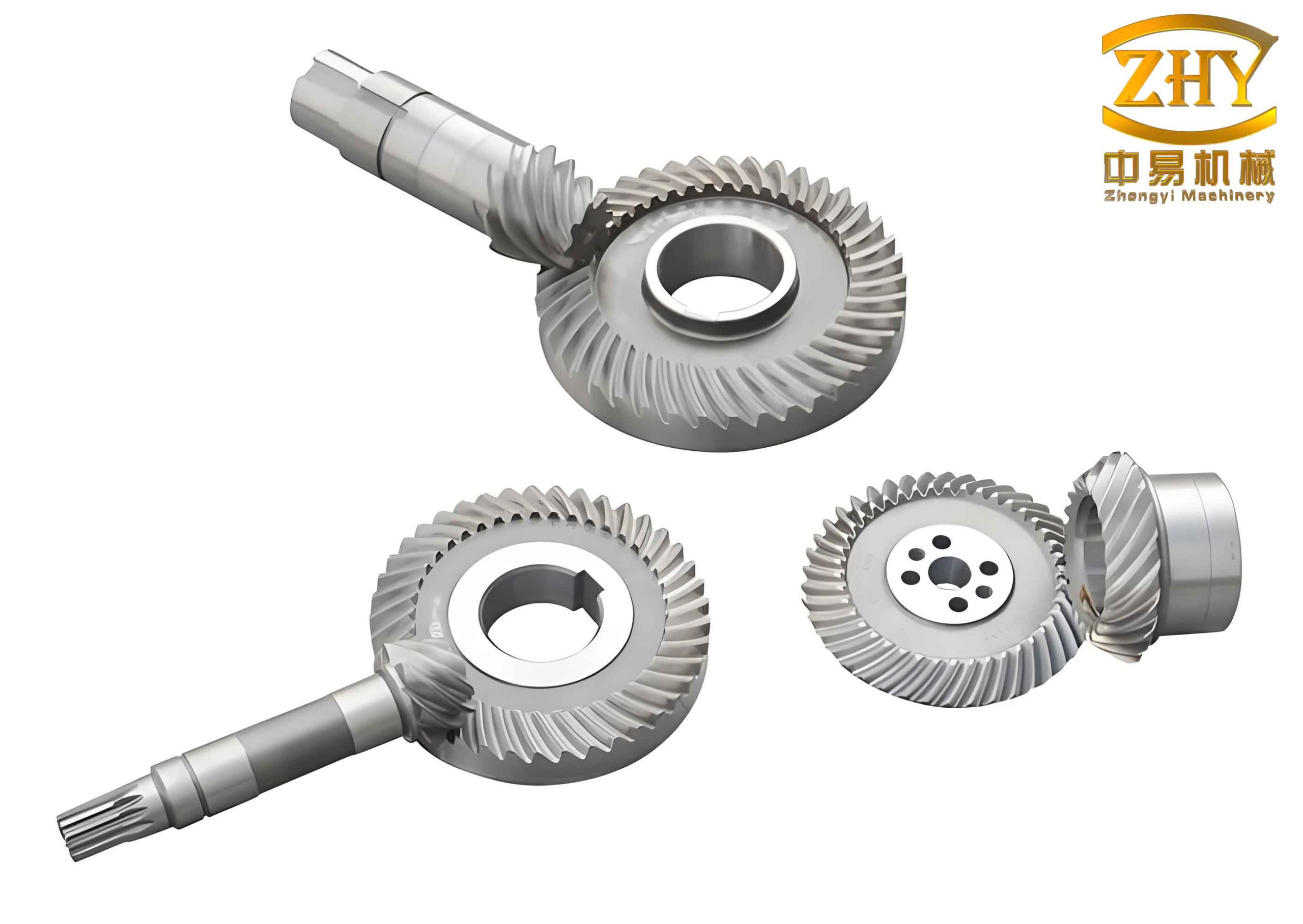
Hyperboloidal gears, commonly known as hypoid gears, are fundamental components in automotive drive axles due to their ability to transmit power between non-intersecting, non-parallel shafts with high torque density and smooth operation. Their complex, spatially curved tooth surfaces, however, present significant challenges in design and manufacturing. To mitigate stress concentrations at the tooth edges caused by assembly errors and load-induced deformations, tooth surface modification, or “ease-off,” is universally applied in practice. This article delves into a sophisticated multi-objective optimization design methodology for hyperboloidal gear tooth surfaces, integrating an ease-off topological modification strategy to holistically improve transmission performance, encompassing loaded transmission error, meshing efficiency, and resistance to surface distress like scuffing.
The core philosophy of our proposed methodology is to represent the modified pinion tooth surface not as an isolated entity, but as a superposition of two distinct components: the fully conjugate tooth surface derived from the gear member and a predefined ease-off surface. This vector summation is expressed as:
$$ \mathbf{R}_{1\gamma}(u, \beta) = \delta_1(x_1(u,\beta), y_1(u,\beta)) \cdot \mathbf{N}_1(u, \beta) + \mathbf{R}_1(u, \beta) $$
where \( \mathbf{R}_{1\gamma} \) is the position vector of the final ease-off pinion surface, \( \mathbf{R}_1 \) and \( \mathbf{N}_1 \) are the position and unit normal vectors of the pinion surface designed solely for a specific transmission error function, and \( \delta_1 \) is the normal ease-off surface function defined in the pinion’s axial (\(x_1\)) and radial (\(y_1\)) coordinate plane.
The design of the ease-off surface \( \delta_1 \) is decoupled into two fundamental aspects: the tooth-to-tooth clearance (transmission error) and the tooth-profile normal clearance. The transmission error (TE) curve is pre-designed, often as a parabolic or higher-order function, to provide sufficient cushion at the mesh entry and exit points, reducing impact and insensitivity to misalignment. Concurrently, a profile modification curve is defined, typically featuring intentional relief at the tooth tip and root to prevent edge loading. This profile curve is then mapped across the tooth flank, considering the contact path inclination, to generate the comprehensive topological ease-off surface \( \delta_1(x_1, y_1) \). This dual-parameter control allows for precise management of the mismatch between the mating hyperboloidal gear surfaces.
Accurately predicting the performance of these complex hyperboloidal gear pairs under load requires a robust simulation chain. We employ Tooth Contact Analysis (TCA) to determine the unloaded kinematic performance, including the path of contact, transmission error, and the instantaneous contact ellipse parameters (orientation, semi-major axis \(a\), semi-minor axis \(b\)). This is followed by Loaded Tooth Contact Analysis (LTCA), which solves for the elastic deformations and redistributed load sharing among multiple contacting tooth pairs. The LTCA model discretizes the potential contact lines into a grid of points. For each point \(i\) on contact line \(k\), the local deformation compatibility and force equilibrium equations are solved iteratively to obtain the actual contact pressure \(p_{ij}\). From this, the Loaded Transmission Error (LTE) and its amplitude (ALTE) are derived. The ALTE is a critical excitation source for gear vibration and noise and is calculated from the maximum variation in the normal displacement along the line of action during a mesh cycle:
$$ \text{ALTE} = t_e = \frac{180}{\pi} (Z_{max} – Z_{min}) (\mathbf{R}_2 \times \mathbf{e}_2 \cdot \mathbf{N}_2) $$
where \(Z_{max}\) and \(Z_{min}\) are the maximum and minimum normal displacements in the mesh cycle, \(\mathbf{R}_2\) and \(\mathbf{N}_2\) are the position and unit normal vectors of the gear contact point, and \(\mathbf{e}_2\) is the unit vector along the gear axis.
The determination of friction and thermal performance is paramount for hyperboloidal gears, which exhibit substantial sliding velocities across the entire tooth flank. For any discrete contact point, the essential kinematic and geometric parameters are extracted from TCA/LTCA: the absolute velocities of the pinion and gear (\( \mathbf{v}_1, \mathbf{v}_2 \)), the radii of principal curvatures (\( \kappa_{1a}, \kappa_{1b}, \kappa_{2a}, \kappa_{2b} \)), and the orientation angles (\( Q_1, \epsilon_{12} \)). The sliding velocity \( \mathbf{v}_s \), entrainment velocity \( \mathbf{v}_e \), and slide-to-roll ratio \( S_r \) are computed as:
$$ \mathbf{v}_s = \mathbf{v}_1 – \mathbf{v}_2, \quad \mathbf{v}_e = \frac{\mathbf{v}_1 + \mathbf{v}_2}{2}, \quad S_r = |\mathbf{v}_e| / |\mathbf{v}_s| $$
The effective radius of curvature \( R \) at the contact point, crucial for lubrication analysis, is given by:
$$ \frac{1}{R} = \frac{1}{ \frac{1}{k_{1a}\sin^2 Q_1 + k_{1b}\cos^2 Q_1} + \frac{1}{k_{2a}\sin^2 (Q_1+\epsilon_{12}) + k_{2b}\cos^2 (Q_1+\epsilon_{12})} } $$
The local Hertzian pressure is \( P_h = \sqrt{w E’ / (2 \pi R)} \), where \( w \) is the load per unit length and \( E’ \) is the equivalent elastic modulus.
Predicting the local coefficient of friction (\( \mu \)) is complex, as it depends on the lubrication regime. We first estimate the central film thickness \( h_m \) using the Dowson-Higginson formula for line contact, adapted for ellipticity parameter \( \kappa = a/b \):
$$ h_m = 2.69 \alpha^{0.53} (\eta_0 u)^{0.67} \rho^{0.397} E’^{-0.073} w^{-0.067} (1 – 1.61 e^{-0.73\kappa^{0.64}}) $$
The specific film thickness (lambda ratio) is \( \lambda = h_m / \sqrt{\sigma_1^2 + \sigma_2^2} \), where \( \sigma \) are the surface roughness values. The lubrication regime is identified based on \( \lambda \): full-film EHL (\( \lambda > 3 \)), mixed (\( 1 < \lambda < 3 \)), or boundary (\( \lambda < 1 \)). The friction coefficient is then computed using a regime-specific model. For mixed lubrication, a weighted average is often used:
$$ \mu_m = a \mu_{ehl} + (1-a) \mu_b, \quad \text{where } a = \frac{1.21 \lambda^{0.64}}{1 + 0.37 \lambda^{1.26}} $$
Here, \( \mu_b \) is the boundary friction coefficient (typically 0.07-0.15), and \( \mu_{ehl} \) is calculated from a full-film traction model, often a function of \( S_r, P_h, \eta_0, |\mathbf{v}_e| \).
With the local friction coefficient \( \mu_{ij} \), sliding velocity \( v_{s,ij} \), and load \( p_{ij} \) known for each discrete point, the instantaneous power loss and meshing efficiency for a given angular position \( \phi \) can be calculated. The total frictional power loss at that instant is the sum over all \( K \) simultaneously contacting tooth pairs and their \( n \) discrete points:
$$ P_{loss}(\phi) = \sum_{k=1}^{K} \sum_{j=1}^{n} \mu_{kj} \cdot v_{s,kj} \cdot p_{kj} $$
The instantaneous meshing efficiency \( \eta(\phi) \) is:
$$ \eta(\phi) = 1 – \frac{P_{loss}(\phi)}{T_1 \omega_1} $$
where \( T_1 \) and \( \omega_1 \) are the pinion input torque and angular velocity. The average meshing efficiency \( \eta_{avg} \) over one complete mesh cycle is the integral average of \( \eta(\phi) \).
Furthermore, the risk of scuffing (flash temperature) is assessed using the well-established Blok flash temperature theory. The local flash temperature rise \( T_{f,ij} \) at a contact point is:
$$ T_{f,ij} = X_J X_S \cdot \frac{1.11 \mu_{ij} \sqrt{|\mathbf{v}_{s,ij}|}}{ \sqrt{2 b_{ij}} (B_1 \sqrt{|\mathbf{v}_{1,ij}|} + B_2 \sqrt{|\mathbf{v}_{2,ij}|}) } \sqrt{ w_{ij} } $$
where \( X_J, X_S \) are the mesh entry and load sharing factors, \( B_1, B_2 \) are the thermal contact coefficients of the pinion and gear materials, and \( w_{ij} \) is the load per unit length at that point. The maximum flash temperature on the contact line and its distribution across the tooth flank are critical indicators of scuffing risk.
| Parameter Category | Symbol | Description | Role in Optimization |
|---|---|---|---|
| Transmission Error (Tooth-to-Tooth Clearance) Parameters | \( \varepsilon_0 \) | Parabola coefficient / Base amplitude | Control the shape and magnitude of the unloaded transmission error curve, affecting impact and misalignment sensitivity. |
| \( \lambda_0, \lambda_1 \) | Parameters defining higher-order TE terms | ||
| \( \varepsilon_1, \varepsilon_2, \varepsilon_3, \varepsilon_4 \) | Parameters for 4th-order polynomial TE | ||
| Profile Normal Clearance Parameters | \( d_1, d_2 \) | Control start and end of profile modification zone | Define the ease-off topography (bias, flank form) which governs contact pattern shape, size, location, and load distribution. |
| \( q_1, q_2 \) | Control the amount of tip/root relief | ||
| \( \theta_a \) | Angle controlling the bias of the modification |
The essence of our advanced design methodology lies in formulating and solving a multi-objective optimization problem. The design variables \( \mathbf{y} \) are the parameters defining the ease-off surface \( \delta_1 \), such as the coefficients of the parabolic TE function and the parameters of the profile modification curve. The objectives are to simultaneously minimize the Amplitude of Loaded Transmission Error (ALTE), minimize the maximum instantaneous flash temperature (\( T_{f,max} \)), and maximize the average meshing efficiency (\( \eta_{avg} \)). A normalized aggregate objective function \( G(\mathbf{y}) \) is constructed:
$$ G(\mathbf{y}) = \min \left\{ c_1 \frac{t_e(\mathbf{y})}{t_{e,0}} + c_2 \frac{T_{f,max}(\mathbf{y})}{T_{f,max,0}} – c_3 \frac{\eta_{avg}(\mathbf{y})}{\eta_{avg,0}} \right\} $$
where the subscript \(_0\) denotes the performance of a baseline design (e.g., a fully conjugate design), and \( c_1, c_2, c_3 \) are weighting coefficients reflecting the relative importance of each objective (e.g., \( c_1=0.5, c_2=0.4, c_3=0.1 \)). The optimization process involves an iterative loop: modifying \( \mathbf{y} \), regenerating the pinion ease-off surface, performing TCA and LTCA simulations, computing the friction, efficiency, and flash temperature, and finally evaluating \( G(\mathbf{y}) \). A global search algorithm like Particle Swarm Optimization (PSO) is well-suited for navigating this nonlinear design space with potential local minima.
A numerical case study on an automotive hypoid gear pair illustrates the effectiveness of this approach. The baseline gear geometry and machining settings are defined. Three designs are compared: a fully conjugate design, a traditional parabolic TE modification with significant mismatch (theoretical design), and the optimized ease-off design obtained via the multi-objective optimization. The following table summarizes key performance metrics under a nominal load of 600 Nm on the gear:
| Performance Metric | Fully Conjugate Design | Theoretical Design (High Mismatch) | Optimized Ease-Off Design |
|---|---|---|---|
| Amplitude of LTE (ALTE), arc-sec | High (Reference) | Variable, often high at nominal load | 6.39 (Minimized) |
| Average Meshing Efficiency, \( \eta_{avg} \) | 0.965 (Reference) | 0.962 (Lower due to high pressure) | 0.975 (Maximized) |
| Maximum Flash Temperature, °C | 110 | 94 | 71 (Minimized) |
| Contact Pattern | Full bearing, edge contact risk | Small, centered, elliptical | Biased, properly sized, avoids edges |
| Effective Contact Ratio | Theoretical (~2.6) | Reduced due to mismatch | Increased under load |
| Pressure Distribution | Lower, spread across flank | Higher, concentrated | Optimized, lower peak than theoretical |
The optimized hyperboloidal gear ease-off topography exhibits distinct characteristics: sufficient parabolic transmission error at mesh entry/exit, combined with controlled profile relief. This results in a contact pattern that is diagonally oriented, centered away from the edges, and of optimal size. The load distribution shifts towards the pitch line region where sliding velocities are lower. Consequently, while the load per unit length might be slightly higher than in the conjugate case, the significant reduction in the average sliding velocity and thus the local friction coefficient leads to a net increase in meshing efficiency and a drastic reduction in the maximum flash temperature. Furthermore, the ALTE is minimized because the ease-off modification provides a compliant interface that allows the teeth to share load more evenly across multiple pairs as they deform under load, smoothing out the kinematic displacement variation.
The analysis reveals profound insights into the behavior of hyperboloidal gears. The sliding velocity distribution is not uniform; it is generally lowest near the pitch line and increases towards the tooth root (on the gear) and from the toe to the heel. The effective radius of curvature also varies significantly across the flank. A design with excessive mismatch (like the theoretical one) reduces the real contact ratio, forcing fewer teeth to carry the total load. This leads to higher contact pressures, which, despite potentially favorable kinematics, can increase friction losses and flash temperature risk. The optimized ease-off design strikes a balance: it maintains a high effective contact ratio under load by carefully controlling the initial separation (mismatch), leading to lower ALTE, better load sharing, and improved tribological performance.
In conclusion, the traditional approach of designing hyperboloidal gears primarily for a benign unloaded contact pattern is insufficient for high-performance applications. The proposed integrated methodology, which combines ease-off topological surface definition, high-fidelity loaded contact analysis, advanced tribological models for friction and flash temperature, and multi-objective optimization, represents a significant advancement. It enables the holistic design of hyperboloidal gear drives that are simultaneously quiet, efficient, durable, and resistant to failure modes like scuffing. By explicitly optimizing for minimum ALTE, maximum efficiency, and minimum flash temperature, this framework provides engineers with a powerful tool to push the boundaries of power density and performance in automotive and other advanced drive systems utilizing hyperboloidal gears.