
In the field of mechanical transmission system design, the spur gear stands as one of the most universally employed components. Its structural form is characterized by serialized and parameterized features. Traditional design processes, where parameter changes necessitate repetitive modeling, are not only time-consuming and labor-intensive but also lead to significant data redundancy. Utilizing parameterized modeling capabilities offers an effective solution to this challenge. The fundamental principle of parameterized design is the automatic driving of geometry through the modification of some or all predefined parameters. Furthermore, the dynamic characteristics of a spur gear are paramount to the reliability and transmission efficiency of the entire system. Conducting a finite element modal analysis on a spur gear to determine its natural frequencies and mode shapes allows for the proactive avoidance of resonance and harmful vibrational modes during system operation. This analysis also helps identify potential weak points in the gear, laying a foundation for subsequent modifications, noise control, and optimization design. UG NX is a high-end CAD software that integrates CAD and CAE functionalities. Its robust parameterized modeling tools and finite element analysis modules enable the completion of both spur gear parameterized design and finite element modal analysis within a single platform. This integration avoids the need for data conversion between separate CAD and CAE software, enhances design efficiency, and facilitates unified management of design data.
Parameterized design is a philosophy that embeds design intent into a computer-aided design model. It involves constraining various features of a part, with the geometric shapes and dimensions of these features represented as variable parameters. If a variable parameter defining a feature is altered, the geometry of that feature changes accordingly. To construct an accurate 3D model of a spur gear, one must adhere to the fundamental laws of gear kinematics and the generating principle of the involute tooth profile. The process begins by establishing the parametric equations for the involute curve using the expression functionality in UG. The parameters controlling the involute are linked to the geometric parameters of the spur gear. After generating the involute, a single tooth profile is completed using mirroring and necessary curve trimming operations, which is then extruded into a solid feature. Finally, the circular pattern of the tooth profile around the gear axis is achieved using associative copy feature operations, resulting in a complete, parameterized 3D model.
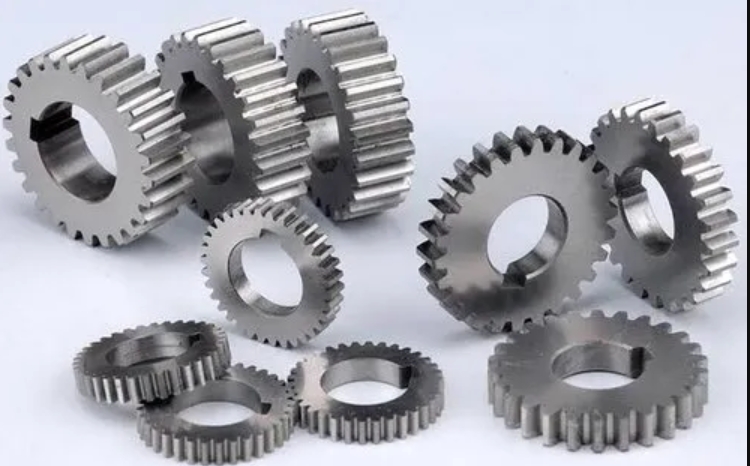
The primary design parameters for a standard spur gear can be categorized into basic parameters and derived parameters. The basic parameters define the gear’s core geometry, while the derived parameters are calculated from them.
| Parameter Type | Symbol | Description | Formula |
|---|---|---|---|
| Basic Parameters | m | Module | – |
| z | Number of Teeth | – | |
| α | Pressure Angle (typically 20°) | – | |
| ha* | Addendum Coefficient (usually 1 for standard gears) | – | |
| c* | Dedendum Clearance Coefficient (usually 0.25) | – | |
| Derived Parameters | d | Pitch Diameter | $$d = m \cdot z$$ |
| db | Base Circle Diameter | $$d_b = m \cdot z \cdot \cos(\alpha)$$ | |
| da | Addendum Circle (Outer) Diameter | $$d_a = d + 2 \cdot h_a^* \cdot m$$ | |
| df | Dedendum Circle (Root) Diameter | $$d_f = d – 2 \cdot (h_a^* + c^*) \cdot m$$ |
The involute tooth profile of a spur gear originates from the base circle. Its formation principle can be described mathematically. In polar coordinates, the equation for an involute curve is given by:
$$ r_k = \frac{r_b}{\cos(\alpha_k)} $$
$$ \theta_k = \tan(\alpha_k) – \alpha_k $$
where $r_k$ is the radius to a point on the involute, $r_b$ is the base circle radius, $\alpha_k$ is the pressure angle at that point, and $\theta_k$ is the involute roll angle. Since the default independent variable ‘t’ in UG expressions ranges from 0 to 1, to draw a 90-degree segment of the involute, we set the angle of rotation S = 90° × t. Therefore, $\tan(\alpha_k) = \frac{S \cdot r_b}{r_b} = S$. The change in polar angle becomes $\theta_k = S – \arctan(S)$. Converting to Cartesian coordinates for UG, the equations are:
$$ x = r_k \cdot \cos(180^\circ – \theta_k) $$
$$ y = r_k \cdot \sin(180^\circ – \theta_k) $$
Care must be taken regarding the unit (degrees vs. radians) within the UG system. The corresponding expressions entered into UG’s expression editor would define variables for module (m), number of teeth (z), etc., and compute the coordinates accordingly. For a spur gear with parameters m=2 mm, z=20, α=20°, ha*=1, and c*=0.25, a 90-degree involute segment is created. Mirroring this curve about a plane and trimming it with the addendum and dedendum circles yields the complete profile for one tooth. This profile is extruded, and then a circular pattern feature is applied to create all teeth, resulting in the full parameterized 3D model of the spur gear. Decorative features like keyways or bore holes can be suppressed for simplified finite element analysis. In this parameterized framework, modifying the values of the basic parameters in the expression list automatically updates the entire spur gear model, significantly enhancing design efficiency.
The transition from the CAD model to a finite element model for modal analysis is seamless within the UG/NX Structure module. This process ensures data integrity and saves time. The finite element modeling of the spur gear involves three key steps. First, the 3D solid geometry is discretized into finite elements. For a complex shape like a spur gear, tetrahedral elements (specifically 10-node tetrahedral elements, Tet10) are often suitable. The global element size can be determined by automatic mesh sizing algorithms within UG/NX. Second, boundary conditions are applied. Simulating the gear mounted on a shaft, displacement constraints are typically applied to all nodes on the inner cylindrical surface (bore) of the spur gear, restricting translation in the X, Y, and Z directions (Ux=Uy=Uz=0). Third, material properties are assigned. For a common gear steel, the material is isotropic. The essential properties include Young’s Modulus (E), Poisson’s ratio (ν), and density (ρ). A typical set of values is: E = 2.06×10¹¹ Pa, ν = 0.3, and ρ = 7800 kg/m³.
Modal analysis aims to determine the inherent vibration characteristics—natural frequencies and mode shapes—of a structure. For an undamped multi-degree-of-freedom system, the general equation of free vibration is:
$$ [M]\{\ddot{x}\} + [K]\{x\} = \{0\} $$
where [M] is the mass matrix, [K] is the stiffness matrix, {x} is the displacement vector, and {$\ddot{x}$} is the acceleration vector. Assuming a harmonic solution of the form $\{x\} = \{A^{(j)}\} \sin(\omega_{nj} t + \phi_j)$, where $\{A^{(j)}\}$ is the j-th mode shape vector and $\omega_{nj}$ is the j-th natural frequency (in rad/s), leads to the generalized eigenvalue problem:
$$ [K]\{A^{(j)}\} – \omega_{nj}^2 [M]\{A^{(j)}\} = \{0\} $$
Non-trivial solutions exist only if the determinant of the coefficient matrix is zero:
$$ \det\left([K] – \omega_{nj}^2 [M]\right) = 0 $$
This is the characteristic equation. Solving this eigenvalue problem yields ‘n’ natural frequencies ($\omega_{n1}, \omega_{n2}, …, \omega_{nn}$) and their corresponding mode shapes $\{A^{(j)}\}$. The natural frequencies are ordered such that $0 < \omega_{n1} < \omega_{n2} < … < \omega_{nn}$. To ensure operational safety, the first natural frequency of the spur gear should be higher than any dominant excitation frequency in the working environment to avoid resonance. In this analysis, the first five modes are extracted and examined.
| Mode Order (j) | Natural Frequency (Hz) | Description of Mode Shape (Dominant Deformation) |
|---|---|---|
| 1 | 1065 | First bending mode, where the spur gear deforms primarily in a two-node diameter (ovalization). |
| 2 | 1367 | Second bending mode, often showing a three-node diameter deformation pattern. |
| 3 | 1936 | Third bending mode or a combined bending-torsional mode. |
| 4 | 2009 | Higher-order bending or a breathing mode involving radial expansion/contraction. |
| 5 | 2231 | Complex higher-order mode potentially involving web/pitch circle deformation. |
The results from the finite element modal analysis provide crucial insights into the dynamic behavior of the spur gear. The displacement and stress contour plots for each mode reveal areas of high deformation and potential stress concentration. For instance, in the first bending mode, maximum displacement typically occurs at the rim of the spur gear, opposite each other, while the stress concentrations appear near the root fillet regions of the teeth. Analyzing these mode shapes helps identify the gear’s薄弱环节 (weak links). Understanding these dynamic characteristics is essential for predicting the spur gear’s response under operational dynamic loads, guiding design improvements for noise reduction, and establishing a basis for future dynamic response and fatigue life calculations. The parameterized model allows for quick re-analysis with different geometric parameters (e.g., module, face width, number of teeth) to study their effect on the natural frequencies of the spur gear.
The integration of parameterized design and finite element analysis within UG NX for spur gears offers substantial advantages. The mathematical foundation of the involute curve is successfully translated into UG expressions, enabling full, precise parameterization of the spur gear model. Altering basic gear parameters in the expression list automatically regenerates a new 3D model, eliminating repetitive design work and boosting productivity. Studying the inherent vibrational characteristics of the spur gear through finite element modal analysis yields vital data on its low-order natural frequencies and primary mode shapes. These results provide a theoretical basis for dynamic performance testing, informed design modifications, and maintenance planning. They allow engineers to visualize the dynamic behavior of the spur gear, pinpoint structural weaknesses under vibration, and ensure the design avoids critical resonance conditions. This holistic approach, combining parameterized CAD with integrated CAE, streamlines the development process for spur gears and contributes significantly to creating more reliable and efficient mechanical transmission systems.
To further elaborate on the parameterization process, the UG expression file for a spur gear might contain dozens of interrelated formulas. Below is a simplified representation of key expressions controlling the spur gear geometry, demonstrating the dependency chain.
| Variable Name | Formula / Value | Comment |
|---|---|---|
| m | 2.0 | Module (mm) – Primary User Input |
| z | 20 | Number of Teeth – Primary User Input |
| alpha_deg | 20.0 | Pressure Angle (degrees) |
| alpha_rad | alpha_deg * pi() / 180 | Pressure Angle (radians) |
| ha_coeff | 1.0 | Addendum Coefficient |
| c_coeff | 0.25 | Dedendum Clearance Coefficient |
| d | m * z | Pitch Diameter |
| db | d * cos(alpha_rad) | Base Circle Diameter |
| da | d + 2 * ha_coeff * m | Addendum Diameter |
| df | d – 2 * (ha_coeff + c_coeff) * m | Dedendum Diameter |
| rb | db / 2 | Base Circle Radius |
| t | 0.0 to 1.0 | UG System Variable (for involute) |
| S_deg | 90 * t | Roll Angle in Degrees |
| S_rad | S_deg * pi() / 180 | Roll Angle in Radians |
| inv_alpha_k | tan(S_rad) – S_rad | Involute function of S |
| rk | rb / cos(S_rad) | Radius to point on involute |
| theta_k_deg | (180/pi()) * inv_alpha_k | Polar angle for UG (degrees) |
| x_involute | rk * cos(180 – theta_k_deg) | X-coordinate of involute point |
| y_involute | rk * sin(180 – theta_k_deg) | Y-coordinate of involute point |
| z_involute | 0 | Z-coordinate (for 2D curve) |
The finite element analysis can be extended beyond modal analysis. For a complete assessment of a spur gear’s performance, stress analysis under load is critical. Using the same parameterized CAD model, a static structural analysis can be performed to evaluate contact stresses (e.g., using Hertzian contact theory approximations) and bending stresses at the tooth root under a specified torque. The maximum contact stress $\sigma_H$ for two spur gears in mesh can be estimated by:
$$ \sigma_H = Z_E \cdot Z_H \cdot Z_\epsilon \cdot \sqrt{\frac{F_t}{b \cdot d_1} \cdot \frac{u+1}{u}} $$
where $Z_E$ is the elasticity factor, $Z_H$ is the zone factor, $Z_\epsilon$ is the contact ratio factor, $F_t$ is the tangential load, $b$ is the face width, $d_1$ is the pitch diameter of the pinion, and $u$ is the gear ratio. Similarly, the tooth root bending stress $\sigma_F$ can be approximated by the Lewis formula, enhanced by application factors:
$$ \sigma_F = \frac{F_t}{b \cdot m} \cdot Y_F \cdot Y_S \cdot Y_\beta \cdot K_A \cdot K_V \cdot K_{F\beta} \cdot K_{F\alpha} $$
where $Y_F$ is the form factor, $Y_S$ is the stress correction factor, $Y_\beta$ is the helix angle factor (1 for spur gear), and the $K$ factors account for application, dynamic load, face load distribution, and transverse load distribution, respectively. Performing these analyses on the parameterized spur gear model allows for rapid iteration and optimization of gear geometry to meet specific strength and durability requirements.
In conclusion, the methodology presented demonstrates a powerful workflow for the design and analysis of spur gears. The creation of a fully parameterized spur gear model in UG NX, driven by fundamental gear equations, provides immense flexibility and efficiency. The subsequent finite element analysis, particularly modal analysis, delivers critical insights into the dynamic characteristics of the spur gear. The natural frequencies and mode shapes inform decisions that prevent resonance, reduce noise, and improve overall system reliability. This integrated CAD/CAE approach, centered around a parameterized spur gear model, represents a modern and effective strategy for advancing mechanical transmission design. The ability to quickly modify parameters like module, pressure angle, or number of teeth and immediately observe the impact on mass, stiffness, and natural frequencies is invaluable for innovative spur gear development.