
In modern heavy-haul railway systems, the reliability of transmission components, particularly gear shafts, is paramount for operational safety and efficiency. This study focuses on the stress analysis and fatigue failure mechanisms of gear shafts used in HXD1 locomotive traction motor revolving shaft assemblies. These gear shafts are critical elements in power transmission, often subjected to complex loading conditions including bending, torsion, and impact loads. The failure of such gear shafts, typically after approximately 400,000 kilometers of service, poses significant challenges, prompting a detailed investigation into the root causes. Through a combination of statistical analysis of failed gear shafts and advanced finite element modeling, this work aims to elucidate the stress distribution and concentration effects that lead to fatigue crack initiation. The findings are intended to inform design improvements and maintenance strategies for enhancing the fatigue resistance of gear shafts.
The gear shafts in question are part of a conical interference fit assembly, which offers advantages such as simplicity, high load-carrying capacity, and ease of assembly. However, the presence of stress concentrators like oil grooves and radial holes on these gear shafts can compromise their integrity. Previous studies have attributed failures to various factors including fretting fatigue, corrosion fatigue, and stress concentration at geometric discontinuities. This study builds upon that work by providing a detailed stress analysis using finite element methods to quantify the stress states at critical locations on the gear shafts. The analysis considers the full assembly including the gear pair, shafts, and bearings under operational loads.
Statistical analysis of failed gear shafts reveals consistent patterns in crack initiation sites. Specifically, fatigue origins are predominantly located at the intersection of the circumferential oil groove and radial oil hole on the large end of the gear shaft. These origins are asymmetrically distributed with respect to the diameter plane of the oil groove valley, and they do not coincide with the groove’s lowest point. Out of a sample of failed gear shafts, approximately 83% showed crack initiation without complete fracture, while 17% experienced complete fracture. Notably, 52% of the initiation cases involved cracks only on the left side (when viewed from the cone end towards the gear end), 29% had cracks on both sides, and only 2% had cracks solely on the right side. This asymmetry suggests that stress conditions differ between the two sides, influencing crack initiation probability. Such statistical insights guide the stress analysis to focus on the asymmetric stress concentration zones.
To model the stress behavior, a detailed finite element model of the traction motor revolving shaft assembly and gear pair system was developed using ANSYS software. The model incorporates three-dimensional solid elements for critical regions like the gear shaft and motor shaft interface, while beam elements are used for less critical sections to optimize computational efficiency. Key aspects modeled include:
- The conical interference fit assembly process, simulating the press-fitting and hydraulic expansion steps.
- Precise involute helical gear teeth profiles for the pinion and driven gear to capture accurate contact stresses.
- Radial bearing supports and constraints representing the actual mounting conditions.
- Operational loads including gravitational forces from components like the motor, gear housing, and axle weights, as well as the driving torque ranging from 0 to 44,000 N·m.
The mesh is highly refined around the oil groove and oil hole intersection to resolve stress gradients accurately. Contact nonlinearities and geometric nonlinearities are considered to simulate real-world behavior. The model validation is based on comparisons with analytical stress concentration factors and empirical failure data.
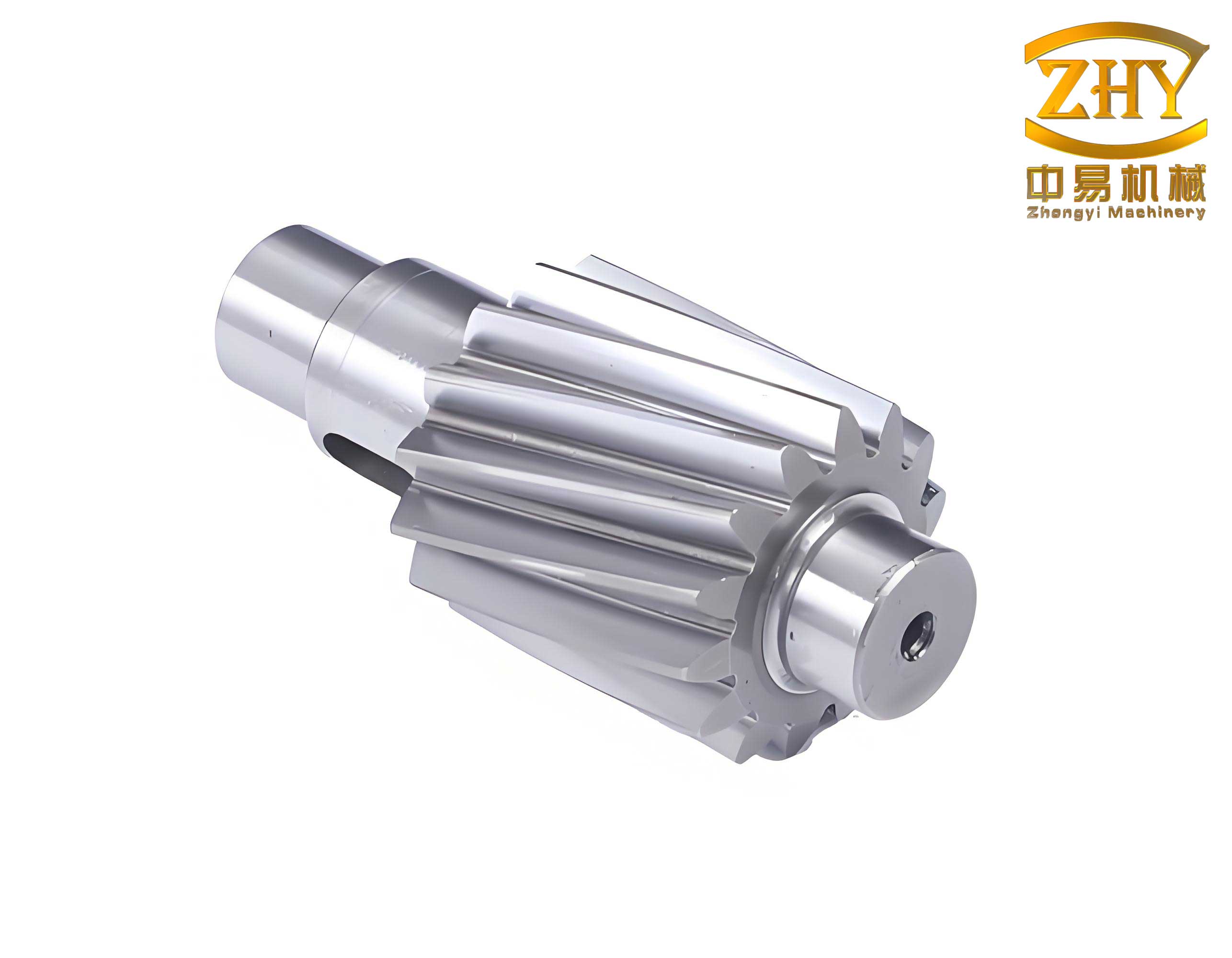
The stress analysis under maximum torque conditions (28,800 N·m) reveals significant stress concentration at the oil groove-oil hole intersection on the gear shaft. The maximum axial stress reaches 789 MPa, with a stress concentration factor (Kt) of approximately 4-5 compared to regions without discontinuities. This stress level remains below the yield strength of the gear shaft material (17CrNiMo6 steel, with a yield strength of 955 MPa), indicating high-cycle fatigue behavior. The stress distribution shows two distinct concentration points, labeled A and B, on either side of the oil hole, asymmetrically positioned relative to the oil groove valley’s diameter plane. This matches the observed crack initiation sites in failed gear shafts.
A comparative analysis of stress states with and without the oil hole demonstrates that the radial hole is the primary contributor to stress concentration. For instance, with only the oil groove present, the maximum principal stress at the groove bottom is around 360 MPa, significantly lower than with the hole. To quantify the effect of hole diameter, parametric studies were conducted for diameters of 4 mm, 5 mm (actual), 6 mm, and 7 mm. The results are summarized in Table 1, showing that increasing the hole diameter to 6 mm can reduce the stress concentration factor.
| Oil Hole Diameter (mm) | Maximum Principal Stress at Point A (MPa) | Maximum Principal Stress at Point B (MPa) | Stress Concentration Factor (Kt) |
|---|---|---|---|
| 4 | 810 | 836 | 4.8 |
| 5 | 789 | 815 | 4.7 |
| 6 | 750 | 775 | 4.3 |
| 7 | 730 | 755 | 4.1 |
The stress difference between points A and B varies with torque load. As shown in Figure 1 (represented mathematically below), the first principal stress at point B exceeds that at point A by up to 26 MPa under high torque conditions (11,000 to 28,800 N·m), while under moderate torque (3,800 to 11,000 N·m), the difference is minimal (0-2 MPa) with point A slightly higher. This asymmetry explains the statistical preference for crack initiation at point B during high-load events like locomotive startup or deceleration. The stress state at these points is primarily uniaxial tension aligned with the gear shaft axis, as confirmed by principal stress vector analysis. The orientation of the first principal stress dictates the initial crack propagation direction, perpendicular to this stress, which aligns with fractographic observations.
The fatigue crack initiation process in gear shafts is influenced by both macroscopic stress concentrations and microscopic surface conditions. According to the persistent slip band theory, fatigue cracks nucleate along planes of maximum shear stress. The presence of circumferential machining marks on the oil groove surface, with an average roughness (Ra) of 2.67 μm, introduces additional stress risers. Under axial tensile stress, these marks create localized shear stress concentrations, facilitating crack initiation. The orientation of these marks relative to the principal stress direction is critical; circumferential marks perpendicular to the stress axis are particularly detrimental. This underscores the importance of surface finish in fatigue performance of gear shafts.
To generalize the stress concentration effects, analytical formulas for stress concentration factors (Kt) in shafts with radial holes under bending or torsion can be referenced. For a shaft with a radial hole of radius r, outer diameter D, and inner diameter d, the stress concentration factor under bending is given by:
$$K_t = C_1 + C_2 \left( \frac{2r}{D} \right) + C_3 \left( \frac{2r}{D} \right)^2 + C_4 \left( \frac{2r}{D} \right)^3$$
where coefficients C1, C2, C3, and C4 are functions of D and d. However, this formula does not account for additional geometric features like circumferential grooves, necessitating finite element analysis for complex gear shafts. For the gear shaft in study, with D = 120 mm, d = 60 mm, and r = 2.5 mm, the approximate Kt from this formula is 3.5, but the actual Kt is higher due to the groove interaction. The combined effect can be expressed as a multiplicative factor, but empirical correction is needed. Table 2 summarizes key material properties and loading parameters used in the analysis.
| Parameter | Value | Description |
|---|---|---|
| Material | 17CrNiMo6 Steel | High-strength gear steel |
| Yield Strength | 955 MPa | Average from tensile tests |
| Ultimate Tensile Strength | 1,200 MPa | Typical value for this steel |
| Young’s Modulus | 210 GPa | Assumed for steel |
| Poisson’s Ratio | 0.3 | Standard for steel |
| Maximum Torque | 44,000 N·m | Design driving torque |
| Operating Torque Range | 0-28,800 N·m | Typical service range |
| Oil Groove Depth | 3 mm | Approximate measurement |
| Oil Hole Diameter | 5 mm | Standard size |
The finite element results further indicate that the stress concentration zones are critical for fatigue life prediction. Using the stress-life (S-N) approach, the fatigue strength of the gear shaft material can be estimated. For 17CrNiMo6 steel under fully reversed bending, the endurance limit (Se) is approximately 500 MPa for a polished specimen. However, with a stress concentration factor of 4.7, the effective alternating stress (σa) at the concentration point under maximum torque is:
$$\sigma_a = \frac{K_t \cdot \sigma_{nom}}{2}$$
where σnom is the nominal bending stress. For a nominal stress of 170 MPa (calculated from beam theory), σa becomes 400 MPa, which exceeds the endurance limit when adjusted for surface finish and size effects. This confirms the high-cycle fatigue regime. The fatigue life can be modeled using the Basquin equation:
$$\sigma_a = \sigma_f’ (2N_f)^b$$
where σf’ is the fatigue strength coefficient, b is the fatigue strength exponent, and Nf is the number of cycles to failure. For this material, typical values are σf’ = 1,200 MPa and b = -0.12. Solving for Nf with σa = 400 MPa yields a predicted life on the order of 10^5 cycles, consistent with the observed service life of gear shafts.
To mitigate fatigue failures in gear shafts, several design modifications are proposed based on the stress analysis. First, increasing the oil hole diameter from 5 mm to 6 mm can reduce the stress concentration factor by about 10%, as shown in Table 1. Second, surface enhancement techniques such as shot peening or roller burnishing can introduce compressive residual stresses at the critical points A and B. The beneficial effect of residual stress (σres) on fatigue strength can be quantified using the modified Goodman relation:
$$\sigma_a = S_e \left(1 – \frac{\sigma_m + \sigma_{res}}{S_u}\right)$$
where σm is the mean stress, Se is the endurance limit, and Su is the ultimate tensile strength. Introducing a compressive residual stress of -300 MPa, for example, could increase the allowable alternating stress by 20-30%, significantly extending the fatigue life of gear shafts. Additionally, improving surface finish by polishing the oil groove to reduce roughness or altering the machining direction to align marks with the principal stress axis can decrease stress risers. These measures collectively enhance the durability of gear shafts in locomotive applications.
In conclusion, this study provides a detailed stress analysis of gear shafts in HXD1 locomotives, highlighting the asymmetric stress concentration at the oil groove-oil hole intersection as the primary driver for fatigue crack initiation. The finite element model accurately captures the stress distribution, revealing higher stresses at point B under high torque conditions, which correlates with statistical failure data. The analysis underscores the importance of geometric design and surface conditions on the fatigue performance of gear shafts. Recommendations include optimizing hole diameter, applying surface mechanical strengthening, and improving machining practices to introduce compressive residual stresses and reduce stress concentrations. Future work could involve experimental validation through fatigue testing of modified gear shafts and probabilistic analysis to account for material variability. This comprehensive approach aims to ensure the reliability and longevity of gear shafts in heavy-haul railway operations, contributing to safer and more efficient transportation systems.