
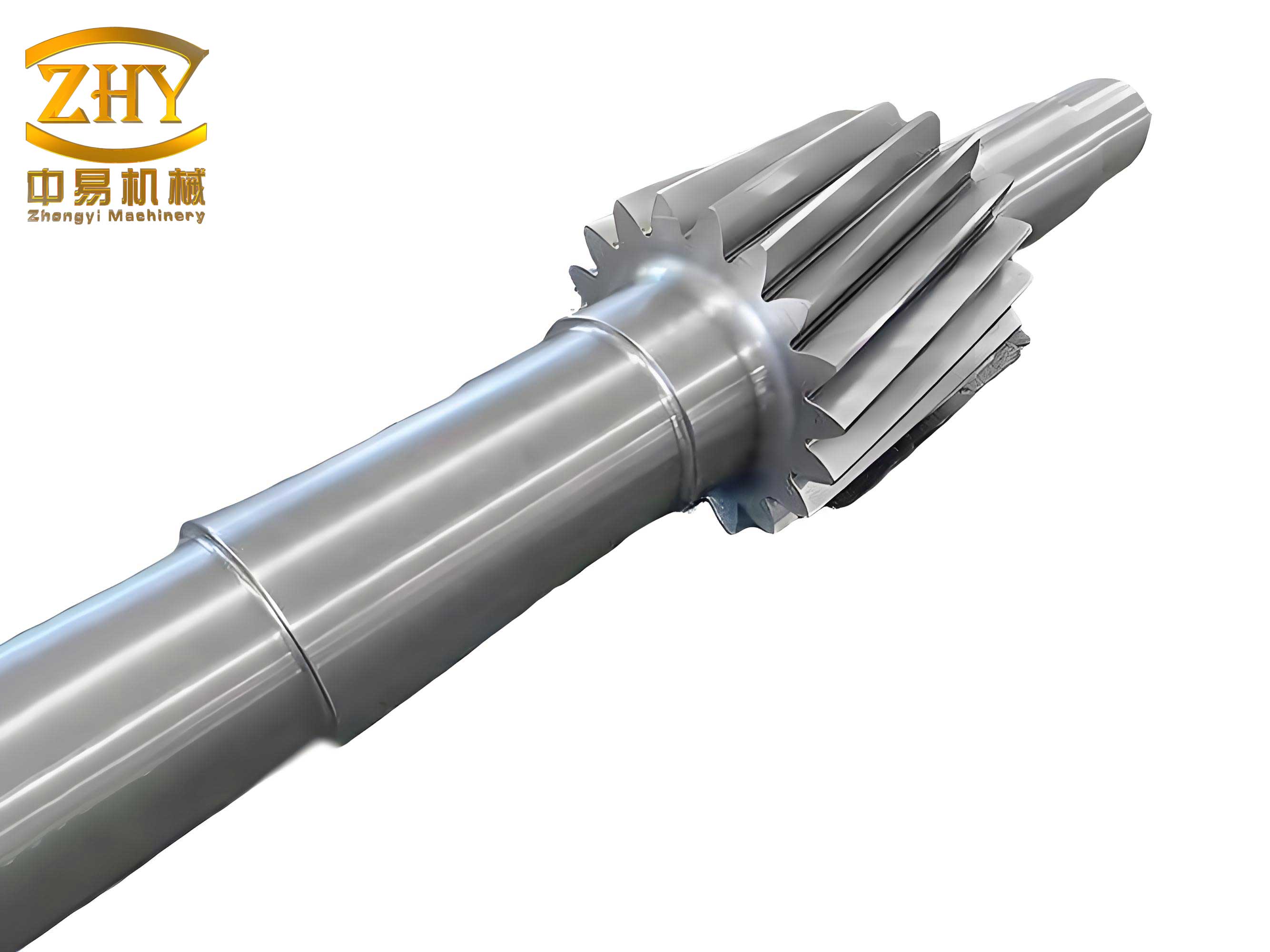
In modern heavy-haul locomotive drivetrains, the gear shaft within the motor rotating shaft assembly serves as a critical component for transmitting immense torque from the traction motor to the driving wheelset. Its operational reliability directly impacts the safety and availability of the locomotive. A conical interference fit is frequently employed to join this gear shaft to the motor shaft, prized for its superior torque transmission capacity, excellent concentricity, and resistance to shock loads. However, field experience with certain locomotive models has revealed a troubling trend of premature fatigue failure in these gear shafts, often initiating at specific geometric discontinuities, after accumulating approximately 400,000 kilometers in service. This work presents a detailed, first-principles investigation into the stress states governing the fatigue crack initiation in such gear shafts, leveraging advanced finite element analysis (FEA) to unravel the complex interplay of geometry, load, and material response.
The primary failure mode observed is high-cycle fatigue. Fractographic examinations consistently identify two distinct fatigue origins. These origins are not randomly located but are found symmetrically yet asymmetrically at the intersection region of a circumferential oil groove and a radial oil hole machined near the large end of the conical fitting surface of the gear shaft. Intriguingly, these crack initiation sites are offset from the point of minimum radius in the oil groove’s valley. This precise and repeatable location points unequivocally to a localized stress concentration as the primary driver for fatigue nucleation. The core objective of this analysis is to quantify this stress concentration, map the detailed stress field around these critical points, and establish a definitive link between the computed stress state and the statistical patterns observed in failed gear shaft samples.
To understand the stress concentration effect of a radial hole in a shaft under bending or torsion, classical theory provides stress concentration factor (K_t) formulas. For a shaft of outer diameter D with a transverse hole of diameter d (or radius r), subjected to bending moments, the stress concentration factor can be approximated by a polynomial function:
$$K_t = C_1 + C_2\left(\frac{2r}{D}\right) + C_3\left(\frac{2r}{D}\right)^2 + C_4\left(\frac{2r}{D}\right)^3$$
where the coefficients C1, C2, C3, and C4 are functions of the shaft’s geometry, specifically the ratios of inner diameters if present. While this formula offers initial insight, its applicability is severely limited for the complex gear shaft geometry under investigation. The presence of the adjacent circumferential oil groove, the conical interface with press-fit contact stresses, and the combined bending-torsion loading from gear meshing forces create a multiaxial, non-linear stress field that cannot be captured by simplified analytical solutions. This complexity necessitates a high-fidelity computational approach.
We constructed a three-dimensional, non-linear finite element model of the complete motor rotating shaft assembly, including the gear shaft, motor shaft, and the driven gear pair. The model incorporates several critical features to ensure realism:
- Conical Interference Fit Simulation: The press-fit process between the gear shaft and motor shaft was simulated sequentially, applying internal hydraulic pressure to the motor shaft bore and enforcing a defined axial displacement to achieve the specified interference fit, followed by pressure release.
- Detailed Gear Meshing: The helical gear teeth on the gear shaft and the mating bull gear were modeled with accurate involute profiles. Load sharing among multiple gear teeth in contact was considered.
- System-Level Constraints and Loads: The model included bearing supports, constraints representing the connection to the wheelset, and applied loads encompassing the full operational spectrum. These include the motor’s output torque (ranging from 0 to 44,000 N·m), gravitational forces from the motor mass, gear masses, and the chassis.
- Local Mesh Refinement: The region surrounding the oil groove and oil hole intersection was densely meshed with high-order elements to accurately resolve steep stress gradients.
The governing equilibrium equations solved by the FEA software at each node are based on the principle of virtual work, minimizing the total potential energy of the system. For linear elastic material behavior (valid before yield), the constitutive relationship is given by Hooke’s Law in its generalized form for isotropic materials:
$$\{\sigma\} = [D]\{\epsilon\}$$
where $\{\sigma\}$ is the stress vector, $\{\epsilon\}$ is the strain vector, and $[D]$ is the material stiffness matrix, defined by the Young’s modulus (E) and Poisson’s ratio ($\nu$) of the gear shaft material, typically a high-strength alloy steel like 17CrNiMo6.
The FEA results reveal a highly localized stress field. Under maximum operational torque, a pronounced stress concentration is evident at the intersection of the oil groove and the oil hole. The maximum axial stress at this location reaches approximately 789 MPa. To contextualize this value, the nominal bending stress in the shaft section without the discontinuity is only about 160-180 MPa. This yields a structural stress concentration factor (K_t) of approximately 4.4 to 4.9. Crucially, this peak stress remains below the yield strength of the gear shaft material (~955 MPa), confirming the high-cycle fatigue nature of the failure.
A detailed examination of the stress contour plot on the groove surface unveils the exact pattern observed in failed parts. Two distinct stress concentration “hot spots” are identified, labeled Point A and Point B. They are located on opposite sides of the radial oil hole and are symmetrically disposed about the shaft axis, but they are asymmetrical with respect to the diameter plane that passes through the very bottom of the oil groove valley. This mirrors the documented crack origin sites with remarkable accuracy. The principal stress vectors at these points indicate a nearly uniaxial tensile stress state oriented at an angle to the shaft axis, dictating the initial direction of fatigue crack propagation.
A pivotal finding from the parametric analysis is the differential stress state between these two symmetric critical points. The first principal stress at Point B consistently exceeds that at Point A under most loading conditions, particularly during high-torque events like locomotive startup or dynamic braking. The stress difference $\Delta \sigma$ can be modeled as a function of the applied torque T:
$$\Delta \sigma (T) = \sigma_{B}^{(1)}(T) – \sigma_{A}^{(1)}(T)$$
Where $\sigma_{B}^{(1)}$ and $\sigma_{A}^{(1)}$ are the first principal stresses at Points B and A, respectively. The FEA data shows that for torques above approximately 11,000 N·m, $\Delta \sigma(T)$ becomes positive and increases non-linearly with torque, reaching about 26 MPa at the maximum torque of 28,800 N·m.
This inherent mechanical asymmetry in an otherwise symmetric geometry has a direct and profound implication for fatigue life. According to the Basquin equation for high-cycle fatigue, the number of cycles to failure N_f is related to the stress amplitude $\sigma_a$:
$$N_f = \left(\frac{\sigma_f’}{\sigma_a}\right)^b$$
where $\sigma_f’$ is the fatigue strength coefficient and b is the fatigue strength exponent. Even a modest increase in stress amplitude significantly reduces the predicted life. A 26 MPa increase represents a substantial portion of the fatigue limit for high-strength steels. Therefore, Point B, subjected to a higher local stress amplitude under the most severe operational loads, has a statistically higher probability of initiating a fatigue crack first and exhibiting a faster crack growth rate. This computational prediction is strongly corroborated by statistical analysis of field failures.
| Failure Category | Percentage of Total Samples | Key Observations |
|---|---|---|
| Only Left-Side Crack (Point B) | 52% | Point B is the sole initiation site. |
| Cracks on Both Sides (A & B) | 29% | 86% of these show the Point B crack longer than Point A crack. |
| Only Right-Side Crack (Point A) | 2% | Rare occurrence, likely due to micro-geometric or material variations. |
| Complete Fracture | 17% | All exhibited prior cracking at both points, with Point B crack more advanced. |
The analysis further dissects the individual contributions of the oil groove and the oil hole to the overall stress concentration. A comparative FEA study was conducted on modified geometries:
- Gear shaft with only the circumferential oil groove (no radial oil hole).
- Gear shaft with the standard oil groove and radial oil hole (baseline).
- Gear shaft with the oil groove and radial oil holes of varying diameters.
The results are summarized in the table below. The key takeaway is that the radial oil hole is the dominant feature responsible for the severe stress concentration. The circumferential groove alone induces a much milder stress rise. This insight opens a clear path for design mitigation.
| Radial Oil Hole Diameter (mm) | Maximum First Principal Stress (MPa) at Max Torque | Estimated Structural Stress Concentration Factor (K_t) | Relative Severity |
|---|---|---|---|
| No Hole (Groove only) | ~360 | ~2.0 | Low |
| 4 | ~815 | ~4.6 | High |
| 5 (Baseline) | 789 | 4.4 | High |
| 6 | ~710 | ~3.9 | Medium-High |
| 7 | ~680 | ~3.8 | Medium |
The data indicates that increasing the oil hole diameter from 5mm to 6mm can reduce the peak stress by about 10%. This beneficial effect occurs because a larger hole has a less abrupt transition curvature at its edge relative to the groove surface, slightly reducing the geometric severity of the notch. The relationship between peak stress $\sigma_{max}$ and hole radius r can be expressed as an inverse function for this specific geometry context:
$$\sigma_{max} \propto \frac{1}{r^n}$$
where the exponent n is derived from curve fitting the FEA data, typically between 0.2 and 0.5 for this range, indicating a non-linear but beneficial scaling.
Beyond macro-geometry, surface condition plays a critical role. The circumferential machining marks on the oil groove surface act as micro-stress raisers. Under the primary axial tensile stress field, these circumferential scratches create localized plastic zones and intensify the stress at their roots. The effective stress concentration factor $K_{t,eff}$ becomes a product of the macro-geometric factor $K_{t,macro}$ and a micro-geometric factor $K_{t,micro}$ due to surface roughness:
$$K_{t,eff} \approx K_{t,macro} \cdot K_{t,micro}$$
Where $K_{t,micro}$ is greater than 1 and is a function of surface finish parameters like Ra (arithmetic mean roughness). This synergistic effect explains why cracks initiate precisely at the intersection line where the highest macro-stress concentration coincides with the micro-notch effect of machining marks oriented perpendicular to the maximum principal stress direction.
Based on this comprehensive stress analysis, a multi-faceted strategy for enhancing the fatigue performance of the locomotive gear shaft can be formulated:
- Design Optimization: Where space and lubrication flow requirements permit, increasing the radial oil hole diameter from 5mm to 6mm is a straightforward and effective method to reduce the peak stress concentration factor by approximately 10-15%.
- Surface Engineering: Implementing controlled surface mechanical enhancement techniques at the two identified critical zones (Points A and B) is highly recommended. Processes like shot peening, laser shock peening, or deep rolling can introduce a deep, stable layer of residual compressive stress ($\sigma_{res}$) at the surface. This compressive stress superimposes onto the operational tensile stress, effectively lowering the mean stress ($\sigma_m$) and the stress amplitude ($\sigma_a$) experienced by the material during cycling. The modified stress state significantly retards fatigue crack initiation. The improvement can be quantified using the modified Goodman relation:
$$\sigma_a = \sigma_{alt} \left(1 – \frac{\sigma_m + \sigma_{res}}{\sigma_{uts}}\right)$$
where a negative $\sigma_{res}$ increases the allowable $\sigma_a$ for a given life. - Surface Finish Improvement: The finishing process for the oil groove surface, especially near the oil hole intersection, should aim to eliminate circumferential tool marks. Polishing or superfinishing this local area to a lower Ra value, or alternatively, inducing a surface texture aligned parallel to the maximum principal stress direction, can substantially reduce $K_{t,micro}$.
In conclusion, the fracture of the HXD1 locomotive gear shaft is decisively governed by a predictable and quantifiable stress concentration at the oil groove-oil hole interface. High-fidelity finite element analysis has successfully replicated the unique asymmetric dual-origin failure pattern, quantified the stress differential between the origins, and isolated the key geometric contributors. The stress field dictates not only the location of crack initiation but also the statistical likelihood of which side fails first. This deep understanding moves the problem from one of observational failure analysis to one of predictive engineering. The proposed countermeasures—moderate geometric optimization combined with targeted surface enhancement and finishing—leverage this understanding to proactively increase the fatigue strength of the component. This integrated approach, rooted in detailed stress analysis, provides a robust framework for enhancing the durability and reliability of critically loaded gear shafts in demanding applications across the heavy machinery and transportation sectors.