
The study of gear transmission systems is a cornerstone of mechanical engineering, with particular emphasis on designs that offer high efficiency, compactness, and smooth operation. Among these, hyperboloidal gears, commonly known as hypoid gears, represent a pinnacle of design for intersecting yet non-parallel and non-intersecting axes. Their ability to transmit motion and power between offset shafts makes them indispensable in critical applications, most notably in the rear axle differentials of automobiles, where they contribute to lowering the vehicle’s center of gravity and improving driveline packaging. The performance of these gears is not solely dictated by their design but is profoundly influenced by the realities of manufacturing and assembly. This article delves deeply into the tooth contact analysis (TCA) of a specific type of hypoid gear—the epicycloidal or face-hobbed hypoid gear—with a focused investigation on the impact of assembly misalignments.
Hyperboloidal gears are celebrated for their high load-carrying capacity, operational smoothness, and low noise generation. The epicycloidal variant, characterized by its constant-height teeth and continuous, multi-flank contact during meshing, offers distinct advantages. Unlike the face-milled spiral bevel gears which use an intermittent indexing process, face-hobbed hyperboloidal gears are produced via a continuous generating and indexing method. This process not only enhances manufacturing efficiency by combining roughing and finishing in a single cycle but also theoretically produces a perfectly conjugate gear pair when machined with a matched “two-part cutter head.” In practice, minor modifications are introduced to the tooth surfaces to create a localized bearing contact, which is crucial for accommodating inevitable misalignments and ensuring controlled transmission error, thereby further reducing noise and vibration.
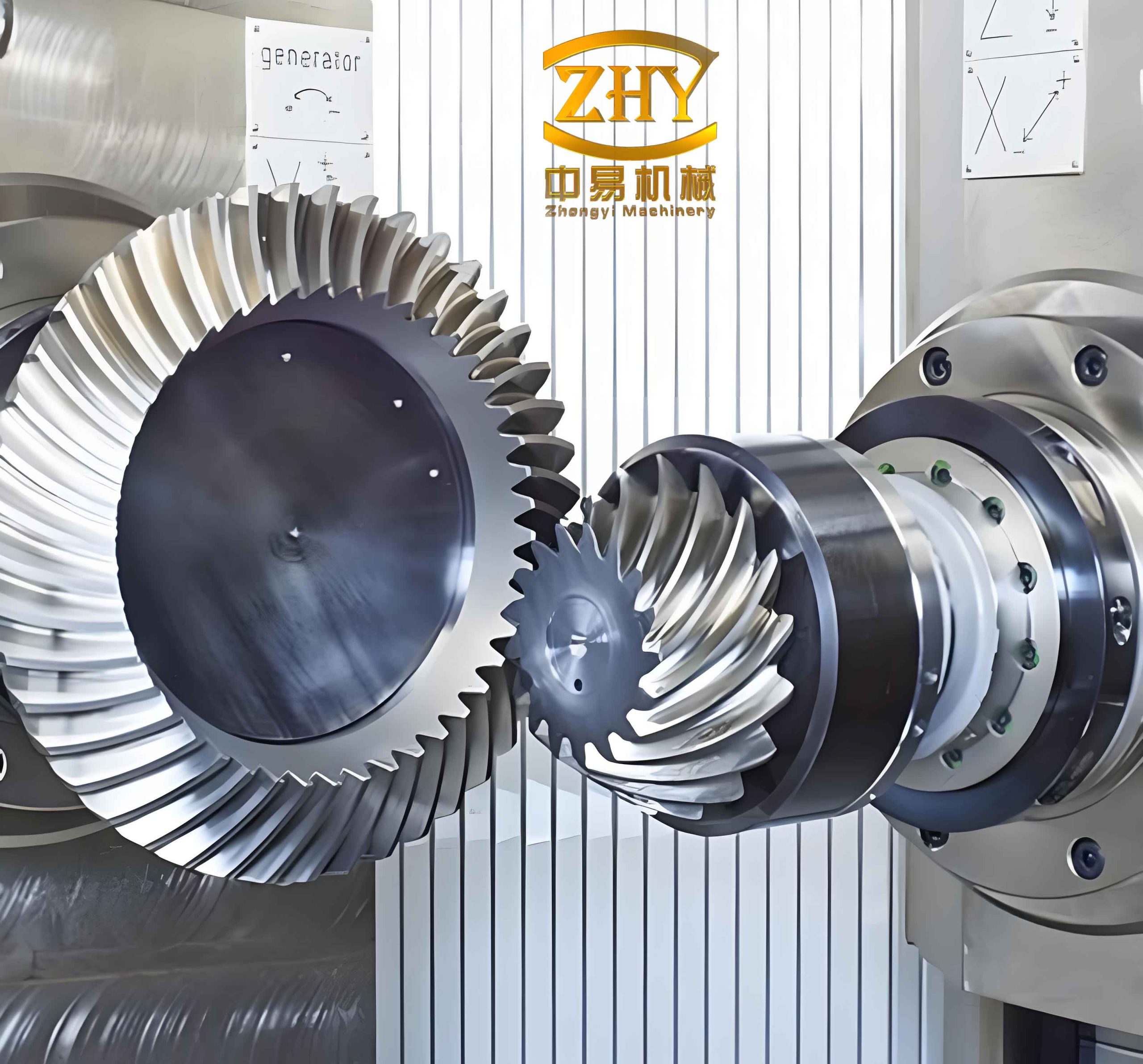
The core principle behind generating the tooth flank of epicycloidal hyperboloidal gears is the “crown gear” or “imaginary generating gear” concept. The cutting process simulates the meshing of the workpiece with a virtual planar gear. The tooth flanks are generated as the envelope of the family of surfaces traced by the cutting tool relative to the rotating gear blank. The distinctive epicycloidal lengthwise tooth curve is produced by the relative rolling motion between the cutter head and the imaginary crown gear. The cutter head, equipped with multiple groups of blades (typically comprising an inner blade for the convex side and an outer blade for the concave side of the tooth), rotates while the workpiece and the imaginary gear rotate in a precisely synchronized ratio. This coordinated motion, known as face-hobbing, generates the tooth slot’s geometry and performs continuous indexing simultaneously.
Establishing a precise mathematical model is the foundational step for performing a sophisticated Tooth Contact Analysis (TCA). The model must accurately represent the geometry of the cutting tool, its motion relative to the imaginary generating gear, and finally, the envelope surface generated on the workpiece. For epicycloidal hyperboloidal gears machined with a dual-cutter head, the coordinate systems and transformation matrices become the language of this geometry.
The cutting edges of the inner (I) and outer (A) blades are defined in their respective tool coordinate systems. A point on the cutting edge can be represented in the tool coordinate system \( S_t \) by the vector \( \mathbf{r}_t(u) \), where \( u \) is a blade profile parameter. This involves a series of transformations from the blade edge coordinate system \( S_m \).
$$
\mathbf{r}_m(u) = \begin{bmatrix} u \sin \alpha_{0k} \\ 0 \\ u \cos \alpha_{0k} \\ 1 \end{bmatrix}
$$
The transformation from the blade system \( S_m \) to the tool system \( S_t \) involves rotations and translations based on tool parameters like the blade pressure angle \( \alpha_{0k} \), blade offset angle \( \delta_{0k} \), nominal cutter radius \( r_{0k} \), and an initial blade setting angle \( \beta_{ik} \). The composite transformation is:
$$
\mathbf{r}_t(u) = \mathbf{M}_{tp} \mathbf{M}_{pn} \mathbf{M}_{nm} \mathbf{r}_m(u)
$$
where the transformation matrices are defined as:
$$
\mathbf{M}_{nm} = \begin{bmatrix}
\cos \delta_{0k} & -\sin \delta_{0k} & 0 & 0 \\
\sin \delta_{0k} & \cos \delta_{0k} & 0 & 0 \\
0 & 0 & 1 & 0 \\
0 & 0 & 0 & 1
\end{bmatrix}, \quad
\mathbf{M}_{pn} = \begin{bmatrix}
1 & 0 & 0 & r_{0k} \\
0 & 1 & 0 & 0 \\
0 & 0 & 1 & 0 \\
0 & 0 & 0 & 1
\end{bmatrix}, \quad
\mathbf{M}_{tp} = \begin{bmatrix}
\cos \beta_{ik} & -\sin \beta_{ik} & 0 & 0 \\
\sin \beta_{ik} & \cos \beta_{ik} & 0 & 0 \\
0 & 0 & 1 & 0 \\
0 & 0 & 0 & 1
\end{bmatrix}
$$
The subscript \( k \) denotes either the inner (I) or outer (A) blade, each with its specific set of parameters. The imaginary generating gear, or crown gear, is a virtual entity whose tooth surface is the family of surfaces swept by the cutting tool. In the coordinate system \( S_d \) attached to this generating gear, the surface is defined by two motion parameters: the rotation of the cutter \( \beta \) and the rotation of the generating gear \( \varphi_{c1} \), which are kinematically linked. The relationship is given by \( \varphi_{c1} = (z_0 / z_p) \beta \), where \( z_0 \) is the number of blade groups on the cutter head and \( z_p \) is the number of teeth on the imaginary generating gear.
$$
\mathbf{r}_d(u, \beta, \varphi_{c1}) = \mathbf{M}_{dc}(\varphi_{c1}) \mathbf{M}_{cb} \mathbf{M}_{bt}(\beta) \mathbf{r}_t(u)
$$
The matrices \( \mathbf{M}_{bt} \), \( \mathbf{M}_{cb} \), and \( \mathbf{M}_{dc} \) incorporate the cutter eccentricity \( E_{xz} \), cutter phase angle \( \phi_e \), machine root angle \( \gamma_m \), radial setting \( S_R \), and the initial cradle angle \( \theta_c \).
Finally, the tooth surface of the actual workpiece gear (pinion or gear) is generated as the envelope of the family of generating gear surfaces relative to the rotating gear blank. In the coordinate system \( S_1 \) attached to the workpiece, the surface equation requires an additional motion parameter, the workpiece rotation angle \( \varphi_1 \).
$$
\mathbf{r}_1(u, \beta, \varphi_{c2}, \varphi_1) = \mathbf{M}_{1g}(\varphi_1) \mathbf{M}_{gf} \mathbf{M}_{fe} \mathbf{M}_{ed}(\varphi_{c2}) \mathbf{r}_d(u, \beta)
$$
Here, \( \varphi_{c2} \) is the generating gear rotation during workpiece generation, kinematically tied to \( \varphi_1 \) by \( \varphi_{c2} = (z / z_p) \varphi_1 \), where \( z \) is the number of teeth on the workpiece. The matrices \( \mathbf{M}_{fe} \) and \( \mathbf{M}_{gf} \) include crucial machine settings such as the machine offset \( E_m \), sliding base feed \( \Delta B \), and machine center to back \( \Delta A \). The conjugate condition, or the equation of meshing, must be satisfied simultaneously. This condition states that the relative velocity at the contact point between the generating surface and the workpiece must be perpendicular to the common surface normal.
$$
f_1(u, \beta, \varphi_1) = \mathbf{n}_1 \cdot \mathbf{v}_1^{(m1)} = \mathbf{n}_1 \cdot \left( \frac{\partial \mathbf{r}_1}{\partial \varphi_1} \right) = 0
$$
Solving the system of equations comprising the surface equation \( \mathbf{r}_1(u, \beta, \varphi_1) \) and the equation of meshing \( f_1(u, \beta, \varphi_1)=0 \) yields the complete mathematical definition of the generated tooth flank for the epicycloidal hyperboloidal gear.
Tooth Contact Analysis (TCA) is the computational simulation of the meshing of two gear tooth flanks. Its primary outputs are the transmission error curve and the pattern of contact (bearing contact) on the tooth surface. For a pair of mating hyperboloidal gears, the pinion surface \( \Sigma_1 \) and the gear surface \( \Sigma_2 \) are defined by their respective generation models. The assembly of the gear pair is defined by the shaft angle \( \Sigma \), offset \( V \), and pinion axial setting \( H \). In a fixed global coordinate system \( S_s \), the position and normal vectors of both surfaces are expressed as functions of their respective parameters and assembly rotation angles \( \phi_1 \) (pinion) and \( \phi_2 \) (gear).
The fundamental conditions for contact at any instant are: 1) position vectors of the contacting points coincide, and 2) unit normals at those points are collinear. This leads to the TCA system of vector equations:
$$
\begin{aligned}
\mathbf{r}_s^{(1)}(u^{(1)}, \beta^{(1)}, \varphi_1^{(1)}, \phi_1) &= \mathbf{r}_s^{(2)}(u^{(2)}, \beta^{(2)}, \varphi_1^{(2)}, \phi_2) \\
\mathbf{n}_s^{(1)}(u^{(1)}, \beta^{(1)}, \varphi_1^{(1)}, \phi_1) &= \mathbf{n}_s^{(2)}(u^{(2)}, \beta^{(2)}, \varphi_1^{(2)}, \phi_2)
\end{aligned}
$$
Given that the unit normals have a magnitude of 1, these vector equations yield five independent scalar equations. Together with the two equations of meshing (one from the generation of each gear member), we have seven equations. The unknowns are the eight parameters: \( u^{(1)}, \beta^{(1)}, \varphi_1^{(1)}, u^{(2)}, \beta^{(2)}, \varphi_1^{(2)}, \phi_1, \phi_2 \). By choosing \( \phi_1 \) as the input parameter, the system can be solved numerically for the remaining seven unknowns. Iterating \( \phi_1 \) through a mesh cycle provides the path of contact across the tooth flank. The transmission error, a key indicator of meshing smoothness, is calculated as:
$$
\Delta \phi_2(\phi_1) = \phi_2 – \phi_{20} – \frac{z_1}{z_2} (\phi_1 – \phi_{10})
$$
where \( \phi_{10}, \phi_{20} \) are initial contact angles. A symmetric, parabolic-shaped transmission error curve is highly desirable as it helps absorb linear errors due to misalignments, reducing vibration and noise. Furthermore, by considering a small deformation (e.g., 6.35 μm) under load, the instantaneous contact ellipse at each point can be calculated, revealing the bearing contact pattern.
To demonstrate the application of the derived model and TCA, a detailed example of an epicycloidal hyperboloidal gear pair is presented. The design and manufacturing parameters are critical for achieving the desired performance.
Table 1: Basic Geometry Parameters of the Hyperboloidal Gear Pair
| Parameter | Pinion | Gear |
|---|---|---|
| Shaft Angle, Σ | 90° | 90° |
| Offset Distance, V | 40 mm | 40 mm |
| Number of Teeth, z | 12 | 49 |
| Mean Spiral Angle, βm | 42.922° (LH) | 30° (RH) |
| Axial Distance, H | 16.570 mm | 8.331 mm |
| Face Width, F | 65 mm | 60 mm |
| Pitch Cone Angle, δ | 18.206° | 71.354° |
Table 2: Key Machine Tool Settings for Manufacturing
| Parameter | Pinion (Example: Convex Side) | Gear (Example: Concave Side) |
|---|---|---|
| Cutter Blade Groups, z0 | 5 | 5 |
| Nominal Cutter Radius, r0 | 135.00 mm | 135.46 mm |
| Cutter Pressure Angle, α0 | 21° / -19° | 19° / -21° |
| Blade Offset Angle, δ0 | -6.4° | 6.4265° |
| Machine Offset, Em | 35.697 mm | 4.115 mm |
| Machine Root Angle, γm | 18.2058° | 71.3535° |
| Cradle Radial Setting, SR | 172.038 mm | 172.038 mm |
Using the mathematical model with the parameters above, the three-dimensional tooth flanks are generated. The TCA under ideal, misalignment-free assembly conditions yields the primary performance benchmarks. Through careful modification of machine settings—such as the initial cradle angle \( \theta_c \) and the difference between inner and outer cutter radii—a favorable contact pattern and transmission error can be achieved. For this example, the TCA results show a well-centered bearing contact on both the convex and concave sides of the gear teeth. The transmission error curve exhibits a symmetric, parabolic profile, indicating a design optimized for low-noise operation and the ability to accommodate minor disturbances smoothly. This ideal setup serves as the baseline for evaluating the effects of assembly errors.
In real-world applications, perfect assembly is unattainable. Manufacturing tolerances, mounting deflections, and operational wear introduce misalignments that can drastically alter the meshing behavior of hyperboloidal gears. The most critical static assembly errors for hypoid gears are: the error in shaft angle (\( \Delta \Sigma \)), the error in pinion axial setting (\( \Delta H \)), and the error in offset distance (\( \Delta V \)). TCA is an invaluable tool for quantifying the sensitivity of a gear design to these errors.
A systematic analysis was conducted by introducing each error individually into the TCA model of the example gear pair. The results are summarized below:
Table 3: Influence of Assembly Misalignments on Meshing Behavior
| Type of Misalignment | Effect on Bearing Contact Location | Effect on Transmission Error | Relative Sensitivity |
|---|---|---|---|
| Shaft Angle Error (\( \Delta \Sigma \)) e.g., \( \Delta \Sigma = -0.05^\circ \) |
Contact shifts strongly towards the toe (for negative \( \Delta \Sigma \)) or heel (for positive \( \Delta \Sigma \)) of the gear tooth. | Magnitude and symmetry of the parabolic error curve are significantly distorted. The peak-to-peak error increases noticeably. | Highest. Small angular errors cause substantial changes in contact path and load distribution. |
| Axial Setting Error (\( \Delta H \)) e.g., \( \Delta H = -0.1 \, \text{mm} \) |
Contact shifts towards the toe (for negative \( \Delta H \)) or heel (for positive \( \Delta H \)), but the shift is generally less severe than for an equivalent shaft angle error. | Noticeable change in the shape and magnitude of the transmission error curve, though often less dramatic than shaft angle error. | Medium to High. Critical for setting the depth of mesh and initial contact position. |
| Offset Error (\( \Delta V \)) e.g., \( \Delta V = +0.1 \, \text{mm} \) |
Contact shifts longitudinally, typically towards the toe for positive \( \Delta V \) and heel for negative \( \Delta V \). The pattern may also widen or narrow. | Alters the transmission error profile. The parabolic shape may become asymmetric, and the mean level may shift. | Medium. Directly changes the relative rolling action between the mating surfaces. |
The analysis confirms a consistent trend: positive errors tend to shift the contact pattern towards the heel (larger diameter) of the gear tooth, while negative errors shift it towards the toe (smaller diameter). Among the three, the shaft angle error \( \Delta \Sigma \) exhibits the greatest influence on both the contact path location and the form of the transmission error curve. A deviation of just -0.05° can move the contact patch to the very edge of the tooth and disrupt the smooth parabolic error function, potentially leading to edge-loading, increased stress, and elevated noise. This highlights why precise control over the housing geometry and bearing preload is paramount in the assembly of hyperboloidal gear drives.
An important observation from this and similar studies is that epicycloidal hyperboloidal gears, due to their localized bearing contact design and optimized tooth geometry, generally exhibit a lower sensitivity to assembly misalignments compared to, for instance, straight bevel gears. The designed lengthwise and profile modifications allow the gear pair to “absorb” a certain amount of misalignment while maintaining a functional, albeit relocated, contact pattern and a manageable transmission error. This inherent robustness is a key advantage in automotive applications where perfect alignment cannot be guaranteed over the life of the vehicle.
In conclusion, the performance of epicycloidal hyperboloidal gears is a complex interplay between sophisticated design, precise manufacturing, and controlled assembly. The mathematical modeling of the face-hobbing process using the two-part cutter head system provides a rigorous foundation for understanding tooth geometry. Tooth Contact Analysis (TCA) serves as the critical bridge between this theoretical geometry and practical performance, allowing engineers to predict meshing behavior under both ideal and real-world conditions. The investigation into assembly misalignments—specifically shaft angle, axial setting, and offset errors—reveals a clear hierarchy of sensitivity, with shaft angle error being the most critical. The results demonstrate that while these hyperboloidal gears are designed to be relatively tolerant, precise control of assembly parameters remains essential to achieve the optimal contact pattern, minimal transmission error, and consequently, the high efficiency, durability, and quiet operation for which these advanced gear systems are renowned. The methodologies and insights presented form a core part of the modern design and validation process for high-performance hypoid gear drives.