
The pursuit of optimal performance in power transmission systems, particularly in demanding applications like automotive rear axles, has consistently driven the refinement of gear design and analysis methodologies. Among various gear types, the hypoid gear stands out for its ability to connect non-parallel, non-intersecting shafts with a high gear ratio in a compact arrangement, while offering smoother operation compared to bevel gears. However, the complex spatial geometry of hypoid gear teeth, characterized by an offset between the axes, makes predicting their meshing behavior under various conditions a significant challenge. This article presents a detailed, first-person account of our development and implementation of a comprehensive Tooth Contact Analysis (TCA) methodology for hypoid gear drives. Our approach encompasses both conventional tooth surface contact and critical edge contact scenarios, thereby modeling the complete meshing process. We will derive the fundamental equations, detail the computational procedures, and demonstrate the power of this simulation-based approach for evaluating and optimizing hypoid gear performance, effectively reducing prototyping costs and enhancing final product quality.
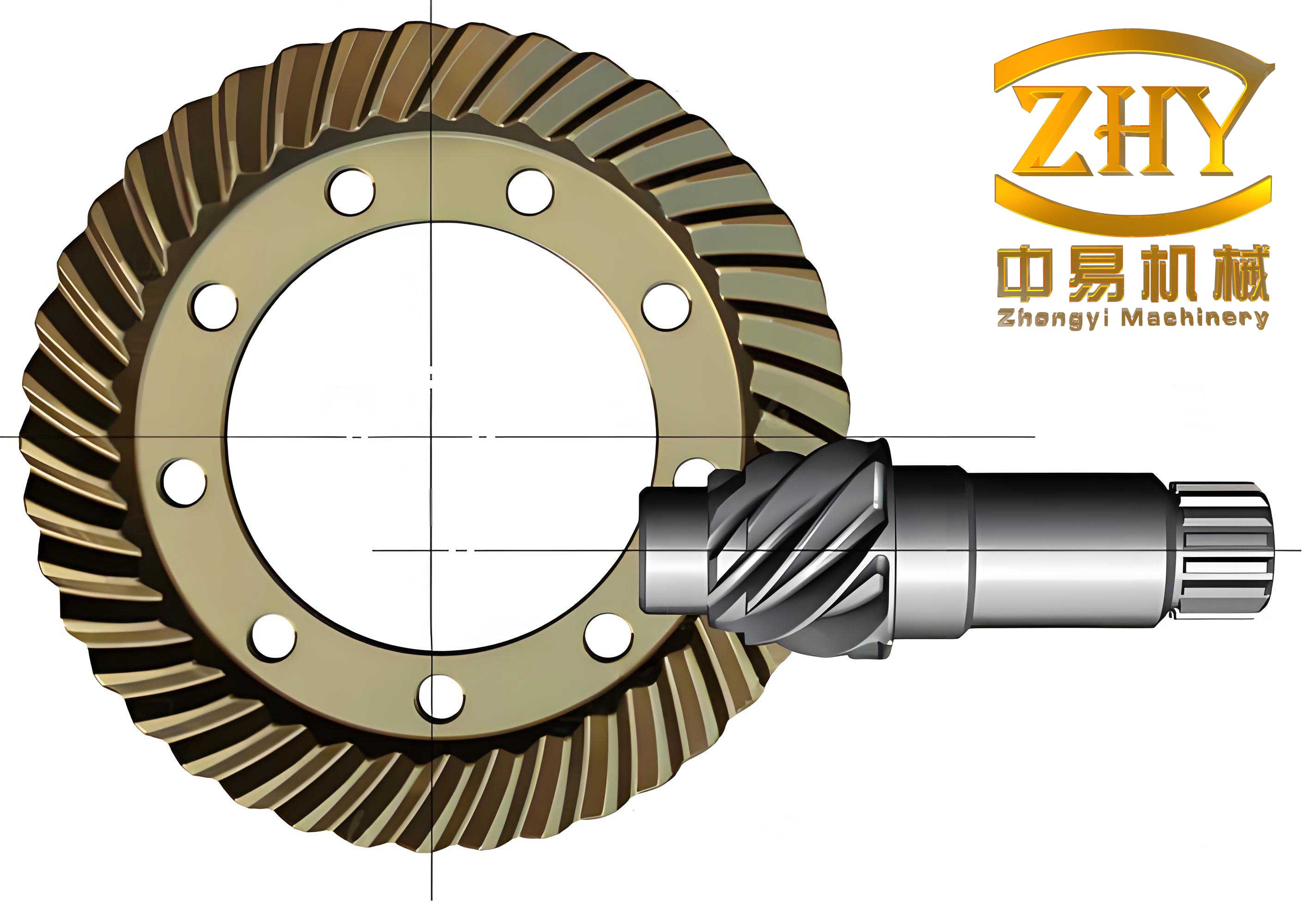
The accurate representation of the tooth surface geometry is the cornerstone of any reliable TCA for hypoid gears. The surfaces are not standard geometric shapes but are generated via a complex machining process involving a hypothetical crown gear or a pair of imaginary generating gears. Our modeling begins with the mathematical description of the cutter blades used to generate the gear and pinion.
Mathematical Modeling of Gear Tooth Surfaces
Gear (Wheel) Tooth Surface Generation
The tooth surface of the hypoid gear is generated by a tapered or profiled cutter head. In our coordinate system, the cutter surface for the gear is defined by parameters $\theta_G$ (angular position on the cutter) and $s_G$ (radial setting). The position vector of a point on the cutter surface in the cutter coordinate system $S_c$ is given by:
$$
\mathbf{r}_c(\theta_G, s_G) =
\begin{bmatrix}
(r_{c2} – s_G \sin \alpha_G) \cos \theta_G \\
(r_{c2} – s_G \sin \alpha_G) \sin \theta_G \\
-s_G \cos \alpha_G \\
1
\end{bmatrix}
$$
where $r_{c2}$ is the cutter point radius and $\alpha_G$ is the cutter blade pressure angle. The unit normal vector on this surface is:
$$
\mathbf{n}_c(\theta_G, s_G) =
\begin{bmatrix}
-\cos \alpha_G \cos \theta_G \\
-\cos \alpha_G \sin \theta_G \\
-\sin \alpha_G
\end{bmatrix}
$$
To obtain the gear tooth surface, we must account for the entire kinematic chain of the gear generating machine. This involves a series of coordinate transformations from the cutter system $S_c$ to the machine cradle system $S_m$, and finally to the gear coordinate system $S_2$, which is rigidly connected to the gear. The transformations incorporate machine settings such as the cradle angle $\phi_c$, the gear roll angle $\phi_2$, radial distance $S_{R2}$, and others. The resulting surface in $S_2$ is a function of the generating parameters and the machine kinematics:
$$
\mathbf{r}_2(\theta_G, s_G, \phi_c, \phi_2) = \mathbf{M}_{2m}(\phi_2) \mathbf{M}_{mc} \mathbf{M}_{cradle}(\phi_c) \mathbf{M}_{cutter} \mathbf{r}_c(\theta_G, s_G)
$$
During the generation process, the cutter and the blank are in a simulated mesh, governed by the equation of meshing and a fixed roll ratio $m_{G2}$:
$$
\mathbf{n}_c \cdot \mathbf{v}_c^{(c2)} = f(\theta_G, s_G, \phi_c) = 0, \quad \phi_2 = m_{G2} \phi_c
$$
Here, $\mathbf{v}_c^{(c2)}$ is the relative velocity between the cutter and the gear blank in the generation motion. By simultaneously solving the surface equation and the equation of meshing, we can eliminate one parameter (typically $s_G$) and express the gear tooth surface as a function of two independent parameters: $\theta_G$ and $\phi_2$ (or $\phi_c$). The final form is:
$$
\mathbf{r}_2 = \mathbf{r}_2(\theta_G, \phi_2), \quad \mathbf{n}_2 = \mathbf{n}_2(\theta_G, \phi_2)
$$
Pinion Tooth Surface Generation
The modeling of the pinion tooth surface follows a conceptually similar but practically more complex path due to the need for localized bearing contact, which is achieved through a modified generation process. The pinion cutter surface is defined in its own coordinate system with parameters $\theta_P$ and $s_P$:
$$
\mathbf{r}_p(\theta_P, s_P) =
\begin{bmatrix}
(r_{c1} + s_P \sin \alpha_P) \cos \theta_P \\
(r_{c1} + s_P \sin \alpha_P) \sin \theta_P \\
-s_P \cos \alpha_P \\
1
\end{bmatrix}
$$
The corresponding unit normal is:
$$
\mathbf{n}_p(\theta_P, s_P) =
\begin{bmatrix}
-\cos \alpha_P \cos \theta_P \\
-\cos \alpha_P \sin \theta_P \\
-\sin \alpha_P
\end{bmatrix}
$$
The pinion generation involves its own set of machine settings and kinematics, including a separate cradle system and roll ratio $m_{P1}$. The coordinate transformation yields the pinion surface in its body-fixed coordinate system $S_1$:
$$
\mathbf{r}_1(\theta_P, s_P, \phi_{cp}, \phi_1) = \mathbf{M}_{1m}(\phi_1) \mathbf{M}_{mcp} \mathbf{M}_{cradle_p}(\phi_{cp}) \mathbf{M}_{cutter_p} \mathbf{r}_p(\theta_P, s_P)
$$
The equation of meshing for pinion generation is:
$$
\mathbf{n}_p \cdot \mathbf{v}_p^{(p1)} = g(\theta_P, s_P, \phi_{cp}) = 0, \quad \phi_1 = m_{P1} \phi_{cp}
$$
After elimination, the pinion surface is represented as:
$$
\mathbf{r}_1 = \mathbf{r}_1(\theta_P, \phi_1), \quad \mathbf{n}_1 = \mathbf{n}_1(\theta_P, \phi_1)
$$
Tooth Contact Analysis (TCA) for Surface Contact
The core of TCA is to simulate the meshing of the theoretically generated pinion and gear surfaces under assembly conditions. We establish a fixed global coordinate system $S_f$ attached to the gearbox housing. The pinion and gear are installed with a shaft angle $\Sigma$ and an offset $E$. Their positions are defined by rotation angles $\psi_1$ and $\psi_2$, respectively.
The position vectors and unit normals of both tooth surfaces are transformed into the global system $S_f$:
$$
\mathbf{R}_1(\theta_P, \phi_1, \psi_1) = \mathbf{M}_{f1}(\psi_1) \mathbf{r}_1(\theta_P, \phi_1)
$$
$$
\mathbf{N}_1(\theta_P, \phi_1, \psi_1) = \mathbf{L}_{f1}(\psi_1) \mathbf{n}_1(\theta_P, \phi_1)
$$
$$
\mathbf{R}_2(\theta_G, \phi_2, \psi_2) = \mathbf{M}_{f2}(\psi_2) \mathbf{r}_2(\theta_G, \phi_2)
$$
$$
\mathbf{N}_2(\theta_G, \phi_2, \psi_2) = \mathbf{L}_{f2}(\psi_2) \mathbf{n}_2(\theta_G, \phi_2)
$$
For the two surfaces to be in point contact at any instant, they must satisfy the following system of vector equations, which state that a contact point is common to both surfaces and the normals are collinear at that point:
$$
\begin{cases}
\mathbf{R}_1(\theta_P, \phi_1, \psi_1) = \mathbf{R}_2(\theta_G, \phi_2, \psi_2) \\
\mathbf{N}_1(\theta_P, \phi_1, \psi_1) = \mathbf{N}_2(\theta_G, \phi_2, \psi_2)
\end{cases}
$$
This system represents five independent scalar equations (since the normality condition provides only two independent equations due to the unit length of the normals). The unknowns are the six parameters: $\theta_P, \phi_1, \psi_1, \theta_G, \phi_2, \psi_2$. Therefore, one parameter can be chosen as the input. Typically, the pinion rotation angle $\psi_1$ is incremented through the mesh cycle. For each value of $\psi_1$, the remaining five nonlinear equations are solved numerically (e.g., using the Newton-Raphson method) for the other five unknowns.
The solution provides, for each mesh position, the contact point on both the pinion and gear surfaces, as well as the corresponding gear rotation $\psi_2$. From this data, two primary results are obtained:
- Transmission Error (TE): Defined as the deviation of the actual gear position from the position dictated by a perfectly conjugate, rigid-body motion. It is calculated as:
$$
\Delta \psi_2 = (\psi_2 – \psi_{20}) – \frac{N_1}{N_2} (\psi_1 – \psi_{10})
$$
where $N_1$ and $N_2$ are the numbers of teeth on the pinion and gear, and $\psi_{10}, \psi_{20}$ are initial reference angles. A plot of $\Delta \psi_2$ vs. $\psi_1$ reveals the kinematic fidelity of the hypoid gear pair. A small, smooth, parabolic-like TE curve is often desired for low noise excitation. - Contact Path and Contact Ellipse: The locus of contact points on the gear tooth surface forms the contact path or bearing pattern. At each instant, the contact is not a point but an ellipse due to local elastic deformation under load. The size and orientation of this instantaneous contact ellipse are determined by the principal curvatures and directions of the two surfaces at the contact point, combined with an assumed (or calculated) approach distance $\delta$ along the common normal. The semi-major ($a$) and semi-minor ($b$) axes of the contact ellipse are given by:
$$
a = \sqrt{\frac{\delta}{A + B – \sqrt{(A – B)^2 + 4C^2}}}, \quad b = \sqrt{\frac{\delta}{A + B + \sqrt{(A – B)^2 + 4C^2}}}
$$
where $A, B, C$ are coefficients derived from the surface principal curvatures and the angle between their principal directions. The orientation of the ellipse relative to the tooth profile and lengthwise directions is crucial for assessing load distribution and susceptibility to edge loading.
The table below summarizes typical parameters used in a hypoid gear design and TCA process.
| Parameter | Pinion | Gear | Description |
|---|---|---|---|
| $N$ | 10 | 41 | Number of teeth |
| $\beta_m$ | 54.190° | 30.374° | Mean spiral angle |
| $a_t$ | 9.0174 mm | 1.8234 mm | Outer addendum |
| $b_t$ | 3.3721 mm | 10.2711 mm | Outer dedendum |
| $F$ | 64.01 mm | 36.53 mm | Face width |
| $\Sigma$ | 90° | Shaft angle | |
| $E$ | 28.575 mm | Offset | |
| $\alpha_n$ | 17° / 25° | Normal pressure angle (drive/coast) | |
Edge Contact Analysis: Completing the Meshing Picture
Conventional TCA, as described above, assumes contact occurs only between the working flanks of the teeth. In reality, due to manufacturing errors, assembly misalignments, or load-induced deflections, the theoretical contact pattern may shift towards the edge of the tooth. At the transition from one pair of teeth to the next, this can result in contact between the edge (tip or heel) of one tooth and the flank of its mate—a condition known as edge contact. Ignoring this phenomenon leads to a discontinuous and unrealistic simulation where contact seems to “jump” from one pair to the next. To model the complete and continuous meshing process of a hypoid gear, edge contact analysis is essential.
Our methodology for edge contact analysis extends the standard TCA equations. Consider the case where the pinion tooth edge (e.g., the tip edge) contacts the gear tooth flank. Let $\mathbf{R}_1^{edge}$ represent a point on the pinion’s tip edge. This edge curve can be defined as the intersection of the pinion tooth surface with its tip cylinder or tip cone surface. A more computationally robust approach, which we adopted, is to define the edge as the boundary of the pinion flank surface where the surface normal is perpendicular to the tip cone’s normal.
For a point on the pinion tip edge, the condition for it to be an edge point is that its surface normal $\mathbf{N}_1$ is orthogonal to the normal of the tip cone surface $\mathbf{n}_{tip}$ at that same location in the global coordinate system:
$$
\mathbf{N}_1(\theta_P, \phi_1, \psi_1) \cdot \mathbf{n}_{tip}(\mathbf{R}_1) = 0
$$
The tip cone normal can be easily derived from the pinion’s geometry (tip angle $\delta_{a1}$). The edge contact condition now requires that this edge point lies on the gear tooth flank and that their normals are collinear. However, at an edge contact, the pinion does not have a defined flank normal at the very edge. Instead, the tangency condition is between the edge curve and the gear tooth surface. This is enforced by requiring that the tangent vector to the pinion edge $\mathbf{T}_1^{edge}$ is perpendicular to the common normal $\mathbf{N}_2$ of the gear surface:
$$
\mathbf{T}_1^{edge} \cdot \mathbf{N}_2 = 0
$$
The tangent vector $\mathbf{T}_1^{edge}$ can be calculated as the cross product of the pinion surface normal and the tip cone normal at the edge point: $\mathbf{T}_1^{edge} = \mathbf{N}_1 \times \mathbf{n}_{tip}$.
Therefore, the system of equations for pinion tip edge-to-gear flank contact becomes:
$$
\begin{cases}
\mathbf{R}_1^{edge}(\theta_P, \phi_1, \psi_1) = \mathbf{R}_2(\theta_G, \phi_2, \psi_2) \\
\mathbf{T}_1^{edge}(\theta_P, \phi_1, \psi_1) \cdot \mathbf{N}_2(\theta_G, \phi_2, \psi_2) = 0 \\
\mathbf{N}_1(\theta_P, \phi_1, \psi_1) \cdot \mathbf{n}_{tip} = 0
\end{cases}
$$
This system typically provides five independent scalar equations. The unknowns are $\theta_P, \phi_1, \psi_1, \theta_G, \phi_2, \psi_2$. Again, $\psi_1$ is used as the input variable, and the system is solved for the remaining five unknowns. A similar set of equations can be derived for gear edge-to-pinion flank contact.
The inclusion of edge contact analysis completes the TCA simulation. When the main flank contact path moves too close to the edge, the solver seamlessly transitions to the edge contact equations, producing a continuous transmission error curve that shows a characteristic sharp drop or rise at the moment of edge contact, accurately reflecting the potential for vibration and noise in such conditions.
Computational Implementation and Simulation Results
We have implemented the complete TCA methodology, including both surface and edge contact analysis, in a comprehensive software package. The process begins with the definition of the machine settings for both the hypoid gear and pinion, derived from an optimized head-cutter design process. The software then performs the following steps sequentially:
- Generates the pinion and gear tooth surfaces numerically based on the machine kinematics.
- For a specified range of pinion rotation angle $\psi_1$, solves the nonlinear TCA equations (flank or edge contact as applicable).
- Calculates the transmission error and the instantaneous contact ellipse parameters at each mesh position.
- Plots the resulting bearing pattern on the gear tooth and the transmission error curve.
To demonstrate the capability of our TCA system, we present results from two different pinion machine setting designs (Design A and Design B) for the same basic hypoid gear pair (parameters as in the table above). The design goals for the contact are specified at a reference point.
| Condition | Design A | Design B |
|---|---|---|
| Reference Point Location | Mid-face, mid-flank | Mid-face, mid-flank |
| Contact Ellipse Semi-Major Axis | 4.8 mm | 3.5 mm |
| Contact Path Inclination ($\zeta_2$) | 40° | 10° |
| Transmission Error Slope | ~0 $\mu$rad/deg | -0.01 $\mu$rad/deg |
The TCA results are striking. For Design A, the simulated bearing pattern is centrally located with the desired inclination and size, and the transmission error curve is nearly flat and parabolic, indicating excellent kinematic performance. For Design B, the bearing pattern is narrower and more lengthwise-oriented, and the TE curve has a slight negative slope, as targeted. These simulations were achieved without cutting a single physical prototype, showcasing the power of computational TCA for hypoid gear design evaluation.
The true value of a comprehensive TCA is further highlighted when analyzing misaligned conditions. The figure below illustrates the critical difference between standard TCA and TCA with edge contact for a hypoid gear set with a +0.2 mm error in the offset (E) setting.
- Standard TCA (Flank Only): Shows the contact pattern shifted significantly towards the heel and toe. The transmission error curve appears to have a large, discontinuous jump near the roll-off angle, suggesting an unrealistic and severe kinematic disturbance.
- Comprehensive TCA (with Edge Contact): Models the actual physical event. The contact pattern shows the pinion tip edge engaging the gear flank. The transmission error curve is now continuous but features a very steep, almost vertical segment corresponding to the brief period of edge contact before the next tooth pair takes over the load. This provides a much more accurate and physically meaningful prediction of the gear pair’s behavior under misalignment, which is vital for assessing noise, vibration, and durability.
Conclusion
In this article, we have detailed the development of a comprehensive tooth contact analysis methodology for hypoid gear drives. Our approach rigorously models the complex geometry of hypoid gear teeth from their generation process and simulates their meshing behavior under both ideal and realistic conditions. The key advancement lies in the seamless integration of edge contact analysis with traditional flank contact analysis, enabling the simulation of the entire, continuous meshing cycle—including the transitions that occur due to errors or deflections.
The mathematical framework, built upon coordinate transformation theory and the differential geometry of surfaces, provides the foundation for a robust computational implementation. By solving the resulting systems of nonlinear equations, we can accurately predict critical performance indicators such as the tooth bearing pattern, the instantaneous contact ellipse, and the transmission error. The ability to perform these simulations on a computer allows for the rapid evaluation and optimization of hypoid gear designs, the assessment of sensitivity to manufacturing and assembly errors, and the reduction of costly physical prototyping cycles. Ultimately, this comprehensive TCA methodology serves as a powerful tool for enhancing the quality, performance, and reliability of hypoid gear drives in demanding applications.