
In my extensive experience designing automotive drivetrains, the application of hypoid gears for the final drive or rear axle differential is paramount. The superior characteristics of hypoid gear sets—namely, their smooth operation, high load-bearing capacity, and the crucial offset of the pinion axis which allows for lower vehicle profiles and better driveline packaging—make them the dominant choice in modern vehicles. However, the design process for these gears is notoriously complex and iterative, involving numerous interrelated geometric and strength parameters. This complexity often becomes a bottleneck, hindering design efficiency. Therefore, I have developed and consistently advocate for a comprehensive Computer-Aided Design (CAD) methodology centered on optimization. This approach integrates the entire design process, from initial parameter selection based on rigorous performance targets to the final generation of manufacturing drawings. By providing only a few key input parameters, a designer can obtain an optimized set of design variables and a complete component drawing, significantly reducing manual calculation workload and enhancing both the quality and speed of the design cycle.
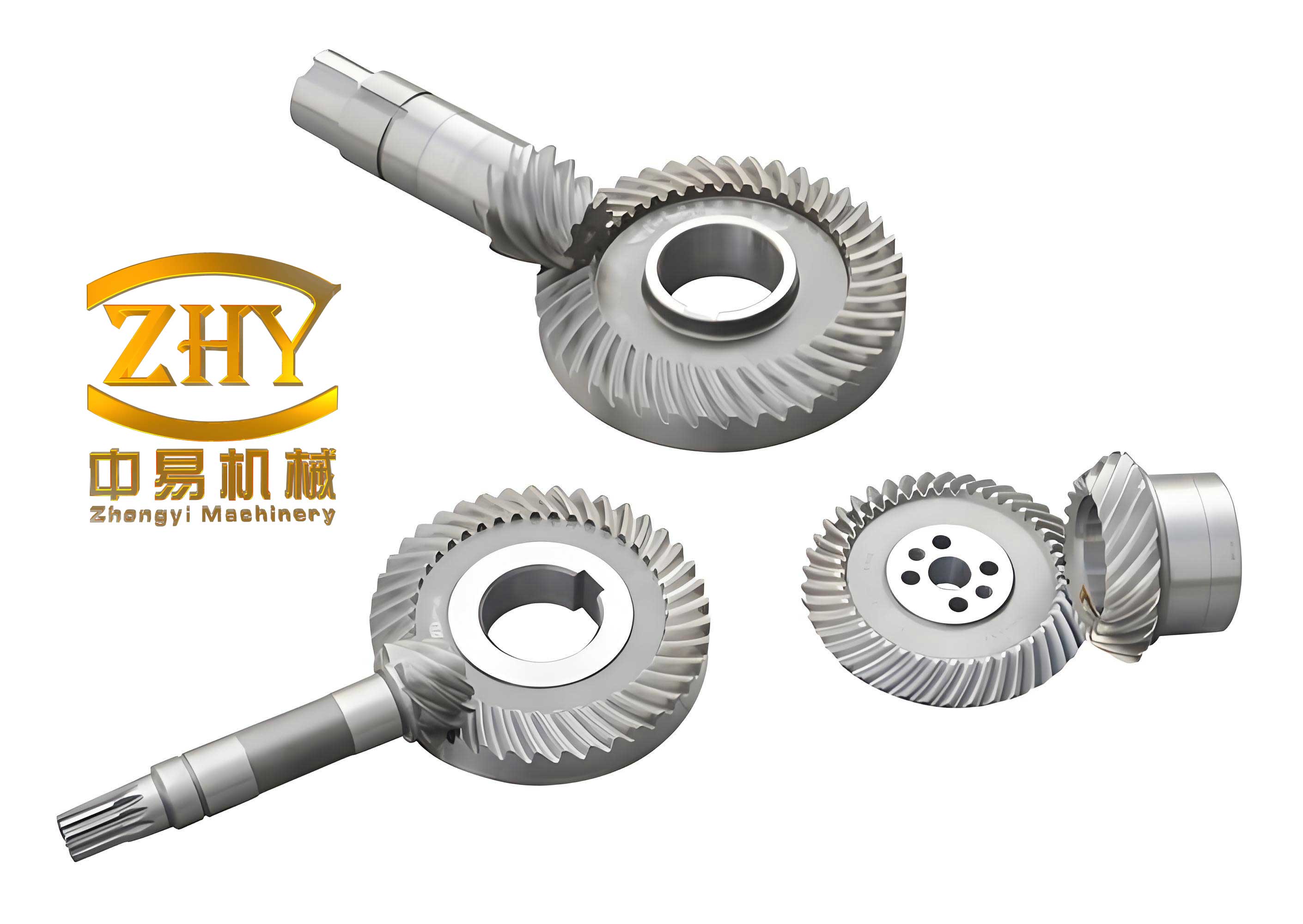
Fundamental Calculations for Hypoid Gear Design
The core of any robust hypoid gear design lies in the accurate calculation of its geometric relationships and the subsequent verification of its strength under operational loads. The following sections detail the key formulas I employ in this foundational stage.
Calculation of Tooth Surface Overlap Coefficient (ε)
For a hypoid gear set to operate smoothly and quietly, a sufficient tooth surface overlap coefficient is essential. This coefficient, often analogous to the transverse contact ratio in parallel axis gears but more complex due to the hypoid geometry, ensures multiple teeth are in contact during the meshing cycle. I calculate it using the following comprehensive formula:
$$ε = \frac{F}{p} \cdot \frac{\sqrt{R_{o2}^2 – R_{2}^2} + \sqrt{R_{o1}^2 – R_{1}^2} – A \sin α_n}{π m_t \cos β_{av}}$$
Where the constituent terms are further defined as:
$$p = π m_t$$
$$R_1 = \frac{d_{m1}}{2}, \quad R_2 = \frac{d_{m2}}{2}$$
$$d_{m1} = d_1 – F_1 \sin δ_1, \quad d_{m2} = d_2 – F_2 \sin δ_2$$
$$R_{o1} = \sqrt{R_1^2 + \left( \frac{F_1}{2} \right)^2}, \quad R_{o2} = \sqrt{R_2^2 + \left( \frac{F_2}{2} \right)^2}$$
$$A = \sqrt{R_1^2 + R_2^2 – 2 R_1 R_2 \cos Σ}$$
$$β_{av} = \frac{β_1 + β_2}{2}$$
The parameters in these equations are summarized in the table below for clarity:
| Symbol | Description | Symbol | Description |
|---|---|---|---|
| $d_1$, $d_2$ | Pinion/Gear Pitch Diameter | $F_1$, $F_2$ | Pinion/Gear Face Width |
| $d_{m1}$, $d_{m2}$ | Mean Pitch Diameter | $δ_1$, $δ_2$ | Pitch Cone Angle |
| $R_1$, $R_2$ | Mean Cone Distance | $β_1$, $β_2$ | Spiral Angle at Midpoint |
| $m_t$ | Transverse Module at Large End | $β_{av}$ | Average Spiral Angle |
| $α_n$ | Normal Pressure Angle | $Σ$ | Shaft Angle (typically 90°) |
| $R_{o1}$, $R_{o2}$ | Outer Cone Distance | $A$ | Offset (Hypoid Offset Distance) |
Strength Calculation for Hypoid Gears
Strength verification is non-negotiable. I typically base the design on the everyday driving torque, which is representative of the majority of the gear’s service life and is a common practice for passenger cars, trucks, and buses. The torque on the ring gear (driven gear) is calculated as:
$$T = \frac{G_a \cdot r_r}{i_g \cdot η} \cdot (f_i + f_r + f_p)$$
Here, $G_a$ is the total vehicle weight, $r_r$ is the tire rolling radius, $i_g$ is the final drive ratio, and $η$ is the driveline efficiency (often taken as 0.9). The coefficients $f_i$, $f_r$, and $f_p$ represent the dynamic inertia, rolling resistance, and grade coefficients, respectively. Their selection depends on vehicle type, as shown below:
| Vehicle Type | $f_i$ | $f_r$ | $f_p$ |
|---|---|---|---|
| Passenger Car | 0.05 | 0.015 | 0.05 |
| Truck / Bus | 0.05 | 0.02 | 0.04 |
| Off-road Vehicle | 0.06 | 0.025 | 0.05 |
If the performance factor $P = \frac{G_a}{T_{emax}}$ (where $T_{emax}$ is max engine torque) is less than or equal to 5.5 for trucks, $f_i$ is set to 0.
With the load torque established, I calculate the bending stress ($σ_f$) and contact stress ($σ_H$) using industry-standard AGMA/ISO adapted formulas for hypoid gears.
Bending Stress:
$$σ_{f1} = \frac{T_1 \cdot K_o \cdot K_s \cdot K_m}{d_1 \cdot F \cdot m_n \cdot J_1 \cdot K_v} \cdot Y_x, \quad σ_{f2} = \frac{T_2 \cdot K_o \cdot K_s \cdot K_m}{d_2 \cdot F \cdot m_n \cdot J_2 \cdot K_v} \cdot Y_x$$
Contact Stress:
$$σ_H = C_p \sqrt{\frac{T_1 \cdot K_o \cdot K_s \cdot K_m}{d_1^2 \cdot F \cdot I} \cdot \frac{Z_R}{K_v}}$$
The factors in these equations account for overload ($K_o$), size ($K_s$, $Y_x$), dynamic load ($K_v$), load distribution ($K_m$), geometry ($J$, $I$), surface finish ($Z_R$), and material properties ($C_p$). These stresses must be compared against the allowable bending endurance limit $[σ_f]$ and allowable contact stress $[σ_H]$ for the chosen material.
Optimization Framework for Hypoid Gear Parameters
Manually balancing the geometric parameters to achieve high contact ratio, sufficient strength, and manufacturable dimensions is tedious. I frame this as a constrained optimization problem. The primary goal for NVH (Noise, Vibration, and Harshness) performance is to maximize the tooth surface overlap coefficient (ε). Therefore, I define the optimization problem as follows:
$$ \text{Maximize: } f(\mathbf{X}) = ε(\mathbf{X}) $$
$$ \text{Subject to: } g_j(\mathbf{X}) \leq 0, \quad j=1,2,…,m $$
$$ \text{Where: } \mathbf{X} = [x_1, x_2, x_3, x_4, x_5, x_6]^T = [z_1, F, m_t, β_m, E, δ_1]^T $$
The design vector $\mathbf{X}$ contains both discrete and continuous variables. The pinion tooth count $z_1$ is a discrete integer. While face width $F$, module $m_t$, and pinion spiral angle $β_m$ are theoretically continuous, manufacturing standards and practical considerations often lead me to treat them as pseudo-discrete variables, selecting from preferred series. The hypoid offset $E$ and pinion pitch angle $δ_1$ are treated as continuous variables within bounds.
The constraints $g_j(\mathbf{X})$ are critical to ensure a viable design. I implement the following key constraints derived from mechanical design principles and empirical limits:
- Strength Constraints: $σ_f – [σ_f] \leq 0$ and $σ_H – [σ_H] \leq 0$.
- Geometric/Avoidance Constraints: These prevent undercut, ensure sufficient tool clearance, and limit the pinion diameter relative to the offset. For example: $d_{a1} – (A \sinδ_2 – k) \leq 0$, where $d_{a1}$ is pinion tip diameter and $k$ is a clearance constant.
- Manufacturability/Experience Constraints: Bounds on spiral angle (e.g., $45° \leq β_m \leq 55°$), face width to cone distance ratio (e.g., $F / R_{m2} \leq 0.3$), and pinion offset to pitch diameter ratio (e.g., $E / d_1 \leq 4.0$).
- Side Constraints (Bounds): Direct limits on all design variables: $x_i^L \leq x_i \leq x_i^U$.
To solve this Mixed-Discrete Nonlinear Programming (MDNLP) problem, I do not rely on methods that optimize in the continuous space and then “round off” discrete variables, as this can lead to infeasible or sub-optimal designs. Instead, I utilize a direct search method suitable for mixed-discrete variables, such as a variant of the Complex algorithm or a heuristic pattern search that explicitly handles variable discreteness. This ensures the final optimized solution respects the actual manufacturable values from the outset.
Integrated CAD System Implementation
The true power of this methodology is realized when the optimization engine is seamlessly integrated with a geometric modeling and drafting system. My implementation workflow is as follows:
- Input: The designer provides a minimal set of input parameters via a simple file or GUI. This includes vehicle data (weight, max torque, tire size), performance targets (desired gear ratio $i_0$, minimum target overlap coefficient $[ε]$), allowable stresses $[σ_f]$, $[σ_H]$, and broad bounds for the design variables.
- Optimization Execution: The optimization program reads the inputs, formulates the problem, and executes the mixed-discrete search algorithm. It repeatedly calls the analysis functions (for ε, $σ_f$, $σ_H$, geometry) until an optimum is found.
- Data Output: The complete set of optimized parameters is written to a structured data file. This includes not only the design vector $\mathbf{X}^*$ but also all derived geometric dimensions (pitch diameters, cone angles, tooth depths, etc.).
- Automated Drawing Generation: A separate program, written in a language like AutoLISP for AutoCAD or using the API of modern CAD software, reads this data file. It performs any final detailed calculations (e.g., for precise tooth taper, back-angle) and then automatically generates the fully dimensioned detail drawing for both the hypoid pinion and the hypoid ring gear. This eliminates manual drafting and associated errors.
This integrated system transforms the hypoid gear design process from a multi-day, error-prone manual task to a matter of minutes, allowing the engineer to focus on evaluating design alternatives and higher-level system integration.
Detailed Design Example: Light Truck Hypoid Gear
To concretely illustrate the process, I will walk through a full design case for a light truck final drive hypoid gear set.
Input Specifications:
- Total Vehicle Mass, $G_a = 4500 \, \text{kg}$
- Engine Max Torque, $T_{emax} = 350 \, \text{N·m}$
- Final Drive Ratio, $i_0 = 5.83$
- Tire Specification: 7.00-16, leading to a rolling radius $r_r \approx 0.38 \, \text{m}$
- Vehicle Type: Truck
- Allowable Stresses (for case-hardened steel): $[σ_f] = 450 \, \text{MPa}$, $[σ_H] = 2200 \, \text{MPa}$
- Target Overlap Coefficient: $[ε] \geq 1.8$
Design Variable Bounds:
I set initial search bounds based on typical values for this vehicle class:
$$ 6 \leq z_1 \leq 11 $$
$$ 0.04 \leq m_t \, (\text{m}) \leq 0.008 $$
$$ 30 \leq β_m \, (°) \leq 55 $$
$$ 0.03 \leq E \, (\text{m}) \leq 0.06 $$
$$ 10 \leq δ_1 \, (°) \leq 25 $$
Optimization Results:
The mixed-discrete optimization algorithm converges to the following optimal design vector:
$$ \mathbf{X}^* = [z_1^*, F^*, m_t^*, β_m^*, E^*, δ_1^*]^T = [8, 0.042\,m, 6.8 \times 10^{-3}\,m, 48.5°, 0.045\,m, 16.2°]^T $$
At this point, the key performance metrics are:
$$ ε^* = 1.92 \quad (\text{Meets target of } \geq 1.8) $$
$$ σ_f^* = 412 \, \text{MPa} \quad (< [σ_f] = 450 \, \text{MPa}) $$
$$ σ_H^* = 2080 \, \text{MPa} \quad (< [σ_H] = 2200 \, \text{MPa}) $$
All geometric avoidance and ratio constraints are satisfied.
Derived Geometry (Partial List):
Using the optimal parameters, the full geometry is computed automatically. Key derived dimensions for the hypoid gear set are:
| Parameter | Pinion Value | Gear Value | Unit |
|---|---|---|---|
| Number of Teeth ($z$) | 8 | ($i_0 \cdot z_1 \approx 47$) | – |
| Pitch Diameter ($d$) | 0.0544 | 0.3196 | m |
| Mean Cone Distance ($R_m$) | 0.0761 | 0.1645 | m |
| Pitch Cone Angle ($δ$) | 16.2° | 73.8° | deg |
| Face Width ($F$) | 0.042 | 0.042 | m |
| Spiral Angle ($β$) | 48.5° (L.H.) | 32.0° (R.H.) | deg |
| Outer Cone Distance ($R_o$) | 0.0852 | 0.1697 | m |
This complete dataset is then passed directly to the drafting module, which generates the manufacturing drawing for the hypoid ring gear (and a separate one for the pinion). The drawing includes all necessary views, dimensions, tolerances (e.g., for tooth spacing and runout), heat treatment specifications, and material callouts.
Conclusion and Advantages
The computer-aided design and optimization methodology I have described represents a significant advancement over traditional manual design processes for hypoid gears. By mathematically formalizing the design objectives and constraints, and by employing a mixed-discrete variable optimization strategy, the system automatically navigates the complex design space to find a high-performance solution. This solution simultaneously maximizes the tooth surface overlap coefficient for smoothness and low noise while rigorously satisfying bending and contact strength requirements. The direct integration of this optimizer with CAD drafting software through a data pipeline completely automates the final drawing production. This holistic approach offers profound benefits: it drastically reduces design time from days to hours or less, minimizes human error in calculations and drafting, allows for rapid exploration of “what-if” scenarios (e.g., changing material or vehicle load case), and ultimately leads to more reliable, efficient, and better-performing hypoid gear designs for automotive applications. The core of this efficient and robust design process is the strategic application of optimization to the intricate geometry of the hypoid gear, solidifying its role as the superior solution for automotive final drives.