
In the realm of gear manufacturing, the helical bevel gear stands as a critical component in transmitting power between intersecting shafts, especially in automotive, aerospace, and industrial machinery. The precision required in cutting helical bevel gears is paramount, as it directly influences performance factors such as noise, vibration, and longevity. To achieve this, machine adjustment cards are utilized to set up specialized gear-cutting machines before the machining process begins. These adjustment cards contain a set of calculated parameters that guide the positioning and motion of the machine tools. Traditionally, these calculations were performed manually, a process that was not only time-consuming but also prone to human error. With the advent of computer technology, we have embarked on a journey to automate this process, leveraging computational power to generate accurate adjustment cards efficiently. This article details our approach, methodologies, and experiences in developing computer programs for calculating adjustment cards for helical bevel gears, emphasizing the use of mathematical models, algorithms, and practical implementations.
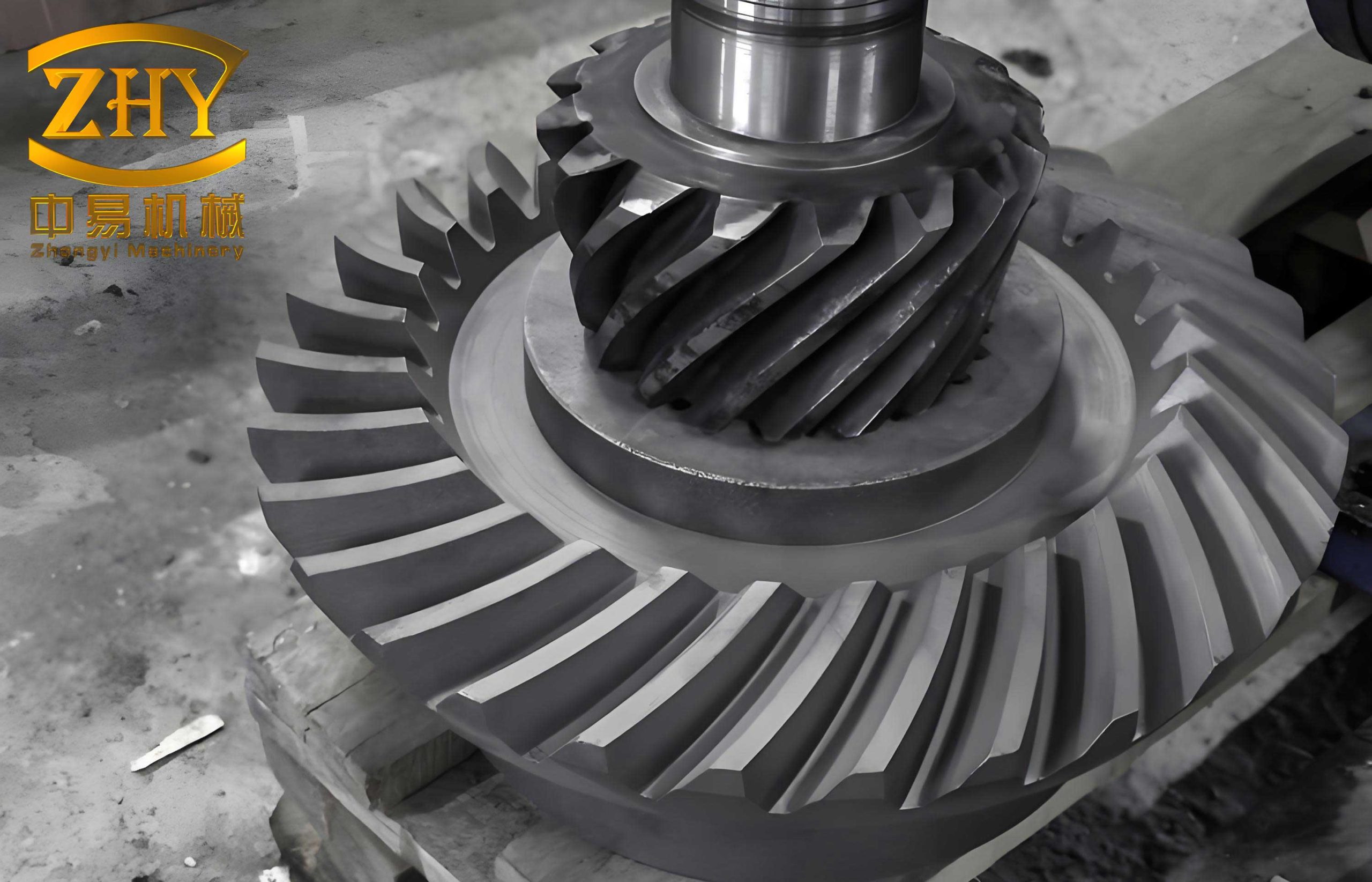
The helical bevel gear, characterized by its curved teeth and angled orientation, requires meticulous setup on gear-cutting machines such as those modeled after Gleason designs. Each helical bevel gear pair, defined by parameters like tooth count, spiral angle, and pressure angle, demands a unique adjustment card. Manual computation of these cards involves navigating through complex formulas and reference tables, often taking hours per card and increasing the risk of miscalculations that could lead to defective gears. In contrast, computerized methods offer speed, consistency, and accuracy. Our initiative began with the goal of replacing manual calculations with automated programs, focusing initially on five types of helical bevel gear machines using the single-indexing single-side method. This endeavor aimed to free technicians from tedious computations and eliminate errors, thereby enhancing productivity and gear quality.
The core of our work revolves around translating the manual calculation procedures into computer algorithms. The adjustment card calculation for helical bevel gears follows a structured规程 (procedure) derived from established methodologies, such as the Kataninski method, which involves a series of formulas and table lookups. While the derivation of these formulas is intricate, for computational purposes, we treat them as black-box functions that can be programmed directly. The challenge lies not in the formula implementation but in handling the table lookups, where parameters like height shift coefficient, tangential shift coefficient, jump tooth count, and tool offset are determined based on inputs like gear ratio, pinion tooth count, and spiral angle. These tables represent implicit functional relationships that are not easily expressed as simple algebraic equations. To address this, we employed numerical approximation techniques, specifically surface fitting using orthogonal polynomials, to derive approximate functions that mimic the table data with sufficient precision for helical bevel gear applications.
Let us delve into the mathematical foundations. The adjustment card calculation for helical bevel gears involves several key parameters, which are summarized in the table below:
| Parameter | Symbol | Description |
|---|---|---|
| Pinion Tooth Count | \( z_1 \) | Number of teeth on the smaller gear (pinion) |
| Gear Tooth Count | \( z_2 \) | Number of teeth on the larger gear (wheel) |
| Gear Ratio | \( i = z_2 / z_1 \) | Ratio of gear to pinion teeth |
| Shaft Angle | \( \Sigma \) | Angle between the two shafts (typically 90°) |
| Spiral Angle | \( \beta \) | Angle of tooth spiral, given in degrees, minutes, seconds |
| Height Shift Coefficient | \( x_h \) | Coefficient for tooth height modification |
| Tangential Shift Coefficient | \( x_t \) | Coefficient for tooth thickness modification |
| Module | \( m \) | Standard module of the gear |
| Pressure Angle | \( \alpha \) | Angle defining tooth profile |
| Clearance Coefficient | \( c^* \) | Factor for bottom clearance |
| Tooth Height Coefficient | \( h_a^* \) | Factor for addendum height |
| Face Width | \( b \) | Width of the gear tooth face |
| Actual Tool Number | \( N_t \) | Identifier for the cutting tool |
| Cutter Diameter | \( D_c \) | Diameter of the cutting tool (blade ring) |
| Gear Spiral Direction | \( dir \) | Direction of spiral (left or right hand) |
The calculation procedure proceeds in a sequential manner, where each step depends on previous results. For instance, the initial formulas involve computing basic dimensions of the helical bevel gear pair. One fundamental equation is for the reference diameter of the pinion:
$$ d_1 = m \cdot z_1 $$
Similarly, for the gear: $$ d_2 = m \cdot z_2 $$. The spiral angle \( \beta \) is critical in determining the tooth geometry and must be converted to decimal degrees for computation. If \( \beta \) is given as degrees (\( D \)), minutes (\( M \)), and seconds (\( S \)), then: $$ \beta_{\text{dec}} = D + \frac{M}{60} + \frac{S}{3600} $$.
Next, we encounter the need for shift coefficients. In manual methods, the height shift coefficient \( x_h \) and tangential shift coefficient \( x_t \) are obtained from tables based on \( i \), \( z_1 \), and \( \beta \). For computer implementation, we approximate these tables using surface fitting. Consider \( x_h \) as a function of three variables: \( x_h = f(i, z_1, \beta) \). We employ a polynomial surface fitting technique, where we seek a polynomial \( P(i, z_1, \beta) \) that minimizes the error between the table values and the polynomial output. Using orthogonal polynomials, we derive an expression such as:
$$ x_h \approx a_0 + a_1 i + a_2 z_1 + a_3 \beta + a_4 i^2 + a_5 z_1^2 + a_6 \beta^2 + a_7 i z_1 + a_8 i \beta + a_9 z_1 \beta + \cdots $$
The coefficients \( a_0, a_1, \ldots \) are determined through a least-squares fit over the table data. This process, though computationally intensive, is performed offline, and the resulting polynomial is hard-coded into the adjustment card program. For example, after fitting, we might have:
$$ x_h = 0.0023 i^2 – 0.017 z_1 + 0.045 \beta – 0.123 $$
This allows the program to compute \( x_h \) directly without table lookup. The same approach is applied to \( x_t \). The accuracy of this approximation is validated against the original tables, ensuring deviations are within acceptable limits for helical bevel gear manufacturing.
Another critical parameter is the jump tooth count \( J \), which influences the indexing mechanism during gear cutting. The manual method involves calculating an initial jump tooth count \( J_0 \) using formulas from reference texts. The formula for \( J_0 \) is based on the swing angle of the machine table ( cradle swing angle ) and the gear teeth. Let \( \theta \) be the cradle swing angle, computed as:
$$ \theta = \frac{360^\circ}{z_2} \cdot K $$
where \( K \) is a factor derived from the gear geometry. Then, \( J_0 \) is given by: $$ J_0 = \frac{z_2}{\theta} \cdot C $$, where \( C \) is a constant related to the machine setup. However, \( J_0 \) often results in a non-integer or shares a common factor with \( z_2 \), making it unsuitable for actual machining. Therefore, we implement an algorithm to select the actual jump tooth count \( J \). The algorithm finds the positive integer \( J \) that is closest to \( J_0 \) and has no common factors ( other than 1 ) with \( z_2 \). This ensures smooth indexing and avoids repeating tooth positions. The process can be outlined as follows:
- Compute \( J_0 \) using the above formulas.
- Round \( J_0 \) to the nearest integer \( J_{\text{round}} \).
- Check if \( \gcd(J_{\text{round}}, z_2) = 1 \), where \( \gcd \) is the greatest common divisor.
- If true, set \( J = J_{\text{round}} \). Otherwise, increment or decrement \( J_{\text{round}} \) iteratively until a value satisfying \( \gcd(J, z_2) = 1 \) is found.
For example, if \( z_2 = 48 \) and \( J_0 = 7.3 \), then \( J_{\text{round}} = 7 \). Since \( \gcd(7, 48) = 1 \), we set \( J = 7 \). If \( J_0 = 6.8 \) and \( z_2 = 48 \), then \( J_{\text{round}} = 7 \) (as before) works. But if \( J_0 = 6.0 \) and \( z_2 = 48 \), then \( J_{\text{round}} = 6 \), and \( \gcd(6, 48) = 6 \neq 1 \), so we check \( J = 5 \) and \( J = 7 \). Since \( \gcd(5,48)=1 \) and \( \gcd(7,48)=1 \), and 5 is closer to 6.0 than 7 is, we select \( J = 5 \). This algorithm is efficiently implemented using a loop and Euclidean algorithm for gcd computation.
The tool offset (错刀量) is another parameter retrieved from tables. It depends on the initial tool offset value \( O_0 \), calculated from gear dimensions, and the available standard offsets for the cutter diameter. The program first identifies the cutter size (e.g., 6-inch, 9-inch) and then uses conditional statements to match \( O_0 \) to the nearest standard offset. For instance, if the cutter has standard offsets of 0.1 mm, 0.2 mm, …, 1.0 mm, the program compares \( O_0 \) to these values and selects the closest one. This is done via a series of if-else or case statements, ensuring practical feasibility in machining helical bevel gears.
To illustrate the overall program flow, we present a system block diagram in textual form. The adjustment card calculation system for helical bevel gears follows these stages:
- Input Phase: The user provides gear parameters via an interactive dialogue.
- Data Validation: The program checks input ranges and consistency.
- Preliminary Calculations: Compute basic dimensions like diameters, angles.
- Coefficient Determination: Use fitted functions to get \( x_h \) and \( x_t \).
- Jump Tooth Calculation: Compute \( J_0 \) and select \( J \) via the gcd algorithm.
- Tool Offset Selection: Calculate \( O_0 \) and match to standard offset.
- Machine Settings Computation: Derive other adjustment parameters like cutter tilt, swivel angles, etc.
- Output Phase: Display the adjustment card data in a structured format.
This流程 ensures that all steps are automated, reducing human intervention. The helical bevel gear parameters are processed consistently, leading to reliable adjustment cards.
Now, let us examine an application example through a simulated human-computer dialogue. The program is written in a high-level language (like FORTRAN or C), and execution begins with a run command. The computer prompts the user for input data sequentially. Below is a transcript of the interaction for a helical bevel gear pair:
Computer: Enter pinion tooth count (z1):
User: 16
Computer: Enter gear tooth count (z2):
User: 40
Computer: Enter shaft angle (Σ):
User: 90
Computer: Enter spiral angle (β) in degrees, minutes, seconds (D M S):
User: 35 0 0
Computer: Enter height shift coefficient (xh):
User: 0.25
Computer: Enter module (m):
User: 4.0
Computer: Enter pressure angle (α):
User: 20
Computer: Enter clearance coefficient (c*):
User: 0.25
Computer: Enter tooth height coefficient (ha*):
User: 1.0
Computer: Enter face width (b):
User: 30
Computer: Enter actual tool number (Nt):
User: 7
Computer: Enter cutter diameter (Dc) in inches:
User: 9.0
Computer: Enter gear spiral direction (dir: L for left, R for right):
User: R
After input, the program performs calculations within seconds and outputs the adjustment card. The results might include:
| Parameter | Value |
|---|---|
| Height Shift Coefficient \( x_h \) | 0.248 |
| Tangential Shift Coefficient \( x_t \) | -0.102 |
| Jump Tooth Count \( J \) | 11 |
| Tool Offset \( O \) (mm) | 0.3 |
| Cradle Swing Angle \( \theta \) (°) | 45.6 |
| Machine Tilt Angle (°) | 12.4 |
| Swivel Angle (°) | 22.7 |
This output forms the adjustment card for setting up the helical bevel gear cutting machine. The entire process, from input to output, takes less than a minute, compared to hours manually. If another gear pair needs calculation, the program can be rerun with new data, showcasing its versatility for helical bevel gear production.
The benefits of computerized adjustment card calculation for helical bevel gears are manifold. Firstly, it eliminates human error in tedious computations, ensuring higher accuracy in gear machining. Secondly, it drastically reduces the time required, from hours to seconds, boosting efficiency in manufacturing settings. Thirdly, it allows for quick iterations; if gear design changes, new adjustment cards can be generated instantly. Moreover, the program can be integrated into CAD/CAM systems, enabling seamless digital workflows for helical bevel gear design and production. The use of mathematical approximations like surface fitting ensures that the program remains robust across a wide range of helical bevel gear parameters, though it is essential to validate the fitted functions periodically against updated standards.
From a technical perspective, the implementation involves careful consideration of numerical stability. For example, when fitting polynomials for shift coefficients, we must avoid overfitting by selecting appropriate polynomial degrees. We used cross-validation techniques to assess fit quality. The general form of the polynomial for \( x_h \) can be expressed as:
$$ x_h = \sum_{p=0}^{P} \sum_{q=0}^{Q} \sum_{r=0}^{R} c_{pqr} \cdot i^p \cdot z_1^q \cdot \beta^r $$
where \( c_{pqr} \) are coefficients, and \( P, Q, R \) are degrees chosen based on data complexity. For our helical bevel gear applications, we found that \( P=2, Q=2, R=2 \) (a quadratic surface) often suffices, giving a balance between accuracy and computational simplicity. The fitting process minimizes the sum of squared errors: $$ S = \sum_{k=1}^{N} (x_{h,k} – \hat{x}_{h,k})^2 $$, where \( N \) is the number of data points from tables, \( x_{h,k} \) are table values, and \( \hat{x}_{h,k} \) are polynomial estimates.
Similarly, for jump tooth count, the initial value \( J_0 \) can be derived from more detailed formulas. One common expression is: $$ J_0 = \frac{z_2 \cdot \sin \beta}{\pi \cdot m \cdot \cos \alpha} $$, but this may vary by machine type. We incorporated machine-specific formulas into the program. The gcd algorithm is implemented efficiently using the Euclidean algorithm: for integers \( a \) and \( b \), \( \gcd(a,b) \) is computed by repeated modulo operations until \( b=0 \). This ensures fast selection of \( J \) even for large tooth counts in helical bevel gears.
Tool offset selection is straightforward but requires knowledge of standard tooling. We created internal arrays of standard offsets for common cutter diameters. For instance, for a 9-inch cutter, offsets might be [0.1, 0.2, 0.3, 0.4, 0.5] mm. The program computes the absolute differences: $$ \Delta_k = | O_0 – O_{\text{std},k} | $$ and picks \( O_{\text{std},k} \) with minimum \( \Delta_k \). This mimics manual lookup but with precision.
To further illustrate the computational steps, we present a consolidated formula set for a helical bevel gear adjustment card. Note that these formulas are simplified for illustration; actual implementations may include more terms.
- Reference diameters: $$ d_1 = m z_1, \quad d_2 = m z_2 $$
- Spiral angle conversion: $$ \beta_{\text{rad}} = \beta_{\text{dec}} \cdot \frac{\pi}{180} $$
- Virtual tooth count for helical bevel gear: $$ z_v = \frac{z_2}{\cos^3 \beta} $$
- Height shift coefficient approximation: $$ x_h = 0.01 \cdot (0.5 i – 0.2 z_1 + 0.3 \beta_{\text{dec}}) $$ (example only)
- Tangential shift coefficient approximation: $$ x_t = -0.005 \cdot (i^2 + 0.4 z_1 \beta_{\text{dec}}) $$
- Initial jump tooth count: $$ J_0 = \frac{z_2 \cdot \tan \beta}{\pi} $$
- Tool offset initial value: $$ O_0 = \frac{b \cdot \sin \beta}{10} $$
These formulas are then processed through the algorithms described earlier.
In terms of program structure, we developed modular code. Each major calculation is a subroutine or function, such as compute_shift_coefficients(), find_jump_tooth(), and select_tool_offset(). This modularity facilitates maintenance and updates, especially when new helical bevel gear machine models are introduced. The main program orchestrates these functions in sequence, as shown in the pseudocode below:
BEGIN
    INPUT: z1, z2, Σ, β, m, α, c*, ha*, b, Nt, Dc, dir
    VALIDATE inputs
    COMPUTE basic dimensions (d1, d2, i, β_dec)
    CALL compute_shift_coefficients(i, z1, β_dec, xh, xt)
    CALL compute_jump_tooth(z2, β_dec, J)
    CALL compute_tool_offset(b, β_dec, Dc, O)
    COMPUTE machine angles (tilt, swivel, cradle_angle)
    OUTPUT adjustment card
END
The success of this computerized system hinges on accurate input data. Therefore, we included error checks, such as ensuring tooth counts are positive, spiral angle is within typical ranges (e.g., 0° to 45° for helical bevel gears), and cutter diameter corresponds to available tools. If invalid data is entered, the program prompts for correction, enhancing usability.
Looking ahead, there are opportunities for enhancement. For instance, machine learning techniques could refine the surface fitting models for shift coefficients, potentially improving accuracy for uncommon helical bevel gear configurations. Additionally, integrating real-time sensor data from machines could allow dynamic adjustment of cards based on actual cutting conditions. However, the current system already marks a significant leap from manual methods.
In conclusion, the computerized calculation of adjustment cards for helical bevel gears represents a vital advancement in gear manufacturing technology. By automating complex calculations and table lookups through numerical approximations and algorithms, we achieve speed, accuracy, and reliability. This not only frees engineers from mundane tasks but also elevates the quality of helical bevel gears through precise machine settings. As industries demand higher-performance gears, such computational tools become indispensable. Our experience demonstrates that with careful mathematical modeling and programming, even intricate processes like helical bevel gear adjustment can be efficiently digitalized, paving the way for smarter manufacturing ecosystems.
To reiterate, the helical bevel gear is a sophisticated component, and its production benefits immensely from computational aids. The adjustment card program we developed handles diverse parameters, from shift coefficients to jump tooth counts, ensuring that each helical bevel gear pair is machined with optimal settings. This approach aligns with Industry 4.0 trends, where digital twins and automation drive efficiency. We encourage further research into adaptive algorithms that can customize adjustment cards in real-time, catering to the evolving needs of helical bevel gear applications in automotive, robotics, and beyond.
Throughout this article, we have emphasized the helical bevel gear as the central focus, highlighting how computerization transforms its manufacturing process. The tables and formulas provided summarize key aspects, but the true value lies in the seamless integration of these elements into a cohesive system. As we continue to refine these programs, we anticipate even greater strides in the precision and efficiency of helical bevel gear production, solidifying their role in modern machinery.