
As industrial equipment continues to evolve, the demand for customized transmission components has surged. Non-standard cylindrical gears, designed to meet specific application requirements, offer significantly broader prospects compared to their standardized counterparts. However, the adjustment of key geometric parameters in a non-standard cylindrical gear—such as pressure angle, addendum and dedendum coefficients, and profile shift coefficient—fundamentally alters its tooth profile geometry and the form of the tooth root transition curve. These alterations directly impact critical performance metrics, including flank load-carrying capacity, root bending stress, and overall transmission behavior. Traditional evaluation methodologies present considerable challenges. Approximations based on ISO standard gear empirical formulas lack the necessary precision for accurate non-standard gear analysis. Conversely, building detailed three-dimensional models from complex mathematical derivations for every parameter change is a notoriously tedious, inefficient, and error-prone process. This work addresses this gap by deriving the precise mathematical models of non-standard cylindrical gear tooth profiles based on their generating processes. By implementing these models within a parametric framework, we enable the real-time, accurate generation of tooth geometry and facilitate efficient analysis and simulation for complex non-standard cylindrical gear designs.
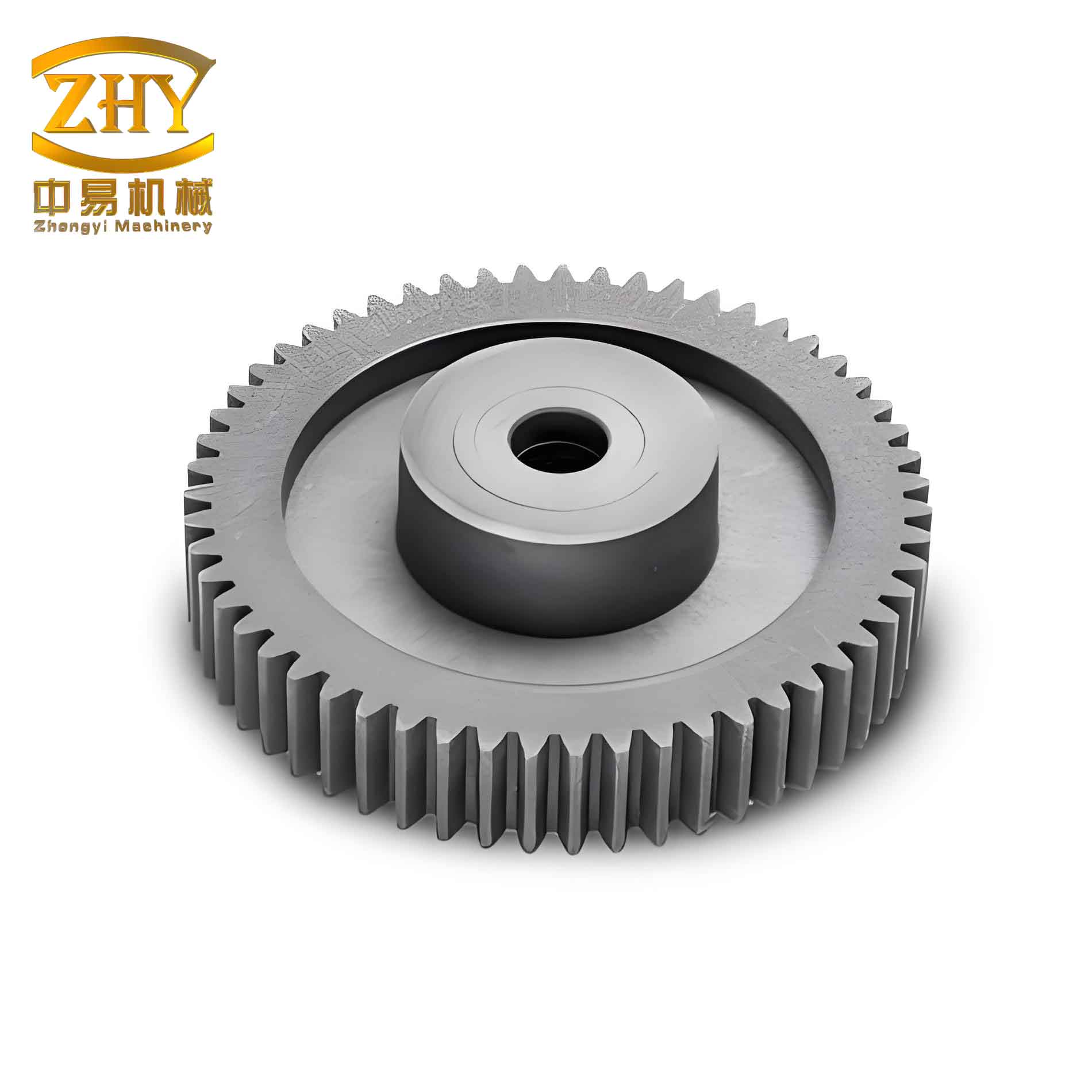
Precise Mathematical Foundation for Non-Standard Cylindrical Gear Tooth Forms
The accurate construction of a cylindrical gear tooth profile is bifurcated into two distinct sections: the active involute flank and the root transition curve. For external cylindrical gears, the profile is typically generated via a rack-type cutter (e.g., hob or worm grinding wheel). For internal cylindrical gears, a shaping process with a pinion-type cutter is employed. The transition curve of a hobbed gear is an extended involute, while that of a shaped gear is an extended epicycloid. Calculating the coordinates of points on the involute profile is relatively straightforward. The primary challenge lies in accurately determining the coordinates of the transition curve and ensuring a smooth, tangency-continuous connection with the involute segment. By formulating equations that simulate the generation process, the exact coordinates for the entire tooth profile contour can be obtained.
Tooth Profile Generation for External Cylindrical Gears
The geometric relationship for hobbing an external cylindrical gear is illustrated in the referenced schematic. Line segment LM represents the straight-line portion of the rack cutter, and arc MN is the tip rounding. Point Q is the center of this rounding. Let XPY be the fixed coordinate system, and X1O1Y1 be the coordinate system attached to the rack cutter, with the rolling pitch line on the O1X1 axis. During generation, the rack translates, and the gear blank rotates about its center O2 such that their pitch circles roll without slip. The coordinates of a cutting point B on the straight flank relative to the rack coordinate system S1 are given by:
$$ x_1^{(B)} = -\left( \frac{\pi m}{4} – \xi m \tan \alpha_0 – y_1^{(B)} \tan \alpha_0 \right) $$
$$ y_1^{(B)} = \frac{S}{\tan \alpha_0} – \frac{\pi m}{4 \tan \alpha_0} $$
where \(m\) is the module, \(\xi\) is the profile shift coefficient, \(\alpha_0\) is the cutter pressure angle, and \(S\) is the distance from the rack centerline (Y1 axis) to the fixed Y axis.
The geometry of the tip rounding is detailed in an enlarged view. The distance from the start point M of the rounding to the rack centerline is:
$$ E = 1.25m – R_T + R_T \sin \alpha_0 $$
The distance from the curvature center Q to the rolling pitch line is:
$$ F = 1.25m – R_T – \xi m $$
The length L from the pitch point P to center Q and the angle \(\psi\) are defined as:
$$ L = \frac{F}{\sin \psi} $$
$$ S = E + \frac{F}{\tan \psi} – R_T \cos \alpha_0 – \frac{\pi m}{4 \tan \alpha_0} $$
Consequently, the coordinates of a cutting point K on the tip rounding in S1 are:
$$ x_1^{(K)} = L \cos \psi + R_T \sin \psi – S $$
$$ y_1^{(K)} = L \sin \psi – R_T \cos \psi $$
Finally, these cutter coordinates are transformed into the coordinate system S2 attached to the generated external cylindrical gear using the coordinate transformation, where \(\phi = S / r\) and \(r\) is the pitch radius of the gear:
$$ x_2 = (S + x_1) \cos \phi + (r + y_1) \sin \phi $$
$$ y_2 = -(S + x_1) \sin \phi + (r + y_1) \cos \phi $$
This set of equations accurately defines both the involute and transition curve portions of the external cylindrical gear tooth.
Tooth Profile Generation for Internal Cylindrical Gears
The profile of an internal cylindrical gear is generated by a pinion-shaped shaper cutter. The shaper cutter’s own tooth profile is first generated by a virtual rack. Defining coordinate systems S1(x1, y1) and Sj(xj, yj) fixed to the shaper and the machine frame respectively, the involute profile of the shaper cutter is derived as:
$$
\mathbf{r}_1^{(B)}(\theta_1) = \begin{bmatrix}
\left( r_{p1} \theta_1 – \left( \frac{\pi m}{4} – x_c m \tan \alpha_1 \right) \cos \alpha_1 \right) \cos(\theta_1 + \alpha_1) + m r_{p1} \sin(\theta_1 + \alpha_1) \\
-\left( r_{p1} \theta_1 – \left( \frac{\pi m}{4} – x_c m \tan \alpha_1 \right) \cos \alpha_1 \right) \sin(\theta_1 + \alpha_1) + m r_{p1} \cos(\theta_1 + \alpha_1)
\end{bmatrix}
$$
where \(r_{p1}\) is the pitch radius of the shaper, \(\theta_1\) is its rotation angle, \(\alpha_1\) is the generating pressure angle, and \(x_c\) is the shaper’s profile shift coefficient.
To avoid stress concentration at the root of the internal gear, the sharp corner at the shaper tip is replaced with a fillet. The center Q1 of this fillet is found at the intersection of the normal to the involute at its endpoint M1 and the normal to the shaper tip circle at point N2. The coordinates of a cutting point K1 on this fillet in S1 are:
$$
x_1^{(K)} = \left[ r_{a1} – (r_{a1} – R_{T1}) \cos \gamma_1 + R_{T1} \right] \cos\left( \frac{\pi}{Z_1} – \theta_1 \right) – \left[ (r_{a1} – R_{T1}) \sin \gamma_1 \right] \sin\left( \frac{\pi}{Z_1} – \theta_1 \right)
$$
$$
y_1^{(K)} = \left[ r_{a1} – (r_{a1} – R_{T1}) \cos \gamma_1 + R_{T1} \right] \sin\left( \frac{\pi}{Z_1} – \theta_1 \right) + \left[ (r_{a1} – R_{T1}) \sin \gamma_1 \right] \cos\left( \frac{\pi}{Z_1} – \theta_1 \right)
$$
$$
\psi_1 = \arctan\left( \frac{ \left[ r_{a1} – (r_{a1} – R_{T1}) \cos \gamma_1 \right] \cos\left( \frac{\pi}{Z_1} – \theta_1 \right) – (r_{a1} – R_{T1}) \sin \gamma_1 \sin\left( \frac{\pi}{Z_1} – \theta_1 \right) } { \left[ r_{a1} – (r_{a1} – R_{T1}) \cos \gamma_1 \right] \sin\left( \frac{\pi}{Z_1} – \theta_1 \right) + (r_{a1} – R_{T1}) \sin \gamma_1 \cos\left( \frac{\pi}{Z_1} – \theta_1 \right) – r_{p1} } \right)
$$
where \(R_{T1}\) is the shaper tip radius, \(r_{a1}\) is the shaper tip radius, \(Z_1\) is the number of teeth on the shaper, and \(\gamma_1\) is a fixed geometric angle.
Through coordinate transformation from the shaper to the internal cylindrical gear workpiece, the final tooth profile equations for the internal gear are obtained. The involute portion is given by:
$$
x_2 = \left[ r_{p2} \theta_1 – \left( \frac{\pi m}{4} – x_c m \tan \alpha_1 \right) \cos \alpha_1 \right] \cos\left( \left(1 – \frac{Z_1}{Z_2}\right)\theta_1 – \alpha_1 \right) + m r_{p2} \sin\left( \left(1 – \frac{Z_1}{Z_2}\right)\theta_1 – \alpha_1 \right)
$$
$$
y_2 = -\left[ r_{p2} \theta_1 – \left( \frac{\pi m}{4} – x_c m \tan \alpha_1 \right) \cos \alpha_1 \right] \sin\left( \left(1 – \frac{Z_1}{Z_2}\right)\theta_1 – \alpha_1 \right) + m r_{p2} \cos\left( \left(1 – \frac{Z_1}{Z_2}\right)\theta_1 – \alpha_1 \right)
$$
And the transition curve (fillet) portion is given by:
$$
x_2 = \left[ A – \frac{Z_1}{Z_2} \left( r_{a1} – (r_{a1} – R_{T1}) \cos \gamma_1 + R_{T1} \cos(\theta_1 + \psi_1) \right) \right] \cos\left( \frac{Z_1}{Z_2} \theta_1 \right) – \frac{Z_1}{Z_2} R_{T1} \sin(\theta_1 + \psi_1) \sin\left( \frac{Z_1}{Z_2} \theta_1 \right)
$$
$$
y_2 = -\left[ A – \frac{Z_1}{Z_2} \left( r_{a1} – (r_{a1} – R_{T1}) \cos \gamma_1 + R_{T1} \cos(\theta_1 + \psi_1) \right) \right] \sin\left( \frac{Z_1}{Z_2} \theta_1 \right) – \frac{Z_1}{Z_2} R_{T1} \sin(\theta_1 + \psi_1) \cos\left( \frac{Z_1}{Z_2} \theta_1 \right)
$$
where \(A\) is the center distance, and \(Z_2\) is the number of teeth on the internal cylindrical gear.
Parametric Model Construction and Finite Element Implementation
Parametric Mesh Generation for Cylindrical Gears
Based on the derived tooth profile equations, a computational algorithm is written to calculate the coordinates of discrete nodes along the tooth profile for any set of non-standard cylindrical gear parameters. The number of nodes can be controlled to achieve the desired mesh density. The figures referenced show the resulting nodal distributions for a single tooth of both external and internal cylindrical gears.
Using these planar nodes as a basis, a three-dimensional finite element mesh for a single tooth is constructed. For the cylindrical gear body, 8-node linear brick elements with reduced integration (C3D8R in Abaqus) are selected. This element type provides accurate displacement solutions and is less sensitive to mesh distortion. The single-tooth model is then replicated circumferentially to form the full gear model. After merging nodes within a specified tolerance at the interfaces, a complete, watertight finite element mesh for the non-standard cylindrical gear is obtained. Models for both spur and helical cylindrical gears can be generated by extruding or twisting the base profile. The assembly of meshed gear pairs, both external and internal, completes the preparation for analysis.
Automated Parametric Finite Element Analysis Setup
To eliminate repetitive manual operations when analyzing different cylindrical gear designs, a full parametric workflow is implemented using Abaqus scripting. Two primary methods are available: Python scripting, which automates the graphical user interface (GUI) operations, and direct modification of the input (.inp) file. The Python scripting approach offers greater flexibility and automation for complex modeling sequences and was chosen for this implementation. The parametric script encompasses the entire analysis pipeline:
- Importing or creating the gear geometry based on input parameters.
- Defining material properties (e.g., Young’s modulus, Poisson’s ratio).
- Assembling the gear pair with precise initial positioning.
- Creating analysis steps (typically a static general step).
- Defining surface-to-surface contact interactions between gear flanks, including contact properties like friction.
- Applying boundary conditions (e.g., constraining the ring gear, coupling the pinion/planet gear to a reference point).
- Applying loads (e.g., torque or rotation at the reference point).
- Creating and submitting the analysis job, then extracting results.
This parametric system allows for the rapid generation and analysis of non-standard cylindrical gear pairs by simply updating the input parameter file, which includes gear geometry (module, teeth, pressure angle, profile shift, etc.), material data, load case, and mesh density.
Model Validation via Gear Tooth Modification Analysis
The accuracy and effectiveness of the developed parametric model for non-standard cylindrical gears are validated through a detailed study of gear tooth modifications. A non-standard planetary gearset, comprising both external and internal meshes, serves as the test case. The basic parameters of this cylindrical gear system are summarized in the table below.
| Parameter | Sun Gear | Planet Gear | Ring Gear |
|---|---|---|---|
| Number of Teeth | 48 | 55 | 162 |
| Module (mm) | 3.8 | ||
| Pressure Angle (°) | 22.5 | ||
| Face Width (mm) | 90 | 88 | 88 |
| Sun Gear Speed (rpm) | 1128.0 | ||
| Input Power (kW) | 2985.8 | ||
Precise lead crowning (parabolic modification) is applied to the gear teeth to optimize contact pressure distribution. The parametric model effortlessly incorporates this modification by adjusting the nodal coordinates along the face width according to the crowning function. The contact stress results clearly demonstrate the benefit: the unmodified cylindrical gears show high edge-loading stresses, while the crowned gears exhibit a more uniform, lower-magnitude stress distribution across the face width for both the external (sun-planet) and internal (planet-ring) meshes.
Furthermore, the model’s capability to analyze misalignment is tested by introducing a small shaft parallelism error (1 arc-minute) and then applying compensatory lead crowning. The results, as shown in the corresponding stress plots, are compelling. Without modification, the misalignment causes severe stress concentration at one end of the cylindrical gear tooth. With the properly applied lead crown, the contact pressure is recentered and evenly distributed, validating the model’s precision in simulating real-world assembly errors and corrective modifications. These validation cases confirm that the parametric modeling approach yields highly accurate and reliable results, crucial for the design and analysis of non-standard cylindrical gears.
Conclusion
This work presents a comprehensive methodology for the precise parametric modeling of non-standard cylindrical gears. By rigorously deriving the tooth profile equations from the fundamental generating processes of both external (hobbing) and internal (shaping) cylindrical gears, a mathematically exact foundation is established. This foundation is then integrated into an automated finite element analysis workflow via Python scripting within Abaqus, creating a powerful parametric modeling tool. The key advantage of this approach is the seamless integration of accurate geometric modeling with efficient computational analysis. The model faithfully replicates the theoretical tooth surface, excluding manufacturing errors, ensuring high-fidelity simulation results. It readily accommodates complex modifications like lead crowning and can simulate the effects of assembly errors. This parametric framework provides an efficient and reliable technical means for the design, performance evaluation, and optimization of non-standard cylindrical gears, enabling rapid iteration and analysis that was previously impractical with traditional methods.