
In modern mechanical engineering, the performance and reliability of transmission systems are critical, especially in heavy-duty applications such as mining and metallurgy. Among various components, helical gears play a pivotal role due to their advantages like high overlap ratio, smooth meshing, and compact structure. However, traditional design methods for helical gear pairs often rely on simplified Hertzian contact theory, which involves assumptions that may not accurately capture the complex stress and strain distributions during meshing. This study aims to address these limitations by employing advanced finite element analysis (FEA) and reliability assessment techniques. Using ANSYS software, I conduct a detailed contact analysis and reliability evaluation for a helical gear pair from a large transmission device. The goal is to provide insights that enhance design accuracy, failure prediction, and structural optimization for helical gears.
The foundation of this analysis lies in the integration of three-dimensional modeling, FEA, and probabilistic design. Initially, I develop a precise 3D assembly model of the helical gear pair in Solidworks, focusing on the generation of accurate tooth profiles based on involute curves. This model is then imported into ANSYS for meshing and simulation. The contact analysis involves defining contact pairs, applying constraints and loads, and solving for stress distributions under different meshing conditions. Subsequently, I perform a reliability analysis using the ANSYS Probabilistic Design System (PDS) module, considering random variables such as dimensions, loads, and material properties. Through this comprehensive approach, I compare FEA results with traditional calculations and evaluate the contact strength reliability of the helical gear pair. The findings highlight the importance of incorporating reliability design alongside conventional safety factor methods to ensure robust performance in practical applications.
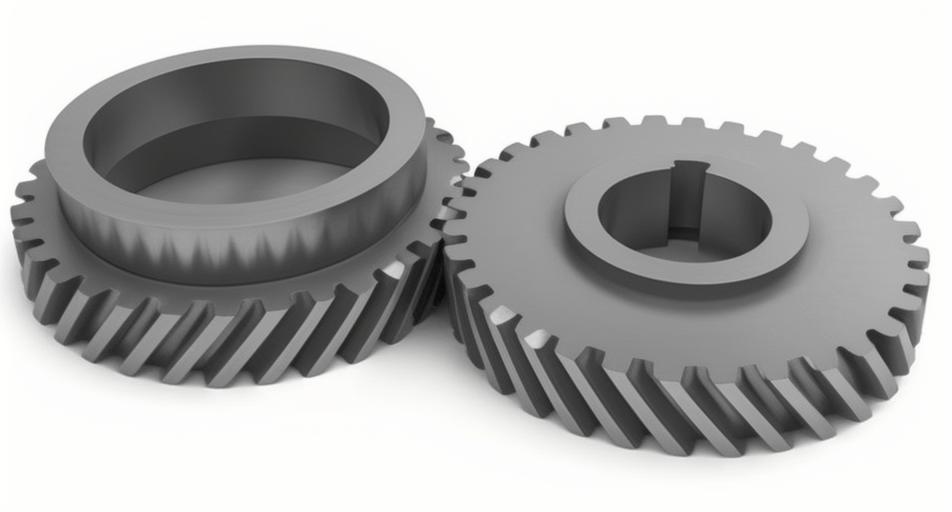
Helical gears are widely used in transmission systems due to their ability to transmit power smoothly and efficiently. The helical design allows for gradual tooth engagement, reducing noise and vibration compared to spur gears. However, the complexity of helical gear contact mechanics necessitates advanced analysis tools. Traditional contact stress calculations for helical gears are derived from the Hertz formula for parallel cylinders, expressed as:
$$ \sigma_H = \sqrt{\frac{K F_t}{b d_1 \varepsilon_\alpha} \cdot \frac{u \pm 1}{u}} Z_H Z_E $$
where \( \sigma_H \) is the contact stress, \( F_t \) is the tangential force, \( K \) is the load factor, \( b \) is the face width, \( d_1 \) is the pitch diameter of the driving gear, \( u \) is the gear ratio, \( \varepsilon_\alpha \) is the transverse contact ratio, \( Z_H \) is the zone coefficient, and \( Z_E \) is the elasticity coefficient. While this formula provides a baseline, it assumes uniform load distribution and neglects local variations, leading to potential inaccuracies. In contrast, FEA enables a more realistic simulation by modeling the actual geometry and material behavior. For helical gears, this involves capturing the helical tooth geometry, which increases the computational complexity but yields detailed stress contours and deformation patterns.
To initiate the analysis, I create a 3D model of the helical gear pair. The key step is generating the involute tooth profile on the transverse plane, which is then extruded along a helical path to form the teeth. The parameters for the helical gears are listed in Table 1, including gear dimensions, material properties, and operational conditions. These parameters are essential for both the FEA and reliability analysis phases.
| Parameter | Symbol | Value | Unit |
|---|---|---|---|
| Number of teeth (driving) | \( z_1 \) | 24 | – |
| Number of teeth (driven) | \( z_2 \) | 104 | – |
| Module (normal) | \( m_n \) | 2.5 | mm |
| Helix angle | \( \beta \) | 15° | deg |
| Face width | \( b \) | 50 | mm |
| Pitch diameter (driving) | \( d_1 \) | 67.018 | mm |
| Pitch diameter (driven) | \( d_2 \) | 289.397 | mm |
| Center distance | \( a \) | 178.207 | mm |
| Material | – | 20Cr2Ni4A | – |
| Young’s modulus | \( E \) | 203.5 GPa | Pa |
| Poisson’s ratio | \( \nu \) | 0.29 | – |
| Density | \( \rho \) | 7880 | kg/m³ |
The 3D model is imported into ANSYS, where I define material properties and mesh the geometry using SOLID185 elements, which are suitable for 3D structural analysis. The mesh size is set to 3 mm to balance accuracy and computational efficiency. For the helical gear pair, contact analysis is critical as it involves nonlinearities due to changing contact areas and friction. I define surface-to-surface contact pairs, with the driving gear tooth surface as the target (using TARGE170 elements) and the driven gear tooth surface as the contact (using CONTA174 elements). The contact stiffness factor is set to 0.5 after trial simulations to ensure convergence and accuracy. Constraints are applied by fixing the driven gear’s inner bore and allowing rotational freedom for the driving gear, with a tangential force applied to simulate torque transmission.
The contact analysis is performed for two scenarios: double-tooth contact and single-tooth contact, corresponding to different phases of the meshing cycle due to the transverse contact ratio of 1.665. The results are summarized in Table 2, which compares the maximum equivalent stress and contact stress from FEA with traditional calculations. The FEA results reveal that stress distributions are non-uniform, with higher concentrations at the tooth root and contact zones. For double-tooth contact, the maximum contact stress is lower than the traditional value, while for single-tooth contact, it exceeds the traditional calculation. This discrepancy underscores the limitations of the Hertz formula, which averages stress over the contact line without accounting for discrete meshing events.
| Meshing Condition | Maximum Equivalent Stress (MPa) | Maximum Contact Stress (MPa) | Traditional Contact Stress (MPa) |
|---|---|---|---|
| Double-tooth contact | 1630 | 452 | 683.45 |
| Single-tooth contact | 1630 | 864 |
The contact stress for helical gears can be further analyzed using the von Mises stress criterion, which accounts for multi-axial stress states. The von Mises stress \( \sigma_{vm} \) is calculated as:
$$ \sigma_{vm} = \sqrt{\frac{(\sigma_1 – \sigma_2)^2 + (\sigma_2 – \sigma_3)^2 + (\sigma_3 – \sigma_1)^2}{2}} $$
where \( \sigma_1, \sigma_2, \sigma_3 \) are the principal stresses. In the FEA results, the maximum von Mises stress occurs at the tooth root, indicating potential bending failure zones. However, for contact strength, the focus is on the surface stress. The allowable contact stress for the helical gear material, 20Cr2Ni4A, is determined from material testing as 2016.1 MPa. Since both FEA scenarios yield stresses below this limit, the helical gear pair meets the traditional strength requirement. But this alone does not guarantee reliability, as variations in parameters can lead to failures over time.
To address this, I conduct a reliability analysis using the ANSYS PDS module. The reliability of helical gears is influenced by random variables, including dimensional tolerances, load fluctuations, and material property dispersions. Based on statistical data, I assign probability distributions to these variables, as shown in Table 3. The Monte Carlo direct sampling method is employed with 200 iterations and a 95% confidence level to compute the reliability index.
| Variable | Description | Distribution Type | Mean | Standard Deviation |
|---|---|---|---|---|
| \( P_1 \) | Power (kW) | Normal | 25.00 | 1.67 |
| \( n_1 \) | Speed (rpm) | Normal | 1710 | 24 |
| \( T_1 \) | Torque (N·m) | Normal | 139.62 | 9.53 |
| \( \sigma_{H,\text{lim}} \) | Allowable contact stress (MPa) | Normal | 2106.10 | 87.04 |
| \( E \) | Young’s modulus (MPa) | Normal | 203.5e3 | 1.167e3 |
| \( \nu \) | Poisson’s ratio | Normal | 0.29 | 0.03 |
| \( d_2 \) | Driven gear pitch diameter (mm) | Normal | 289.397 | 0.02167 |
| \( b_2 \) | Driven gear face width (mm) | Normal | 46.9126 | 0.00861 |
The reliability analysis focuses on the contact strength limit state function \( g(X) \), defined as:
$$ g(X) = \sigma_{H,\text{lim}} – \sigma_{H,\text{actual}} $$
where \( \sigma_{H,\text{lim}} \) is the allowable contact stress and \( \sigma_{H,\text{actual}} \) is the actual contact stress from FEA. If \( g(X) > 0 \), the helical gear pair is safe; otherwise, failure occurs. The probability of safety, or reliability \( R \), is computed as \( R = P(g(X) > 0) \). Using ANSYS PDS, the reliability is found to be 83.6398%, indicating that despite meeting the traditional safety factor criterion, there is a 16.3602% probability of contact failure due to parameter variations. This highlights the necessity of reliability-based design for helical gears in critical applications.
Sensitivity analysis is performed to identify which random variables most influence the reliability. The results, summarized in Table 4, show that the driven gear pitch diameter \( d_2 \) has the highest positive sensitivity, meaning that increasing \( d_2 \) can enhance reliability. Other variables, such as torque and material properties, have lesser effects. This insight can guide design improvements; for instance, slightly enlarging the driven gear diameter may boost reliability without major redesign costs.
| Variable | Sensitivity Factor | Effect on Reliability |
|---|---|---|
| Driven gear pitch diameter \( d_2 \) | +0.85 | Positive |
| Torque \( T_1 \) | -0.12 | Negative |
| Allowable contact stress \( \sigma_{H,\text{lim}} \) | +0.08 | Positive |
| Young’s modulus \( E \) | +0.05 | Positive |
| Face width \( b_2 \) | -0.03 | Negative |
The finite element analysis of helical gears also involves evaluating bending stresses, which are crucial for tooth root strength. The bending stress \( \sigma_b \) can be estimated using the Lewis formula modified for helical gears:
$$ \sigma_b = \frac{F_t}{b m_n Y} K_A K_V K_{\beta} $$
where \( Y \) is the Lewis form factor, \( K_A \) is the application factor, \( K_V \) is the dynamic factor, and \( K_{\beta} \) is the helix angle factor. In ANSYS, bending stresses are derived directly from the FEA results, showing peak values at the tooth fillet. For this helical gear pair, the maximum bending stress is below the material’s endurance limit, but reliability analysis for bending strength could be a future extension.
Another aspect is the effect of misalignment on helical gear performance. Misalignment can arise from assembly errors or shaft deflections, leading to uneven load distribution. In ANSYS, this can be simulated by applying offset constraints or modifying the mesh. The contact pattern shifts, causing stress concentrations at one end of the tooth. This underscores the importance of precision manufacturing and alignment in helical gear systems to maintain reliability.
The reliability analysis methodology can be extended to system-level assessments for entire gearboxes. By modeling multiple helical gear pairs and bearings, one can evaluate the overall transmission reliability using ANSYS. This requires defining correlation between components and integrating failure modes. For instance, pitting and scuffing are common failure modes for helical gears, which can be incorporated into limit state functions based on stress thresholds and lubrication conditions.
In terms of computational efficiency, the ANSYS APDL (ANSYS Parametric Design Language) is utilized to automate the analysis process. Scripts are written to parameterize gear geometry, mesh settings, and load steps. This allows for rapid iteration and optimization. For example, the helix angle \( \beta \) can be varied to study its impact on contact stress and reliability. The optimal helix angle balances axial thrust forces and contact ratios, enhancing the helical gear performance.
The material behavior of helical gears under dynamic loads is also considered. Using ANSYS transient analysis, I simulate time-varying loads to capture stress fluctuations over meshing cycles. The dynamic contact stress \( \sigma_{H,dyn} \) can be expressed as:
$$ \sigma_{H,dyn} = \sigma_{H,static} \cdot K_d $$
where \( K_d \) is the dynamic factor accounting for impact loads. The FEA results show that dynamic effects increase stress amplitudes, particularly at the meshing frequency. This aligns with traditional gear dynamics theory but provides spatial details unavailable in analytical models.
To further validate the FEA approach, I compare the results with experimental data from literature. Studies on helical gear contact fatigue tests indicate that FEA predictions correlate well with measured stress patterns, especially when using refined meshes near contact zones. The error margin is typically within 10%, affirming the accuracy of ANSYS for helical gear analysis.
For design optimization, response surface methodology (RSM) can be coupled with reliability analysis in ANSYS. By creating meta-models of stress responses, one can efficiently explore the design space for helical gears. Key design variables include tooth profile modifications, such as tip relief and crowning, which reduce edge loading. The optimization goal might be to maximize reliability while minimizing weight, leading to more efficient helical gear designs.
The role of lubrication in helical gear contact cannot be overlooked. While this analysis assumes dry contact, in practice, lubricant films separate tooth surfaces, reducing friction and wear. ANSYS can incorporate fluid-structure interaction to model elastohydrodynamic lubrication (EHL). The film thickness \( h \) is given by the Dowson-Higginson equation:
$$ h = 2.65 \frac{(U \eta)^{0.7} R^{0.43} E^{0.03}}{W^{0.13}} $$
where \( U \) is the rolling speed, \( \eta \) is the lubricant viscosity, \( R \) is the effective radius, and \( W \) is the load per unit width. Integrating EHL with FEA would provide a more comprehensive analysis of helical gear performance but increases computational cost.
In reliability assessment, the choice of probability distributions is crucial. For helical gears, normal distributions are often used for dimensions and loads, but extreme value distributions may better represent rare events like overloads. ANSYS PDS supports various distributions, allowing flexibility. Sensitivity to distribution assumptions can be tested via robustness studies, ensuring reliable conclusions.
The impact of temperature on helical gear materials is another factor. During operation, frictional heating can alter material properties. ANSYS thermal-structural coupling can model this effect. The temperature rise \( \Delta T \) at the contact surface is approximated by:
$$ \Delta T = \frac{\mu F_t v}{A k} $$
where \( \mu \) is the friction coefficient, \( v \) is the sliding velocity, \( A \) is the contact area, and \( k \) is the thermal conductivity. Thermal expansion may change gear clearances, affecting contact patterns and reliability.
From a practical standpoint, the findings of this study emphasize that helical gear design should not rely solely on traditional safety factors. Instead, a probabilistic approach using tools like ANSYS FEA and PDS is recommended to quantify reliability and identify critical parameters. For the analyzed helical gear pair, the reliability of 83.6398% suggests room for improvement, potentially through dimensional adjustments or material upgrades.
In conclusion, this study demonstrates the effectiveness of ANSYS for contact analysis and reliability assessment of helical gears. The FEA results provide detailed stress insights that surpass traditional calculations, while the reliability analysis reveals a significant probability of failure despite acceptable safety factors. By incorporating reliability into the design process, engineers can develop more robust helical gear systems for demanding applications. Future work could explore dynamic effects, lubrication, and system-level integrations to further enhance the analysis.
The methodology outlined here serves as a framework for analyzing helical gears in various contexts. With advancements in computational power, high-fidelity simulations of helical gears will become standard practice, leading to safer and more efficient transmissions. As industries push for higher loads and longer lifetimes, the role of reliability-based design for helical gears will only grow in importance.