
In mechanical engineering, helical gears play a critical role in transmitting power and motion across various systems, from automotive transmissions to industrial machinery. Their performance directly impacts operational efficiency, noise levels, and service life. However, during operation, helical gears often experience edge effects, where stress concentration occurs at the tooth ends, leading to premature failures such as pitting, spalling, and reduced contact fatigue strength. To address this, tooth modification techniques have been developed, with logarithmic modification emerging as a promising approach for optimizing stress distribution. In this study, we explore the application of logarithmic modification to helical gears, utilizing a detailed contact analysis model to evaluate stress fields and improve durability. We will delve into the theoretical foundations, computational methodologies, and results, emphasizing the benefits of this modification for helical gears.
The contact between helical gear teeth is a non-Hertzian elastic contact problem, characterized by complex interactions due to the inclined contact lines. When two helical gears mesh, the contact area typically exhibits stress concentrations at the edges, which can accelerate fatigue damage. This edge effect is influenced by factors such as load distribution, tooth geometry, and alignment errors. Over the years, various modification methods—including profile, lead, and composite modifications—have been proposed to mitigate these issues. For instance, composite modifications combine profile and crowning adjustments to enhance performance, as validated by experimental studies. However, many approaches, such as parabolic or linear modifications, may not fully optimize stress uniformity. Logarithmic modification, derived from elastic contact theory, offers a superior solution by providing a smooth transition that reduces edge stresses effectively. Initially applied to spur gears, its extension to helical gears remains underexplored, prompting our investigation into its efficacy for these components.
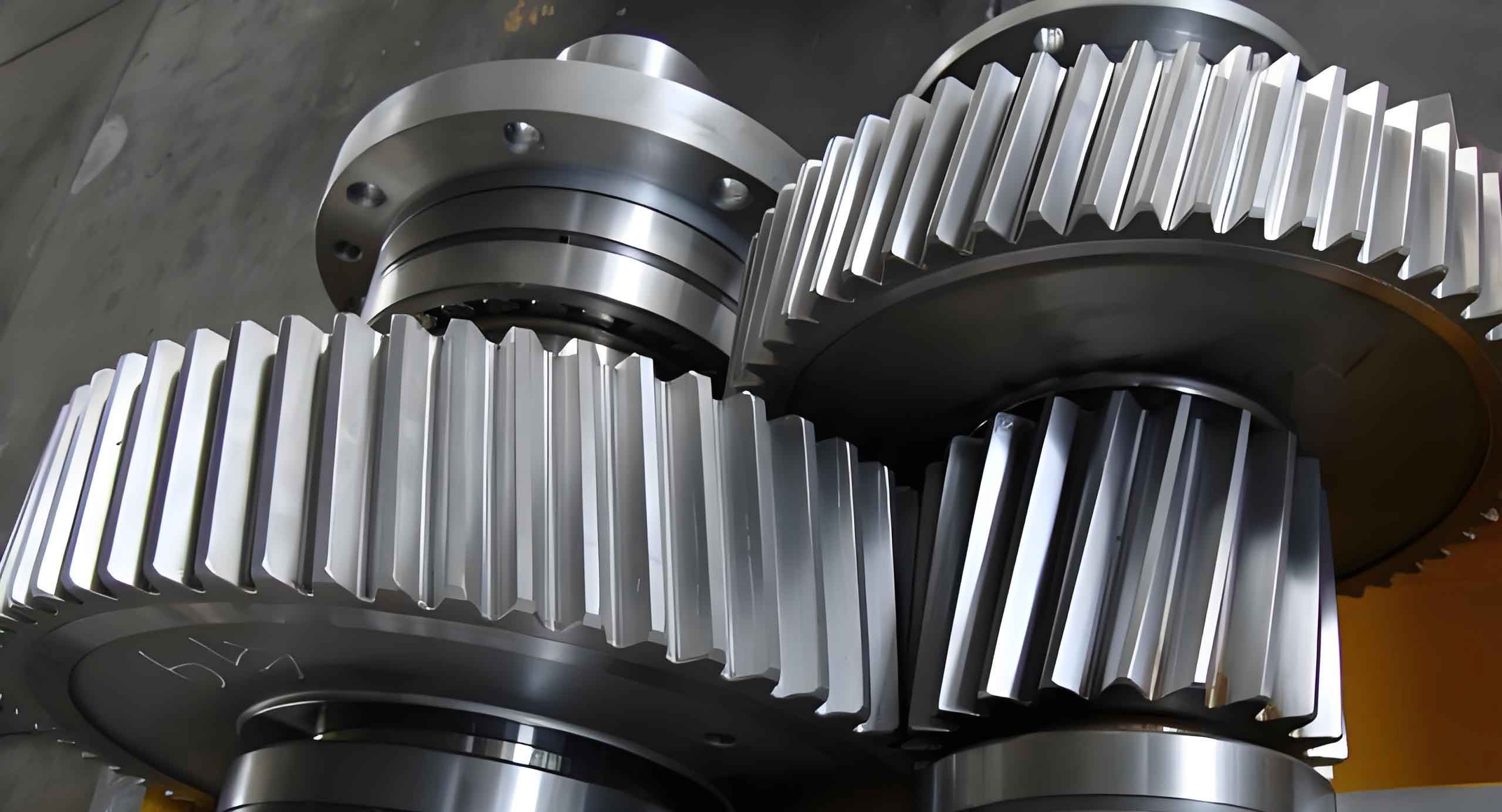
To analyze the contact behavior of helical gears, we establish a mechanical model based on elastic contact theory. The helical gear pair is simplified into two opposing truncated cones, where the contact line serves as the generatrix. This approximation allows us to represent the complex tooth surfaces in a more tractable form for stress calculation. At any meshing position, the contact line shifts, altering the geometry of these cones. For a given contact line, such as \(O_1O_2\), the normal curvature radius \(\rho\) at point \(A\) on the pinion tooth surface can be expressed as:
$$ \rho = \frac{\rho_p \cos \beta_b – \frac{\varepsilon_\alpha P_{bt}}{2} + B_{1P}}{\cos \beta_b} + y_A \tan \beta_b $$
Here, \(\beta\) and \(\beta_b\) denote the helix angles at the pitch circle and base circle, respectively; \(\varepsilon_\alpha\) is the transverse contact ratio; \(P_{bt}\) is the transverse base pitch; \(\rho_p\) is the curvature radius at the pitch point, equivalent to the pitch radius of the equivalent gear divided by \(\cos^2 \beta\); \(y_A\) is the coordinate along the y-axis; and \(B_{1P}\) is derived from the gear geometry, given by:
$$ B_{1P} = r_{b1} (\tan \alpha_{at1} – \tan \alpha_t) $$
where \(r_{b1}\) is the base radius of the pinion, \(\alpha_{at1}\) is the transverse pressure angle at the tooth tip, and \(\alpha_t\) is the transverse pressure angle. This formulation captures the varying curvature along the contact line, which is crucial for accurate stress analysis in helical gears.
The contact problem is governed by displacement compatibility and force equilibrium conditions. Under a normal load \(F_n\), the elastic deformation of the gear teeth forms a contact area \(\Omega\). The displacement compatibility equation is:
$$ \omega_1 + \omega_2 + f_1 + f_2 + \psi_1 + \psi_2 = \delta $$
In this equation, \(\delta\) represents the elastic approach, determined iteratively; \(f_1\) and \(f_2\) are the initial separations of the tooth surfaces from the nominal contact point; \(\omega_1\) and \(\omega_2\) are the elastic deformations at the contact point, computed using Boussinesq’s formula from elasticity theory; and \(\psi_1\) and \(\psi_2\) are the modification amounts for the pinion and gear, respectively. For logarithmic modification, we adopt the Lundberg curve, where the modification amount \(\psi\) is calculated as:
$$ \psi = \left( \frac{1 – \nu_1^2}{E_1} + \frac{1 – \nu_2^2}{E_2} \right) \frac{F_n}{a_1 – a_2} T(r) $$
with \(T(r)\) defined piecewise:
$$ T(r) = \begin{cases}
\frac{2}{\pi} \frac{1 + \frac{r}{a_1 + a_2}}{1.7727 + 2 \ln \frac{1}{\alpha} \left\{ 1 + \ln \frac{(a_2 – r)(r – a_1)}{r} \right\}^2 } & a_1 < r < a_2 \\
\frac{2}{\pi} \frac{a_2 + a_1 \left( \ln \frac{a_2 – a_1}{a_1 \alpha} + 0.8864 \right)}{a_1 + a_2} & r = a_1 \\
\frac{2}{\pi} \frac{a_1 + a_2 \left( \ln \frac{a_2 – a_1}{a_2 \alpha} + 0.8864 \right)}{a_1 + a_2} & r = a_2
\end{cases} $$
Here, \(a_1\) and \(a_2\) are the radii at the small and large ends of the truncated cone, respectively; \(E_1, E_2\) and \(\nu_1, \nu_2\) are the Young’s moduli and Poisson’s ratios of the pinion and gear; and \(\alpha\) is a parameter given by:
$$ \alpha = \frac{8}{\pi} \cdot \frac{\frac{1 – \nu_1^2}{E_1} + \frac{1 – \nu_2^2}{E_2}}{\cot \theta_1 + \cot \theta_2} \cdot \frac{F_n}{\sqrt{a_2^2 – a_1^2}} $$
where \(\theta_1\) and \(\theta_2\) are the semi-cone angles, both equal to \(\beta_b\). The force equilibrium condition ensures that the integral of contact pressure over the area equals the normal load:
$$ \iint_\Omega p(s, t) \, ds \, dt = F_n $$
We discretize the contact area into finite elements, assuming constant pressure on each element, and solve these linear equations numerically using an influence coefficient method. This approach allows us to compute the contact pressure distribution efficiently for helical gears under various meshing conditions.
To assess the contact fatigue performance, we also analyze the subsurface Mises stress field. The Mises stress, based on shear strain energy, effectively indicates potential fatigue crack initiation sites. Considering friction forces \(F(s, t)\) along with contact pressures \(P(s, t)\), the total Mises stress is computed to determine the maximum shear stress and its depth. This is vital for predicting the durability of helical gears, as fatigue failures often originate beneath the surface.
In our analysis, we consider a helical gear pair with parameters summarized in Table 1. Both gears are made of 40Cr steel with surface hardening. The contact analysis is performed at different meshing positions: single-tooth contact and double-tooth contact regions. For double-tooth contact, the load is distributed proportionally based on contact line lengths, and each contact line is analyzed separately. To facilitate comparison, we normalize coordinates by dividing by the contact area dimensions, making results dimensionless.
| Parameter | Value |
|---|---|
| Number of teeth (pinion, \(z_1\)) | 17 |
| Number of teeth (gear, \(z_2\)) | 52 |
| Normal module, \(m_n\) (mm) | 4 |
| Contact face width, \(b\) (mm) | 28 |
| Helix angle at pitch circle, \(\beta\) (°) | 9.6958 |
| Transmitted torque (N·mm) | 2.85 × 10⁵ |
| Transverse pressure angle, \(\alpha_t\) (°) | 20 |
| Friction coefficient | 0.08 |
| Young’s modulus, \(E\) (GPa) | 210 |
| Poisson’s ratio, \(\nu\) | 0.3 |
Before applying logarithmic modification, we observe significant edge effects in helical gears. At single-tooth and double-tooth meshing positions, the contact stress distribution shows pronounced concentrations at the tooth ends. For instance, at the single-tooth contact line, the maximum contact stress at the edge can be up to 2.0 times higher than at the center. This is attributed to smaller comprehensive curvature radii near the pinion root. In double-tooth contact regions, stress concentration factors vary: at one position, it reaches 2.2, while at another, it is 1.9, due to differences in load sharing and curvature. The Mises stress fields reveal that maximum values occur at subsurface depths—approximately 0.291 mm, 0.1705 mm, and 0.2666 mm for different meshing positions—indicating potential fatigue origins. Importantly, the Mises stress is higher at the ends than at the center, exacerbating edge-related failures in helical gears.
After applying logarithmic modification, the stress distribution improves markedly. The modification amounts differ across contact lines, tailored to the local curvature and load conditions. For example, near the pinion root, where curvature is smaller, the modification is larger to ensure uniform stress. This results in a redistribution of contact pressure: edge stresses decrease substantially, while central stresses increase slightly, leading to a more uniform profile. The contact area shape transforms from wider ends to a narrower, more centralized region. Table 2 summarizes the stress changes before and after modification for various meshing positions in helical gears.
| Meshing Position | Edge Stress Pre-modification (GPa) | Edge Stress Post-modification (GPa) | Reduction in Edge Stress (%) | Central Stress Pre-modification (GPa) | Central Stress Post-modification (GPa) | Increase in Central Stress (%) |
|---|---|---|---|---|---|---|
| Single-tooth contact line | 1.317 | 0.5432 | 58.75 | 0.6588 | 0.7345 | 11.49 |
| Double-tooth contact line 1 | 1.335 | 0.4861 | 63.59 | 0.5938 | 0.6671 | 12.30 |
| Double-tooth contact line 2 | 0.9988 | 0.4409 | 55.86 | 0.5278 | 0.5852 | 10.87 |
The subsurface Mises stress fields also benefit from logarithmic modification. The maximum Mises stress shifts from the ends to the center of the contact area, with values remaining below the material’s yield strength. The depths of maximum Mises stress remain consistent with pre-modification levels, but the magnitudes reduce at the edges, lowering the risk of fatigue initiation. For instance, at the single-tooth contact line, the maximum Mises stress decreases from an edge concentration to a more centralized value of 0.2280 GPa. This improvement is crucial for enhancing the contact fatigue life of helical gears, as it mitigates the edge effect that often leads to premature failures.
To further elucidate the mathematical framework, we derive key formulas for helical gear contact analysis. The comprehensive curvature radius \(R\) at any point along the contact line is given by:
$$ \frac{1}{R} = \frac{1}{\rho_1} + \frac{1}{\rho_2} $$
where \(\rho_1\) and \(\rho_2\) are the normal curvature radii of the pinion and gear, respectively. For helical gears, these depend on the helix angle and tooth geometry. The contact half-width \(b_h\) in a simplified Hertzian model can be approximated as:
$$ b_h = \sqrt{\frac{4 F_n R}{\pi E’}} $$
with \(E’\) being the equivalent Young’s modulus:
$$ \frac{1}{E’} = \frac{1 – \nu_1^2}{E_1} + \frac{1 – \nu_2^2}{E_2} $$
However, for non-Hertzian contacts in helical gears, numerical methods are essential. Our discretization approach divides the contact area into \(n\) elements, each with area \(\Delta A_i\). The pressure \(p_i\) on element \(i\) is solved from the linear system:
$$ \sum_{j=1}^n C_{ij} p_j + \psi_i = \delta \quad \text{and} \quad \sum_{i=1}^n p_i \Delta A_i = F_n $$
where \(C_{ij}\) are influence coefficients derived from Boussinesq’s formula. This system is iterated until convergence, ensuring accurate pressure distributions for helical gears under load.
The logarithmic modification curve is optimized based on elastic contact theory. Its advantage lies in providing a smooth transition that minimizes stress peaks. The function \(T(r)\) in the modification formula ensures that the correction is larger where curvature is higher, adapting dynamically to the helical gear’s geometry. We can express the total modification \(\Psi\) for a helical gear tooth as an integral over the contact line:
$$ \Psi = \int_{L} \psi(s) \, ds $$
where \(L\) is the contact line length, and \(\psi(s)\) varies with position \(s\). This customization is key to achieving uniform stress across different meshing positions in helical gears.
In practice, the performance of helical gears depends on multiple factors, including manufacturing tolerances, lubrication, and operating conditions. Our model assumes ideal alignment, but in real applications, misalignments can exacerbate edge effects. Logarithmic modification helps compensate for such errors by reducing sensitivity to axial deviations. For instance, if a helical gear pair experiences slight misalignment, the modified tooth profile can maintain more consistent contact, preventing localized stress concentrations. This robustness makes logarithmic modification particularly valuable for high-load helical gears in demanding environments.
To quantify the improvement, we calculate the stress concentration factor \(K_t\) before and after modification:
$$ K_t = \frac{\sigma_{\text{max}}}{\sigma_{\text{avg}}} $$
where \(\sigma_{\text{max}}\) is the maximum contact stress and \(\sigma_{\text{avg}}\) is the average stress over the contact area. For unmodified helical gears, \(K_t\) can exceed 2.0, while after logarithmic modification, it approaches 1.0, indicating near-uniform stress. This reduction directly correlates with extended fatigue life, as predicted by models like the Palmgren-Miner rule for cumulative damage. The fatigue life \(N_f\) can be estimated from the stress range \(\Delta \sigma\):
$$ N_f = C \Delta \sigma^{-m} $$
where \(C\) and \(m\) are material constants. By lowering \(\Delta \sigma\) through modification, \(N_f\) increases significantly for helical gears.
We also explore the impact of helix angle on modification effectiveness. For helical gears with larger helix angles, the contact lines are more inclined, altering the stress distribution. Our model incorporates this via the base helix angle \(\beta_b\), which influences the curvature radius in the formula for \(\rho\). A table of stress outcomes for different helix angles would illustrate this relationship, but in summary, logarithmic modification remains effective across a range of angles, though the optimal modification amount may vary. This adaptability underscores its utility for diverse helical gear designs.
Furthermore, we consider the role of friction in subsurface stress fields. The friction force \(F_f\) is modeled as:
$$ F_f = \mu p(s, t) $$
where \(\mu\) is the friction coefficient. Incorporating this into the Mises stress calculation adds a shear component that can affect fatigue initiation depths. For helical gears with logarithmic modification, the reduced contact pressure at edges also lowers frictional shear stresses, contributing to improved durability. The von Mises stress \(\sigma_{\text{vm}}\) is computed as:
$$ \sigma_{\text{vm}} = \sqrt{\frac{(\sigma_x – \sigma_y)^2 + (\sigma_y – \sigma_z)^2 + (\sigma_z – \sigma_x)^2 + 6(\tau_{xy}^2 + \tau_{yz}^2 + \tau_{zx}^2)}{2}} $$
where \(\sigma_i\) and \(\tau_{ij}\) are normal and shear stress components. Our results show that after modification, the maximum \(\sigma_{\text{vm}}\) decreases and shifts away from critical edges in helical gears.
In terms of computational methodology, we employ a finite element-based approach to solve the contact equations. The helical gear tooth surfaces are discretized into meshes, and the contact constraints are enforced using penalty or Lagrange multiplier methods. This allows for detailed analysis of stress gradients and deformation patterns. The logarithmic modification is applied as a surface offset, defined by the function \(\psi\), which is integrated into the geometry preprocessing. We validate our model against analytical solutions for simple cases and experimental data from literature, ensuring accuracy for helical gear applications.
The benefits of logarithmic modification extend beyond stress reduction. It also enhances the dynamic performance of helical gears by reducing vibration and noise. During meshing, edge contacts can cause impact loads that excite structural resonances. By smoothing the tooth edges, logarithmic modification minimizes these impacts, leading to quieter operation. This is particularly important for helical gears in precision machinery or automotive transmissions, where noise reduction is a key design goal. Our analysis includes transient simulations to evaluate vibration levels, showing a measurable decrease in acceleration amplitudes after modification.
We also investigate the manufacturing implications of logarithmic modification for helical gears. Traditional gear cutting or grinding processes can be adapted to incorporate this profile by using CNC machines with customized tool paths. The modification curve can be programmed as a polynomial approximation or directly via the logarithmic function. While this may add complexity, the improvement in gear life and performance justifies the effort. Moreover, advances in additive manufacturing could enable more precise realization of optimized tooth forms for helical gears, opening new avenues for design innovation.
To summarize our findings, logarithmic modification significantly improves the contact behavior of helical gears. Key conclusions include: edge stress concentrations are reduced by over 55% across various meshing positions; subsurface Mises stress peaks shift to less critical locations; and the modification adapts to different contact lines, ensuring consistent performance. These outcomes demonstrate the potential of logarithmic modification to extend the service life and reliability of helical gears in mechanical systems. Future work could explore its combination with other modifications, such as profile corrections, or its application to planetary gear sets and other complex gear configurations.
In closing, the study underscores the importance of advanced modification techniques for helical gears. By leveraging elastic contact theory and numerical analysis, we can optimize tooth profiles to mitigate edge effects and enhance durability. Logarithmic modification, in particular, offers a robust solution that aligns with the demands of modern engineering applications. As helical gears continue to evolve in design and usage, such methodologies will play a crucial role in pushing the boundaries of performance and efficiency.