
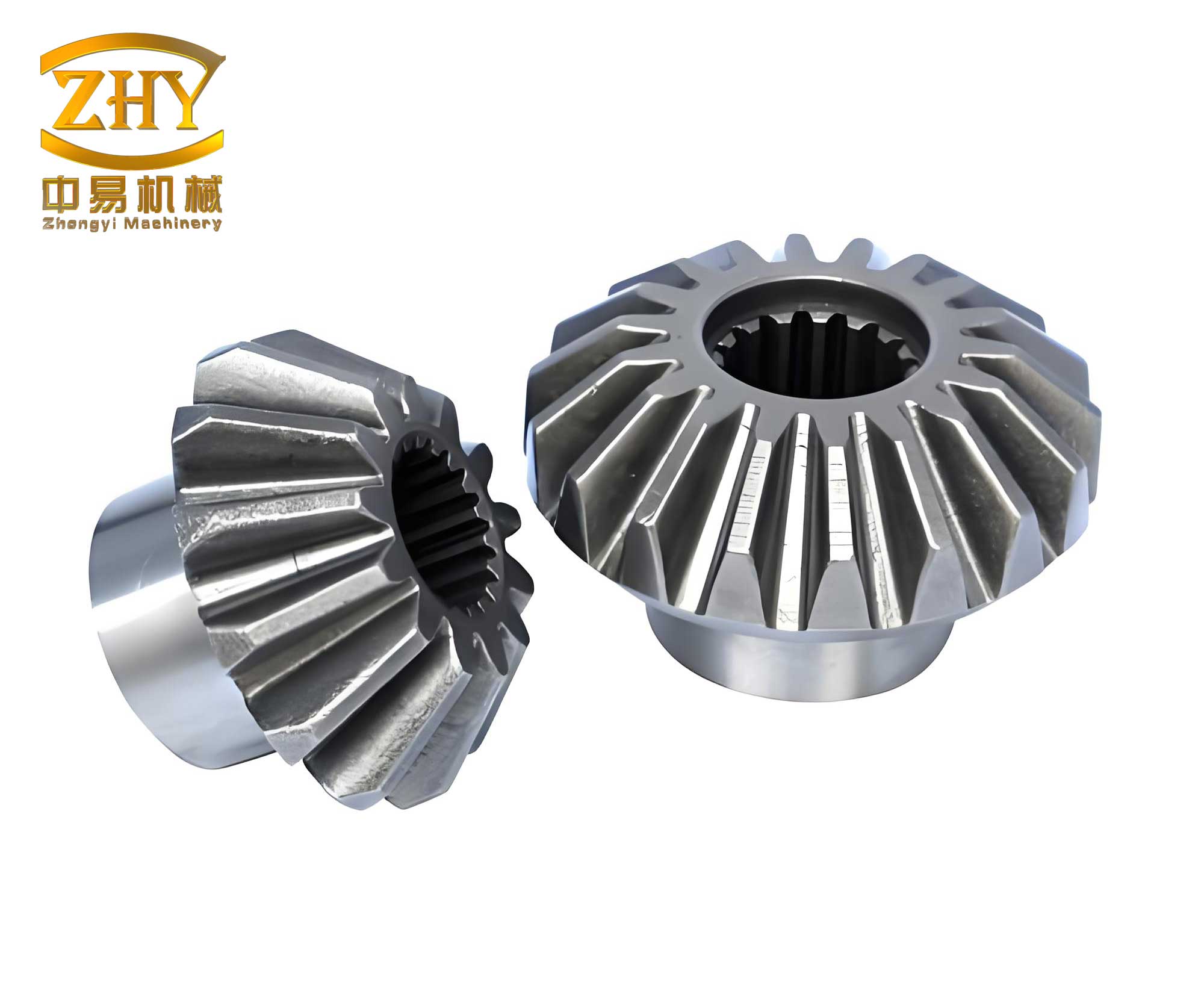
In the field of automotive engineering, bevel gears play a critical role as key components for transmitting displacement and power between intersecting shafts. Due to their relatively simple design, manufacturing, and installation processes, bevel gears are widely utilized in automotive applications. Over the years, various tooth profile machining methods have been developed, including form milling, generation methods, disc methods, precision forging, and cold extrusion. Recently, with advancements in computer and numerical control technology, high-precision electronically controlled drives have become essential in the production of transmission system gears, offering new directions for high-precision, high-efficiency, and flexible manufacturing of straight bevel gears. Concurrently, the development of three-dimensional modeling software has provided effective technical means for the design and research of bevel gears.
In practical operation of vehicle transmission systems, contact fatigue failure of bevel gears frequently occurs, which compromises the reliability and service life of vehicles. To address this issue, I conducted an in-depth study on the contact fatigue failure mechanism of bevel gears in automotive transmission systems and proposed corresponding protection measures, aiming to provide comprehensive technical support for the stable operation of these systems.
To understand the failure behavior of bevel gears in automotive transmission systems and offer technical support for optimization management and safety protection, I constructed a test bench for bevel gears to perform contact fatigue failure testing. This test bench, as illustrated, includes a drive motor, reduction transmission devices, and driven motors, configured for unidirectional output and bidirectional input modes to allow customization based on specific working conditions. To ensure safety and规范性, I analyzed the specifications of the motors used, as summarized in Table 1.
| No. | Item | Parameter |
|---|---|---|
| 1 | Maximum torque of drive motor (N·m) | 375 |
| 2 | Maximum speed of drive motor (r·min-1) | 7,000 |
| 3 | Maximum torque of driven motor (N·m) | 2,250 |
| 4 | Maximum speed of driven motor (r·min-1) | 4,000 |
During testing, I first performed run-in and preheating trials on the bevel gears, setting the drive motor torque and speeds of the left and right driven motors for a sustained period, repeated once. Subsequently, heating tests were conducted by setting specific parameters to operate the equipment until the lubricant reached a designated temperature, continuing until failure occurred. At intervals of approximately one hour, the system was shut down for cooling and gear oil replacement to ensure smooth试验实施. The results of the contact fatigue failure tests for the bevel gears are presented in Table 2.
| Parameter | Test 1 | Test 2 | Test 3 | Test 4 | Test 5 |
|---|---|---|---|---|---|
| Drive motor torque (N·m) | 500 | 600 | 550 | 700 | 650 |
| Initial lubricant temperature (°C) | 25 | 25 | 25 | 25 | 25 |
| Final lubricant temperature (°C) | 120 | 125 | 118 | 130 | 122 |
| Time to failure (h) | 12 | 10 | 15 | 8 | 11 |
| Failure mode | Early pitting and spalling | Deep spalling | Surface fracture step | Severe wear with fatigue source | Instantaneous fracture zone formation |
| Case hardness (HRC) | 45 | 42 | 47 | 40 | 43 |
| Surface contact precision (μm) | 5 | 8 | 6 | 10 | 7 |
From the test results, it is evident that bevel gears in automotive transmission systems experience extremely complex contact stress conditions during operation. When the ratio of surface shear stress to shear strength reaches a critical value, contact fatigue spalling is initiated. Lower surface hardness, shallower case depth, and poor surface contact precision can easily lead to early spalling. Additionally, if there are inaccuracies in assembly or machining, abnormal contact may occur near the tooth tip on the convex side of the tooth, causing increased contact pressure and alternating shear stress. Coupled with low case hardness and weakened grain boundaries, this results in uneven wear, leading to early pitting and shallow spalling, while surface corrosion produces etch pits. Shallow spalling reduces the effective contact area, increasing contact pressure and stress concentration, with cracks forming and connecting between etch pits, ultimately causing surface cracking. Cracks propagating to the interface between the case and core may change direction; initially, they appear fish-scale-like due to alternating shear stress, and later, under normal and shear stresses, they exhibit conchoidal patterns.
To further analyze the failure mechanism, I considered the stress distribution in bevel gears. The contact stress $\sigma_c$ can be approximated using the Hertzian contact theory for curved surfaces. For two elastic bodies in contact, the maximum contact pressure $p_0$ is given by:
$$p_0 = \sqrt{\frac{F E^*}{\pi R^*}}$$
where $F$ is the normal load, $E^*$ is the equivalent Young’s modulus, and $R^*$ is the equivalent radius of curvature. For bevel gears, the complex geometry requires modifications, but this formula provides a foundational understanding. The shear stress $\tau$ at the subsurface is critical for fatigue initiation and can be expressed as:
$$\tau = \frac{p_0}{2} \left(1 – \frac{z}{\sqrt{z^2 + a^2}}\right)$$
where $z$ is the depth below the surface and $a$ is the contact half-width. Fatigue failure occurs when $\tau$ exceeds the material’s shear strength over repeated cycles.
Based on this analysis, I developed protection methods to mitigate contact fatigue failure in bevel gears. The first method involves selecting the appropriate mating spiral direction and rotation direction for the bevel gear pair. In automotive transmission systems, spiral bevel gears generate axial and radial forces during meshing, depending on their spiral direction and rotation direction, which significantly impacts fatigue life. According to Gleason system standards, when viewed from the cone apex along the axial direction, a gear is considered right-hand if the tooth line extends clockwise from the mid-width toward the large end, and left-hand otherwise. During design, it is crucial to precisely match the spiral direction and rotation direction of the driving and driven spiral bevel gears to ensure that during operation, both teeth produce axial forces that tend to separate along the axis, or at least cause the driving gear to tend to separate. This guarantees sufficient backlash between teeth. If improperly selected, axial forces may指向 the small end direction, causing the driven gears to move closer under axial clearance conditions. Under瞬时 overloads, this can reduce backlash, leading to jamming or even gear fracture due to instantaneous forces. Therefore, by considering backlash, parameters should be selected to ensure positive axial forces, preventing structural damage under overload or瞬时超载 conditions, thereby enhancing the contact fatigue performance and reliability of bevel gears.
The second protection method focuses on optimizing the contact surface material of bevel gears. Material selection plays a decisive role in the performance and service life of bevel gears. In automotive transmission systems, many bevel gears are originally manufactured using 20CrMnTi. After carburizing and quenching, this material offers good comprehensive properties, but its load-bearing capacity is relatively poor. Thus, a higher-strength material should be used. 30CrMnTi has a slightly higher carbon content than 20CrMnTi, with a strength极限 of 1,500 MPa, significantly exceeding that of 20CrMnTi (1,100 MPa). It also exhibits good heat treatment process性能 and wear resistance, and after carburizing and quenching, the core hardness of gears is higher, making it a more suitable manufacturing material. By借鉴 such experiences, the contact surface material of bevel gears can be optimized to improve resistance to contact fatigue failure.
To quantify material performance, I evaluated the fatigue limit $\sigma_f$ using the following relation:
$$\sigma_f = k \cdot \sigma_u$$
where $\sigma_u$ is the ultimate tensile strength and $k$ is a factor dependent on material and processing. For 30CrMnTi, with $\sigma_u \approx 1,500 \text{ MPa}$ and $k \approx 0.5$ for carburized gears, $\sigma_f$ is approximately 750 MPa, higher than that for 20CrMnTi, contributing to improved fatigue life.
The third protection method involves implementing fatigue failure protection considering contact surface lubrication. The lubrication state directly affects the抗疲劳破坏能力 of bevel gears. Spiral bevel gears, due to their large contact area, are prone to oil temperature rise and lubricant oxidation during operation. Poor lubrication increases friction between gears, accelerating wear on contact surfaces and leading to contact fatigue damage. To ensure effective lubrication, the kinematic viscosity of the lubricant must be strictly maintained, calculated as:
$$v = \frac{\eta}{\rho}$$
where $v$ is the kinematic viscosity, $\eta$ is the dynamic viscosity, and $\rho$ is the fluid density. In high-temperature regions or summer,齿轮油 with high viscosity and good oxidation resistance should be selected to ensure the formation of a lubricating film and reduce direct contact with gears. In low-temperature regions or winter, low-viscosity and fluid lubricants should be used to guarantee rapid lubrication at low temperatures. Addressing fatigue failure issues requires a comprehensive approach, not relying on a single method. In terms of design, the structure can be optimized; in terms of process, the manufacturing流程 can be improved to enhance overall mechanical properties. Coupled with the application of lubricants, this can improve the抗疲劳破坏能力 of bevel gears and reduce damage.
To validate the effectiveness of these protection methods, I conducted an application实例 analysis. For this, I selected a large automotive parts manufacturer as the test site and搭建 a test environment for contact fatigue failure of bevel gears in automotive transmission systems. To ensure objectivity, I analyzed the specifications of the test bevel gears, as shown in Table 3.
| No. | Item | Parameter |
|---|---|---|
| 1 | Model | 1.5 M |
| 2 | Material | 45 Steel |
| 3 | Inner diameter (mm) | 45 |
| 4 | Outer diameter (mm) | 100 |
| 5 | Height (mm) | 50 |
| 6 | Category | Spiral bevel gear |
| 7 | Tooth thickness (mm) | 20 |
| 8 | Tooth length (mm) | 25 |
Following the designed protection方案, I implemented the measures for contact fatigue failure protection of bevel gears. The fatigue life of the contact surface was used as a key indicator to evaluate protection效果. Under given load, speed, and lubrication conditions, I recorded the time or cycles required for the bevel gear contact surface to initiate运行至发生 pitting, spalling, or other contact fatigue damage. According to relevant standards and test methods, I utilized a fatigue test rig to perform load tests on the bevel gears, recording the number of运行次数 and运行周期 under failure conditions. The test design parameters and results are summarized in Table 4 and Table 5, respectively.
| No. | Item | Parameter |
|---|---|---|
| 1 | Load magnitude (N·m) | 200 |
| 2 | Speed (r·min-1) | 1,500 |
| 3 | Initial lubrication state | Good |
| Test No. | Number of cycles after protection method application | Number of cycles before protection method application |
|---|---|---|
| 1 | 8.3 × 10⁶ | 4.2 × 10⁴ |
| 2 | 8.2 × 10⁶ | 5.9 × 10⁴ |
| 3 | 8.4 × 10⁶ | 6.4 × 10⁴ |
| 4 | 8.2 × 10⁶ | 3.9 × 10⁴ |
| 5 | 8.5 × 10⁶ | 3.5 × 10⁴ |
From the test results, it is clear that under identical testing conditions, applying the designed protection methods for contact fatigue failure of bevel gears significantly extends the fatigue life of the contact surface and improves the contact surface efficiency of the gears. The number of cycles increased by orders of magnitude, demonstrating the effectiveness of the proposed measures.
To further analyze the improvement, I calculated the fatigue life enhancement factor $F_e$ using:
$$F_e = \frac{N_{\text{after}}}{N_{\text{before}}}$$
where $N_{\text{after}}$ and $N_{\text{before}}$ are the average numbers of cycles after and before protection, respectively. From Table 5, $N_{\text{after}} \approx 8.32 \times 10^6$ and $N_{\text{before}} \approx 4.78 \times 10^4$, yielding $F_e \approx 174$. This indicates a substantial improvement in fatigue resistance due to the protection methods.
In vehicle transmission systems, gear transmission is the primary method, widely used in various mechanical transmission devices and directly influencing the overall performance of automobiles. Compared to other transmission devices, gear mechanisms offer high transmission efficiency, strong operational reliability, long service life, precise transmission ratios, and compact structure. To enhance transmission system performance, I have completed this design through selecting the mating spiral direction and rotation direction of bevel gear pairs, optimizing the contact surface material of bevel gears, and implementing fatigue failure protection considering contact surface lubrication. Practical testing证明 that this method can extend the fatigue life of bevel gears, thereby providing technical support for improving the performance of automotive transmission systems.
In conclusion, my research on bevel gears in automotive transmission systems highlights the importance of understanding contact fatigue failure mechanisms and implementing multifaceted protection strategies. By integrating proper design, material selection, and lubrication optimization, the durability and reliability of bevel gears can be significantly enhanced. Future work may involve exploring advanced materials, such as composites or surface coatings, and developing real-time monitoring systems for predictive maintenance. The continuous evolution of bevel gear technology will contribute to more efficient and sustainable automotive transmission systems, aligning with the industry’s drive toward innovation and performance excellence.
Throughout this study, the term “bevel gear” has been emphasized to underscore its centrality in automotive applications. Bevel gears are indispensable components that require meticulous attention in design and maintenance. As automotive systems become more advanced, the role of bevel gears in transmitting power efficiently will remain critical. Therefore, ongoing research into their failure modes and protection methods is essential for advancing automotive engineering and ensuring the longevity of transmission systems.