
In modern industrial applications, spiral gears have gained significant attention due to their advantages in manufacturing ease and cost-effectiveness. However, the lack of mature load-carrying capacity calculation formulas has limited their widespread use. In this article, I analyze the geometric characteristics of contact points in spiral gears and propose practical formulas for contact fatigue strength calculation, aiming to provide guidance for engineering design.
Spiral gears, also known as crossed helical gears, are used in non-parallel and non-intersecting shaft arrangements. Their tooth surfaces are helical, leading to point contact rather than line contact as in parallel axis gears. This point contact results in complex stress distributions, making fatigue strength analysis critical. The primary focus here is on contact fatigue, which is a common failure mode in spiral gears under repeated loading.
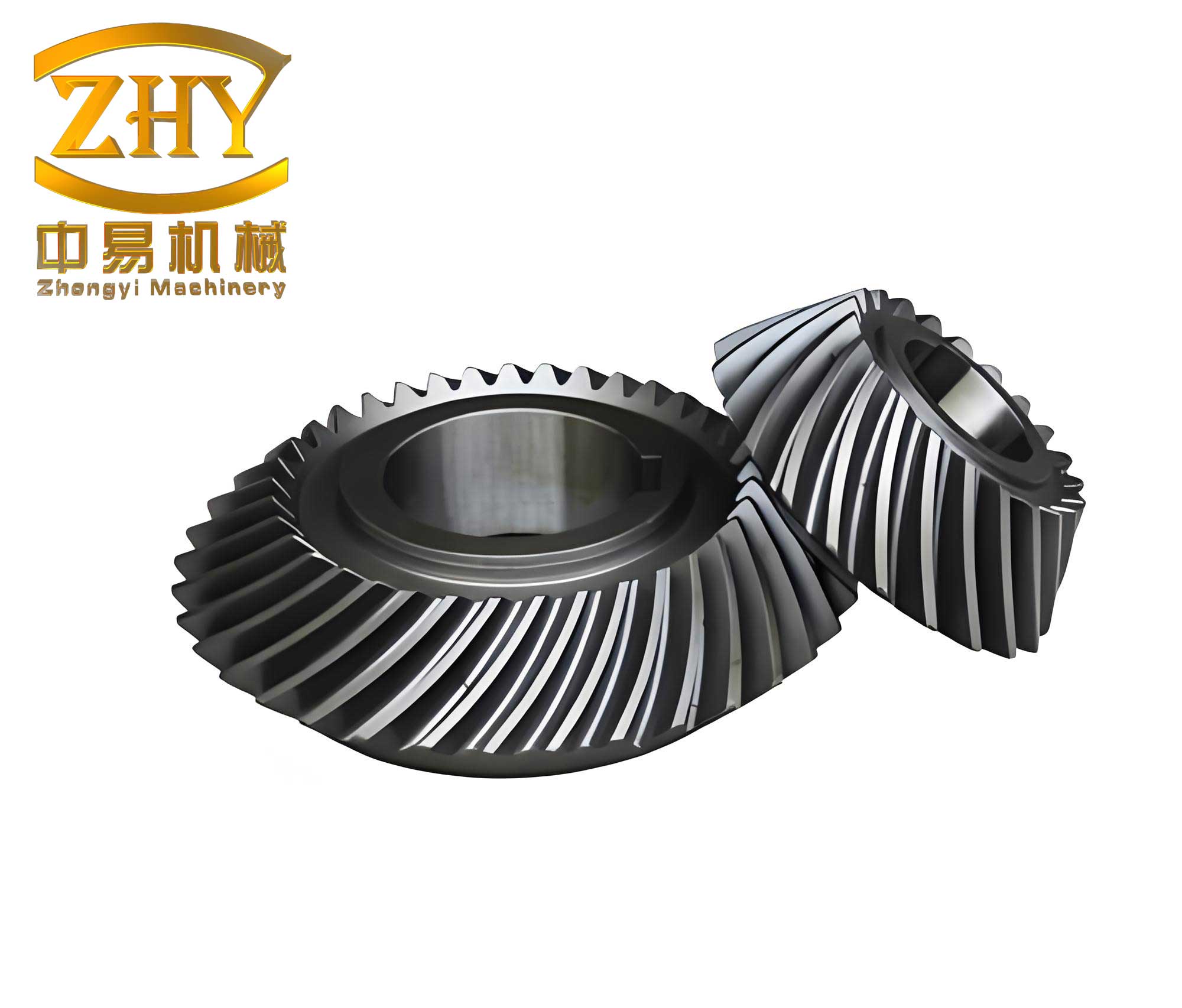
The geometric analysis of spiral gears starts at the pitch point, where the pitch cylinders of the two gears are tangent. Let the shaft angle be denoted by $\Sigma$, and the helix angles of gear 1 and gear 2 be $\beta_1$ and $\beta_2$, respectively. For right-handed spiral gears, the helix angle is positive, and for left-handed, it is negative. The relationship between shaft angle and helix angles is given by:
$$\Sigma = \beta_1 + \beta_2 \quad \text{(for gears of opposite hand)}$$
$$\Sigma = |\beta_1 – \beta_2| \quad \text{(for gears of same hand)}$$
The transverse pressure angle $\alpha_t$ and normal pressure angle $\alpha_n$ are related by:
$$\tan \alpha_t = \frac{\tan \alpha_n}{\cos \beta}$$
where $\beta$ is the helix angle. The base circle helix angle $\beta_b$ is calculated as:
$$\sin \beta_b = \sin \beta \cos \alpha_n$$
These parameters form the basis for understanding the contact geometry of spiral gears.
At the pitch point, the tooth surfaces of spiral gears are approximated as elastic bodies in point contact. According to Hertzian contact theory, the contact area is elliptical, and the maximum contact stress depends on the principal curvatures of the surfaces. For spiral gears, the principal directions of the two tooth surfaces do not coincide, leading to a more complex curvature analysis.
Let the principal curvatures of gear 1 and gear 2 in their respective principal directions be $\kappa_{1a}$, $\kappa_{1b}$ and $\kappa_{2a}$, $\kappa_{2b}$. The direction of the generating line (straight母线) on the involute helicoid surface is one principal direction, with normal curvature zero. The other principal direction is perpendicular to it. The normal curvatures in these directions can be derived as follows:
For gear 1, in the direction of the generating line: $\kappa_{1a} = 0$. In the perpendicular direction:
$$\kappa_{1b} = \frac{\cos \beta_{b1}}{d_1 \sin \alpha_t}$$
Similarly, for gear 2: $\kappa_{2a} = 0$ and
$$\kappa_{2b} = \frac{\cos \beta_{b2}}{d_2 \sin \alpha_t}$$
where $d_1$ and $d_2$ are the pitch diameters, and $\beta_{b1}$, $\beta_{b2}$ are the base helix angles.
The angle between the principal directions of the two surfaces, denoted by $\phi$, is the sum of the angles between the generating line and the tooth tangent line for each gear. This angle $\phi$ is calculated as:
$$\phi = \psi_1 + \psi_2$$
where $\psi_1$ and $\psi_2$ are given by:
$$\tan \psi_1 = \frac{\tan \beta_1}{\tan \alpha_t}, \quad \tan \psi_2 = \frac{\tan \beta_2}{\tan \alpha_t}$$
For right-handed spiral gears, $\psi$ is positive, and for left-handed, it is negative.
The sum of principal curvatures at the pitch point, $\Sigma \rho$, is a key parameter for contact stress calculation. It is defined as:
$$\Sigma \rho = \kappa_{1b} + \kappa_{2b} = \frac{\cos \beta_{b1}}{d_1 \sin \alpha_t} + \frac{\cos \beta_{b2}}{d_2 \sin \alpha_t}$$
However, due to the non-coincident principal directions, the effective curvature ratio $\lambda$ for elliptical contact is introduced. The ratio $\lambda$ of the induced normal curvatures along the major and minor axes of the contact ellipse is:
$$\lambda = \frac{\kappa_{1} – \kappa_{2}}{\sqrt{(\kappa_{1a} – \kappa_{2a})^2 + (\kappa_{1b} – \kappa_{2b})^2 + 2(\kappa_{1a} – \kappa_{2a})(\kappa_{1b} – \kappa_{2b})\cos 2\phi}}$$
This ratio influences the shape of the contact ellipse and thus the stress distribution.
To simplify engineering applications, I define a coefficient $f_0$ that accounts for the effects of helix angles $\beta_1$, $\beta_2$, and shaft angle $\Sigma$ on the combined curvature. This coefficient is derived from the geometric analysis and can be determined using precomputed tables or empirical formulas. For spiral gears, $f_0$ varies with $\beta_1$, $\beta_2$, and $\Sigma$, as shown in the following table for common ranges.
| $\beta_1$ (degrees) | $\beta_2$ (degrees) | $\Sigma$ (degrees) | Hand Combination | $f_0$ |
|---|---|---|---|---|
| 10 | 20 | 30 | Opposite | 1.15 |
| 15 | 15 | 30 | Same | 1.08 |
| 20 | 10 | 30 | Opposite | 1.22 |
| 25 | 5 | 30 | Same | 1.05 |
| 30 | 0 | 30 | N/A | 1.00 |
The contact stress at the center of the elliptical contact area, based on Hertzian theory, is given by:
$$\sigma_H = \sqrt[3]{\frac{3 F_n E’^2}{2 \pi (1 – \nu^2)^2} \cdot \frac{\Sigma \rho}{f_0}}$$
where $F_n$ is the normal load, $E’$ is the equivalent elastic modulus, and $\nu$ is Poisson’s ratio. The equivalent elastic modulus is:
$$\frac{1}{E’} = \frac{1 – \nu_1^2}{E_1} + \frac{1 – \nu_2^2}{E_2}$$
with $E_1$, $E_2$ and $\nu_1$, $\nu_2$ being the elastic moduli and Poisson’s ratios of gear 1 and gear 2, respectively.
For spiral gears, the normal load $F_n$ is related to the transmitted torque $T_1$ of the pinion (gear 1) by:
$$F_n = \frac{2 T_1 K_A K_V K_\beta}{d_1 \cos \alpha_n \cos \beta_1}$$
where $K_A$ is the application factor, $K_V$ is the dynamic factor, and $K_\beta$ is the face load distribution factor. Since spiral gears have point contact, there is no bias load issue, so $K_\beta = 1$ for ideal alignment.
Substituting $F_n$ into the contact stress formula, I derive the design formula for contact fatigue strength of spiral gears:
$$d_1 \geq \sqrt[3]{\frac{2 T_1 K_A K_V}{\cos \beta_1} \cdot \frac{E’}{\pi (1 – \nu^2)} \cdot \frac{f_0}{\Sigma \rho} \cdot \left( \frac{Z_H Z_E Z_\epsilon}{[\sigma]_H} \right)^2}$$
Here, $Z_H$ is the zone factor, $Z_E$ is the elasticity factor, $Z_\epsilon$ is the contact ratio factor, and $[\sigma]_H$ is the allowable contact stress. For spiral gears, these factors are adapted from standard gear calculations but with modifications for point contact.
The allowable contact stress $[\sigma]_H$ is determined by:
$$[\sigma]_H = \frac{\sigma_{H \lim} Z_N Z_W}{S_H}$$
where $\sigma_{H \lim}$ is the contact fatigue limit, $Z_N$ is the life factor, $Z_W$ is the hardness ratio factor, and $S_H$ is the safety factor. The values depend on material properties and operating conditions.
To illustrate the application of this formula, I present a design example comparing spiral gears with straight spur gears for the same working conditions. The conditions are: transmitted power $P = 10 \text{ kW}$, pinion speed $n_1 = 1000 \text{ rpm}$, gear ratio $u = 3$, shaft angle $\Sigma = 90^\circ$, and medium shock load. The pinion is made of steel grade 40Cr with quenched and tempered treatment, and the gear is made of steel grade 45 with normalized treatment.
For straight spur gears, a standard design yields module $m = 3 \text{ mm}$ and center distance $a = 120 \text{ mm}$. For spiral gears, I select initial parameters: helix angles $\beta_1 = 30^\circ$, $\beta_2 = 60^\circ$ (opposite hand), normal pressure angle $\alpha_n = 20^\circ$, and number of teeth $z_1 = 20$, $z_2 = 60$. The pitch diameters are $d_1 = m_t z_1$ and $d_2 = m_t z_2$, where $m_t$ is the transverse module. The transverse pressure angle is calculated as:
$$\alpha_t = \arctan\left(\frac{\tan \alpha_n}{\cos \beta_1}\right) = \arctan\left(\frac{\tan 20^\circ}{\cos 30^\circ}\right) \approx 22.8^\circ$$
The base helix angles are:
$$\beta_{b1} = \arcsin(\sin \beta_1 \cos \alpha_n) = \arcsin(\sin 30^\circ \cos 20^\circ) \approx 28.2^\circ$$
$$\beta_{b2} = \arcsin(\sin \beta_2 \cos \alpha_n) \approx 56.3^\circ$$
The sum of principal curvatures is:
$$\Sigma \rho = \frac{\cos \beta_{b1}}{d_1 \sin \alpha_t} + \frac{\cos \beta_{b2}}{d_2 \sin \alpha_t}$$
Assuming $d_1 = 50 \text{ mm}$ and $d_2 = 150 \text{ mm}$ for initial calculation, $\Sigma \rho \approx 0.012 \text{ mm}^{-1}$. From Table 1, for $\beta_1 = 30^\circ$, $\beta_2 = 60^\circ$, $\Sigma = 90^\circ$, and opposite hand, $f_0 \approx 1.25$.
The material properties: $E_1 = E_2 = 210 \text{ GPa}$, $\nu_1 = \nu_2 = 0.3$. The equivalent elastic modulus is $E’ = 112.5 \text{ GPa}$. The torque on the pinion is $T_1 = 95.5 \text{ Nm}$ for $P = 10 \text{ kW}$ and $n_1 = 1000 \text{ rpm}$. The application factor $K_A = 1.25$ for medium shock, and dynamic factor $K_V = 1.1$ for spiral gears at this speed. The allowable contact stress $[\sigma]_H = 600 \text{ MPa}$ based on material fatigue limits.
Substituting into the design formula:
$$d_1 \geq \sqrt[3]{\frac{2 \times 95.5 \times 1.25 \times 1.1}{\cos 30^\circ} \cdot \frac{112.5 \times 10^3}{\pi (1 – 0.3^2)} \cdot \frac{1.25}{0.012} \cdot \left( \frac{2.5 \times 189.8 \times 0.9}{600} \right)^2} \approx 45.2 \text{ mm}$$
where $Z_H = 2.5$, $Z_E = 189.8 \sqrt{\text{MPa}}$, and $Z_\epsilon = 0.9$ for spiral gears. Thus, a pitch diameter $d_1 = 46 \text{ mm}$ is selected. The transverse module is $m_t = d_1 / z_1 = 2.3 \text{ mm}$, and the normal module is $m_n = m_t \cos \beta_1 = 2.0 \text{ mm}$. To match the center distance, adjust teeth numbers: $z_1 = 23$, $z_2 = 69$, giving $d_1 = 52.9 \text{ mm}$, $d_2 = 158.7 \text{ mm}$, and center distance $a = 105.8 \text{ mm}$.
This design shows that spiral gears can achieve compactness compared to spur gears for the same load conditions. However, due to point contact, the load capacity per unit size is lower, so careful geometric optimization is needed.
The fatigue life of spiral gears depends on the contact stress cycles. The number of stress cycles $N_L$ is calculated from operating hours and rotational speed. The life factor $Z_N$ is then determined from S-N curves for the material. For the pinion with $N_L = 10^7$ cycles, $Z_N \approx 1.0$. The hardness ratio factor $Z_W = 1.0$ for similar hardness gears.
In practice, spiral gears are sensitive to misalignment due to point contact. Therefore, manufacturing accuracy and assembly precision are crucial. The formulas provided here assume ideal conditions; for real applications, additional factors such as lubrication and surface finish should be considered.
To summarize the key parameters and formulas, I present the following tables for quick reference in spiral gear design.
| Symbol | Definition | Unit |
|---|---|---|
| $\beta_1, \beta_2$ | Helix angles of gear 1 and gear 2 | degrees |
| $\Sigma$ | Shaft angle | degrees |
| $\alpha_n$ | Normal pressure angle | degrees |
| $\alpha_t$ | Transverse pressure angle | degrees |
| $d_1, d_2$ | Pitch diameters | mm |
| $z_1, z_2$ | Number of teeth | – |
| $m_n$ | Normal module | mm |
| $m_t$ | Transverse module | mm |
| $\beta_b$ | Base helix angle | degrees |
| $\psi$ | Angle between generating line and tooth tangent | degrees |
| $\phi$ | Angle between principal directions | degrees |
| $\Sigma \rho$ | Sum of principal curvatures | mm⁻¹ |
| $\lambda$ | Induced normal curvature ratio | – |
| $f_0$ | Geometric coefficient for curvature | – |
| Factor | Symbol | Calculation Method |
|---|---|---|
| Application factor | $K_A$ | Based on driven and driving machines |
| Dynamic factor | $K_V$ | From pitch line velocity and accuracy grade |
| Face load distribution factor | $K_\beta$ | Assumed 1 for point contact in spiral gears |
| Zone factor | $Z_H$ | For spiral gears, typically 2.5 |
| Elasticity factor | $Z_E$ | $\sqrt{\frac{E’}{\pi}}$ where $E’$ is equivalent modulus |
| Contact ratio factor | $Z_\epsilon$ | Based on transverse contact ratio, often 0.9 for spiral gears |
| Life factor | $Z_N$ | From S-N curve for material and stress cycles |
| Hardness ratio factor | $Z_W$ | For gear pair hardness difference |
| Safety factor | $S_H$ | Typically 1.0 to 1.5 based on application |
The use of spiral gears in engineering requires a balance between geometric design and load capacity. The proposed formulas enable designers to estimate contact fatigue strength quickly. For instance, in applications where space is limited and shafts are non-parallel, spiral gears offer a viable solution. However, their efficiency is lower than that of worm gears or bevel gears due to sliding friction, so lubrication is essential.
In conclusion, I have presented a comprehensive analysis of contact fatigue strength calculation for spiral gears. The geometric characteristics, such as helix angles and shaft angle, significantly influence the contact stress. By incorporating the coefficient $f_0$ and using Hertzian contact theory, practical design formulas are derived. These formulas help overcome the historical lack of load capacity calculations for spiral gears, promoting their effective use in industrial applications. Future work could focus on experimental validation and refinement of coefficients for different materials and operating conditions.