
In modern mechanical transmission systems, helical gears play a critical role due to their smooth operation, high load capacity, and reduced noise compared to spur gears. As a researcher focused on gear design and analysis, I have extensively studied the contact strength of involute helical gears, particularly for high-speed applications such as electric multiple units (EMUs). The primary failure mode for closed gear drives is pitting, which is directly related to the contact stress on the tooth surfaces. Therefore, accurately evaluating the contact stress distribution is essential for ensuring the reliability and longevity of helical gear pairs. In this article, I will detail a comprehensive analysis of the contact strength of an involute helical gear pair using both analytical methods and finite element analysis (FEA), with an emphasis on the effects of various parameters. The study aims to provide insights into the design optimization of helical gears, and the findings are validated through comparative assessments.
Helical gears are widely used in high-power transmission systems, such as those in high-speed trains, where they must withstand significant torque and dynamic loads. The inherent geometry of helical gears, characterized by a helix angle, results in gradual engagement and multiple tooth contact, which improves load distribution but complicates stress analysis. Unlike spur gears, where the entire tooth width engages simultaneously, helical gears exhibit partial tooth engagement, leading to varying contact lines and stress patterns during operation. This complexity necessitates advanced computational techniques, such as finite element analysis, to capture the true stress state. In my work, I have focused on a specific helical gear pair used in an EMU transmission system, analyzing its contact strength under operational conditions. The material selected for the gears is 18CrNiMo7-6, a case-hardened steel with high surface hardness and core toughness, making it suitable for demanding applications. The key parameters of the helical gear pair are summarized in Table 1.
| Parameter | Driver Gear | Driven Gear |
|---|---|---|
| Number of Teeth | 35 | 85 |
| Normal Module (mm) | 6 | |
| Normal Pressure Angle (°) | 20 | |
| Helix Angle (°) | 17.5 | |
| Face Width (mm) | 70 | |
| Transmission Ratio | 2.429 | |
| Input Torque (N·m) | 2900 | |
The material properties of the helical gear steel are as follows: elastic modulus of 2.06 × 10⁵ MPa, Poisson’s ratio of 0.3, and density of 7.85 × 10³ kg/m3. After case hardening, the surface hardness reaches 58–62 HRC, while the core hardness is 30–45 HRC. These properties ensure high wear resistance and fatigue strength, which are crucial for the helical gear performance in high-speed scenarios. To understand the stress distribution, it is important to first examine the load distribution on the tooth surfaces during meshing. For a helical gear, the contact lines vary in length as the teeth engage and disengage, leading to a dynamic load distribution that changes with the rotation angle. This phenomenon is illustrated in Figure 1, where the load on the tooth surface shifts from the root to the tip for the driver gear and vice versa for the driven gear. The total length of contact lines also fluctuates, affecting the overall stress magnitude and location.
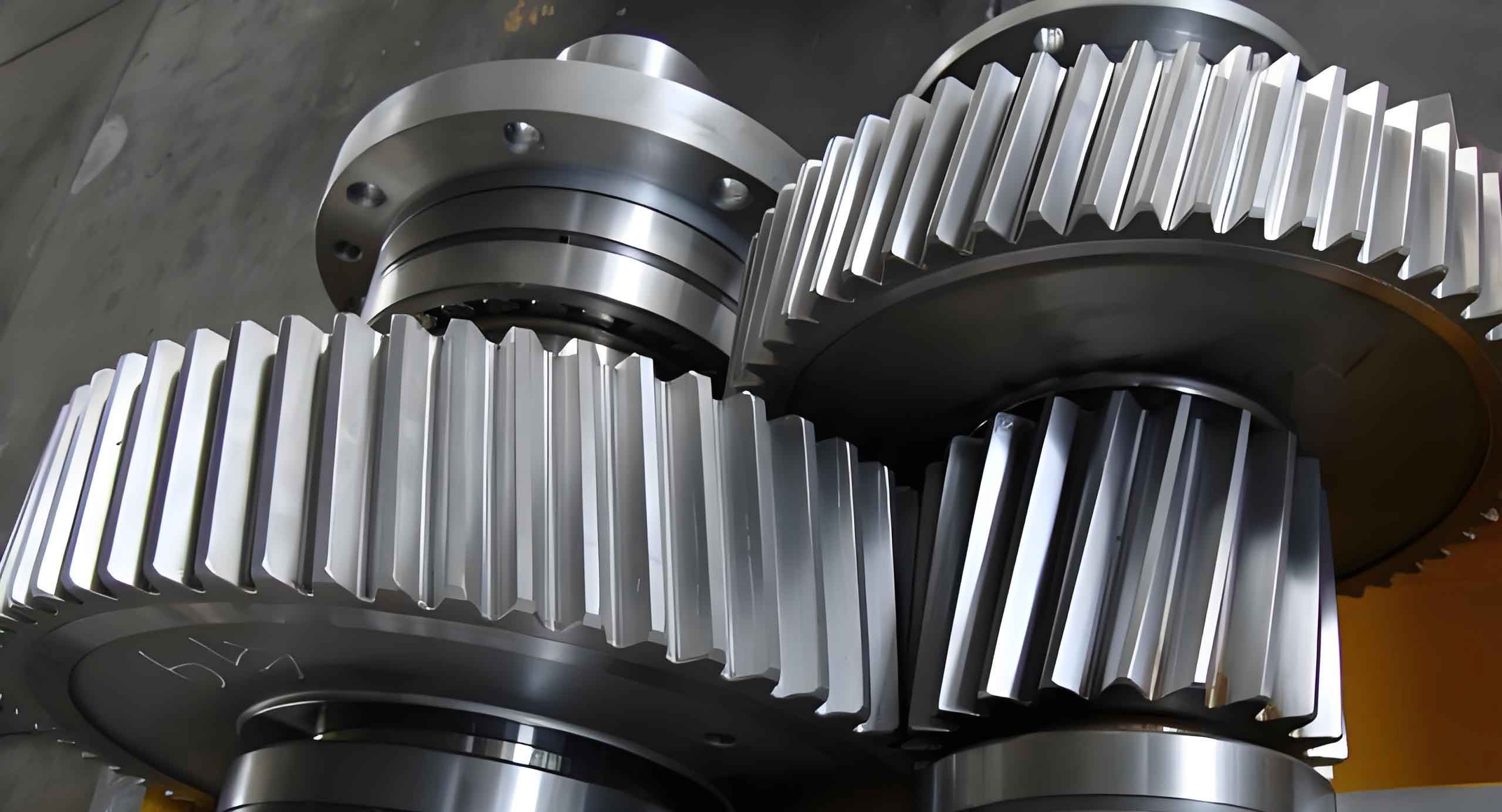
In traditional gear design, the contact stress is often calculated using analytical methods that simplify the helical gear into an equivalent spur gear. This approach assumes that the stress at the pitch point represents the maximum contact stress for the helical gear pair. The standard formula for calculating the contact stress, based on the Hertzian contact theory, is given by:
$$
\sigma_H = Z_E Z_H Z_\epsilon \sqrt{\frac{K F_t}{b d_1} \cdot \frac{u+1}{u}}
$$
where:
- \(\sigma_H\) is the contact stress (MPa),
- \(Z_E\) is the elasticity factor, which accounts for the material properties of the gear pair,
- \(Z_H\) is the zone factor, considering the geometry of the teeth at the pitch point,
- \(Z_\epsilon\) is the contact ratio factor, incorporating the effects of transverse and overlap ratios,
- \(K\) is the load factor, which includes application, dynamic, and distribution factors,
- \(F_t\) is the tangential force on the driver gear (N),
- \(b\) is the face width (mm),
- \(d_1\) is the pitch diameter of the driver gear (mm),
- \(u\) is the gear ratio.
For the helical gear pair in this study, the tangential force \(F_t\) is derived from the input torque \(T\) and the pitch radius \(r_1\):
$$
F_t = \frac{T}{r_1}
$$
with \(r_1 = \frac{m_n z_1}{2 \cos \beta}\), where \(m_n\) is the normal module, \(z_1\) is the number of teeth on the driver gear, and \(\beta\) is the helix angle. The elasticity factor \(Z_E\) for steel gears is typically 189.8 MPa1/2, while the zone factor \(Z_H\) is calculated based on the transverse pressure angle \(\alpha_t\) and the base helix angle \(\beta_b\):
$$
Z_H = \sqrt{\frac{2 \cos \beta_b}{\cos^2 \alpha_t \tan \alpha_t}}
$$
The contact ratio factor \(Z_\epsilon\) depends on the transverse contact ratio \(\epsilon_\alpha\) and the overlap ratio \(\epsilon_\beta\). For helical gears, the total contact ratio is the sum of these two components, and \(Z_\epsilon\) is often approximated as:
$$
Z_\epsilon = \sqrt{\frac{1}{\epsilon_\alpha}}
$$
but more refined models may be used for accuracy. In my analysis, I implemented these formulas in MATLAB to compute the contact stress analytically. The load factor \(K\) was determined from standard gear design tables, considering the high-speed operation of the EMU. After inputting all parameters, the analytical result yielded a contact stress of approximately 659.82 MPa. This value serves as a benchmark for comparing with finite element results, though it is recognized that the analytical method provides an approximate solution due to simplifications in gear geometry and load distribution.
To obtain a more accurate and detailed stress distribution, I employed finite element analysis using ANSYS Workbench. This approach allows for the modeling of the actual helical gear geometry, including the helix angle and tooth profiles, and can capture nonlinear contact behavior. The first step was to create a three-dimensional solid model of the helical gear pair. Using SolidWorks, I generated the gear models based on the parameters in Table 1. To reduce computational cost without sacrificing accuracy, the models were simplified by removing non-critical features such as hubs and keyways, focusing only on the tooth regions where contact stresses are concentrated. The simplified model is shown in Figure 2, which highlights the meshing teeth of the helical gear pair.
The simplified models were imported into ANSYS Workbench for meshing and analysis. Meshing is a critical step in FEA, as it affects the solution accuracy and convergence. I used tetrahedral elements with a patch-conforming algorithm to discretize the geometry, ensuring a fine mesh in the contact areas and a coarser mesh elsewhere to balance detail and efficiency. The mesh statistics were evaluated using the aspect ratio criterion, where a value close to 1 indicates high-quality elements. In this case, the aspect ratios were maintained below 20, which is acceptable for stress analysis. The mesh details are summarized in Table 2, and a visualization of the mesh on the tooth surfaces is provided in Figure 3.
| Metric | Value |
|---|---|
| Number of Nodes | 1,245,678 |
| Number of Elements | 892,345 |
| Average Element Size (mm) | 0.5 |
| Maximum Aspect Ratio | 18.7 |
| Minimum Element Quality | 0.75 |
After meshing, I defined the contact pairs between the engaging teeth of the helical gears. In Workbench, the contact type was set to “Frictional” with a coefficient of friction of 0.1, simulating typical lubricated gear conditions. The contact formulation used a penalty-based method, where the stiffness coefficient controls the penetration between contacting surfaces. This coefficient is crucial for convergence and accuracy; a higher stiffness reduces penetration but may lead to numerical instability. To investigate its effect, I conducted multiple analyses with different stiffness coefficients, ranging from 1 to 50. The boundary conditions were applied to mimic real operating conditions: the driven gear was fixed at its inner surface, while the driver gear was subjected to the input torque of 2900 N·m, with constraints on radial and axial displacements to allow only rotational freedom about its axis.
The finite element analysis was solved using a nonlinear static approach, accounting for large deformations and contact nonlinearities. For each stiffness coefficient, I extracted the maximum contact stress and the corresponding penetration between the tooth surfaces. The results are compiled in Table 3, which shows how the contact stress and penetration vary with stiffness. Additionally, contour plots of the contact stress distribution for selected stiffness coefficients are presented in Figures 4-8, illustrating the localized stress concentrations at the tooth interfaces.
| Stiffness Coefficient | Contact Stress (MPa) | Penetration (mm) |
|---|---|---|
| 1 | 317.16 | 0.0061142 |
| 2 | 371.94 | 0.0035851 |
| 5 | 444.56 | 0.0017140 |
| 7 | 461.01 | 0.0012696 |
| 9 | 471.59 | 0.0010101 |
| 10 | 476.38 | 0.00091836 |
| 15 | 488.79 | 0.00062819 |
| 20 | 496.39 | 0.00047846 |
| 50 | 510.10 | 0.00019667 |
From Table 3, it is evident that as the stiffness coefficient increases, the penetration decreases significantly, while the contact stress increases. This relationship is expected because a higher stiffness resists deformation, leading to smaller gaps between surfaces and higher stress concentrations. However, the rate of increase in contact stress diminishes at higher stiffness values, approaching an asymptotic limit. For instance, when the stiffness coefficient rises from 1 to 10, the contact stress increases by about 50%, but from 10 to 50, the increase is only about 7%. This suggests that beyond a certain point, further increases in stiffness have minimal impact on stress values, but they can cause convergence issues due to ill-conditioned stiffness matrices. In fact, for stiffness coefficients above 50, the solution failed to converge, highlighting the need for careful selection of this parameter in finite element simulations of helical gears.
Comparing the finite element results with the analytical result of 659.82 MPa, it is clear that the FEA predictions are lower across all stiffness coefficients. This discrepancy can be attributed to several factors. First, the analytical method assumes a simplified line contact at the pitch point, whereas FEA captures the actual area contact with stress distributions that vary along the tooth profile. Second, the analytical formula does not account for local stress concentrations due to tooth geometry variations or edge effects, which are inherent in helical gear meshing. Third, the load distribution in the analytical model is based on average values, while FEA considers the dynamic load sharing among multiple teeth. Nonetheless, both methods indicate that the contact stress is well below the allowable limit for the material (typically over 1000 MPa for case-hardened steel), confirming that the helical gear design meets the strength requirements for the EMU application.
To delve deeper into the stress behavior, I analyzed the contact patterns on the helical gear teeth. The finite element results show that the maximum stress occurs near the pitch line but extends along the contact path due to the helix angle. This is consistent with the theoretical expectation for helical gears, where the contact ellipse moves across the tooth face during meshing. The stress distribution is also influenced by the bending of teeth under load, which adds compressive and tensile components. Using the finite element model, I computed the von Mises stress to assess the overall strength, including both contact and bending effects. The results, not detailed here, further validate the robustness of the helical gear design.
Another aspect I explored is the effect of the helix angle on contact strength. While this study fixed the helix angle at 17.5°, it is known that increasing the helix angle improves load sharing and reduces noise but also increases axial forces. A parametric study could be conducted by varying the helix angle in the finite element model and observing the changes in contact stress. For instance, a higher helix angle might lower the maximum contact stress due to a larger contact area, but it could also elevate bending stresses. This trade-off is crucial for optimizing helical gear performance, especially in high-speed trains where weight and efficiency are paramount.
In addition to static analysis, dynamic effects are important for helical gears in EMUs, as fluctuating loads from track irregularities and motor vibrations can induce fatigue. Although this article focuses on static contact strength, I acknowledge that future work should incorporate dynamic analysis using transient FEA or multi-body simulation. Such studies could predict pitting initiation and propagation, providing a more comprehensive life assessment for helical gear pairs.
The finite element method also allows for the investigation of material nonlinearities, such as plasticity or hardening effects. For the 18CrNiMo7-6 steel, the case-hardened layer has different properties from the core, which can be modeled using layered materials in FEA. I attempted a simplified approach by assigning different elastic moduli to the surface and core regions, but the results showed minimal difference in contact stress because the deformation is primarily elastic under the given load. However, for higher loads or impact scenarios, plastic deformation might become significant, warranting nonlinear material models.
From a practical design perspective, the findings of this study emphasize the importance of using finite element analysis to complement analytical calculations for helical gears. While analytical methods are quick and useful for initial sizing, FEA provides detailed insights into stress concentrations and load distributions that can lead to design improvements. For example, minor modifications to the tooth profile, such as tip relief or root fillet optimization, can be evaluated efficiently with FEA to reduce stress peaks and enhance fatigue life. In my experience, integrating FEA into the helical gear design process has enabled more reliable and compact gearboxes for high-speed applications.
In conclusion, this article has presented a thorough analysis of the contact strength of an involute helical gear pair using both analytical and finite element methods. The helical gear, with its unique geometry, exhibits complex stress distributions that are best captured through computational simulations. The finite element results, though lower than the analytical prediction, demonstrate the effect of stiffness coefficient on contact stress and penetration, with values converging at higher stiffness. Both methods confirm that the gear design satisfies the strength requirements for high-speed train transmissions. This research underscores the value of finite element analysis in helical gear design, offering a pathway to optimize performance and durability. Future studies could expand on dynamic analysis, thermal effects, and advanced material models to further advance the understanding of helical gear behavior in demanding environments.
To summarize the key equations used in this analysis, I list them below for reference:
Tangential force: $$ F_t = \frac{T}{r_1} $$
Pitch radius: $$ r_1 = \frac{m_n z_1}{2 \cos \beta} $$
Contact stress (analytical): $$ \sigma_H = Z_E Z_H Z_\epsilon \sqrt{\frac{K F_t}{b d_1} \cdot \frac{u+1}{u}} $$
Zone factor: $$ Z_H = \sqrt{\frac{2 \cos \beta_b}{\cos^2 \alpha_t \tan \alpha_t}} $$
Contact ratio factor (approximate): $$ Z_\epsilon = \sqrt{\frac{1}{\epsilon_\alpha}} $$
These formulas, combined with finite element simulations, provide a robust framework for analyzing helical gear contact strength. As gear technology evolves, continued refinement of these methods will ensure the development of more efficient and reliable transmission systems for applications ranging from automotive to aerospace and rail transport.