
In mechanical engineering, cylindrical gears are fundamental components widely used in power transmission systems due to their high efficiency, stable transmission ratio, and long service life. The performance of cylindrical gears directly impacts the operational lifespan and reliability of machinery. However, gear failures, such as wear and pitting, often originate from excessive contact stresses during meshing, leading to reduced efficiency, increased noise, and potential fatigue cracks. Therefore, analyzing contact stresses in cylindrical gears, especially for modified gears, is crucial for precise design and failure prevention. This article aims to explore the contact stress analysis in modified involute spur cylindrical gears during transmission, focusing on the maximum contact stress and its comparison with the stress at the pitch point. We will derive formulas, analyze influencing factors, and validate findings through finite element methods, all from a first-person perspective as we delve into the mechanics of cylindrical gears.
Cylindrical gears, particularly spur cylindrical gears, operate based on the involute profile, which ensures smooth motion transmission. The contact between mating teeth is a complex Hertzian contact problem, where stresses concentrate at the point of contact. For standard cylindrical gears, the contact stress is often calculated at the pitch point, but for modified cylindrical gears, the maximum contact stress may shift due to changes in gear geometry induced by modification coefficients. Understanding this shift is essential for accurate design and strength evaluation of cylindrical gears.
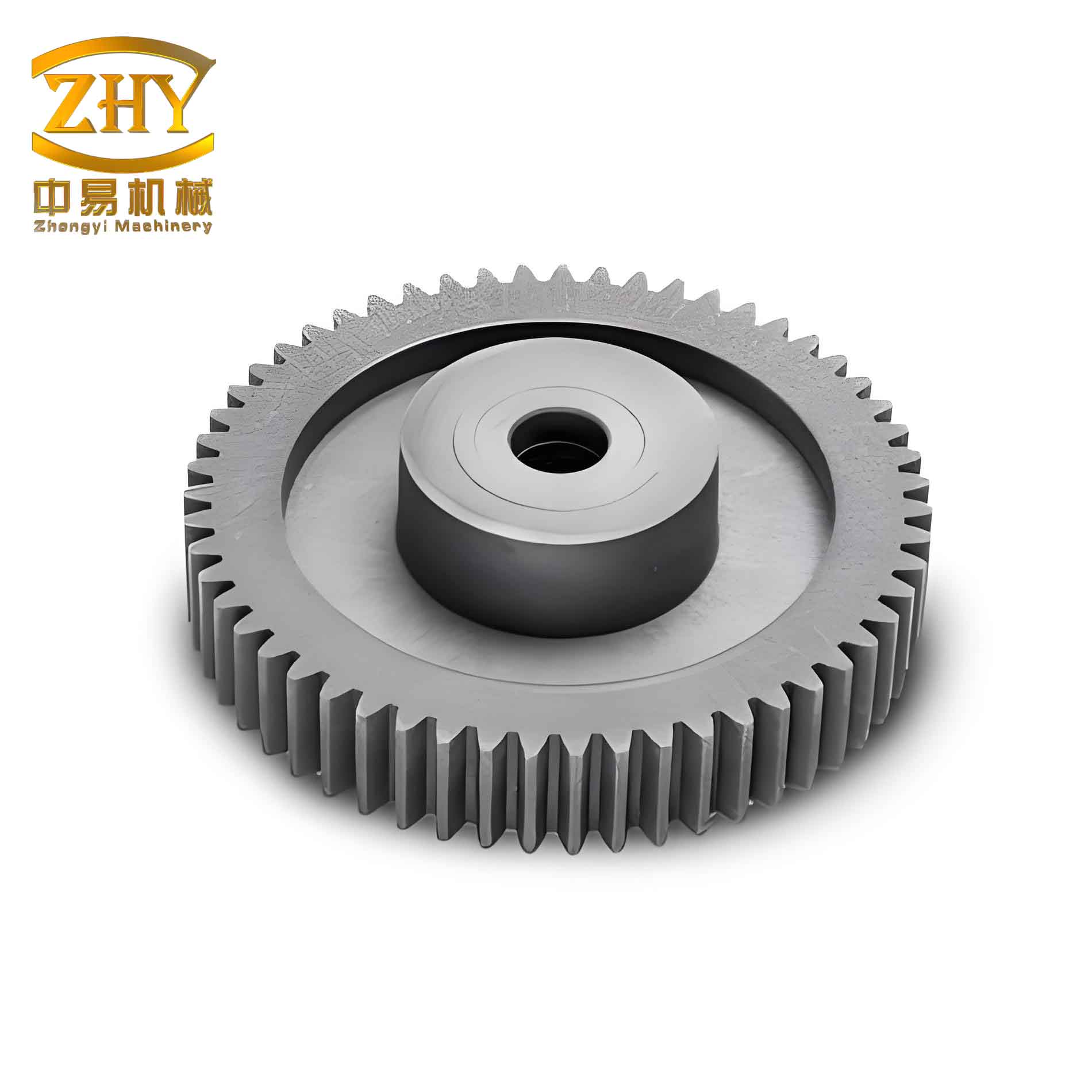
The Hertz contact theory provides the foundation for calculating contact stresses in cylindrical gears. According to Hertz, when two curved surfaces come into contact under a normal load, the contact stress can be expressed as a function of the applied force, material properties, and the radii of curvature at the contact point. For a pair of cylindrical gears, the contact stress at any meshing point i can be given by:
$$ \sigma_{Hi} = \sqrt{ \frac{K F_n}{\pi b} \cdot \frac{1/\rho_{1i} + 1/\rho_{2i}}{ \frac{1-\nu_1^2}{E_1} + \frac{1-\nu_2^2}{E_2} } } $$
where \( K \) is the load correction factor, \( F_n \) is the normal force, \( b \) is the face width, \( \rho_{1i} \) and \( \rho_{2i} \) are the radii of curvature of the pinion and gear teeth at point i, respectively, \( \nu_1 \) and \( \nu_2 \) are Poisson’s ratios, and \( E_1 \) and \( E_2 \) are elastic moduli. For cylindrical gears, the radii of curvature are derived from the involute geometry. Specifically, for the pinion (gear 1) and gear (gear 2), we have:
$$ \rho_{1i} = r_{b1} \tan \alpha_{1i} = \frac{1}{2} m Z_1 \cos \alpha \tan \alpha_{1i} $$
$$ \rho_{2i} = r_{b2} \tan \alpha_{2i} = \frac{1}{2} m Z_2 \cos \alpha \tan \alpha_{2i} $$
Here, \( m \) is the module, \( Z_1 \) and \( Z_2 \) are the numbers of teeth for the pinion and gear, \( \alpha \) is the pressure angle at the standard pitch circle, \( \alpha_{1i} \) and \( \alpha_{2i} \) are the pressure angles at the contact point, and \( r_{b1} \) and \( r_{b2} \) are the base circle radii. The comprehensive curvature \( 1/\rho \) at the contact point is a key parameter influencing the contact stress in cylindrical gears. It can be expressed as:
$$ \frac{1}{\rho} = \frac{1}{\rho_{1i}} + \frac{1}{\rho_{2i}} = \frac{L}{x(L – x)} $$
where \( L \) is the length of the limit meshing line, and \( x \) is the distance from the meshing point to the limit point of the pinion. For cylindrical gears, \( L \) and \( x \) are given by:
$$ L = (r_{b1} + r_{b2}) \tan \alpha’ = \frac{1}{2} m (Z_1 + Z_2) \cos \alpha \tan \alpha’ $$
$$ x = \sqrt{r_{1i}^2 – r_{b1}^2} = \frac{1}{2} m Z_1 \cos \alpha \tan \alpha_{1i} $$
In these equations, \( \alpha’ \) is the operating pressure angle or meshing angle, which differs from the standard pressure angle \( \alpha \) for modified cylindrical gears. The contact stress formula simplifies to:
$$ \sigma_H = Z_E \sqrt{ \frac{K T_1}{b r_1′ \cos \alpha’} \cdot \frac{L}{x(L – x)} } $$
where \( Z_E \) is the elastic coefficient, \( T_1 \) is the torque on the pinion, and \( r_1′ \) is the operating pitch radius of the pinion. For cylindrical gears, this expression highlights how the contact stress varies along the meshing line, with the maximum stress typically occurring in the single-tooth contact region near the boundary with the double-tooth contact region.
Modified cylindrical gears, also known as profile-shifted gears, involve altering the tooth profile by shifting the cutting tool relative to the gear blank. This modification is characterized by the modification coefficients \( x_1 \) and \( x_2 \) for the pinion and gear, respectively. The modification affects the meshing geometry, including the meshing angle \( \alpha’ \) and the tooth thickness, which in turn influences the contact stress distribution. For modified cylindrical gears, the meshing angle is calculated as:
$$ \cos \alpha’ = \frac{Z_1 (1 + u) \cos \alpha}{Z_1 (1 + u) + 2(x_1 + x_2)} $$
where \( u = Z_2 / Z_1 \) is the transmission ratio. The addendum pressure angle for the pinion, \( \alpha_{a1} \), is also modified:
$$ \tan \alpha_{a1} = \sqrt{ \left( \frac{Z_1 + 2 + 2x_1}{Z_1 \cos \alpha} \right)^2 – 1 } $$
These changes necessitate a detailed analysis of the maximum contact stress in modified cylindrical gears, as the traditional pitch point calculation may not suffice.
To determine the maximum contact stress in modified cylindrical gears, we focus on the boundary point between the single-tooth and double-tooth contact regions, denoted as point C. At this point, the distance \( x \) is given by \( x = r_{b1} \tan \alpha_{a1} – \pi m \cos \alpha \). Substituting into the contact stress formula, the maximum contact stress \( \sigma_{Hmax} \) is:
$$ \sigma_{Hmax} = Z_E \sqrt{ \frac{K T_1}{b r_1′ \cos \alpha’} \cdot \frac{m (Z_1 + Z_2) \cos \alpha \tan \alpha’}{ (r_{b1} \tan \alpha_{a1} – \pi m \cos \alpha) [ m (Z_1 + Z_2) \cos \alpha \tan \alpha’ – 2 r_{b1} \tan \alpha_{a1} + 2 \pi m \cos \alpha ] } } $$
For comparison, the contact stress at the pitch point \( \sigma_{HP} \) is derived by setting \( x = \frac{1}{2} m Z_1 \cos \alpha \tan \alpha’ \), yielding:
$$ \sigma_{HP} = Z_E \sqrt{ \frac{K T_1}{b r_1′ \cos \alpha’} \cdot \frac{2(1 + u)}{u m Z_1 \cos \alpha \tan \alpha’} } $$
We define the stress ratio \( \lambda \) as the ratio of the maximum contact stress to the pitch point contact stress for cylindrical gears:
$$ \lambda = \frac{\sigma_{Hmax}}{\sigma_{HP}} = \sqrt{ \frac{u \tan^2 \alpha’}{ \left[ (1 + u) \tan \alpha’ – \tan \alpha_{a1} + \frac{2\pi}{Z_1} \right] \left( \tan \alpha_{a1} – \frac{2\pi}{Z_1} \right) } } $$
This stress ratio \( \lambda \) is a critical parameter for designing modified cylindrical gears, as it quantifies the increase in contact stress due to gear modification. The maximum contact stress can then be expressed as \( \sigma_{Hmax} = \lambda \sigma_{HP} \), simplifying the design process for cylindrical gears.
To analyze the behavior of the stress ratio in modified cylindrical gears, we consider various factors such as the pinion tooth number \( Z_1 \), transmission ratio \( u \), and modification coefficients. For instance, in equally modified cylindrical gears where \( x_1 + x_2 = 0 \), the meshing angle equals the standard pressure angle (\( \alpha’ = \alpha \)). The stress ratio varies with \( Z_1 \) and \( u \), as summarized in Table 1 for different scenarios. The table illustrates that for cylindrical gears, when \( Z_1 \) is less than 17, the stress ratio increases with \( Z_1 \), while for \( Z_1 \) greater than 17, it decreases with \( Z_1 \). The maximum stress ratio occurs at \( Z_1 = 17 \). Additionally, the stress ratio increases with the transmission ratio \( u \), indicating that high-ratio cylindrical gears experience higher maximum contact stresses relative to the pitch point stress.
| Condition | Pinion Teeth \( Z_1 \) | Transmission Ratio \( u \) | Stress Ratio \( \lambda \) | Notes |
|---|---|---|---|---|
| Equally Modified ( \( x_1 + x_2 = 0 \) ) | 10 to 17 | 1.7 to 6 | Increases with \( Z_1 \) | Max at \( Z_1 = 17 \) |
| Equally Modified ( \( x_1 + x_2 = 0 \) ) | ≥17 | 1.7 to 6 | Decreases with \( Z_1 \) | – |
| Positive Modification ( \( x_1 + x_2 > 0 \) ) | 11 to 17 | 1.7 to 5 | Increases with \( Z_1 \), decreases with \( x_1 \) | Meshing angle increases |
| Negative Modification ( \( x_1 + x_2 < 0 \) ) | 11 to 17 | 1.7 to 5 | Increases with \( Z_1 \), decreases with \( x_1 \) | Meshing angle decreases |
| Standard Cylindrical Gears ( \( x_1 = x_2 = 0 \) ) | ≥17 | 1 to 5 | Decreases with \( Z_1 \), increases with \( u \) | \( \alpha’ = \alpha \) |
For precise design of cylindrical gears, if the maximum contact stress exceeds the pitch point stress by 8% or more (i.e., \( \lambda \geq 1.08 \)), it is necessary to base the contact strength calculation on \( \sigma_{Hmax} \). Based on the stress ratio analysis, Table 2 provides the ranges of \( Z_1 \) and \( u \) where such precise design is required for cylindrical gears. This table serves as a guideline for engineers working with modified cylindrical gears to ensure adequate safety margins.
| Pinion Teeth \( Z_1 \) | Minimum Transmission Ratio \( u \) | Stress Ratio \( \lambda \) | Implication for Cylindrical Gears |
|---|---|---|---|
| 23 | 11.2 | ≥1.080 | Precise design needed only for very high \( u \) |
| 22 | 5.3 | ≥1.080 | Precise design for moderate to high \( u \) |
| 21 | 4.3 | ≥1.083 | Similar requirement as above |
| 20 | 3.2 | ≥1.080 | Precise design for \( u \) above 3.2 |
| 19 | 2.6 | ≥1.081 | Common in many applications |
| 18 | 2.2 | ≥1.082 | Precise design often required |
| 17 | 1.8 | ≥1.080 | Critical point with max \( \lambda \) |
| 16 | 2.0 | ≥1.080 | Precise design for \( u \geq 2 \) |
| 15 | 2.6 | ≥1.080 | Typical for modified cylindrical gears |
| 14 | 2.7 | ≥1.081 | Similar to \( Z_1 = 15 \) |
| 13 | 3.1 | ≥1.080 | Precise design for \( u \geq 3.1 \) |
| 12 | 6.4 | ≥1.080 | Only for very high \( u \) |
The derivation of the stress ratio formula is further validated through finite element analysis (FEA) using software like Abaqus. Consider an example of modified cylindrical gears with input power \( P_1 = 10 \, \text{kW} \), transmission ratio \( u = 3 \), pinion speed \( n_1 = 960 \, \text{r/min} \), and modification coefficients \( x_1 = 0.15 \) and \( x_2 = -0.11 \). The pinion has \( Z_1 = 15 \) teeth, and the gear has \( Z_2 = 45 \) teeth. The material properties are set as \( E_1 = 209 \, \text{GPa} \), \( E_2 = 205 \, \text{GPa} \), and \( \nu_1 = \nu_2 = 0.28 \). Using the formulas, we compute the meshing angle and stress ratio for these cylindrical gears:
$$ \cos \alpha’ = \frac{15 \times (1 + 3) \times \cos 20^\circ}{15 \times (1 + 3) + 2 \times (0.15 – 0.11)} = 0.9384 $$
$$ \alpha’ = \cos^{-1}(0.9384) \approx 20.1^\circ $$
$$ \tan \alpha_{a1} = \sqrt{ \left( \frac{15 + 2 + 2 \times 0.15}{15 \times \cos 20^\circ} \right)^2 – 1 } \approx 0.396 $$
Substituting into the stress ratio formula:
$$ \lambda = \sqrt{ \frac{3 \times \tan^2 20.1^\circ}{ \left[ (1 + 3) \times \tan 20.1^\circ – 0.396 + \frac{2\pi}{15} \right] \left( 0.396 – \frac{2\pi}{15} \right) } } \approx 1.085 $$
This indicates that for these modified cylindrical gears, the maximum contact stress is about 8.5% higher than the pitch point stress. The FEA simulation of the contact between cylindrical gears at the boundary point and pitch point yields stress nephograms, with the maximum contact stresses measured as \( \sigma’ = 55.89 \, \text{MPa} \) and \( \sigma = 52.21 \, \text{MPa} \), respectively. The experimental stress ratio is \( \lambda_{FEA} = 55.89 / 52.21 \approx 1.0705 \), showing a relative error of only 1.34% compared to the calculated value. This close agreement validates the accuracy of the derived stress ratio formula for cylindrical gears.
In designing cylindrical gears based on contact strength, the diameter of the pinion can be determined using the maximum contact stress criterion. The formula for the pinion diameter \( d_1 \) is:
$$ d_1 \geq \sqrt[3]{ \frac{K T_1}{\phi_d} \cdot \frac{4}{\cos^2 \alpha \times \tan \alpha’} \cdot \frac{1 + u}{u} \cdot \left( \frac{\lambda Z_E}{[\sigma_H]} \right)^2 } $$
where \( \phi_d \) is the face width coefficient and \( [\sigma_H] \) is the allowable contact stress. For the example above, with \( \lambda = 1.085 \), the required pinion diameter is larger than that calculated using \( \lambda = 1 \) (pitch point stress), emphasizing the importance of considering the stress ratio in modified cylindrical gears. Specifically, the diameter increases by approximately 5.59% when accounting for the maximum stress, leading to a larger module selection (e.g., \( m = 5 \, \text{mm} \) vs. \( m = 4.5 \, \text{mm} \)). This underscores the need for precise design in high-stress applications of cylindrical gears.
The analysis of cylindrical gears reveals several key insights. First, the stress ratio \( \lambda \) is a function of the pinion tooth number, transmission ratio, and modification coefficients. For modified cylindrical gears, when \( Z_1 < 17 \), \( \lambda \) increases with \( Z_1 \), but for \( Z_1 > 17 \), it decreases with \( Z_1 \). This non-monotonic behavior is due to the interplay between gear geometry and meshing conditions in cylindrical gears. Second, the transmission ratio \( u \) has a positive correlation with \( \lambda \), meaning that cylindrical gears with higher reduction ratios are more susceptible to elevated maximum contact stresses. Third, modification coefficients influence \( \lambda \) by altering the meshing angle and addendum pressure angle; increasing \( x_1 \) generally reduces \( \lambda \) for a given \( Z_1 \), as it improves the tooth profile strength. These findings are crucial for optimizing the design of cylindrical gears in various mechanical systems.
In conclusion, the contact stress analysis in modified involute spur cylindrical gears demonstrates that the maximum contact stress often exceeds the pitch point stress, particularly for gears with specific tooth numbers and transmission ratios. The derived stress ratio \( \lambda \) provides a simplified method to calculate the maximum contact stress as \( \sigma_{Hmax} = \lambda \sigma_{HP} \), facilitating precise design of cylindrical gears. Based on the analysis, if the stress ratio is 1.08 or higher, it is recommended to use the maximum contact stress for contact strength calculations in cylindrical gears. The tables presented summarize the conditions under which such precise design is necessary, offering practical guidance for engineers. The validation through finite element analysis confirms the reliability of the formulas. Future work could extend this analysis to helical cylindrical gears or consider dynamic effects in high-speed applications. Overall, this study enhances the understanding of contact mechanics in cylindrical gears, contributing to more robust and efficient gear transmission systems.
Throughout this article, we have emphasized the importance of cylindrical gears in mechanical design and provided detailed mathematical frameworks for stress evaluation. By incorporating modification effects, we enable better customization of cylindrical gears for specific operational requirements, ensuring longevity and performance. The use of tables and formulas, as shown, aids in summarizing complex relationships, making this information accessible for designers and researchers working with cylindrical gears. As technology advances, further refinements in contact stress analysis will continue to improve the reliability of cylindrical gears in demanding applications.