
In my extensive experience within gear manufacturing, managing the distortion of spiral bevel gears during heat treatment remains one of the most significant technical challenges. The inherently complex geometry of spiral bevel gears, characterized by curved teeth and conical pitch surfaces, makes them particularly susceptible to dimensional changes during processes like carburizing or carbonitriding followed by quenching. Uncontrolled distortion severely compromises the contact pattern and meshing accuracy of the gear pair, leading to increased noise, reduced load-bearing capacity, and premature failure. While press quenching is an effective solution, it is often coupled with continuous furnaces and requires re-heating, which is less practical for batch-type operations common in many workshops. Therefore, developing a comprehensive strategy combining process optimization with specialized tooling is essential. This article details a proven methodology I have employed to successfully minimize distortion in spiral bevel gears processed in periodic, pit-type furnaces.
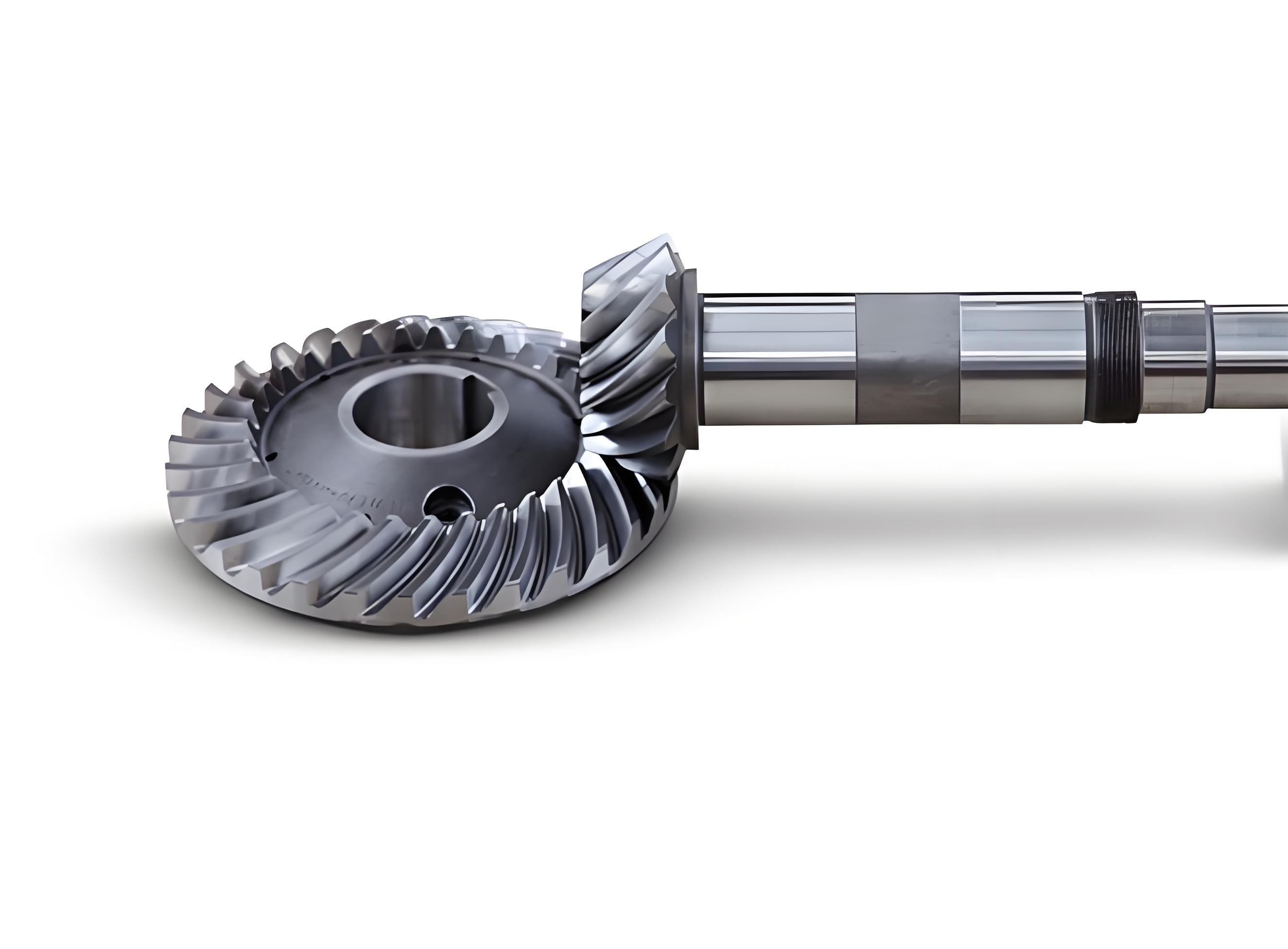
The root causes of heat treatment distortion in spiral bevel gears are multifaceted. Beyond the core material properties, factors such as forging flow lines, the quality of the preliminary heat treatment (normalizing), residual stresses from machining, the specific quenching medium and its temperature, and the heating/cooling uniformity all play critical roles. For spiral bevel gears, asymmetrical cooling rates between the web, the rim, and the tooth profile are primary drivers of warpage and out-of-roundness. The goal is to manage these variables systematically to achieve predictable, minimal distortion.
I. Preliminary Heat Treatment of Gear Blanks
The foundation for dimensional stability is laid long before the final hardening. For low-alloy carburizing steel blanks for spiral bevel gears, a simple normalizing cycle is frequently inadequate. This often results in non-uniform microstructure, banded ferrite-pearlite structures, and sub-optimal hardness. Such conditions not only cause machining issues like “built-up edge” but also promote erratic distortion during subsequent carburizing and quenching.
I have found that a combined normalizing and high-temperature tempering process is vastly superior. The normalizing temperature should be approximately 20-30°C above the intended carburizing temperature to refine the grain structure. This is followed by a high temper, which relieves internal stresses and further homogenizes the microstructure. The recommended cycle for common gear steels like 20CrMnTi, 20CrMo, or 20MnCr5 is summarized below.
| Material | Process | Temperature (°C) | Cooling Method | Target Microstructure |
|---|---|---|---|---|
| 20CrMnTi, 20CrMo, 20MnCr5 | Normalizing | Ac3 + (40~60) | Air Cool | Fine Ferrite + Pearlite |
| High-Temperature Tempering | 650 – 680 | Air Cool | Stress-Relieved, Homogenized Structure |
This preparatory step ensures a consistent, fine-grained starting condition that responds more predictably during case hardening, directly contributing to reduced distortion in the final spiral bevel gears.
II. Optimization of Case Depth and Process Selection
The specified case depth is a critical parameter. An excessively deep case requires prolonged exposure at high temperature, exacerbating thermal gradients and distortion potential. Conversely, a shallow case compromises contact fatigue and pitting resistance. A balanced approach is necessary. Furthermore, the choice between standard carburizing and a modified process significantly impacts both performance and distortion.
I advocate for a two-stage “Carburizing + Carbonitriding” process. This method first establishes the required total case depth at a high temperature (e.g., 920-930°C), then enriches the superficial layer with carbon and nitrogen at a lower temperature (e.g., 840-850°C). The carbonitriding stage, typically lasting about one hour, promotes a favorable surface microstructure. This allows for a reduction in the total effective case depth by approximately 15-20% compared to a standard carburizing process while maintaining or even enhancing contact fatigue life. The shorter high-temperature exposure directly reduces thermal stress and distortion. Recommended case depths for spiral bevel gears using this method are as follows:
| Gear Module, mn (mm) | Recommended Total Case Depth (mm) | Surface Carbon Content (wt.%) |
|---|---|---|
| 3.0 – 5.0 | 0.7 – 1.1 | 0.75 – 0.85 |
| 5.5 – 8.0 | 1.2 – 1.6 | 0.80 – 0.90 |
| 8.5 – 10.0 | 1.7 – 2.1 | 0.80 – 0.90 |
The surface hardness, $H_{surface}$, and core hardness, $H_{core}$, are related to the carbon profiles. A typical hardness gradient can be modeled as a function of distance from the surface, $x$:
$$ H(x) = H_{core} + (H_{surface} – H_{core}) \cdot e^{-kx} $$
where $k$ is a constant dependent on the processing parameters. For spiral bevel gears, achieving a high core hardness with a tough, martensitic structure is vital for bending strength.
III. The Two-Stage Carburizing + Carbonitriding Process
The detailed procedure for the two-stage process is central to controlling distortion in spiral bevel gears. The process curve consists of four distinct phases:
- High-Temperature Strong Carburizing: At ~930°C, a high carbon potential (e.g., 1.1-1.2% C) is maintained to rapidly build carbon concentration at the surface and drive diffusion. This phase establishes the depth foundation quickly.
- High-Temperature Diffusion: The carbon potential is lowered (e.g., to ~0.85% C) at the same temperature. This allows carbon to diffuse inward, smoothing the carbon gradient and preventing excessive carbide network formation. Time: 60-90 minutes.
- Temperature Ramp-Down with Ammonia Introduction: The furnace temperature is decreased from ~930°C to ~850°C. Ammonia ($NH_3$) flow is initiated during this ramp. The decomposing nitrogen atoms dissolve in the austenite, stabilizing it and retarding carbide precipitation upon cooling due to nitrogen’s austenite-stabilizing effect. The carbon potential is kept moderate.
- Carbonitriding: At ~850°C, both enriched atmosphere and ammonia flows are increased for approximately 60 minutes. This stage actively introduces nitrogen into the case, lowering the martensite start ($M_s$) temperature and promoting a controlled amount of retained austenite (target: 20-30%) and fine carbonitrides in the surface layer.
The key advantage for spiral bevel gears is the direct quench from the carbonitriding temperature. Eliminating a separate re-heat cycle for quenching saves energy and, most importantly, avoids the additional thermal shock and distortion associated with a second austenitization. The process can be summarized by the following conceptual model for carbon flux, $J_C$, and nitrogen flux, $J_N$, over time, $t$:
$$ J_C(t) = -D_C(T) \cdot \frac{\partial C(x,t)}{\partial x} \quad \text{and} \quad J_N(t) = -D_N(T) \cdot \frac{\partial N(x,t)}{\partial x} $$
where $D_C$ and $D_N$ are temperature-dependent diffusion coefficients for carbon and nitrogen, respectively. The temperature profile $T(t)$ is carefully controlled to optimize these fluxes.
Quenching is performed in a fast oil agitated at 60-80°C. Immediate tempering at 180-200°C for 2-4 hours is mandatory to relieve quenching stresses and transform any unstable retained austenite. Subsequent shot peening is highly recommended to induce beneficial compressive residual stresses on the tooth flanks, further enhancing fatigue performance of the spiral bevel gears.
IV. Design and Application of Minimal-Distortion Quenching Fixtures
Even with an optimized thermal cycle, non-uniform cooling during the quench can warp a spiral bevel gear. Typical distortion modes include: a) dish-like bending or warping of the mounting face (back face), and b) out-of-roundness of the bore or pilot diameter.
To combat this, I designed and implemented a dedicated minimal-distortion quenching fixture. The fixture’s principle is to enforce more uniform and controlled cooling, particularly for the web and bore areas which tend to cool slower than the teeth and rim. The fixture consists of:
- A Top Plate: For stability and handling.
- An Inner Mandrel: Fits into the gear bore to maintain roundness and align the gear vertically.
- An Outer Cage/Support: Prevents radial collapse or eccentricity.
- A Base Plate with Convex Ring and Channels: This is the critical element. The gear rests with its back face on a raised, annular ring. This ring has radial oil channels and peripheral holes machined into it. When submerged, quench oil is forced through these channels directly onto the central web and back face of the gear, significantly accelerating cooling in this normally sluggish zone.
The cooling rate $V_{cool}$ for different sections can be approximated. For the tooth flank cooling in free oil: $V_{tooth} \propto h_{tooth} \cdot (T_{gear} – T_{oil})$. For the web section cooled by the fixture’s directed oil flow: $V_{web} \propto h_{fixture} \cdot (T_{gear} – T_{oil})$, where $h_{fixture} > h_{tooth}$ due to forced convection. By ensuring $V_{web} \approx V_{rim}$, thermal stresses that cause dishing are minimized. Multiple spiral bevel gears can be fixtures on a single stack, ensuring batch consistency.
V. Practical Results and Verification
The combined strategy of optimized preliminary treatment, two-stage carburizing+nitriding, and fixture quenching was applied to production batches of automotive rear axle spiral bevel gears (e.g., ring gears with ~300mm diameter). The results were systematically evaluated.
1. Microstructure: The final microstructure met stringent automotive standards.
- Surface: Fine martensite (level 1-2), retained austenite (level 4-5, ~25%), and finely dispersed carbides/carbonitrides (level 1-2).
- Core: Low-carbon lath martensite with minimal free ferrite, providing excellent strength and toughness.
2. Hardness Profile: Typical results from test coupons are shown below. The slight dip in surface hardness is due to the controlled retained austenite, while the sub-surface peak hardness ensures high load-bearing capacity.
| Measurement Point | Distance from Surface (mm) | Hardness (HRC) | Microstructure |
|---|---|---|---|
| Surface | 0.05 – 0.10 | 58 – 60 | Martensite + RA + Carbides |
| Sub-Surface | 0.20 – 0.30 | 61 – 63 | Martensite + RA |
| Case Core Transition | ≥ 1.2 * Case Depth | 35 – 45 | Mixed Martensite |
| Core | Center of Tooth | 38 – 42 | Low-C Martensite |
3. Distortion Measurement: The effectiveness of the fixture was quantified by measuring key dimensions before and after heat treatment. Distortion was consistently held within very tight tolerances, making post-heat treatment grinding unnecessary for many applications. Data from a batch of ring gears is illustrative.
| Distortion Parameter | Specification Limit (mm) | Average Measured Value (mm) | Maximum in Batch (mm) |
|---|---|---|---|
| Back Face Flatness (Warp) | ≤ 0.10 | 0.04 | 0.07 |
| Bore Out-of-Roundness | ≤ 0.05 | 0.02 | 0.035 |
| Pilot Diameter Variation | ≤ 0.08 | 0.03 | 0.06 |
The flatness, $ \delta_{flat} $, and out-of-roundness, $ \delta_{round} $, were reduced to a fraction of their typical unfixtured values, which can be modeled as:
$$ \delta_{fixtured} = \frac{\delta_{free}}{SF} $$
where $SF$ is a “Stabilization Factor” provided by the fixture, typically between 3 and 5 for these spiral bevel gears.
4. Contact Pattern Analysis: The ultimate functional test is the gear’s running contact pattern. Gears processed with this methodology showed contact patterns on the flank that were virtually identical to their pre-heat-treatment lapped pattern. The pattern location, length, and height remained well within the specified zone, indicating minimal change in the tooth geometry due to distortion. This is critical for quiet operation and long service life of the spiral bevel gear set.
VI. Conclusion
Controlling distortion in spiral bevel gears requires a holistic, systems-based approach. It cannot be solved by a single magic bullet. My experience conclusively shows that the integration of three key elements is highly effective:
- A robust preliminary heat treatment (normalizing + tempering) to create a homogeneous, stress-relieved blank.
- An optimized two-stage carburizing and carbonitriding process that reduces high-temperature exposure time, enhances surface properties, and enables direct quenching.
- A purpose-engineered minimal-distortion quenching fixture that enforces symmetrical and accelerated cooling in critical sections.
This combined methodology achieves distortion levels comparable to those obtained with sophisticated press quenching systems, but at a lower capital and operational cost, making it particularly suitable for batch production in periodic furnaces. The successful application of this strategy ensures that spiral bevel gears meet stringent geometric tolerances, exhibit excellent contact patterns, and deliver high performance and durability in demanding applications like automotive drivetrains. The principles of process control and tailored fixturing discussed here provide a reliable framework for the heat treatment of other complex, asymmetrical components prone to distortion.