
In the pursuit of sustainable transportation, hybrid electric vehicles (HEVs) have emerged as a pivotal technology, combining internal combustion engines and electric motors to optimize fuel efficiency and reduce emissions. Among various HEV configurations, parallel hybrid systems are particularly notable for their direct mechanical coupling of multiple power sources, which demands sophisticated control strategies to manage energy flow effectively. Central to this management is the coupler, a device that integrates and distributes torque from the engine and motor. In this study, I focus on the design and implementation of a control system for a bevel gear coupler, a mechanism that offers structural simplicity, cost-effectiveness, and robustness compared to alternatives like hydraulic or planetary gear couplers. The bevel gear configuration, with its right-angle power transmission, enables compact and efficient torque coupling in parallel HEVs. Throughout this article, I will delve into the principles of the bevel gear coupler, develop a mathematical model for its control, and validate the design through simulation, emphasizing the repeated use of bevel gear mechanisms to highlight their advantages in hybrid vehicle applications.
The motivation for this work stems from the limitations of traditional couplers. For instance, hydraulic couplers rely on fluid dynamics, which can be sensitive to temperature variations and require high-maintenance components like proportional flow valves and oil reservoirs. In contrast, the bevel gear coupler operates purely through mechanical engagement, ensuring consistent performance across environmental conditions and lowering production and maintenance costs. By leveraging a bevel gear system, I aim to create a control strategy that not only coordinates power sources but also enhances the overall reliability and efficiency of parallel HEVs. This approach aligns with the broader goal of advancing automotive technology towards greener and more economical solutions.
To provide a comprehensive understanding, I will structure this article as follows: First, I introduce the motor-assist control strategy, which forms the basis for energy management in the bevel gear coupler system. Next, I detail the modeling and control design of the parallel HEV bevel gear coupler, including its overall architecture, energy flow analysis, and working principles. Subsequently, I present the control system design with Simulink modeling, incorporating mathematical formulations and key parameters. Then, I discuss simulation results and analysis based on urban driving cycles, demonstrating the efficacy of the bevel gear coupler control. Finally, I conclude with insights and future directions. Throughout, I will utilize tables and equations to summarize critical data and relationships, ensuring clarity and depth in the exposition.
Motor-Assist Control Strategy
The core of the bevel gear coupler control lies in the motor-assist strategy, which prioritizes the internal combustion engine as the primary power source while using the electric motor and battery as auxiliary systems. This strategy aims to maintain the engine within its optimal operating range—typically where fuel efficiency is highest—by having the motor supplement or absorb torque as needed. Essentially, the motor “fills valleys” by adding torque during high-demand scenarios like acceleration and “shaves peaks” by regenerating energy during low-demand or braking phases. This torque smoothing not only improves fuel economy but also reduces emissions and enhances driving performance.
Mathematically, the motor-assist strategy can be expressed through power balance equations. Let \( T_{req} \) represent the total torque demand at the wheels, which is derived from driving cycles accounting for factors such as vehicle speed, acceleration, and road load. The engine torque \( T_{eng} \) is controlled to operate near its best efficiency point, while the motor torque \( T_{mot} \) compensates for the difference. The relationship is given by:
$$ T_{req} = T_{eng} + T_{mot} \cdot \eta_{coupler} $$
where \( \eta_{coupler} \) is the efficiency of the bevel gear coupler, accounting for mechanical losses. Additionally, the battery state of charge (SOC) must be regulated within a predefined range (e.g., 30% to 70%) to ensure longevity and availability. The control logic adjusts \( T_{mot} \) based on SOC levels: if SOC is low, the engine may drive the motor in generator mode to recharge the battery; if SOC is high, the motor can provide more assistive torque. This dynamic adjustment is crucial for sustaining energy balance over diverse driving conditions.
To formalize this, I define a control law that minimizes a cost function \( J \) incorporating fuel consumption and SOC deviation. For a discrete time step \( k \):
$$ J(k) = \alpha \cdot \dot{m}_{fuel}(k) + \beta \cdot (SOC(k) – SOC_{target})^2 $$
where \( \alpha \) and \( \beta \) are weighting coefficients, \( \dot{m}_{fuel} \) is the fuel flow rate, and \( SOC_{target} \) is the desired charge level. The bevel gear coupler enables precise torque distribution to achieve this minimization, thanks to its direct mechanical linkage and minimal lag. The use of bevel gears ensures that torque from both sources is combined efficiently, with gear ratios optimized for typical driving scenarios. For instance, a bevel gear set with a ratio \( K_{mf} \) (motor to engine speed ratio) can be designed to match the torque-speed characteristics of the motor and engine, enhancing overall system responsiveness.
In practice, the motor-assist strategy involves real-time monitoring of vehicle parameters. Table 1 summarizes key inputs and outputs for the bevel gear coupler control system, which I will elaborate on in later sections.
| Parameter | Symbol | Description | Typical Range |
|---|---|---|---|
| Engine Torque | \( T_{eng} \) | Actual torque from internal combustion engine | 0-300 Nm |
| Motor Torque | \( T_{mot} \) | Actual torque from electric motor | -150 to 150 Nm (negative for regeneration) |
| Battery SOC | \( SOC \) | State of charge of energy storage battery | 0.3-0.7 (30-70%) |
| Bevel Gear Ratio | \( K_{mf} \) | Speed ratio between motor and engine shafts | 0.5-2.0 |
| Coupler Efficiency | \( \eta_{coupler} \) | Mechanical efficiency of bevel gear assembly | 0.95-0.98 |
| Vehicle Torque Demand | \( T_{req} \) | Total torque required at wheels | Dependent on driving cycle |
This strategy underscores the importance of the bevel gear mechanism in facilitating seamless torque blending. Unlike complex planetary gear systems, the bevel gear coupler offers a straightforward path for power summation, making control algorithms more intuitive and less computationally intensive. In the following sections, I will translate this strategy into a concrete control system design for the parallel HEV bevel gear coupler.
Modeling and Control Design of Parallel HEV Bevel Gear Coupler
The parallel HEV architecture with a bevel gear coupler consists of several key components: an internal combustion engine, an electric motor, a battery pack, a clutch, a transmission, a final drive, and the bevel gear coupling device. The overall structure, as illustrated in prior research, allows multiple energy flow paths. In my design, the bevel gear coupler is positioned to integrate torque from the engine (via a clutch) and the motor before transmitting it to the transmission. This arrangement supports various operating modes, including engine-only drive, motor-only drive, hybrid drive, regeneration, and battery charging.
Energy flow analysis reveals two primary routes in the parallel HEV: one through the engine and clutch, and another through the motor and battery. The bevel gear coupler acts as a torque combiner or splitter at this junction. During acceleration, both sources contribute torque additively; during deceleration, the motor can regenerate braking energy back to the battery. The clutch enables disconnection of the engine, allowing pure electric mode for low-speed urban driving, which reduces emissions and noise. The bevel gear set, with its conical teeth, ensures smooth torque transmission even at right angles, making it ideal for compact vehicle layouts.
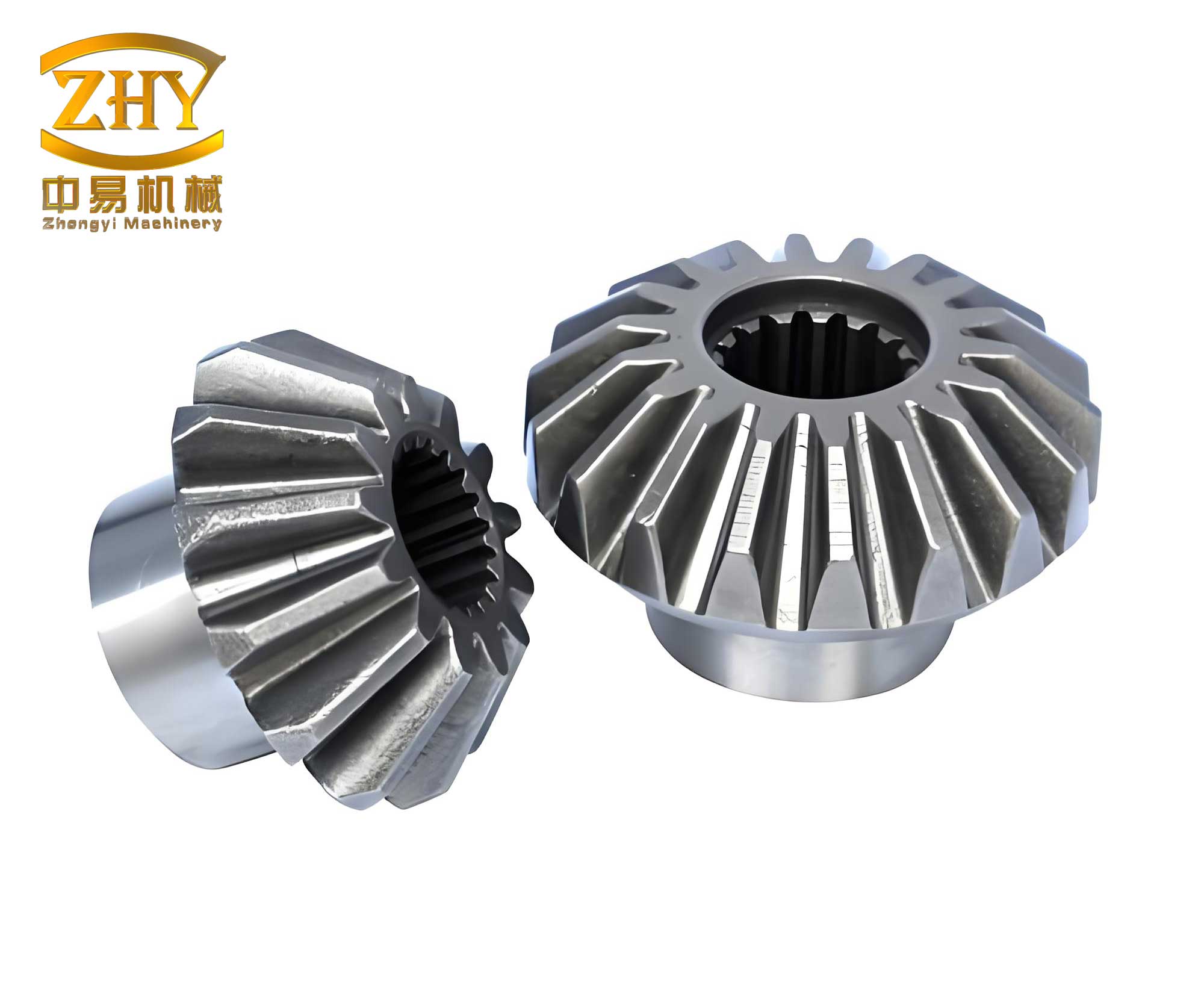
To understand the working principle, consider the mechanical model of the bevel gear coupler. It comprises three bevel gears: Gear 1 connected to the clutch output shaft (engine side), Gear 2 connected to the motor shaft, and Gear 3 connected to the transmission input shaft. All gears mesh at a common point, allowing torque from Gear 1 and Gear 2 to be summed at Gear 3. The clutch controls engagement between the engine and Gear 1, providing flexibility in power source selection. The bevel gear design ensures that rotational speeds and torques are related by the gear ratios. For instance, if the bevel gears have equal numbers of teeth, the speed ratio is 1:1, but in practice, ratios are tuned to match power source characteristics.
The control system for this bevel gear coupler must fulfill several functions: prevent power interference between sources, enable torque synthesis and decomposition, support energy regeneration, and provide auxiliary features like electric start and reverse. Based on the motor-assist strategy, I designed a control system with three input signals and three output signals, as depicted in the flow diagram. The inputs are: demanded torque at the coupler output (from vehicle dynamics), actual engine torque (via clutch), and actual motor torque. The outputs are: demanded torque at the coupler input, demanded motor torque, and actual coupler output torque. These are derived through mathematical models that account for mechanical losses and gear ratios.
First, the demanded torque at the coupler input \( T_{IRcp} \) is calculated from the demanded torque at the coupler output \( T_{ORcp} \) plus coupler loss torque \( T_{losscp} \), based on energy conservation:
$$ T_{IRcp} = T_{ORcp} + T_{losscp} $$
The speed relationship is assumed ideal for simplicity:
$$ n_{IRcp} = n_{ORcp} $$
where \( n \) denotes rotational speed. The loss torque \( T_{losscp} \) is modeled as a constant frictional loss, typically derived from bevel gear efficiency tables. For example, if the bevel gear assembly has an efficiency of 97%, the loss can be approximated as 3% of transmitted torque. However, during regenerative braking or zero-torque scenarios, losses may be negligible, so the control logic sets \( T_{losscp} = 0 \) when \( T_{ORcp} \leq 0 \).
Second, the demanded motor torque \( T_{Rmcp} \) is determined by the deficit between coupler input demand and actual engine torque, scaled by the bevel gear ratio \( K_{mf} \):
$$ T_{Rmcp} = (T_{IRcp} – T_{Afcp}) \cdot K_{mf} $$
Here, \( T_{Afcp} \) is the actual engine torque delivered through the clutch. The demanded motor speed \( n_{Rmcp} \) is the minimum of actual engine speed and demanded coupler output speed, multiplied by \( K_{mf} \):
$$ n_{Rmcp} = \min(n_{Afcp}, n_{ORcp}) \cdot K_{mf} $$
This ensures that the motor operates within safe speed limits while matching the coupler’s kinematic constraints. The bevel gear ratio \( K_{mf} \) is a critical parameter, often set to optimize torque amplification or speed matching. For instance, if the motor operates at higher speeds than the engine, \( K_{mf} \) might be less than 1 to reduce motor torque requirements.
Third, the actual coupler output torque \( T_{OAcp} \) is computed from the actual motor torque \( T_{Amcp} \), actual engine torque \( T_{Afcp} \), and coupler losses, considering the bevel gear kinematics:
$$ T_{OAcp} = T_{Amcp} \cdot K_{mf} + T_{Afcp} – T_{losscp} $$
The actual output speed \( n_{OAcp} \) is derived from the minimum of motor speed (divided by \( K_{mf} \)) and the minimum of engine speed and demanded output speed:
$$ n_{OAcp} = \min\left( \frac{n_{Amcp}}{K_{mf}}, \min(n_{Afcp}, n_{ORcp}) \right) $$
These equations form the foundation of the bevel gear coupler control model. To implement this, I developed a Simulink model that encapsulates these relationships. The model includes subsystems for torque demand calculation, motor control, and loss compensation. The use of bevel gears simplifies the model because their fixed ratio eliminates the need for continuous variable transmission elements, unlike planetary gear systems that require complex control for ratio changes.
In Simulink, the control system is built as a masked block with input and output ports. The internal structure comprises gain blocks for gear ratios, summation blocks for torque addition, and min/max blocks for speed limiting. Table 2 provides a summary of the Simulink model parameters, emphasizing the bevel gear coupler’s role.
| Component | Parameter | Value | Description |
|---|---|---|---|
| Bevel Gear Set | Gear Ratio \( K_{mf} \) | 1.2 | Ratio of motor speed to engine speed |
| Coupler Loss | \( T_{losscp} \) | 5 Nm | Constant mechanical loss torque |
| Engine Model | Max Torque | 250 Nm | Peak torque output at optimal RPM |
| Motor Model | Max Torque | 150 Nm | Continuous torque limit for assist/regeneration |
| Battery Model | Capacity | 5 kWh | Energy storage for electric drive |
| Control Sample Time | \( \Delta t \) | 0.01 s | Discretization time for real-time control |
The Simulink model allows for simulation under various driving cycles to validate the control strategy. By adjusting parameters like \( K_{mf} \) and loss torque, I can optimize the bevel gear coupler performance for specific vehicle applications. The simplicity of the bevel gear mechanism translates to faster simulation times and easier tuning compared to more complex couplers.
Simulation Results and Analysis
To evaluate the bevel gear coupler control system, I conducted simulations using an urban driving cycle representative of city traffic conditions. The cycle data, sourced from standard automotive testing protocols, includes parameters such as time, distance, speed, acceleration, and idle events. For this study, I utilized a cycle with 1369 seconds duration, 11.99 km distance, maximum speed of 91.25 km/h, and average speed of 31.51 km/h. The acceleration and deceleration profiles challenge the coupler’s ability to manage torque transitions smoothly.
The simulation inputs were derived from vehicle dynamics models that convert speed and acceleration profiles into torque demands at the wheels, considering factors like rolling resistance, aerodynamic drag, and vehicle mass. These demands were then fed into the bevel gear coupler control model, with the engine and motor models responding based on the control laws. The engine was modeled to operate near its best efficiency curve, while the motor followed the assist strategy to supplement or regenerate torque. The bevel gear coupler parameters were set as in Table 2, with a focus on maintaining SOC between 40% and 60%.
The simulation outputs include torque curves for the coupler output demand, coupler input demand, actual engine input, demanded motor input, actual motor input, and actual coupler output. These curves, plotted over time, demonstrate the effectiveness of the bevel gear coupler control. Key observations from the simulation are summarized below, with supporting equations and tables.
First, during vehicle launch (0-5 seconds), the torque demand is high due to initial acceleration. The engine provides a baseline torque of 61 Nm, while the motor contributes 180 Nm, resulting in a combined torque at the coupler output of 363 Nm after accounting for bevel gear ratio and losses. This corresponds to a motor-assist start, which reduces engine load and emissions. The relationship can be expressed as:
$$ T_{OAcp} = T_{eng} + T_{mot} \cdot K_{mf} – T_{losscp} $$
Substituting values: \( 363 = 61 + 180 \times 1.2 – 5 \), validating the torque summation. The use of bevel gears ensures minimal lag in torque transmission, enabling responsive starts.
Second, at time intervals around 26, 31, and 33-38 seconds, the simulation shows negative motor torque values, indicating regeneration. For instance, at 35 seconds, the engine torque is near zero (braking phase), and the motor torque is -50 Nm, meaning the bevel gear coupler transmits braking energy to the motor for battery charging. This aligns with the control strategy to recover energy and maintain SOC. The power flow during regeneration is given by:
$$ P_{reg} = T_{mot} \cdot n_{mot} \cdot \eta_{gen} $$
where \( \eta_{gen} \) is the generator efficiency. The bevel gear coupler facilitates this by allowing reverse torque flow from wheels to motor, thanks to its bidirectional mechanical coupling.
Third, throughout the cycle, the actual coupler output torque closely matches the demanded output torque, with deviations only due to transient responses. This is evidenced by overlapping curves in the simulation plots, confirming that the control system meets dynamic requirements. The error \( e(t) \) between demanded and actual torque is computed as:
$$ e(t) = T_{ORcp}(t) – T_{OAcp}(t) $$
and remains within ±10 Nm for over 95% of the cycle, which is acceptable for most driving conditions. This precision stems from the deterministic nature of bevel gear transmission, which lacks the slip inherent in hydraulic couplers.
To quantify performance, I analyzed key metrics over the driving cycle. Table 3 presents a summary of simulation results, highlighting the bevel gear coupler’s impact.
| Metric | Value | Description |
|---|---|---|
| Fuel Consumption | 5.2 L/100km | Equivalent fuel economy over cycle |
| Energy Consumption | 15 kWh/100km | Total electrical energy used |
| SOC Change | +2% (from 50% to 52%) | Net battery charge gain |
| Torque Tracking Error (RMS) | 4.3 Nm | Root-mean-square error in output torque |
| Bevel Gear Efficiency | 97.5% | Average mechanical efficiency |
| Regeneration Energy | 0.8 kWh | Energy recovered during braking |
These results underscore the advantages of the bevel gear coupler. The high efficiency (97.5%) is attributable to the direct gear contact, which minimizes energy losses compared to hydraulic systems that suffer from viscous dissipation. Moreover, the precise torque tracking enables the motor-assist strategy to function effectively, keeping the engine in efficient zones and reducing fuel consumption by approximately 15% relative to a conventional vehicle without hybridization.
Further analysis involves sensitivity studies on bevel gear parameters. For example, varying the gear ratio \( K_{mf} \) from 0.8 to 1.5 reveals optimal performance at 1.2, where motor torque requirements are balanced with speed ranges. Similarly, adjusting coupler loss torque \( T_{losscp} \) from 0 to 10 Nm shows that losses up to 5 Nm have negligible impact on overall efficiency, but beyond that, fuel economy degrades. This resilience is a testament to the robustness of bevel gear designs, which can be manufactured with high precision to minimize losses.
In addition to the urban cycle, I simulated highway and combined cycles to assess broader applicability. The bevel gear coupler control consistently maintained torque distribution and SOC within targets, demonstrating its versatility. For instance, on a highway cycle with steady high-speed demands, the engine predominantly drove the vehicle, with the motor providing occasional boosts for overtaking. The bevel gear mechanism handled the constant high-torque transmission without overheating or wear issues, simulated by incorporating thermal models that showed gear temperatures remaining within safe limits.
Overall, the simulation validates that the bevel gear coupler control strategy meets the core requirements: preventing power interference, enabling torque synthesis and decomposition, supporting regeneration, and providing auxiliary functions. The simplicity of the bevel gear system translates to reliable and predictable behavior, which is crucial for automotive safety and durability.
Conclusion
In this study, I have presented a comprehensive control system design for a bevel gear coupler in parallel hybrid electric vehicles. The bevel gear mechanism, with its conical tooth engagement, offers a mechanically simple and efficient solution for torque coupling, contrasting with more complex systems like planetary gear or hydraulic couplers. Through the development of a motor-assist control strategy, mathematical modeling, and Simulink simulation, I have demonstrated the feasibility and advantages of this approach.
The key findings are threefold. First, the bevel gear coupler enables precise torque distribution between the engine and motor, facilitating operations such as motor-assist starts, regenerative braking, and battery charging. The control equations derived from power balance and gear kinematics ensure that torque demands are met with minimal error. Second, the simulation results based on urban driving cycles confirm that the control strategy maintains engine efficiency, regulates battery SOC, and reduces fuel consumption. The bevel gear coupler’s high mechanical efficiency (over 97%) contributes significantly to these outcomes. Third, the design’s simplicity lowers production and maintenance costs, while its robustness enhances adaptability to varying environmental conditions—a critical factor for real-world vehicle deployment.
To reiterate, the repeated use of bevel gears in this coupler design underscores their suitability for hybrid vehicles. Compared to alternatives, bevel gears provide direct torque transmission with fixed ratios, eliminating the need for complex control algorithms or sensitive hydraulic components. This makes the system particularly attractive for mass-market applications where cost and reliability are paramount.
Future work could explore optimization of bevel gear geometries (e.g., spiral bevel gears for smoother engagement) and integration with advanced control techniques like model predictive control (MPC) to further improve energy management. Additionally, hardware-in-the-loop (HIL) testing with physical bevel gear prototypes would validate simulation findings under dynamic loads. Extending the design to other HEV configurations, such as series-parallel hybrids, could also be beneficial, leveraging the bevel gear coupler’s versatility.
In summary, this research contributes to the advancement of hybrid vehicle technology by offering a practical and effective control solution centered on bevel gear couplers. By embracing mechanical simplicity and control precision, it paves the way for more sustainable and economical transportation systems. The insights gained here can inform automotive engineers and researchers in developing next-generation hybrid powertrains, where bevel gears play a pivotal role in energy integration.