
As a heat treatment engineer with decades of experience, I have encountered numerous challenges related to the dimensional stability of precision components. Among these, the distortion of bevel gears during carburizing and quenching processes remains a critical issue, particularly for thin-walled, disk-shaped parts used in transmissions. These bevel gears are essential for power transmission, and any deviation from their intended geometry can severely impact meshing performance, transmission accuracy, noise levels, and overall efficiency. In this article, I will delve into a comprehensive analysis of the distortion mechanisms in bevel gears during carbonitriding and quenching, and present a novel process methodology involving specialized quenching fixtures and presses that effectively mitigate such deformation. The focus will be on practical insights, supported by theoretical principles, formulas, and data summaries, to provide a robust framework for addressing similar challenges in heat treatment of bevel gears.
Bevel gears, especially those designed as driven components in transmission systems, often exhibit a thin-walled disk geometry with a large number of teeth and a relatively thin-keyed bore. This structural characteristic makes them highly susceptible to distortion during heat treatment, primarily due to uneven heating and cooling. The specific bevel gear in question is manufactured from 30CrMnTi steel, with stringent technical requirements: a case depth of 0.7–1.2 mm, surface hardness of 58–64 HRC, core hardness of 35–49 HRC, end-face warpage limited to ≤0.2 mm, and bore roundness within ≤0.15 mm. Failure to meet these tolerances, particularly the warpage specification, can render the bevel gears unusable, as subsequent machining cannot correct such distortions, leading to significant scrap rates and increased costs.
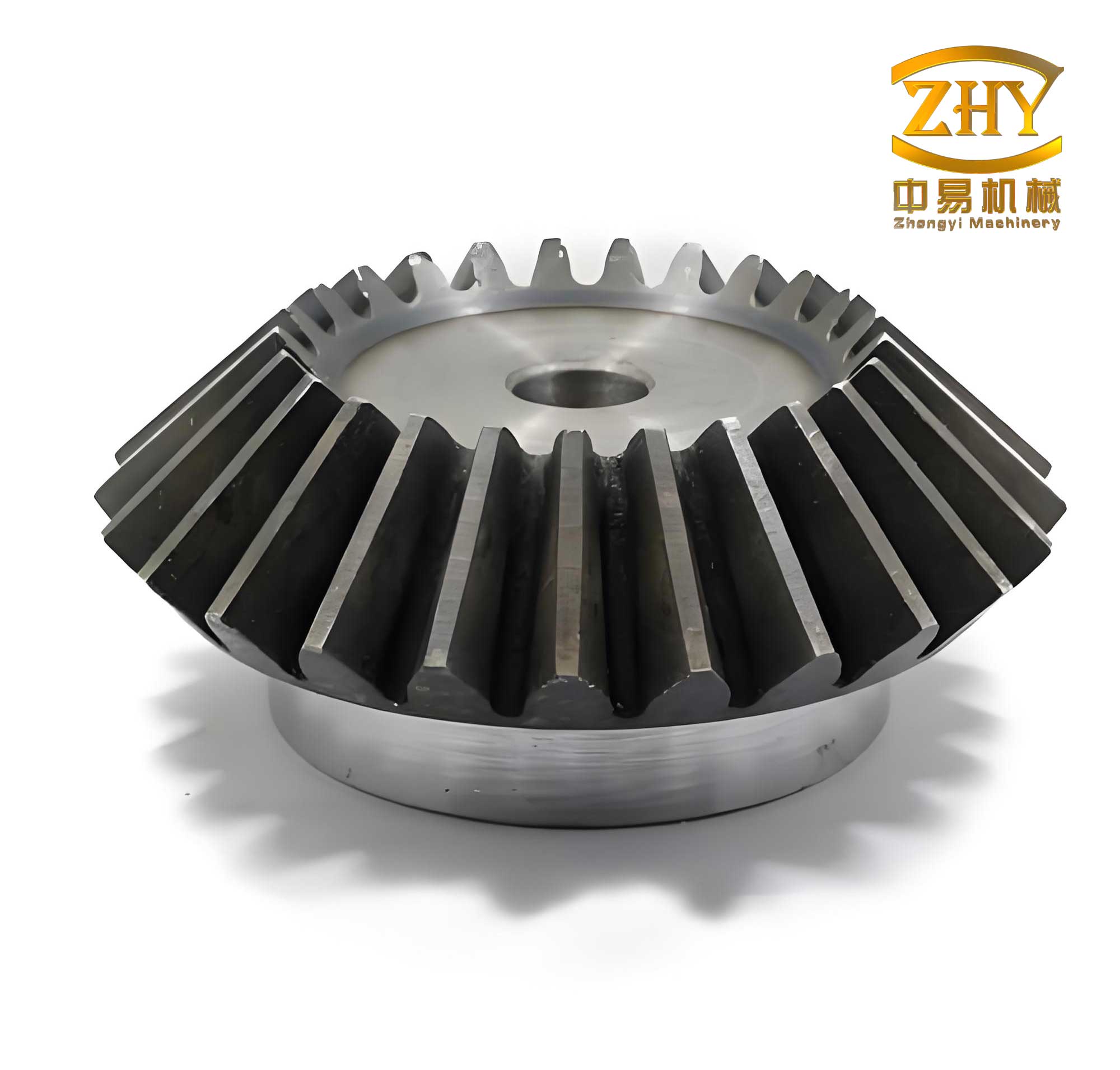
Distortion in heat treatment is an inherent phenomenon arising from the interplay of thermal stresses, transformation stresses, and structural inhomogeneities. For bevel gears, the primary types of distortion include warping (or bending), volumetric changes, and aging-induced deformation. Warping is often the most prominent, driven by non-uniform temperature gradients and phase transformation sequences. The fundamental causes can be categorized as follows:
- Thermal Stresses: Rapid or uneven heating generates temperature differentials between thick and thin sections, leading to expansion and contraction mismatches. The resulting stress can be approximated by the formula for thermal stress: $$\sigma_{th} = E \alpha \Delta T$$ where \(E\) is Young’s modulus, \(\alpha\) is the coefficient of thermal expansion, and \(\Delta T\) is the temperature gradient.
- Transformation Stresses: During quenching, the austenite-to-martensite transformation occurs at different times across the section due to varying cooling rates. This asynchrony induces transformation stresses, which are influenced by the volume change associated with martensite formation. The volumetric strain can be expressed as: $$\epsilon_v = \frac{\Delta V}{V_0} \approx \beta (C_{m} – C_{a})$$ where \(\beta\) is a material constant, and \(C_{m}\) and \(C_{a}\) are the carbon concentrations in martensite and austenite, respectively.
- Geometric Factors: The asymmetric design of bevel gears, with offset rims and hubs, creates inherent stress imbalances. Thin walls exacerbate cooling rate disparities, while residual stresses from prior machining operations can amplify distortion.
- Process Parameters: Inadequate fixturing, improper support during heating or cooling, and suboptimal quenching media flow contribute to non-uniform heat transfer.
In the initial process, the bevel gears were quenched freely using a mandrel inserted through the bore. While this approach maintained bore roundness within limits, it failed to restrain end-face warpage, leading to excessive distortion—often reaching 0.5–0.6 mm, far beyond the 0.2 mm tolerance. This outcome underscored the necessity for a constrained quenching strategy that addresses both bore and face deformation simultaneously.
To tackle this, I designed a dedicated quenching fixture system for use with a quenching press. The fixture comprises an upper die and a lower die, both tailored to the contour of the bevel gear. The lower die features 24 radial grooves to facilitate uniform oil flow, ensuring consistent cooling across the gear’s surface. Similarly, the upper die is machined with matching grooves and a cavity that conforms to the gear’s profile, allowing it to apply pressure evenly on the end-face during quenching. A mandrel is still employed within the bore to control roundness, but now the entire assembly is subjected to controlled pressure in the quenching press. This setup minimizes temperature gradients and counteracts warping tendencies by mechanically constraining the gear throughout the martensitic transformation.
The effectiveness of this method hinges on optimizing several parameters. Below is a summary of key process variables and their impact on distortion control for bevel gears:
| Parameter | Original Process | Improved Process | Effect on Distortion |
|---|---|---|---|
| Quenching Method | Free quenching with mandrel | Press quenching with fixture | Reduces warpage by constraining faces |
| Cooling Uniformity | Non-uniform oil flow | Grooved dies for enhanced flow | Minimizes thermal gradients |
| Applied Pressure | None | Adjustable (via hydraulic press) | Counters transformation stresses |
| Quenching Oil Temperature | Ambient (~20°C) | 40–80°C | Slows cooling, reduces stress |
| Fixture Contact | Limited to bore | Full face contact | Restricts bending moments |
Mathematically, the pressure required to suppress warpage can be derived from the balance between thermal stress and applied mechanical stress. Assuming a simplified model of a thin disk, the critical pressure \(P_c\) needed to prevent buckling-like distortion is: $$P_c = \frac{k D^2}{t^2} \sigma_{th}$$ where \(k\) is a geometric constant, \(D\) is the diameter, \(t\) is the thickness, and \(\sigma_{th}\) is the thermal stress. In practice, the press pressure is adjusted in real-time based on monitoring during the quench, typically ranging from 0.5 to 2 MPa, depending on the size and geometry of the bevel gears.
The carbonitriding process itself also influences distortion. The introduction of nitrogen lowers the martensite start temperature (\(M_s\)), which can be estimated using the equation: $$M_s(°C) = 539 – 423C – 30.4Mn – 17.7Ni – 12.1Cr – 7.5Mo + 10N$$ where alloying elements are in weight percent. For 30CrMnTi with carbonitriding, the \(M_s\) drop reduces transformation stresses, but uneven case depth or carbon/nitrogen gradients can exacerbate distortion. Therefore, precise control of atmosphere composition and temperature during carbonitriding is crucial. The case depth \(d\) as a function of time \(t\) and temperature \(T\) follows the parabolic law: $$d = k_0 \sqrt{t} e^{-Q/RT}$$ where \(k_0\) is a constant, \(Q\) is activation energy, and \(R\) is the gas constant. Maintaining a uniform case ensures symmetric volume expansion during quenching.
Furthermore, the preparatory heat treatment plays a vital role. For these bevel gears, normalizing followed by high-temperature tempering is employed to refine the grain structure, dissolve alloy carbides, and produce a homogeneous sorbite matrix. This pretreatment increases the density of the initial microstructure, reducing the volumetric difference between the core and case during transformation, thereby mitigating distortion. The hardness after pretreatment typically ranges from 180 to 220 HB, ensuring machinability and stability.
Quenching oil temperature is another critical factor. While traditional practices often use ambient oil, raising the temperature to 40–80°C improves fluidity and reduces the cooling severity in the martensite range. The cooling curve can be modeled using the Newtonian approximation: $$T(t) = T_q + (T_i – T_q) e^{-ht}$$ where \(T_i\) is initial temperature, \(T_q\) is oil temperature, and \(h\) is the heat transfer coefficient. Higher \(T_q\) decreases \(h\), slowing cooling and lowering stress. Experiments confirm that for carbonitrided bevel gears, oil at 60°C achieves adequate hardness (60–63 HRC) while cutting warpage by over 50% compared to 20°C oil.
The implementation of the new quenching fixture and press process yielded remarkable results. Statistical data from production batches show a dramatic improvement in dimensional conformity:
| Metric | Before Improvement | After Improvement |
|---|---|---|
| Average End-Face Warpage (mm) | 0.45 | 0.12 |
| Maximum Warpage (mm) | 0.60 | 0.18 |
| Bore Roundness (mm) | 0.10 | 0.08 |
| Hardness Uniformity (HRC spread) | 4–5 | 2–3 |
| Scrap Rate Due to Distortion | ~15% | <2% |
These outcomes validate the efficacy of constrained quenching for thin-walled bevel gears. The process not only meets the technical specifications but also enhances transmission performance by ensuring precise gear tooth engagement. Additionally, the reduction in scrap translates to significant cost savings and resource efficiency.
From a broader perspective, the control of distortion in bevel gears requires a holistic approach. It involves meticulous attention to material selection, part design, preprocessing, and every stage of heat treatment. For instance, finite element analysis (FEA) can be employed to simulate temperature and stress distributions during quenching. The governing heat transfer equation during cooling is: $$\rho c_p \frac{\partial T}{\partial t} = \nabla \cdot (k \nabla T) + q_{trans}$$ where \(\rho\) is density, \(c_p\) is specific heat, \(k\) is thermal conductivity, and \(q_{trans}\) is the heat source due to phase transformation. Such simulations help optimize fixture design and quenching parameters for complex bevel gear geometries.
Moreover, the carbonitriding atmosphere must be tightly regulated to avoid excessive carbon or nitrogen saturation, which can lead to brittle compounds and uneven expansion. The equilibrium carbon potential \(C_p\) in the atmosphere relates to temperature and gas composition via: $$C_p = f(T, CO, CO_2, CH_4, H_2O)$$ Modern controllers use infrared sensors to maintain \(C_p\) within ±0.05%, ensuring a gradual gradient from case to core. This minimizes the additional stresses from abrupt property changes.
In practice, the operation of the quenching press requires skill. The pressure must be applied smoothly as the bevel gear enters the oil, held steady during the martensitic transformation, and released gradually after temperature equalization. Monitoring via thermocouples embedded in the fixture allows real-time adjustments. This hands-on aspect underscores the importance of trained personnel in achieving consistent results with bevel gears.
Looking ahead, advancements in additive manufacturing could enable custom-designed fixtures that conform even more precisely to individual gear geometries, further reducing distortion. Additionally, the use of polymer quenchants or interrupted quenching techniques may offer alternatives for certain bevel gear applications. However, the principle of mechanical constraint remains paramount for thin-walled components.
In conclusion, through systematic analysis and innovative fixturing, the distortion of bevel gears during carburizing and quenching can be effectively controlled. The integration of quenching presses with tailored dies addresses the root causes of warpage by balancing thermal and transformation stresses. This methodology, coupled with optimized process parameters, ensures that bevel gears meet stringent dimensional tolerances, thereby enhancing transmission reliability and efficiency. As heat treatment professionals, continuous learning and adaptation are key to overcoming such challenges, and the lessons from this case can be applied to a wide range of precision components. The journey toward distortion-free bevel gears is a testament to the synergy between theory and practice in metallurgical engineering.