
In my extensive work on heat treatment processes for mining machinery components, I have consistently faced the challenge of managing heat treatment defects, particularly distortion during high-frequency induction hardening of medium-modulus gears. These gears, typically made from medium-carbon or medium-carbon alloy steels with modules ranging from 4 to 8 millimeters and face widths exceeding 100 millimeters, are critical for medium to heavy-duty transmissions in coal mine reducer boxes. The use of a dual-turn induction coil for continuous surface quenching can achieve hardened layers up to two-thirds or full tooth height, meeting operational demands. However, controlling tooth alignment and bore distortion—key heat treatment defects—remains problematic, directly impacting assembly precision and machine performance. While specialized gear manufacturers often employ post-quenching finishing processes like bore machining and tooth grinding to overcome these defects, non-specialized facilities, including ours, frequently lack such equipment. Therefore, based on our existing conditions, we have investigated the root causes of distortion and developed cooling methods to mitigate these heat treatment defects. Drawing from external expertise, we implemented high-frequency pre-treatment to prevent contraction, adjusted machining dimensions to account for potential shrinkage, and utilized core-plug quenching to stabilize bore geometry. These measures have effectively controlled quenching distortion, allowing quenched gears to be assembled directly without finishing, thereby reducing costs and cycle times.
The primary heat treatment defects in gear quenching arise from non-uniform thermal stresses during rapid heating and cooling. When a dual-turn induction coil is used for continuous heating, the alternating processes of preheating and heating create a deep hardened layer on the tooth surface. This deepened thermal layer accelerates heat transfer from the tooth surface to the bore, leading to plastic deformation in gears with relatively thin walls. If the deformation is dominated by thermal stress, the bore tends to contract into a drum-shaped form (referred to as “drum distortion”). The magnitude of distortion varies significantly with the quenching cooling method, highlighting the importance of process control in minimizing heat treatment defects. To quantify this, we conducted experiments on gears made of 45 steel with a module of 6, using the electrical parameters listed in Table 1. The distortion results, summarized in Table 2, demonstrate how different cooling approaches affect bore and tooth alignment accuracy.
| Filament Voltage (V) | Anode Voltage (kV) | Tank Circuit Voltage (kV) | Anode Current (A) | Grid Current (A) | Total Heating Time (s) |
|---|---|---|---|---|---|
| 11.5 | 10.5 | 8.5 | 2.5 | 0.45 | 80 |
The thermal stress causing heat treatment defects can be modeled using the formula for stress due to temperature gradient: $$ \sigma = E \cdot \alpha \cdot \Delta T $$ where \( \sigma \) is the thermal stress, \( E \) is the elastic modulus, \( \alpha \) is the coefficient of thermal expansion, and \( \Delta T \) is the temperature difference between the heated surface and the cooler interior. During quenching, rapid cooling induces martensitic transformation, accompanied by volume expansion, which compounds the stress. The resultant distortion, especially bore contraction, follows a pattern where the ends contract more than the center, leading to drum-shaped deformation. This is a classic example of heat treatment defects stemming from inhomogeneous phase transformations and thermal gradients.
| Cooling Method | Bore Shape Post-Quench | Tooth Alignment Variation | Bore Ovality | Bore Contraction at Ends | Accuracy Grade Post-Quench |
|---|---|---|---|---|---|
| Bore splashing with water (conventional) | Drum-shaped | 0.12–0.15 | 0.08–0.10 | 0.30–0.35 | Below standard |
| Bore immersed in water | Moderate distortion | 0.08–0.10 | 0.05–0.07 | 0.15–0.20 | Grade 8–9 |
| Bore with internal water circulation during quenching | Minimal distortion | 0.05–0.07 | 0.03–0.05 | 0.08–0.12 | Grade 7–8 |
As shown in Table 2, bore splashing with water—a common practice where cooling water from the induction coil contacts the bore—produces the most severe drum distortion, with end contractions up to 0.35 mm, nearly double that of other methods. This exacerbates heat treatment defects due to sudden heating and cooling of the bore at transformation temperatures, increasing thermal stress. In contrast, circulating water through the bore during tooth surface quenching maintains the bore near room temperature, preserving the plastic strength of the bore wall surface and resisting elastic contraction. This method minimizes overall distortion, reducing tooth alignment variation and bore ovality to within Grade 7–8 accuracy (based on standards like GB 10095-88 for gears and GB 1800-79 for bores). However, even with internal water cooling, absolute bore contraction often falls below the lowest tolerance of GB 1800-79, particularly at the ends. To address this, we integrated high-frequency pre-treatment to further reduce end contraction and achieve more uniform deformation, thereby mitigating these persistent heat treatment defects.
High-frequency pre-treatment involves heating the gear blank after semi-finishing turning to create a pre-contraction effect. By applying high-frequency heating to the outer diameter edges, a controlled heated layer depth is achieved. Upon cooling, this layer contracts, causing elastic compressive deformation in the unheated bore areas—essentially a pre-shrinkage. After this, the bore is finish-turned, gears are hobbled, and final high-frequency quenching is performed. Since the bore is machined in a pre-contracted state, post-quench shrinkage is reduced. The key is to control heating time to ensure the heated layer depth exceeds the tooth height and is greater at the gear ends than at the center. This compensates for the drum-shaped distortion trend. For materials like 45 carbon steel and 40Cr alloy steel, we adapt pre-treatment methods based on wall thickness and module: normalizing for thicker walls (≥30 mm) and modules <8 mm, or internal water-cooled normalizing for thinner walls and modules ≥8 mm. For 40Cr steel, subcritical normalizing or low-temperature annealing below Ac1 is used to prevent excessive surface hardness that could affect hobbing. Table 3 details the process parameters and results for typical components, showcasing how pre-treatment curbs heat treatment defects.
| Product Model | Gear Name | Material | Module (mm) | Dimensions: OD × Face Width × Wall Thickness (mm) | Heating Parameters: Anode Voltage (kV) / Anode Current (A) / Grid Current (A) | Specific Power (kW/cm²) | Heating Time (s) | Bore Contraction Relative to Original (mm) |
|---|---|---|---|---|---|---|---|---|
| M-10 | Planetary Gear | 45 Steel | 6 | φ200 × 100 × 25 | 10.5 / 2.5 / 0.45 | 0.8–1.0 | 60 | 0.10–0.15 |
| M-12 | Reducer Gear | 40Cr | 8 | φ250 × 120 × 30 | 11.0 / 2.8 / 0.50 | 1.0–1.2 | 70 | 0.15–0.20 |
In Table 3, the bore contraction of 0.10–0.15 mm indicates that post-quench end shrinkage can be reduced by a corresponding amount. However, even after pre-treatment, the bore may still shrink by 0.05–0.10 mm compared to the pre-quench size. Therefore, we adjust machining dimensions by expanding the bore tolerance下限 (lower limit) by 0.05–0.10 mm during finishing, so that final quenching yields the desired dimensions. This synergy between cold and hot processing is crucial for controlling heat treatment defects. Nevertheless, for gears with significant bore cross-sectional changes (e.g., stepped bores), pre-treatment alone is insufficient due to non-uniform shrinkage across sections. For such high-precision gears (Grade 2 or above), we employ core-plug quenching to stabilize dimensions—a reliable method despite being labor-intensive for small-batch production.
Core-plug quenching involves inserting a precision-made core into the bore before quenching. The core, typically surface-hardened and ground to the lower deviation of the bore tolerance, prevents deformation in the critical bore sections during high-frequency heating. After quenching, the core is pressed out, leaving the bore within tolerance. This method effectively isolates heat treatment defects in complex geometries. The process can be represented by a simple model for bore stability: $$ \Delta D_{\text{final}} = \Delta D_{\text{quench}} – \delta_{\text{core}} $$ where \( \Delta D_{\text{final}} \) is the net bore change, \( \Delta D_{\text{quench}} \) is the inherent quenching distortion, and \( \delta_{\text{core}} \) is the constraint provided by the core. While it adds operational steps, core-plug quenching ensures precision for gears with tight tolerances, making it a valuable tool in our arsenal against heat treatment defects.
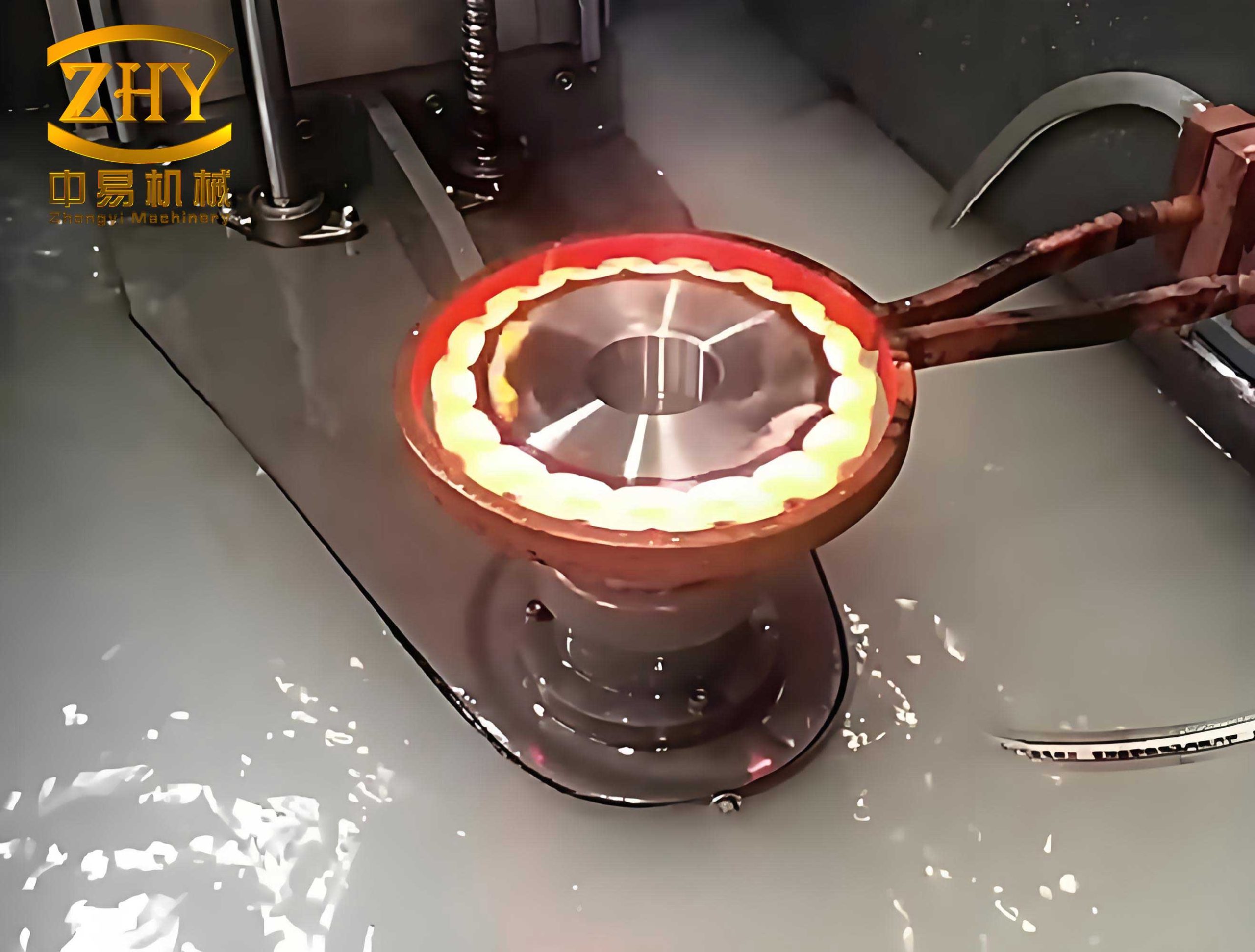
The image above illustrates typical heat treatment defects like distortion and cracking in gears, underscoring the importance of our process controls. In practice, we have optimized our setup using a GP100-C3 high-frequency induction heating furnace and a self-built carriage-type quenching machine with a low-specific-power single-turn induction coil. For materials like 45 steel and 40Cr, we select pre-treatment methods based on geometry: normalizing for thicker sections, and internal water-cooled normalizing for thinner ones. The success of these techniques hinges on maintaining the bore at room temperature during quenching, which minimizes thermal stress gradients. To streamline operations, we plan to replace manual internal water circulation with automated spray cooling using pressurized water and specialized nozzles, further reducing labor and enhancing consistency in mitigating heat treatment defects.
Our findings emphasize that proper high-frequency pre-treatment, coupled with bore cooling during quenching and coordinated machining adjustments, can effectively control heat treatment defects for medium-modulus wide gears with general precision requirements (bore Grade 7 or above). The relationship between process parameters and distortion can be summarized with an empirical formula: $$ D = k_1 \cdot P \cdot t^{1/2} – k_2 \cdot C $$ where \( D \) is distortion magnitude, \( P \) is specific power, \( t \) is heating time, \( C \) is cooling efficiency factor, and \( k_1 \), \( k_2 \) are material constants. This highlights how optimizing heating and cooling reduces heat treatment defects. Moreover, the economic benefits are significant: direct assembly of quenched gears eliminates the need for grinding equipment, saving capital investment and operational costs. However, the complexity of internal water cooling remains a drawback, prompting ongoing innovations for automation.
In conclusion, through systematic analysis and experimentation, we have developed a comprehensive approach to minimize heat treatment defects in high-frequency quenching of mining gears. By addressing distortion causes—such as thermal stress-induced drumming—and implementing tailored solutions like pre-treatment, internal water cooling, and core-plugging, we achieve gear accuracies suitable for direct use. These strategies not only enhance product reliability but also demonstrate the critical role of process integration in overcoming heat treatment defects. Future work will focus on automating cooling processes and expanding these methods to other gear types, continually refining our fight against heat treatment defects in industrial applications.