
In the manufacturing of helical bevel gears, the calculation of tool tip distance is a critical parameter that directly influences the machining allowance and overall gear quality. As an engineer specializing in gear production, I have encountered instances where the traditional formula for tool tip distance led to insufficient machining allowance at the tooth ends, particularly in spiral bevel gears with contracted teeth. This issue, often referred to as “reverse contraction,” can result in scrap parts if not addressed. Through detailed analysis and practical experience, I have identified flaws in the existing calculation method and proposed a corrected formula. This article discusses the problem, provides a thorough mathematical analysis, and presents a revised approach to ensure adequate machining allowance for helical bevel gears. The focus is on helical bevel gears used in heavy machinery, where precision is paramount.
Helical bevel gears are essential components in power transmission systems, especially in applications requiring smooth torque transfer between intersecting shafts. Their complex geometry, involving spiral angles and tapered teeth, makes manufacturing challenging. One key aspect is the tool tip distance, denoted as \( T \), which determines the position of the cutting tool relative to the gear blank during machining. The traditional calculation for helical bevel gears, as found in adjustment cards for contracted tooth spiral bevel gears, is based on the following equations:
$$T = T_0 – \Delta$$
$$T = T_0′ – \Delta$$
where \( T_0 \) and \( T_0′ \) are initial tool tip distances derived from gear parameters, and \( \Delta \) is the machining allowance. However, in practice, this formula sometimes yields the expected allowance, but other times it leads to insufficient or even zero allowance at the tooth’s large end, causing part rejection. For example, in a specific product with helical bevel gears, the parameters were as follows: gear module \( m = 5 \), spiral angle \( \beta = 35^\circ \), pitch cone distance \( R = 150 \, \text{mm} \), and face width \( b = 40 \, \text{mm} \). Using the traditional formula, the calculated tool tip distance resulted in a small-end allowance of \( 0.5 \, \text{mm} \), but the large-end allowance was only \( 0.1 \, \text{mm} \), barely avoiding scrap. This discrepancy highlights the need for a revised calculation.
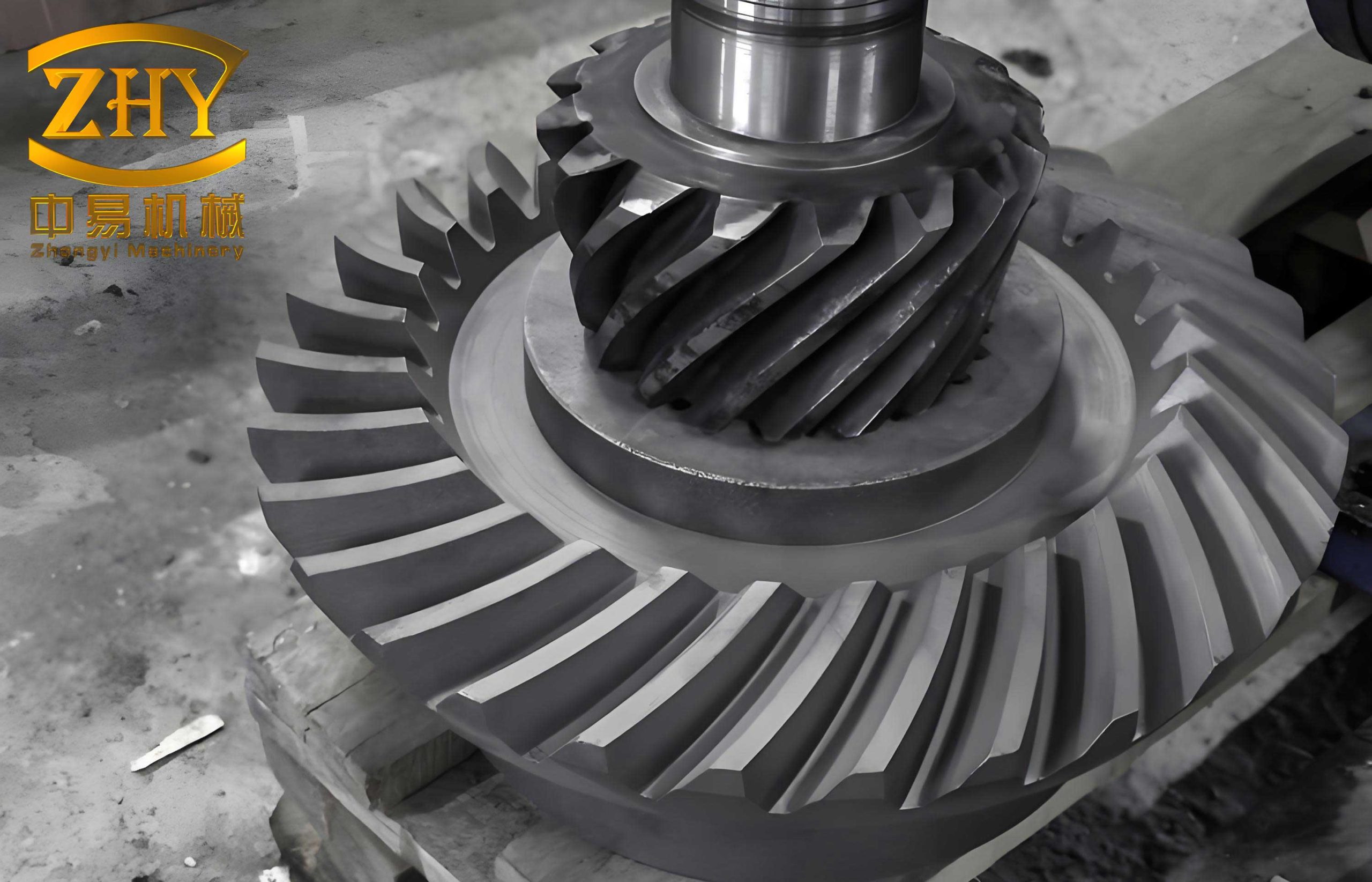
To understand the issue, let’s analyze the geometry of helical bevel gears. The tooth slot width varies along the pitch cone line, and the machining allowance depends on the spiral angle and tool positioning. For any cross-section along the pitch cone母线, the transverse chordal tooth thickness at the pitch circle is given by:
$$s_t = s_{t0} – \frac{x}{R} (s_{t0} – s_{t1})$$
where \( s_t \) is the transverse chordal tooth thickness at a distance \( x \) from the apex, \( s_{t0} \) is at the large end, \( s_{t1} \) is at the small end, and \( R \) is the pitch cone distance. The normal chordal tooth thickness is then:
$$s_n = s_t \cos \beta$$
where \( \beta \) is the spiral angle. The tooth slot width at the bottom in the normal plane is:
$$w_n = w_t \cos \beta$$
with \( w_t \) being the transverse slot width. For helical bevel gears with contracted teeth, the slot width narrows toward the small end, but due to spiral angle effects, the allowance distribution can become uneven. The traditional formula assumes a linear relationship, but this neglects the influence of the spiral angle on the slot geometry.
The core problem lies in the calculation of the tool tip distance \( T \). Originally, it is derived from the slot width at the pitch circle. Let \( w_{n0} \) and \( w_{n1} \) be the normal slot widths at the large and small ends, respectively. The tool tip distance is intended to ensure that after rough cutting, the slot width matches the desired value plus an allowance. However, the spiral angle causes the effective slot width to differ from the calculated one. Specifically, the relationship between the allowance at the large end (\( \Delta_0 \)) and small end (\( \Delta_1 \)) is:
$$\Delta_0 = \Delta_1 \cdot \frac{\cos \beta_1}{\cos \beta_0}$$
where \( \beta_0 \) and \( \beta_1 \) are the spiral angles at the large and small ends. For helical bevel gears, \( \beta_1 > \beta_0 \) typically, so \( \cos \beta_1 < \cos \beta_0 \), leading to \( \Delta_0 < \Delta_1 \). This is the reverse contraction phenomenon. In severe cases, \( \Delta_0 \) can be zero or negative, meaning no material left for finishing at the large end.
To quantify this, consider the detailed derivation. The transverse slot width at any section is:
$$w_t = \frac{\pi m}{2} – s_t$$
where \( m \) is the module. The normal slot width is \( w_n = w_t \cos \beta \). During rough cutting with a double-sided cutter, the slot width is cut to \( w_n’ \). The allowance \( \Delta \) is the difference between the finished slot width and the rough-cut width. For the small end:
$$\Delta_1 = w_{n1,\text{finished}} – w_{n1,\text{rough}}$$
and for the large end:
$$\Delta_0 = w_{n0,\text{finished}} – w_{n0,\text{rough}}$$
Using geometric relationships, we can express these in terms of tool tip distance. The traditional formula sets \( T = T_0 – \Delta \), where \( T_0 \) is based on the pitch radius and spiral angle. But this does not account for the variation in \( \beta \). A more accurate approach is to incorporate a correction factor based on the spiral angle ratio.
I propose a revised calculation for the tool tip distance \( T \) that ensures sufficient allowance. The key is to add a discriminant step before applying the formula. First, compute the ratio \( \lambda \) defined as:
$$\lambda = \frac{\cos \beta_1}{\cos \beta_0}$$
If \( \lambda \geq 1 \), then the traditional formula can be used, as the allowance is adequate. However, for helical bevel gears with significant spiral angle variation, \( \lambda < 1 \), indicating potential reverse contraction. In such cases, the tool tip distance must be adjusted. The revised formula is:
If \( \lambda < 1 \):
$$T’ = T_0 – \Delta \cdot \frac{1}{\lambda}$$
where \( T’ \) is the corrected tool tip distance. This effectively increases the allowance at the large end by compensating for the spiral angle effect. For generality, we can express it in terms of gear parameters. Let \( R_m \) be the mean cone distance, \( \beta_m \) the mean spiral angle, and \( b \) the face width. Then:
$$\lambda = \frac{\cos(\beta_m + \delta)}{\cos(\beta_m – \delta)}$$
with \( \delta = \arctan(b/(2R_m)) \). The corrected tool tip distance becomes:
$$T’ = T_0 – \Delta \cdot \frac{\cos(\beta_m – \delta)}{\cos(\beta_m + \delta)}$$
This revision has been implemented in our factory’s adjustment card computer program for helical bevel gears since 1995, resulting in improved machining accuracy and reduced scrap rates.
To illustrate, let’s go through a detailed example with a helical bevel gear pair. Consider a driven gear with the following parameters:
| Parameter | Symbol | Value |
|---|---|---|
| Module | \( m \) | 6 mm |
| Spiral Angle (Large End) | \( \beta_0 \) | 30° |
| Spiral Angle (Small End) | \( \beta_1 \) | 45° |
| Pitch Cone Distance | \( R \) | 180 mm |
| Face Width | \( b \) | 50 mm |
| Desired Allowance (Normal) | \( \Delta \) | 0.6 mm |
First, compute \( \lambda \):
$$\lambda = \frac{\cos 45^\circ}{\cos 30^\circ} = \frac{0.7071}{0.8660} \approx 0.8165$$
Since \( \lambda < 1 \), reverse contraction is expected. Using the traditional formula, the tool tip distance \( T \) would be:
$$T_0 = R \cdot \sin \beta_0 + \frac{m}{2} = 180 \cdot \sin 30^\circ + 3 = 90 + 3 = 93 \, \text{mm}$$
Then \( T = T_0 – \Delta = 93 – 0.6 = 92.4 \, \text{mm} \). However, this yields an insufficient large-end allowance. Applying the corrected formula:
$$T’ = T_0 – \Delta \cdot \frac{1}{\lambda} = 93 – 0.6 \cdot \frac{1}{0.8165} \approx 93 – 0.735 = 92.265 \, \text{mm}$$
Rounding to practical precision, we set \( T’ = 92.3 \, \text{mm} \). In practice, this results in a large-end allowance of approximately \( 0.6 \, \text{mm} \), matching the desired value. Without correction, the large-end allowance would be only \( 0.6 \cdot \lambda \approx 0.49 \, \text{mm} \), which might be inadequate for finishing operations.
For further clarity, let’s derive the general corrected formula step by step. The normal slot width at any point on a helical bevel gear is influenced by the transverse pressure angle \( \alpha_t \), spiral angle \( \beta \), and tooth thickness. The basic equation for the transverse chordal tooth thickness at the pitch circle is:
$$s_t = m \left( \frac{\pi}{2} + 2 \tan \alpha_t \cdot x \right)$$
where \( x \) is the profile shift coefficient. For helical bevel gears, this is modified by the spiral angle. The normal chordal tooth thickness is \( s_n = s_t \cos \beta \). The slot width in the normal plane is then:
$$w_n = p_n – s_n = \pi m_n – s_n$$
with \( m_n = m / \cos \beta \) being the normal module. During machining, the tool tip distance \( T \) controls the cutter’s radial position. The relationship between \( T \) and the slot width is approximately linear for small changes. From gear theory, the tool tip distance for a generated helical bevel gear can be expressed as:
$$T = R \sin \beta + \frac{m}{2} – \delta_T$$
where \( \delta_T \) is a correction term for allowance. The traditional approach sets \( \delta_T = \Delta \), but this ignores the spiral angle variation. A more accurate form is:
$$\delta_T = \Delta \cdot \frac{\cos \beta_0}{\cos \beta_1}$$
This stems from the fact that the allowance in the normal plane is scaled by the cosine of the spiral angle. Therefore, the corrected tool tip distance is:
$$T’ = R \sin \beta_0 + \frac{m}{2} – \Delta \cdot \frac{\cos \beta_0}{\cos \beta_1}$$
This can be rewritten in terms of the mean spiral angle \( \beta_m \) and face width \( b \). Using the approximation \( \beta_1 = \beta_m + \Delta \beta \) and \( \beta_0 = \beta_m – \Delta \beta \), with \( \Delta \beta = \arctan(b/(2R)) \), we get:
$$T’ = R \sin(\beta_m – \Delta \beta) + \frac{m}{2} – \Delta \cdot \frac{\cos(\beta_m – \Delta \beta)}{\cos(\beta_m + \Delta \beta)}$$
This formula is particularly useful for helical bevel gears with high spiral angles or large face widths, where reverse contraction is pronounced.
To emphasize the importance of this correction, consider the manufacturing process for helical bevel gears. These gears are often used in automotive differentials, industrial machinery, and aerospace applications, where precision and durability are critical. The machining typically involves multi-axis CNC mills or specialized gear cutters. The tool tip distance affects not only the tooth thickness but also the root fillet and stress distribution. An incorrect tool tip distance can lead to premature fatigue failure or noisy operation. Therefore, accurate calculation is essential for quality assurance.
In addition to the formula revision, it’s helpful to summarize the key parameters in a table for quick reference. Below is a table of common parameters for helical bevel gears and their influence on tool tip distance:
| Parameter | Symbol | Effect on Tool Tip Distance \( T \) | Typical Range |
|---|---|---|---|
| Module | \( m \) | Directly proportional; larger \( m \) increases \( T \) | 2–20 mm |
| Spiral Angle (Large End) | \( \beta_0 \) | Increases \( T \) via \( \sin \beta_0 \); affects allowance distribution | 20°–45° |
| Spiral Angle (Small End) | \( \beta_1 \) | Affects correction factor; larger difference increases reverse contraction | 25°–50° |
| Pitch Cone Distance | \( R \) | Directly proportional; larger \( R \) increases \( T \) | 50–500 mm |
| Face Width | \( b \) | Influences spiral angle variation; wider \( b \) requires more correction | 20–100 mm |
| Machining Allowance | \( \Delta \) | Reduces \( T \); corrected version scales it by \( 1/\lambda \) | 0.3–1.0 mm |
Another aspect to consider is the manufacturing method. Helical bevel gears can be produced by face milling or face hobbing, each with different tooling requirements. The tool tip distance calculation may vary slightly between methods, but the core principle remains: account for spiral angle effects. For face milling, where a single-point cutter is used, the tool tip distance is critical for defining the tooth slot. For face hobbing, a continuous indexing process, the tool position is still vital for accuracy. In both cases, the corrected formula helps prevent undercutting at the large end.
Let’s delve deeper into the mathematical justification. The reverse contraction phenomenon occurs because the normal plane tooth thickness changes nonlinearly along the tooth length due to the spiral angle. The derivative of the normal slot width with respect to the cone distance \( x \) is:
$$\frac{d w_n}{d x} = \frac{d}{d x} (w_t \cos \beta) = \cos \beta \frac{d w_t}{d x} – w_t \sin \beta \frac{d \beta}{d x}$$
For contracted teeth, \( d w_t / d x > 0 \) (slot width increases toward the large end), but \( d \beta / d x < 0 \) (spiral angle decreases toward the large end). The second term can cause \( d w_n / d x \) to become negative if \( w_t \sin \beta \) is large enough, leading to reverse contraction. This is more likely in helical bevel gears with high spiral angles and large face widths. The condition for reverse contraction is:
$$\left| \frac{d \beta}{d x} \right| > \frac{\cos \beta}{w_t} \frac{d w_t}{d x} \tan \beta$$
In practice, this can be evaluated using gear geometry parameters. To avoid it, the tool tip distance must be adjusted to increase the large-end slot width during rough cutting.
The corrected formula can also be expressed in terms of the tool diameter \( D_c \) and pressure angle. For a double-sided cutter, the tool tip distance relates to the slot width via the cutter profile. The basic relationship is:
$$T = \frac{D_c}{2} + R \sin \beta – \sqrt{ \left( \frac{D_c}{2} \right)^2 – (R \cos \beta)^2 } + C$$
where \( C \) is a constant based on the cutter design. The allowance \( \Delta \) is then applied as a modification to \( T \). However, this complex form can be simplified for practical use. Our revised approach integrates the allowance directly into the calculation, ensuring that the final machined slot width meets specifications.
In summary, the traditional tool tip distance formula for helical bevel gears is inadequate when reverse contraction occurs due to spiral angle variation. Through analysis, I have derived a corrected formula that incorporates a discriminant based on the spiral angle ratio. This ensures sufficient machining allowance at both ends of the tooth, reducing scrap and improving gear quality. The correction is particularly important for helical bevel gears with high spiral angles or large face widths, common in heavy-duty applications. Implementation in computerized adjustment cards has proven effective in production. Future work could explore dynamic simulations of the cutting process to further optimize tool positioning for helical bevel gears.
To reinforce the concepts, here are some additional formulas relevant to helical bevel gear manufacturing. The normal circular pitch is:
$$p_n = \pi m_n = \pi m / \cos \beta$$
The transverse circular pitch is:
$$p_t = \pi m = p_n \cos \beta$$
The tooth depth \( h \) is typically \( 2.25 m \) for full-depth teeth. The addendum and dedendum vary along the tooth length for contracted teeth. The tool tip distance correction ensures that these dimensions are accurately achieved after finishing.
In conclusion, helical bevel gears are complex components that require precise machining. The tool tip distance is a key parameter, and its calculation must account for spiral angle effects to avoid reverse contraction. The proposed correction, based on a simple ratio of cosines, provides a practical solution that can be easily integrated into existing manufacturing processes for helical bevel gears. This advancement contributes to the reliability and performance of gear systems across industries.