
The dynamic performance of a wind turbine gearbox, a core component in the drivetrain, critically influences the entire system’s reliability. Helical gears, due to their inherent design and the presence of manufacturing/assembly errors, lubrication issues, and complex supporting structures like bearings and rotors, exhibit rich and highly nonlinear dynamic characteristics. Unlike spur gears, the meshing of helical gears generates not only radial and tangential forces but also a significant axial force. This leads to coupled lateral, torsional, and axial vibrations within the system. Understanding this coupled lateral-torsional-axial vibration behavior is paramount for dynamic design and condition monitoring of advanced gear transmission systems like those in wind turbines.
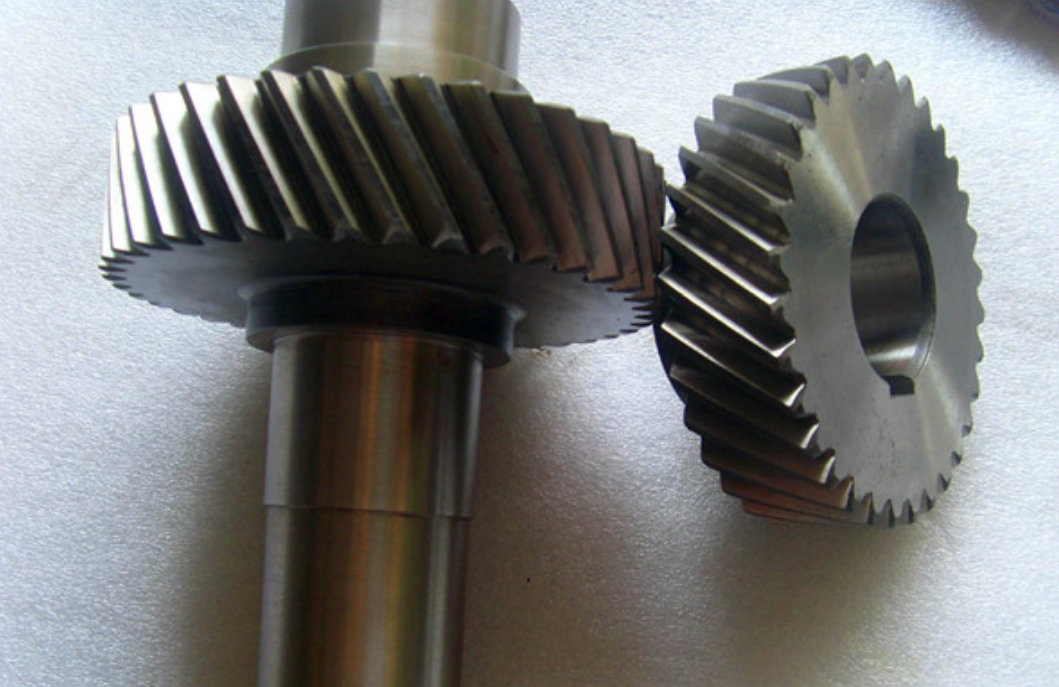
To investigate the dynamic response of a high-speed helical gear stage, a comprehensive nonlinear dynamic model is essential. This model must account for multiple interacting factors: the time-varying nature of input/output torques (simulating fluctuating wind loads), inherent gear eccentricities, combined transmission errors, gravitational forces, and the nonlinear stiffness introduced by supporting bearings. The following analysis develops such a model using a lumped-parameter approach, derives the governing equations, and systematically explores the influence of key operational and design parameters on the system’s vibration signature.
1. Dynamic Modeling of the Helical Gear-Rotor-Bearing System
The physical system consists of a pair of helical gears mounted on flexible shafts, which are supported by nonlinear bearings at both ends, with connected input and output inertias. To model this, fixed coordinate systems are established at the ideal centers of the driving gear (A1), driven gear (A2), and the four bearing locations (B1-B4). The actual rotational centers and mass centers of the gears are distinguished to incorporate eccentricity effects.
The system displacement vector, accounting for lateral (x, y), axial (z), and torsional (θ) degrees of freedom (DOF) for all major masses, is defined as:
$$ \mathbf{X} = [\theta_d, x_{b1}, y_{b1}, z_{b1}, x_1, y_1, z_1, \theta_1, x_{b2}, y_{b2}, z_{b2}, x_{b3}, y_{b3}, z_{b3}, x_2, y_2, z_2, \theta_2, x_{b4}, y_{b4}, z_{b4}, \theta_l]^T $$
This represents a 22-DOF system.
1.1. Helical Gear Mesh Model
The gear mesh is modeled as a spring-damper element acting along the line of action. The dynamic transmission error along the mesh line, δ, is the fundamental source of excitation and is given by:
$$ \delta = r_{b1}\theta_1 + r_{b2}\theta_2 + (x_1 – x_2)\cos\alpha_t \sin\alpha_1 + (y_1 – y_2)\cos\alpha_t \cos\alpha_1 + (z_1 – z_2)\tan\beta_b + (\rho_1 \cos(\omega_1 t + \theta_1) – \rho_2 \cos(\omega_2 t + \theta_2))\sin\alpha_t – e(t) $$
Where $r_b$ are base radii, $\alpha_t$ and $\alpha_1$ are pressure and gear position angles, $\beta_b$ is the base helix angle, $\rho$ and $\omega$ are eccentricities and rotational speeds, and $e(t)$ is the static transmission error: $e(t)=e_0 + e_r \sin(\omega_e t + \phi_e)$.
The meshing force $F_m$ is: $$F_m = k_m(t)\delta + c_m\dot{\delta}$$ where $k_m(t)$ is the time-varying mesh stiffness and $c_m$ is the mesh damping. This force is decomposed into lateral (x, y) and axial (z) components acting on the gear bodies:
$$F_x = -F_m \cos\alpha_t \sin\alpha_1, \quad F_y = -F_m \cos\alpha_t \cos\alpha_1, \quad F_z = F_m \tan\beta_b$$
1.2. Nonlinear Bearing Model
The supporting angular contact ball bearings are a major source of nonlinearity due to their clearance and Hertzian contact. For a bearing with $N_b$ balls, the contact deformation for the $i$-th ball is:
$$ \delta_{bi} = \sqrt{ [A \sin\alpha_0 + z + R_i\theta \cos\varphi_i]^2 + [A \cos\alpha_0 + x\cos\varphi_i + y\sin\varphi_i]^2 } – A $$
where $A$ is the initial distance between raceway curvature centers, $\alpha_0$ is the initial contact angle, $R_i$ is the radius of the inner ring curvature center locus, and $\varphi_i$ is the angular position of the ball. The Heaviside function $H(\delta_{bi})$ ensures force exists only for positive deformation ($\delta_{bi} > 0$).
The resulting nonlinear bearing forces in x, y, and z directions are obtained by summing the contributions from all balls:
$$ F_{bx} = K_b \sum_{i=1}^{N_b} H(\delta_{bi}) \delta_{bi}^{3/2} \cos\alpha_0′ \cos\varphi_i $$
$$ F_{by} = K_b \sum_{i=1}^{N_b} H(\delta_{bi}) \delta_{bi}^{3/2} \cos\alpha_0′ \sin\varphi_i $$
$$ F_{bz} = K_b \sum_{i=1}^{N_b} H(\delta_{bi}) \delta_{bi}^{3/2} \sin\alpha_0′ $$
where $K_b$ is the Hertzian contact stiffness coefficient and $\alpha_0’$ is the loaded contact angle.
1.3. System Equations of Motion
Using Lagrange’s equation, the equations of motion are derived by considering the system’s kinetic energy (T), potential energy (U), and dissipation function (R). The kinetic energy includes terms for translational and rotational motions of all masses, including the effect of gear eccentricity:
$$ T = \frac{1}{2}\sum (m_i (\dot{x}_{gi}^2 + \dot{y}_{gi}^2 + \dot{z}_{gi}^2) + J_i \dot{\phi}_i^2) $$
where $x_{gi}, y_{gi}$ are coordinates of the gear mass centers, related to the rotational centers by the eccentricity $\rho$.
The potential energy includes shaft bending and torsion, gear mesh elasticity, and bearing contact elasticity:
$$ U = \frac{1}{2}\sum (k_{sxi}(x_i – x_{bi})^2 + … ) + \frac{1}{2} k_m \delta^2 + \frac{1}{2} \sum K_b \delta_{bi}^{5/2} $$
The dissipation function follows a similar structure for damping terms.
Applying Lagrange’s equation $ \frac{d}{dt}\left(\frac{\partial T}{\partial \dot{q}_j}\right) – \frac{\partial T}{\partial q_j} + \frac{\partial U}{\partial q_j} + \frac{\partial R}{\partial \dot{q}_j} = Q_j $ for each generalized coordinate $q_j$ in $\mathbf{X}$ yields the complete set of 22 second-order, nonlinear, coupled differential equations governing the lateral-torsional-axial vibration of the helical gear-rotor-bearing system.
2. System Parameters and Analysis Methodology
The following parameters, representative of a wind turbine high-speed stage, are used for numerical simulation. The equations are solved using the Runge-Kutta method.
| Table 1: Gear Parameters | ||
|---|---|---|
| Parameter | Symbol | Value |
| Teeth Number | $z_1, z_2$ | 100, 25 |
| Mass | $m_1, m_2$ (kg) | 667.9, 141.1 |
| Moment of Inertia | $J_1, J_2$ (kg·m²) | 44.35, 0.21 |
| Eccentricity (Baseline) | $\rho_1, \rho_2$ (m) | 5.0×10⁻⁵ |
| Mesh Stiffness | $k_m$ (N/m) | 6.0×10⁸ |
| Helix Angle (Base Circle) | $\beta_b$ (°) | 13.8 |
| Table 2: Shaft & Bearing Parameters | ||
|---|---|---|
| Component | Parameter | Value |
| Shafts | Torsional Stiffness $k_{t1}, k_{t2}$ (N·m/rad) | 8×10⁸, 1.5×10⁸ |
| Lateral Stiffness $k_{s1-4}$ (N/m) | 6×10⁸, 1.5×10⁸ (for respective bearings) | |
| Bearings (B1,B2 / B3,B4) | Contact Stiffness $K_b$ (N/m³ᐟ²) | 13.34×10⁷ / 10.34×10⁷ |
| Number of Balls $N_b$ | 12 | |
3. Dynamic Response Characteristics
The baseline analysis is conducted at an input pinion speed of $n_1=500$ rpm ($n_2=2000$ rpm). Key frequency components are defined as: Pinion rotational frequency $f_1 = n_1/60 = 8.3$ Hz, Gear rotational frequency $f_2 = n_2/60 = 33.3$ Hz, Mesh frequency $f_m = n_1 z_1 / 60 = 833.3$ Hz, and an external torsional excitation frequency $f_t = 159$ Hz.
The vibration responses at the pinion and its left-side bearing are analyzed. A prominent feature is the coupling effect: while lateral vibrations ($x$, $y$ directions) are dominated by $f_1$ and $f_2$ respectively, they also contain significant components from the other direction’s rotational frequency. The axial ($z$) vibration is primarily influenced by $f_1$. The torsional vibration amplitudes of the helical gears are significantly larger than their lateral and axial vibrations, indicating that the system’s dominant vibration mode is torsional. The frequency spectra reveal rich content including rotational frequencies, bearing varying compliance frequencies ($f_{b1} \approx 52$ Hz), combination frequencies like $f_2-f_1$, and the mesh frequency $f_m$.
4. Parametric Influence on System Dynamics
4.1. Effect of Rotational Speed
Increasing the pinion speed to $n_1=700$ rpm ($n_2=2800$ rpm) significantly amplifies vibration displacements across all directions. The frequency spectra become more complex, with increased prominence of combination tones and higher harmonics. Three-dimensional spectral maps versus speed reveal non-monotonic trends. The amplitudes of $f_1$ and $f_2$ in lateral directions show fluctuating behavior with increasing speed. Notably, the mesh frequency $f_m$ component initially decreases and then increases, reaching a minimum around $n_1=650$ rpm. In the torsional response, $f_1$ peaks around $n_1=600$ rpm while $f_2$ reaches a minimum at the same speed, demonstrating the strong speed-dependent coupling in the helical gear system.
4.2. Effect of Gear Eccentricity
Doubling the gear eccentricity from $\rho=5.0\times10^{-5}$ m to $1.0\times10^{-4}$ m has a profound impact. Vibration amplitudes increase substantially, most notably in the torsional direction—approximately proportional to the eccentricity change. The frequency spectra become markedly richer, with a significant increase in the amplitude of rotational frequency components and the emergence of more combination frequencies (e.g., $2f_2$, $3f_2$, $f_2 \pm f_1$). This effect is more pronounced on the smaller, faster-driven gear due to its higher rotational speed and lower inertia. Eccentricity acts as a powerful internal excitation source that exacerbates the coupled vibrations in helical gears.
4.3. Effect of Bearing Clearance
Contrary to eccentricity, variations in bearing radial clearance show a relatively minor influence on the overall vibration amplitude of the helical gear system, particularly in the torsional response. However, the bearing’s nonlinear character becomes more apparent in lateral vibrations as clearance increases, manifesting as a “smearing” or broadening of spectral peaks around the rotational frequencies, indicating more chaotic or stochastic content. The bearing’s own varying compliance frequency remains present. This suggests that while precise bearing clearance is less critical for overall vibration level control, avoiding resonances with the bearing’s characteristic frequencies is important during system design.
5. Conclusions
The analysis of the nonlinear coupled lateral-torsional-axial model for a helical gear-rotor-bearing system leads to the following key conclusions:
- The torsional vibration in helical gear systems is dominant and significantly larger than lateral and axial vibrations due to the strong coupling effects. The system’s response is rich in frequency content, including rotational frequencies, mesh frequency, bearing frequencies, and numerous combination tones.
- Increasing rotational speed nonlinearly amplifies vibration amplitudes and alters the spectral composition, with certain frequency components showing non-monotonic trends. The mesh frequency influence can vary with speed.
- Gear eccentricity is a critical parameter. Increased eccentricity dramatically increases vibration levels, especially torsional amplitudes, and enriches the frequency spectrum with higher harmonics and combination frequencies. Its effect is more severe on lighter, high-speed gears.
- Bearing radial clearance has a less pronounced effect on the global vibration amplitude of the helical gear system compared to speed or eccentricity. However, it promotes nonlinear spectral broadening and its inherent varying compliance frequency must be considered to avoid resonances.
This comprehensive modeling and analysis provide a foundational framework for understanding the complex dynamics of helical gear transmissions in demanding applications like wind turbines, aiding in dynamic design optimization and fault diagnosis.